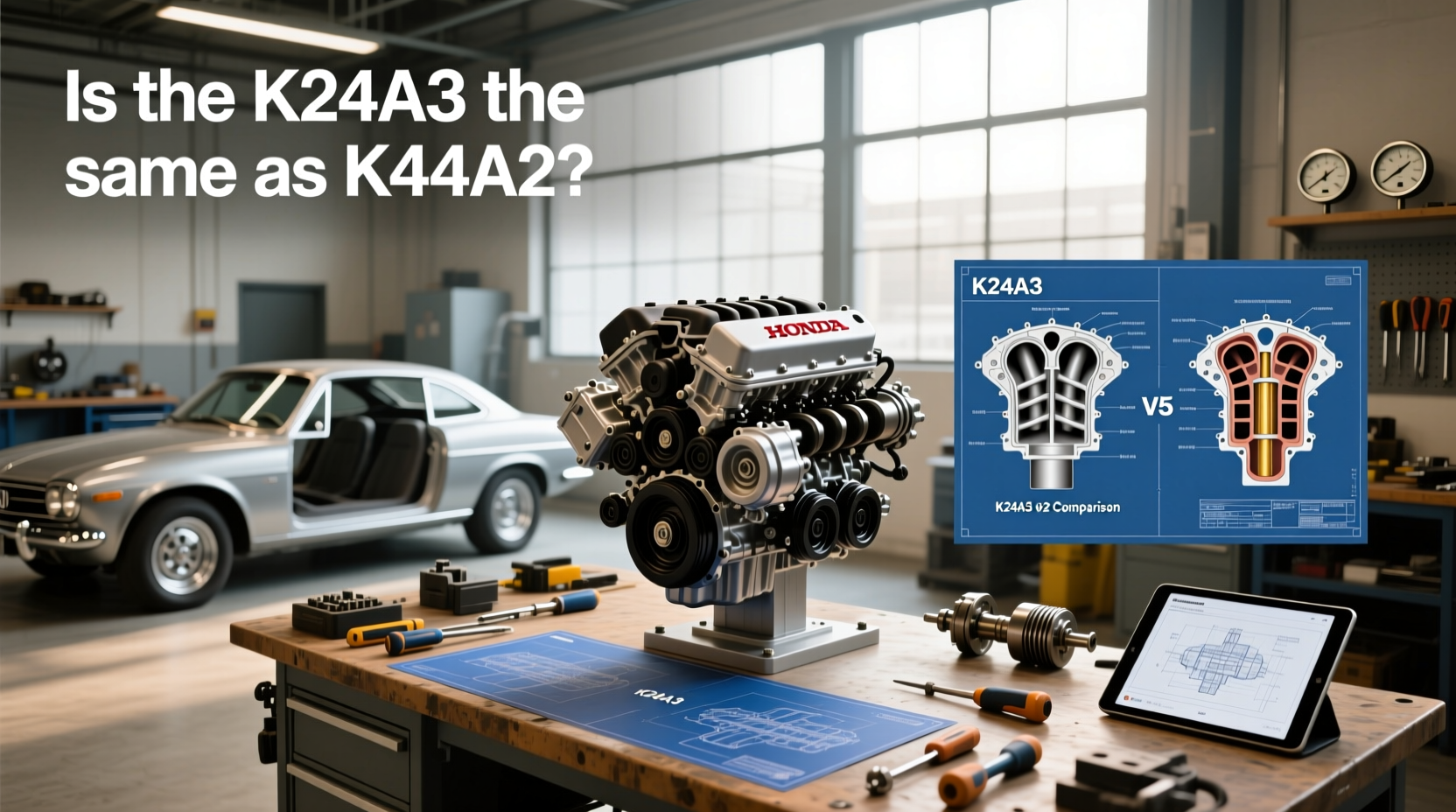
How to Choose K24A3, Is the K24A3 the Same as K24A2? A Practical Buying Guide
Yes, the K24A3 and K24A2 are fundamentally the same engine in core design and mechanical layout — but they are not identical in tuning, power output, or compatibility. If you're considering an engine swap, restoration, or performance build involving either unit, understanding how to choose between the K24A3 and K24A2 is critical. The key differences lie in market-specific calibration, ECU and wiring harness configurations, and slight variations in redline and torque delivery 1. For U.S.-based projects, the K24A2 from the Acura TSX is often preferred due to easier integration with domestic electronics and emissions systems. In contrast, the K24A3 (used in European and Australian Honda Accord models) may require additional modifications for a seamless fit, especially when used outside its native region 2. When evaluating what to look for in k24a3,Is the K24A3 the same as K24A2?, prioritize vehicle application, tuning goals, and compatibility with your chassis’ electrical system.
About K24A3, Is the K24A3 the Same as K24A2?
The Honda K24 engine series is renowned for its reliability, high-revving nature, and strong aftermarket support. Within this family, the K24A2 and K24A3 are two closely related variants that share nearly identical internal components, including the block, cylinder head, displacement (2.4L / 2354 cc), DOHC 16-valve configuration, and compression ratio (10.5:1). However, their designation reflects regional deployment rather than fundamental engineering divergence.
The K24A2 was used primarily in the U.S. market Acura TSX (2004–2008), while the K24A3 powered the Honda Accord Euro R in Europe, Australia, and New Zealand (2005–2006). Both engines feature i-VTEC and were designed for balanced performance—offering responsive daily driving with room for modification. Despite shared architecture, they differ slightly in factory-rated power, redline, and electronic management systems, which affects how each performs in real-world applications and swaps.
Why K24A3, Is the K24A3 the Same as K24A2? Is Gaining Popularity
Enthusiasts continue to seek out both the K24A2 and K24A3 due to their proven durability and tuning flexibility. These engines have gained popularity in the import performance scene because they offer a robust foundation for naturally aspirated and forced-induction builds alike. With over 200,000 miles of reliable service reported by many owners under normal conditions, the K-series platform remains a top choice for long-term ownership and project vehicles 3.
The recurring question — "Is the K24A3 the same as K24A2?" — stems from frequent cross-market interest. As global parts availability improves, more builders consider importing a K24A3 for cost or scarcity reasons. Additionally, some markets lack access to the K24A2, making the K24A3 a viable alternative. Their similarity makes them attractive for swaps into older Civics, Integras, and kit cars where increased displacement and modern fuel injection provide significant gains over smaller four-cylinders.
Types and Variants
While the K24A2 and K24A3 are the focus of this guide, it's important to recognize other members of the K24 family to avoid confusion during selection:
- ⚙️ K24A2 (USDM - Acura TSX): Rated at 200–205 hp and 164–166 lb-ft of torque. Known for smooth integration into North American vehicles. Pros: Widely supported in tuning communities; compatible with OBD-II systems; abundant aftermarket ECUs. Cons: Slightly lower redline (7,200 rpm); less peak torque than K24A3.
- ⚙️ K24A3 (EUDM/AUDM/NZDM - Honda Accord Euro): Produces 190 hp and 171 lb-ft of torque, with a 7,300 rpm redline. Pros: Higher low-end torque; slightly higher rev limit. Cons: Different wiring harness and ECU pinout; may require conversion work for non-native installations.
- ⚙️ K24A4 (Base Accord): Non-i-VTEC version; lower performance; not relevant for performance builds.
- ⚙️ K24Z3/Z7 (Later Models): Feature updated internals and drive-by-wire throttle; different from A2/A3 mechanically and electronically.
When comparing types, remember that only the K24A2 and K24A3 share the RBB-2 cylinder head and similar VTEC profiles, making them most interchangeable.
Key Features and Specifications to Evaluate
To accurately assess whether the K24A3 is suitable as a replacement or upgrade for a K24A2 (or vice versa), examine these technical factors:
- 🔍 Power Output: K24A2 delivers more horsepower (200–205 hp vs. 190 hp), though the K24A3 has higher torque (171 lb-ft vs. ~165 lb-ft).
- ⏱️ Redline: K24A3 reaches 7,300 rpm; K24A2 tops out at 7,200 rpm — a minor but notable difference for track-focused builds.
- 🧰 ECU & Wiring Harness: The K24A3 uses a different ECU map and harness layout, which can complicate swaps into USDM chassis without proper adapters or rewrites.
- 📍 Vehicle Application: Confirm original fitment. K24A2 = Acura TSX (US); K24A3 = Accord Euro (EU/AU/NZ).
- 🔧 Cylinder Head Code: Look for “RBB-2” stamped on the head — common to both A2 and A3.
- 📊 Fuel System: Both use multi-point fuel injection (no direct injection), ensuring compatibility with most bolt-on modifications.
Pros and Cons
Advantages of K24A2 and K24A3
- ⚡ High-revving DOHC i-VTEC design supports aggressive cam profiles and head swaps.
- 📈 Strong tuning potential: Capable of 300+ hp NA with K20 head swaps, or 450–600 whp with turbocharging 4.
- ✅ Proven long-term reliability with routine maintenance.
- 🌐 Global enthusiast community provides extensive technical resources.
Limits and Drawbacks
- ❗ K24A3’s unique ECU and harness may require rewiring or standalone ECU for non-native use.
- 🚚 Importing a K24A3 internationally may involve shipping costs, customs fees, and compliance checks.
- 🧼 Used units may have unknown maintenance history — inspect for oil consumption, timing chain wear, and VTEC operation.
- 📌 Minor power discrepancy between models could matter in competitive builds.
How to Choose K24A3, Is the K24A3 the Same as K24A2?
Follow this step-by-step checklist when deciding between a K24A2 and K24A3:
- 📋 Determine Your Use Case: Daily driver? Track car? Engine swap? The K24A2 is generally easier for US-based swaps.
- 🔍 Verify Engine Identity: Check the physical engine code (stamped on block) and cylinder head number (RBB-2).
- 🔌 Evaluate Electrical Compatibility: If using in a USDM chassis, confirm if harness conversion or standalone ECU will be needed (especially for K24A3).
- 📊 Compare Performance Goals: Need maximum horsepower? Lean toward K24A2. Prefer stronger mid-range torque? Consider K24A3.
- ⚠️ Avoid These Pitfalls:
- Purchasing based only on listing title — always request photos of engine codes.
- Assuming plug-and-play compatibility across regions.
- Ignoring VTEC engagement test or compression results in used units.
Price & Market Insights
As of 2024, prices vary significantly by region and condition:
- K24A2 (US Sourced): $1,800 – $2,800 (core charge included)
- K24A3 (Imported): $1,500 – $2,200 + shipping ($300–$600) and import duties
- Rebuilt Units: Add $300–$700 depending on labor and parts quality
The K24A2 typically commands a premium in North America due to ease of installation and demand. While the K24A3 may appear cheaper upfront, added complexity in integration can offset savings. Always factor in auxiliary costs like mounts, sensors, and potential ECU tuning.
Top-Seller & Competitive Analysis
The K24A2 remains the top-selling variant in performance markets due to ecosystem maturity. Below is a comparison of key attributes:
| Feature | K24A2 (USDM) | K24A3 (EUDM/AUDM) |
|---|---|---|
| Power | 200–205 hp | 190 hp |
| Torque | 164–166 lb-ft | 171 lb-ft |
| Redline | 7,200 rpm | 7,300 rpm |
| ECU/Harness | OBD-II standard (US) | Regional variation (may need adapter) |
| Swap Difficulty (US Chassis) | ⭐⭐☆☆☆ (Low) | ⭐⭐⭐⭐☆ (High) |
| Aftermarket Support | Extensive | Moderate (region-dependent) |
Customer Feedback Synthesis
Based on community forums, reviews, and technical threads, here’s a summary of user experiences:
Common Praises
- “The K24A2 dropped right into my DC5 with minimal rewiring.”
- “Both engines idle smoothly and respond well to cold-air intakes and exhaust upgrades.”
- “Reliability is excellent — I’ve had mine for 15 years and 180k miles.”
Frequent Complaints
- “Bought a ‘K24A3’ online — turned out to be a K24A4 without VTEC.”
- “Spent extra on a standalone ECU because the K24A3 harness didn’t match my harness.”
- “Seller claimed full rebuild, but oil pressure was low after install.”
Sourcing & Supplier Tips
When sourcing a K24A2 or K24A3:
- 🛒 Buy from reputable salvage yards or specialized engine suppliers with return policies.
- 📎 Request clear photos of the engine code, cylinder head stamp, and overall condition.
- 🔎 Ask for a compression test report or video demonstrating startup and VTEC engagement.
- 🌍 For imported units, confirm customs documentation and emissions compliance if registering in regulated areas.
- 🤝 Consider purchasing complete long blocks to ensure matching components.
Maintenance, Safety & Legal Considerations
Both engines require regular oil changes (every 3,000–5,000 miles for performance use), timing chain inspection (~100k miles), and coolant service. Misfires or rough idling may indicate VTEC solenoid or oil pressure issues.
Safety-wise, ensure all fluids are properly contained and electrical connections are secure, especially after swaps. From a legal standpoint, modified engines may not comply with local emissions regulations. Always verify your build meets requirements in your jurisdiction — consult your DMV or equivalent authority before registration.
Conclusion
In answer to “Is the K24A3 the same as K24A2?” — they are mechanically similar but not fully interchangeable without consideration of electronic and regional differences. If you’re performing a US-based engine swap and want simplicity, go with the K24A2. If you’re outside North America or seeking slightly higher torque and redline, the K24A3 can work well — provided you account for ECU and harness compatibility. When exploring how to choose k24a3,Is the K24A3 the same as K24A2?, prioritize verified specifications, intended application, and long-term support over minor power differences.
Frequently Asked Questions
- Can I swap a K24A3 into a USDM Acura TSX originally equipped with a K24A2?
- Yes, but expect differences in ECU mapping and wiring harness. You may need to adapt the harness or use a standalone ECU for full functionality.
- Are the K24A2 and K24A3 cylinder heads interchangeable?
- Yes, both use the RBB-2 head design and are functionally identical, making head swaps straightforward.
- Which engine has better tuning potential: K24A2 or K24A3?
- Both have nearly identical tuning ceilings. The K24A2’s higher factory horsepower gives a slight edge, but modifications quickly outweigh stock differences.
- How do I verify if I’m getting a genuine K24A3 or K24A2?
- Check the engine code stamped on the side of the block near the transmission. Also inspect the cylinder head for 'RBB-2' and confirm vehicle origin.
- Do I need a standalone ECU for a K24A3 engine swap?
- Often yes, especially in non-native markets. The K24A3’s harness and ECU differ from USDM standards, so a standalone unit simplifies integration.




 浙公网安备
33010002000092号
 浙B2-20120091-4