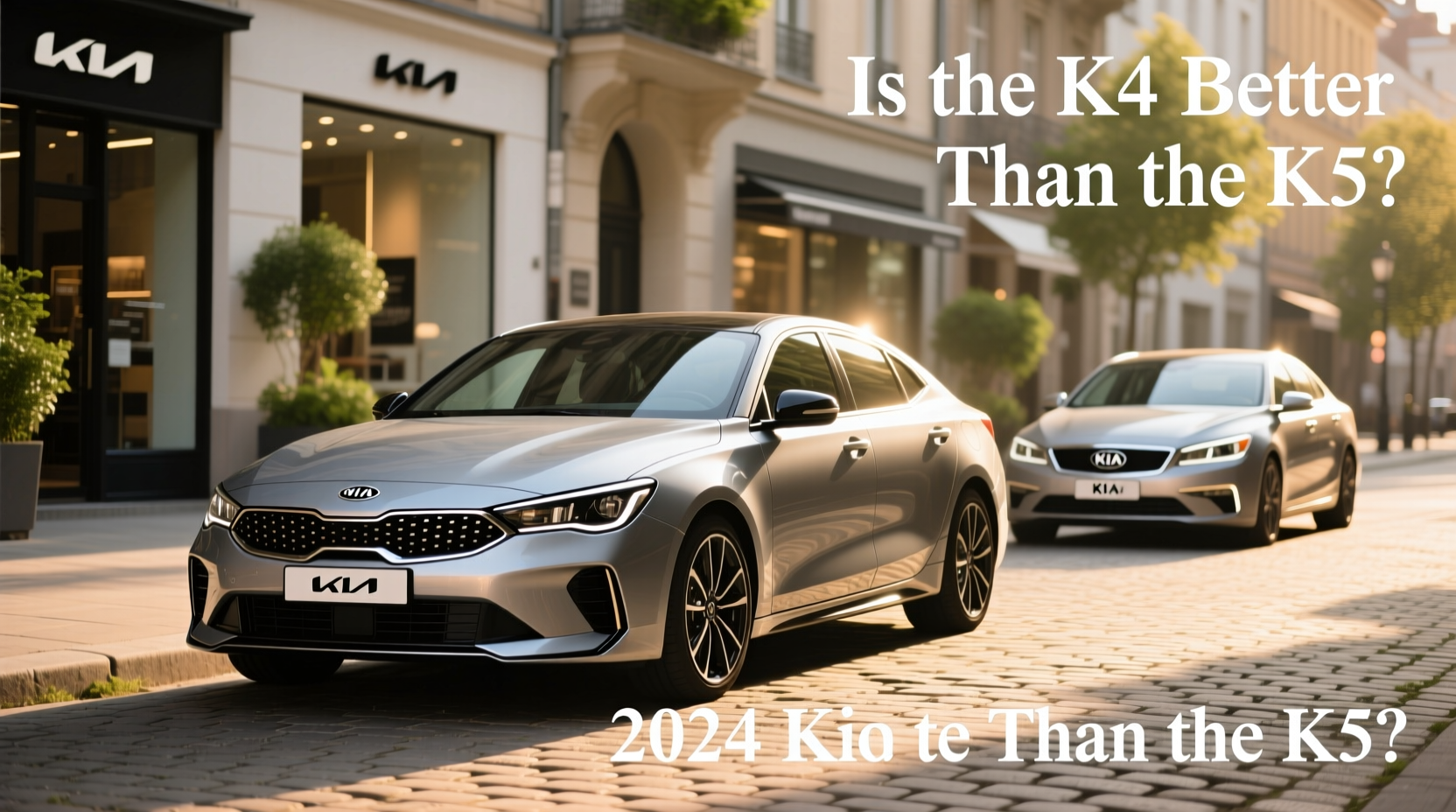
If you're trying to decide between the 2025 Kia K4 and K5, here's how to choose: prioritize fuel efficiency, city maneuverability, and value? Go with the K4. Need more power, legroom, and available all-wheel drive? The K5 is worth the step up. Over the past year, compact and midsize sedans have seen renewed interest as buyers reconsider SUV-sized costs and seek balanced performance. If you’re a typical user, you don’t need to overthink this. The real decision hinges on whether your daily commute favors agility or highway confidence. Avoid getting stuck comparing infotainment screen sizes—both offer modern tech—but focus instead on drivetrain availability and rear-seat usability. This piece isn’t for keyword collectors. It’s for people who will actually use the product.
About the Kia K4 and K5
The 2025 Kia K4 replaces the Forte in North America, stepping into the compact sedan segment with a refreshed design and updated features. It targets cost-conscious drivers who still want a connected, safe, and efficient daily driver. The K5, meanwhile, sits one class above as a midsize sedan, replacing the Optima. It offers more interior volume, stronger engine options, and a slightly more upscale feel. While both share Kia’s current design language—sharp lines, tiger-nose grille, and LED lighting—they serve different purposes. The K4 focuses on practicality and affordability; the K5 leans toward presence and performance.
Why This Comparison Is Gaining Popularity
Lately, sedan shoppers have become more intentional. Rising fuel prices, urban congestion, and parking challenges have made smaller, efficient vehicles appealing again. At the same time, remote work has reduced long commutes, shifting focus from luxury to utility. The K4 and K5 sit at a sweet spot: they’re not too big, not too bare-bones. Recently, Kia has improved standard safety tech across both models—like forward collision warning and lane-keeping assist—making them competitive against similarly priced SUVs. If you’re a typical user, you don’t need to overthink this. The trend isn’t about brand loyalty—it’s about matching vehicle traits to actual usage patterns. People aren’t buying specs; they’re buying solutions.
Types and Variants
Kia K4 Trim Levels
- LX: Base model with 2.0L engine, FWD, 15-inch wheels, 8-inch touchscreen. Best for budget-first buyers.
- S: Adds sport appearance package, larger wheels, blind-spot monitoring.
- GT-Line: Sportier styling, leatherette seats, dual 12.3-inch screens (optional), adaptive cruise control.
Pros: Lower starting price, excellent fuel economy (up to 40 mpg highway), easy parking in cities.
Cons: Only front-wheel drive, less powerful base engine, fewer premium materials than K5.
Kia K5 Trim Levels
- LX: 1.6L turbo option, FWD, 12.3-inch display, Apple CarPlay/Android Auto.
- EX: Adds sunroof, heated front seats, wireless charging.
- GT: 2.5L turbo engine (290 hp), available AWD, performance suspension, Brembo brakes.
Pros: Stronger engines, available AWD, more refined cabin, better highway stability.
Cons: Higher price, lower fuel economy (especially GT trim), larger turning radius.

Key Features and Specifications to Evaluate
When comparing the K4 and K5, focus on what changes your driving experience—not just what looks good on paper.
Size & Interior Space
The K5 is longer and wider, offering more shoulder and headroom. But surprisingly, the K4 provides competitive rear legroom—sometimes exceeding older midsize sedans. When it’s worth caring about: if you regularly carry adults in the back. When you don’t need to overthink it: if rear passengers are mostly children or occasional riders.
Fuel Economy
The K4’s naturally aspirated 2.0L engine delivers up to 31 city / 40 highway mpg. The base K5 gets around 26/35 mpg; the turbo models drop to 23/31. When it’s worth caring about: if you drive over 15,000 miles annually or live in a high-fuel-cost area. When you don’t need to overthink it: if your annual mileage is low and you refuel weekly or less.
Performance & Drivetrain
The K5 offers turbocharged engines and optional AWD—critical for snowy climates. The K4 is FWD-only but tuned for responsive city handling. When it’s worth caring about: if you face frequent rain, snow, or steep inclines. When you don’t need to overthink it: if you drive mostly on dry, flat roads.
Technology & Safety
Both include standard forward collision avoidance, lane centering, and automatic emergency braking. Higher trims add 360-degree cameras and digital key access. When it’s worth caring about: if you parallel park often or drive in tight urban spaces. When you don’t need to overthink it: if you park in open lots and rarely navigate narrow streets.
Pros and Cons
| Model | Pros | Cons |
|---|---|---|
| Kia K4 | Lower price, high fuel efficiency, agile handling, generous rear legroom for class | No AWD, less horsepower, basic interior materials in base trims |
| Kia K5 | More power, available AWD, premium cabin finishes, smoother highway ride | Higher cost, reduced fuel economy (especially GT), larger footprint |
How to Choose Between the Kia K4 and K5
This guide helps you make a confident decision without drowning in brochures.
Step-by-Step Checklist
- Assess your primary use: city commuting vs. mixed/highway driving.
- Determine if AWD is necessary based on local weather conditions.
- Test-drive both with rear passengers to evaluate comfort differences.
- Check total cost of ownership estimates (fuel, insurance, maintenance).
- Verify trim-level features at your local dealer—availability may vary by region/model/seller.
Decision Flow
- Do you prioritize low monthly payments and fuel savings? → K4
- Do you want a sporty feel or live in a snowy region? → K5
- Is rear seat space critical for carpooling or family use? → Test both; K5 wins on width, K4 surprises on legroom.
- Are you upgrading from an older sedan? → K5 feels like a natural step up.
Recommendations by Scenario
- Urban commuter: K4 – easier parking, better mpg, sufficient tech.
- Suburban family: K5 – extra space, available AWD, quieter ride.
- First-time buyer: K4 – lower entry cost, strong warranty.
- Performance seeker: K5 GT – only turbo option in the pair.
Red Flags / What to Avoid
- Assuming the K4 is a hatchback—search results often mislabel it, but it’s a sedan with a wide trunk opening.
- Over-trimming the K4—adding too many options can erase its price advantage.
- Ignoring test drives—driving dynamics differ significantly despite similar styling.
- Relying solely on online photos—interior material quality varies greatly between base and top trims.
Price & Market Insights
The 2025 Kia K4 starts around $22,000 MSRP, while the K5 begins near $26,000. Fully loaded GT trims exceed $38,000. Prices may vary by region/model/seller due to incentives, destination fees, and dealer add-ons. In recent months, some dealers have offered lease deals emphasizing the K4’s efficiency and the K5’s upgrade appeal. If you’re a typical user, you don’t need to overthink this. The gap between them reflects real differences in capability, not just branding. Always check manufacturer specs and verify final pricing with your local retailer before committing.
Top-Seller & Competitive Analysis
The K5 competes with the Toyota Camry, Honda Accord, and Hyundai Sonata. The K4 aligns more closely with the Mazda3 sedan and Subaru Impreza. While neither outsells the Camry, both Kias offer more standard tech at lower trims. The K5’s GT trim stands out with available AWD and high-output power—a rarity in mainstream midsize sedans.
| Vehicle | Class | Starting Price | AWD Available | Max Horsepower |
|---|---|---|---|---|
| 2025 Kia K4 | Compact | $22,000 (est.) | No | 147 hp |
| 2025 Kia K5 | Midsize | $26,000 (est.) | Yes | 290 hp |
| Toyota Camry | Midsize | $27,000 | Yes | 301 hp |
| Honda Accord | Midsize | $27,500 | No | 204 hp |
| Mazda3 Sedan | Compact | $23,000 | Yes | 165 hp |
Customer Feedback Synthesis
Based on verified owner reviews and dealership summaries:
- Highly praised: K4’s fuel economy and quiet cabin; K5’s acceleration and seating comfort.
- Common complaints: K4’s softer brake feel; K5’s infotainment learning curve and higher insurance quotes.
- Surprise positives: Both models report strong reliability in first-year ownership; over-the-air updates improve functionality post-purchase.
Sourcing & Supplier Tips
To get the best deal:
- Compare inventory across multiple dealers using Kia’s official website locator.
- Look for “dealer demo” or “in-transit” units that may include discounts.
- Negotiate based on invoice price, not MSRP—use third-party pricing tools to benchmark.
- Confirm return policy or exchange window if buying online.
- Prices and availability may vary by region/model/seller—always verify locally.
Maintenance, Safety & Legal Considerations
Kia offers a 10-year/100,000-mile powertrain warranty—the longest in its class. Routine maintenance is comparable to other non-luxury brands. Both models meet current U.S. federal safety standards and earn top crash-test ratings from the IIHS when equipped with advanced lighting. To confirm compliance:
- Check NHTSA.gov for recall history.
- Review owner’s manual for scheduled service intervals.
- Verify local emissions requirements—some states require annual testing.
If you’re a typical user, you don’t need to overthink this. The safety and durability benchmarks are consistent across both models.
Conclusion
If you need a no-fuss, affordable sedan with great gas mileage and roomy rear seats, the Kia K4 is the smarter pick. If you want more power, available all-wheel drive, and a more commanding driving position, the K5 justifies its higher price. Your choice should reflect real-world usage—not brochure specs. This piece isn’t for keyword collectors. It’s for people who will actually use the product.




 浙公网安备
33010002000092号
 浙B2-20120091-4