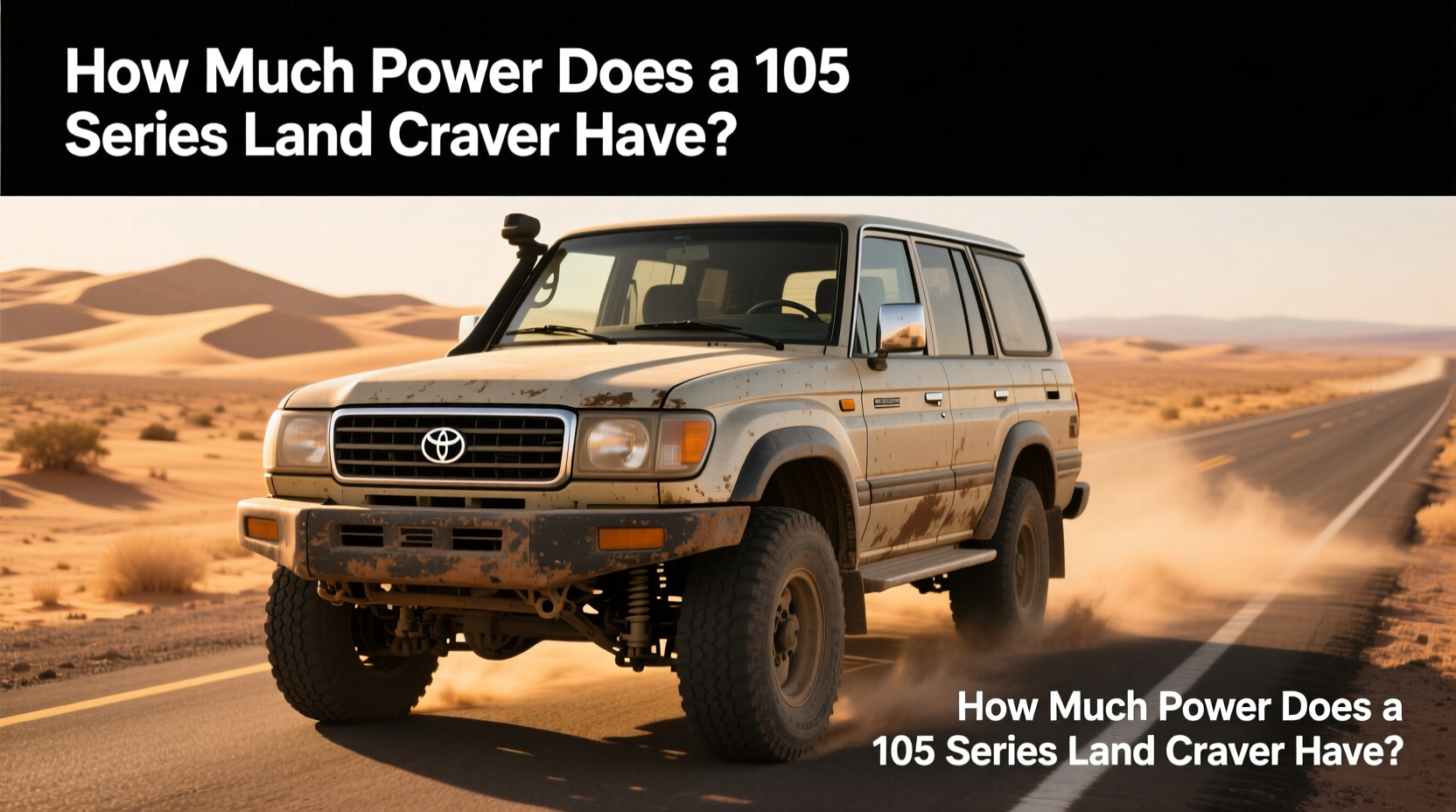
If you're asking how much power does a 105 series Land Cruiser have?, the answer depends on engine type and market. The diesel-powered HZJ105 with the 1HZ engine delivers 129 hp (96 kW), ideal for rugged reliability in remote areas. The petrol FZJ105 with the 1FZ-FE engine offers 241 hp (180 kW), better suited for highway driving and towing. When choosing a Land Cruiser 105, evaluate engine output, regional availability, suspension design, and long-term maintenance needs—especially if you plan off-grid or heavy-duty use. Avoid models with undocumented service history or modified engines.
About the Land Cruiser 105 Series
The Toyota Land Cruiser 105 series, produced from 1998 to 2005, bridges the gap between the legendary 80-series and the more modern 100-series. It retains the body-on-frame chassis and solid front and rear axles of the 80-series, making it exceptionally durable in harsh off-road conditions ⚙️. Unlike the 100-series, which introduced independent front suspension (IFS), the 105 series kept the live axle setup, preferred by off-road purists for its strength and articulation in extreme terrain.
This model was primarily marketed in regions like Africa, Australia, South America, the Middle East, and parts of Asia 🌍. It was designed for users who needed maximum durability in remote, rugged environments—think mining operations, overlanding expeditions, and agricultural transport. The 105 series is not a luxury SUV; it's a utilitarian workhorse built for function over comfort.
Why the Land Cruiser 105 Is Gaining Popularity
Despite being out of production since 2005, the Land Cruiser 105 has seen renewed interest among off-road enthusiasts and preppers. Its popularity stems from several factors: proven mechanical simplicity, ease of repair in isolated areas, and exceptional longevity. With rising demand for reliable used 4x4s that can handle desert crossings or jungle trails without frequent servicing, the 105 fills a niche that newer, more complex vehicles often can't match ✅.
Additionally, the global used vehicle market has made these trucks more accessible. Buyers in North America and Europe are importing them via specialist dealers, drawn by their reputation for surviving decades with minimal care. For those seeking a no-nonsense, go-anywhere vehicle, the 105 series represents a compelling option—especially when compared to electronics-heavy modern SUVs.
Types and Variants
The Land Cruiser 105 came in multiple configurations based on engine and regional specifications:
- HZJ105 (Diesel): Powered by the 4.2L 1HZ naturally aspirated inline-six diesel engine. Produces 129 hp and 271 Nm of torque. Known for fuel efficiency and reliability in hot climates. Best for low-speed, high-durability applications like patrol or rural transport.
- FZJ105 (Petrol): Equipped with the 4.5L 1FZ-FE DOHC petrol engine. Delivers 241 hp and 410 Nm of torque. Offers smoother highway performance and better acceleration. Suitable for mixed-use scenarios where speed and comfort matter.
- HDJ100 variants (in some markets): Though technically part of the 100-series family, some HDJ100 models with turbocharged diesel engines (like the 1HD-T and 1HD-FTE) were sold alongside the 105 and share many components. These offer higher power outputs (up to 201 hp) but may lack the solid front axle of the true 105 series.
Each variant has trade-offs. The diesel HZJ105 excels in fuel economy and engine longevity but lacks power for quick overtaking. The petrol FZJ105 provides better drivability but consumes more fuel and has higher maintenance costs over time.
Key Features and Specifications to Evaluate
When assessing a Land Cruiser 105, focus on these technical and practical aspects:
- Engine Type ⚙️: Confirm whether it’s the 1HZ diesel or 1FZ-FE petrol. Check VIN or engine bay stampings for accuracy.
- Power Output ⚡: Diesel models produce 129 hp; petrol versions generate 241 hp. Torque differences are significant—petrol offers 410 Nm vs. diesel’s 271 Nm.
- Suspension System 🛠️: The 105 series uses solid axles front and rear, enhancing off-road capability. Verify no IFS conversion has been done.
- Fuel Injection System: The 1HZ uses precombustion chamber injection—a robust but older design. Ensure injectors and pump are serviced.
- Coolant and Oil Capacity: 14L coolant, 9.3L engine oil. Useful for maintenance planning.
- Transmission: Most models come with a 4-speed automatic or 5-speed manual. Manual transmissions tend to last longer under heavy loads.
- Drivetrain: Full-time 4WD with a two-speed transfer case. Essential for serious off-roading.
Always verify specifications against official documentation or trusted databases, as modifications and mislabeling are common in the used market.
Pros and Cons
Pros:
- Extremely durable solid-axle suspension
- Simple, repairable mechanical systems
- High resale value in developing markets
- Excellent for off-grid and expedition use
- Wide availability of aftermarket parts
Cons:
- Limited power, especially in diesel models
- Poor fuel economy (petrol version)
- Bare-bones interior and ride comfort
- Aging electronics and potential rust issues
- Harder to source genuine parts in some regions
The Land Cruiser 105 is best suited for buyers prioritizing reliability over refinement. It’s not ideal for urban commuters or those expecting modern safety features.
How to Choose a Land Cruiser 105
Follow this step-by-step guide when evaluating a purchase:
- Determine Your Use Case 🔍: Will you drive mostly off-road? Choose the diesel HZJ105. Need highway performance? Consider the petrol FZJ105.
- Verify Engine Model ⚙️: Inspect the engine block for casting numbers. The 1HZ will have "1HZ" stamped; the 1FZ-FE will show "1FZFE".
- Check Service History 📋: Look for regular oil changes, injector servicing (for diesel), and transmission flushes. Missing records are a red flag.
- Inspect for Rust and Frame Damage 🧰: Pay special attention to wheel arches, floor pans, and chassis rails. Salt exposure accelerates corrosion.
- Test Drive Thoroughly 🚚: Listen for unusual noises, test 4WD engagement, and check for vibrations at speed.
- Review Import Compliance 🌐: If importing, confirm emissions and safety regulations in your country. Some nations restrict older diesels.
Red Flags to Avoid:
- Vehicles with rebuilt or swapped engines
- Unexplained warning lights or smoke during startup
- Inconsistent odometer readings
- Aftermarket ECU tuning (common in modified 1HZ engines)
- Lack of title or ownership documentation
Price & Market Insights
Prices vary widely depending on region, condition, and engine type. In Australia, a well-maintained HZJ105 might sell for AUD 25,000–35,000. In the U.S., imported FZJ105 models range from USD 20,000 to $40,000, depending on modifications and mileage. Diesel models generally hold value better in African and Middle Eastern markets due to fuel availability and operational needs.
Value is tied closely to authenticity and service history. Restored examples with documented maintenance command premiums. Be cautious of unusually low prices—they may indicate hidden damage or title issues. Always compare listings across multiple platforms and consult recent auction results for realistic valuations.
Top-Seller & Competitive Analysis
The HZJ105 diesel remains the most sought-after variant globally due to its legendary 1HZ engine reliability. However, the FZJ105 petrol model appeals to collectors and drivers wanting more power. Below is a comparison of key models:
| Model | Engine | Power (hp) | Torque (Nm) | Fuel Type | Best For |
|---|---|---|---|---|---|
| HZJ105 | 1HZ I6 | 129 | 271 | Diesel | Off-road durability, remote use |
| FZJ105 | 1FZ-FE I6 | 241 | 410 | Petrol | Highway driving, towing |
| HDJ100 (1HD-FTE) | 1HD-FTE I6 Turbo | 201 | 430 | Diesel | Balanced power & efficiency |
Note: While the HDJ100 offers superior power, it uses independent front suspension, reducing off-road articulation compared to the true solid-axle 105 series.
Customer Feedback Synthesis
Buyer reviews consistently highlight several themes:
- Positive: “The 1HZ engine just keeps running—mine has over 400,000 km with only injector servicing.” “Perfect for bush patrols—no breakdowns even in 45°C heat.”
- Negative: “The petrol version drinks fuel—expect 18+ L/100km on highways.” “Ride is very stiff; not comfortable for daily commuting.” “Finding OEM parts outside Australia or Japan can be difficult.”
Common praise centers on mechanical resilience and ease of field repairs. Complaints typically involve outdated ergonomics, noise levels, and the cost of importing or registering in regulated markets.
Sourcing & Supplier Tips
When sourcing a Land Cruiser 105:
- Buy from reputable exporters in Australia, Japan, or the UAE who provide full inspection reports ✅.
- Use third-party inspectors if purchasing remotely—don’t rely solely on seller photos 📎.
- For bulk purchases (e.g., fleet deployment), negotiate CIF pricing and verify shipping timelines ⏱️.
- Check for compliance with local import laws before committing 💼.
- Avoid auctions unless you can inspect the vehicle personally or through a trusted agent.
Consider working with specialists who focus on JDM (Japanese Domestic Market) or Australasian exports, as they often have deeper knowledge of these models.
Maintenance, Safety & Legal Considerations
Maintenance should follow factory intervals where possible. Key tasks include:
- Regular oil changes every 5,000–10,000 km
- Fuel filter replacement (critical for diesel models)
- Transfer case and differential fluid checks
- Brake system inspections
Safety-wise, remember that the 105 lacks airbags, ABS, or electronic stability control. Drive accordingly, especially in wet or slippery conditions ❗.
Legally, ensure the vehicle meets your country’s emission and safety standards before import. Some regions require modifications (e.g., lighting, seat belts) to pass inspection. Always verify requirements with local transport authorities.
Conclusion
If you need a rugged, dependable 4x4 for off-road adventures or operation in remote areas, the Land Cruiser 105 is an excellent choice. For maximum durability and fuel efficiency, select the HZJ105 diesel model. If you prioritize drivability and towing capacity, the FZJ105 petrol version offers significantly more power. Regardless of engine type, prioritize vehicles with full service history, original components, and clean titles. Avoid modified or poorly documented units. By focusing on verified specs and real-world usability, you can make a confident decision when buying a Land Cruiser 105.




 浙公网安备
33010002000092号
 浙B2-20120091-4