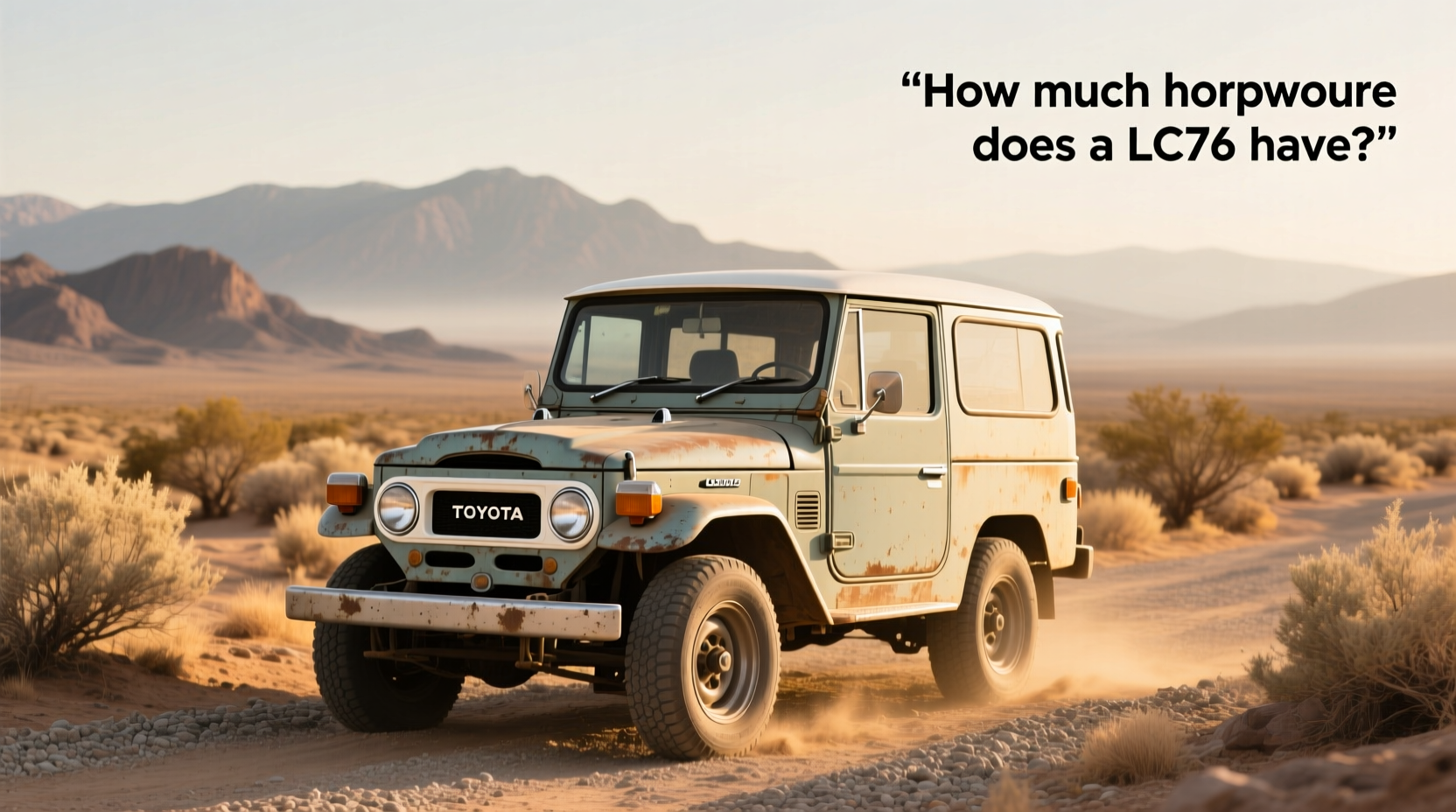
⚡ The Toyota Land Cruiser LC76 comes with two main diesel engines: the older 4.2L 1HZ producing 129 HP, and the modern 2.8L GD-6 turbo-diesel delivering 204 HP. If you prioritize rugged simplicity and mechanical reliability in remote areas, the 4.2L is a proven choice 1. For better on-road performance, higher torque (500 Nm), and automatic transmission, the 2.8L model suits mixed-use or comfort-focused buyers. When learning how to choose Toyota LC76, How much horsepower does a LC76 have? is just one factor—your use case, terrain, and maintenance access matter equally.
About the Toyota LC76: What You Need to Know
The Toyota Land Cruiser LC76 is a heavy-duty utility vehicle designed for extreme durability and off-road capability. Unlike its more luxurious siblings, the LC76 focuses on functionality, often used in agriculture, mining, emergency services, and remote exploration. It's part of Toyota's legendary 70 Series lineup, known for unmatched reliability in harsh environments. When evaluating what to look for in a Toyota LC76, How much horsepower does a LC76 have? is a common starting point, but understanding its role as a workhorse is essential.
The LC76 is available in various body styles, including pickup (troop carrier), wagon, and ambulance variants. Its core appeal lies in simple mechanics, easy servicing, and high ground clearance. Whether transporting goods across deserts or navigating muddy rural roads, the LC76 is built to endure conditions where breakdowns are not an option. Buyers often ask, "How much horsepower does a LC76 have?" because they’re weighing performance against real-world usability in isolated regions.
Why the LC76 Is Gaining Popularity
In recent years, the LC76 has seen renewed global interest due to stricter emissions regulations phasing out similar rugged vehicles. While many manufacturers have shifted toward comfort-oriented SUVs, Toyota has kept the 70 Series alive in select markets, reinforcing its reputation for longevity. Enthusiasts and professionals alike value the LC76’s mechanical transparency—few electronics mean fewer failure points.
This resurgence is also driven by demand in Africa, the Middle East, Australia, and parts of Latin America, where infrastructure is limited and vehicles must operate far from dealerships. The availability of two engine options—the classic 4.2L and the updated 2.8L—allows buyers to match power delivery with operational needs. As more users search for a Toyota LC76, How much horsepower does a LC76 have? becomes a gateway question into deeper comparisons between legacy reliability and modern performance.
Types and Variants: 4.2L vs. 2.8L Engine Models
The primary distinction among LC76 models lies in their engine and drivetrain configurations. Understanding these variants is crucial when navigating how to choose Toyota LC76, How much horsepower does a LC76 have? being only one aspect of a broader decision matrix.
🔧 4.2L Diesel (1HZ Engine)
This naturally aspirated inline-six diesel engine has been a staple in Toyota’s lineup since the 1990s. Known for its near-indestructible design, it powers the traditionalist version of the LC76.
Pros:
- Extremely reliable with minimal electronic components
- Easy to repair in remote locations with basic tools
- Lower fuel system complexity (mechanical injection)
- Full-time 4WD provides consistent traction
Cons:
- Low horsepower (129 HP) limits highway and towing performance
- Only available with a 5-speed manual transmission
- Higher fuel consumption per kilometer compared to newer engines
- Limited torque (285 Nm), affecting hill climbing and load carrying
✨ 2.8L Turbo-Diesel (GD-6 Engine)
The newer 2.8L four-cylinder turbo-diesel represents a significant upgrade in performance and refinement. It reflects Toyota’s effort to modernize the 70 Series without compromising core durability.
Pros:
- Significantly higher horsepower (204 HP) and torque (500 Nm)
- Available with a 6-speed automatic transmission
- Better fuel efficiency despite larger tank (130L vs. 90L)
- Improved throttle response and on-road drivability
Cons:
- More complex electronics and common-rail injection increase repair difficulty off-grid
- Part-time 4x4 requires driver engagement (manual hubs)
- Higher initial cost and potentially pricier maintenance
- Less proven long-term in extreme environments compared to 1HZ
Key Features and Specifications to Evaluate
When deciding on a Toyota LC76, How much horsepower does a LC76 have? should be considered alongside other critical metrics:
- Torque: More important than horsepower for off-roading and hauling. The 2.8L offers nearly double the torque of the 4.2L.
- Transmission: Manual vs. automatic affects driving comfort, especially over long distances.
- Fuel Capacity: The 2.8L model has a larger 130L tank, enhancing range in remote areas.
- Drive System: Full-time 4WD (4.2L) offers constant traction; part-time (2.8L) improves on-road efficiency.
- Serviceability: Simpler engines are easier to maintain without specialized tools.
- Emissions Compliance: The 2.8L meets newer standards, making it legal in more countries.
Also consider cabin comfort, availability of spare parts, and aftermarket support in your region. These factors influence long-term ownership costs and practicality.
Pros and Cons: Who Should Buy Which Model?
No single LC76 variant is universally better. The ideal choice depends on your environment and usage pattern.
Choose the 4.2L if:
- You operate in very remote areas with no service centers
- You need maximum mechanical simplicity
- Your speeds are mostly low to moderate (under 80 km/h)
- You already have experience maintaining older diesel engines
Choose the 2.8L if:
- You drive frequently on highways or paved roads
- You want automatic transmission for ease of use
- You carry heavy loads or tow trailers regularly
- You value quicker acceleration and better responsiveness
Avoid either model if you expect luxury features, advanced safety systems, or quiet cabin acoustics. The LC76 is a utilitarian vehicle first.
How to Choose a Toyota LC76: Step-by-Step Buying Guide
Follow this checklist to make an informed decision tailored to your needs:
- Define Your Use Case ✅
Will you use it primarily off-road, on mixed terrain, or for long-distance transport? High-speed travel favors the 2.8L. - Assess Maintenance Access 🔧
If you're far from certified workshops, the 4.2L’s simplicity may outweigh its lower power. - Check Transmission Preference ⚙️
Manual drivers may prefer the 4.2L; those wanting convenience should opt for the 2.8L automatic. - Evaluate Fuel Infrastructure 🛣️
The 2.8L’s larger tank gives greater range, useful in fuel-scarce regions. - Verify Legal Compliance 🌐
Some countries ban non-Euro 5/6 vehicles. The 2.8L is more likely to meet current standards. - Review Available Stock 📋
Dealer inventory varies by region. Confirm which engine and body style are actually available.
Red Flags to Avoid:
- Purchase without inspecting service history—especially for used imports
- Buying a modified 4.2L claiming higher output without proper engineering validation
- Ignoring local import duties and registration requirements
- Assuming all LC76s have the same features regardless of market specification
Price & Market Insights
Pricing for the Toyota LC76 varies widely based on region, engine type, and configuration. As of 2024–2025:
- The 4.2L manual model typically starts around $45,000–$55,000 USD in African and Middle Eastern markets.
- The 2.8L automatic version ranges from $60,000–$75,000 USD, reflecting added technology and performance.
Used models can be found at lower prices, but exercise caution—engine wear, rust, and improper modifications are common issues. In some countries, LC76s are sold through government or fleet channels, limiting retail availability. Always confirm whether the price includes shipping, taxes, and compliance certification.
From a value perspective, the 4.2L offers the lowest cost of ownership in terms of repairs and parts. However, the 2.8L may provide better long-term value if you drive extensively and require comfort and reliability under modern conditions.
Top-Seller & Competitive Analysis
The 2.8L automatic variant is increasingly becoming the top-selling LC76 model in markets where it’s available, thanks to improved drivability and regulatory compliance. However, the 4.2L remains dominant in regions with weak infrastructure.
| Feature | 4.2L Diesel (1HZ) | 2.8L Diesel (GD-6) |
|---|---|---|
| Engine | 4.2L 6-cyl NA | 2.8L 4-cyl Turbo |
| Horsepower | 129 HP @ 3800 RPM | 204 HP @ 3200–3400 RPM |
| Torque | 285 Nm @ 2200 RPM | 500 Nm @ 1600–2800 RPM |
| Transmission | 5-speed Manual | 6-speed Automatic |
| Drive System | Full-time 4WD | Part-time 4x4 |
| Fuel Tank | 90L (Dual) | 130L |
| Ideal For | Remote off-grid use | Mixed on/off-road |
Compared to rivals like the Nissan Patrol or Mitsubishi Pajero, the LC76 stands out for durability over comfort. It doesn’t compete directly with luxury SUVs but excels where others fail—deep sand, rocky trails, and flooded roads.
Customer Feedback Synthesis
Based on user reviews and field reports, here are the most frequent observations:
Common Praises:
- "The 4.2L runs forever—even after 300,000 km with basic care."
- "The 2.8L transformed our patrol operations with smoother rides and faster response times."
- "Spare parts are widely available in Africa and the Gulf region."
- "Simple dashboard means fewer things break down."
Recurring Complaints:
- "Ride is stiff and noisy, especially on paved roads."
- "Limited dealer network outside major cities makes warranty claims difficult."
- "Aftermarket suspension upgrades are almost mandatory for comfort."
- "Fuel economy on the 4.2L is poor—around 12–14 L/100km loaded."
Sourcing & Supplier Tips
When sourcing a Toyota LC76, consider the following:
- New Units: Purchase through authorized CFAO Motors or Toyota distributors in Africa, the Middle East, or Australia. Verify VIN authenticity and factory build sheet.
- Used Imports: Many buyers import from Japan or UAE. Inspect for rust, engine compression, and transmission wear. Use a pre-purchase inspection service.
- Batch Orders: For fleets or resale, negotiate directly with regional distributors. Minimum order quantities may apply.
- Verification Steps:
- Confirm engine type via chassis plate
- Check for tampered odometers
- Test 4WD engagement and differential locks
- Inspect frame for welding or structural damage
Always ensure the vehicle complies with your country’s import regulations before shipment.
Maintenance, Safety & Legal Considerations
Regular maintenance is simpler on the 4.2L due to mechanical fuel injection and lack of DPF/EGR systems. The 2.8L requires more attention to sensors, turbo health, and emission controls.
Safety-wise, the LC76 lacks modern ADAS features. Rollover risk increases on steep inclines with high center of gravity. Always use seatbelts and avoid aggressive cornering.
Legally, verify that the model meets local emissions and safety standards. Some countries restrict gray-market imports. Consult your national transport authority before registration.
Conclusion: Making the Right Choice
If you need a no-nonsense, repairable rig for isolated regions with minimal support, the 4.2L LC76 with 129 HP is a time-tested solution. But if you require stronger performance, automatic shifting, and better fuel economy for mixed terrain, the 2.8L model with 204 HP is the smarter investment. Answering "How much horsepower does a LC76 have?" is only the beginning—your real decision hinges on environment, workload, and long-term accessibility to service. Prioritize function over figures, and you’ll find the right LC76 for your mission.
Frequently Asked Questions
- How much horsepower does a LC76 have?
- The Toyota LC76 comes in two main variants: the 4.2L diesel produces 129 HP, while the 2.8L turbo-diesel generates 204 HP. Output depends on engine selection.
- What is the difference between the LC76 4.2L and 2.8L?
- The 4.2L uses a naturally aspirated engine with manual transmission and full-time 4WD, ideal for rugged simplicity. The 2.8L has a turbo engine, automatic option, higher torque, and better on-road performance.
- Is the LC76 suitable for daily driving?
- It can be used daily, but the ride is firm and cabin noise is high. The 2.8L automatic is more comfortable for regular commutes than the 4.2L manual.
- Which LC76 engine is more reliable?
- The 4.2L is mechanically simpler and has decades of proven field reliability. The 2.8L is modern and robust but relies on electronics that may complicate repairs off-grid.
- Can the LC76 handle extreme off-road conditions?
- Yes, both variants are built for extreme off-road use. The 4.2L excels in remote durability, while the 2.8L offers superior traction and power in challenging terrain.




 浙公网安备
33010002000092号
 浙B2-20120091-4