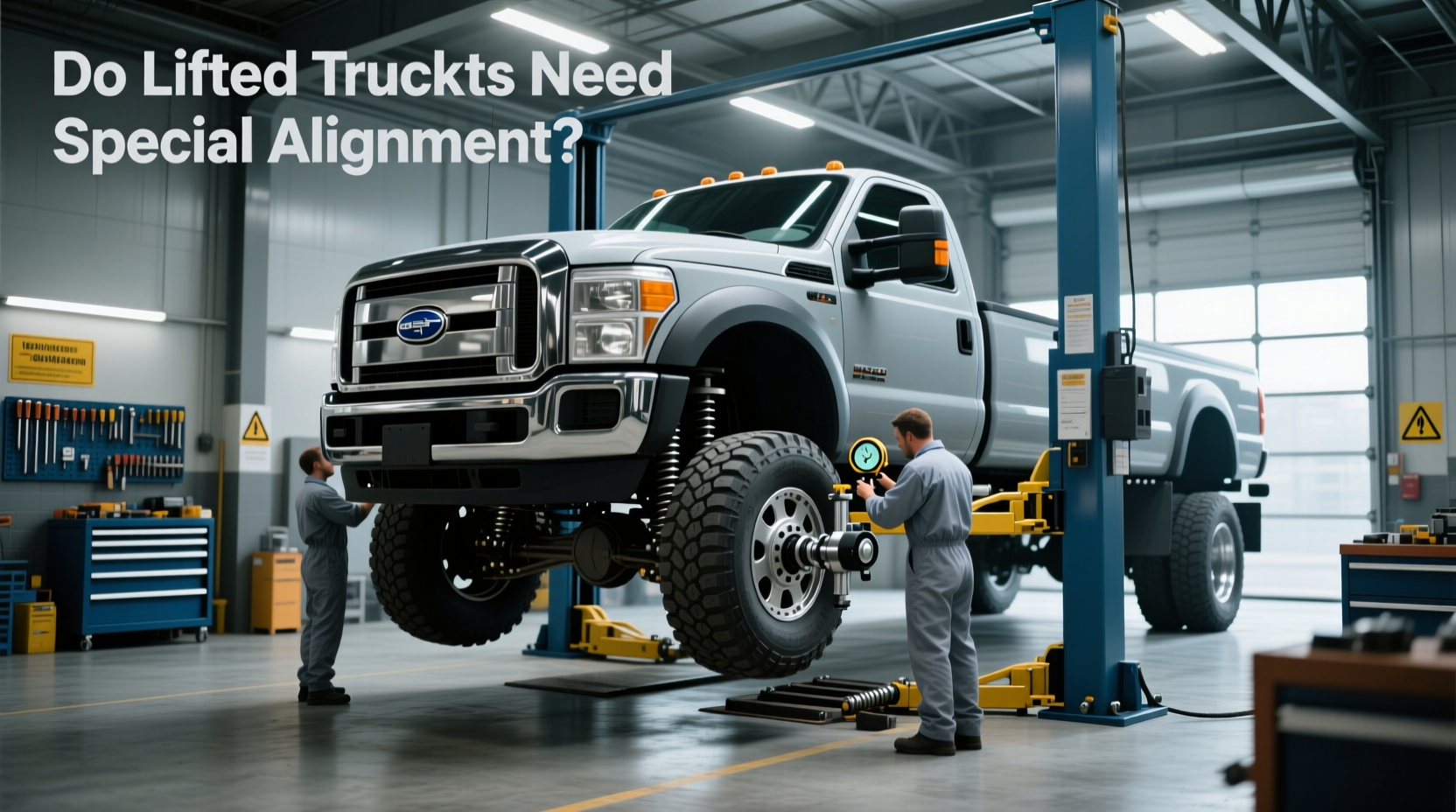
If you own a lifted heavy-duty truck, the answer is clear: yes, lifted trucks require special alignment settings that differ significantly from factory specifications 6. When selecting a heavy duty truck alignment service or evaluating your current setup, understanding how lift kits alter suspension geometry—particularly caster, camber, and toe—is essential to avoid premature tire wear, steering instability, and reduced fuel efficiency 5. For optimal performance, always adjust alignment after installing a lift kit using recommended specs based on lift height and tire size—not stock values. Avoid shops unfamiliar with modified suspensions, as improper calibration can lead to dangerous handling issues.
About Heavy Duty Truck Alignment: Do Lifted Trucks Need Special Alignment?
Heavy duty truck alignment refers to the precise adjustment of the suspension system to ensure tires contact the road at correct angles, optimizing handling, safety, and component longevity 4. Unlike passenger vehicles, heavy-duty trucks carry substantial loads and operate under extreme conditions, making proper alignment critical for stability and operational efficiency 3.
When a truck is lifted—whether via a spacer or full suspension kit—the entire front-end geometry changes. Control arms shift angle, ball joints reposition, and steering linkages extend, all of which directly affect camber, caster, and toe 6. As a result, relying on factory alignment specs leads to poor tracking, uneven tire wear, and compromised control. This answers the central question: lifted trucks absolutely need specialized alignment adjustments, not just a routine check-up.
Why Heavy Duty Truck Alignment for Lifted Trucks Is Gaining Popularity
The rise in popularity of lifted trucks—especially among off-road enthusiasts, overlanding communities, and commercial operators needing increased ground clearance—has driven demand for accurate, customized alignment solutions 5. Larger tires (33” and above) are commonly paired with lifts, further amplifying the need for corrected alignment settings to maintain highway stability and directional control.
Additionally, as aftermarket suspension technology improves, more owners are modifying their trucks confidently, knowing that proper post-lift alignment mitigates many downsides of modification. Mechanics and alignment specialists are also adapting, with growing numbers offering expertise in lifted vehicle dynamics—a trend reflected in online forums and specialty shops catering specifically to this niche 7.
Types and Variants
While alignment itself isn’t sold as a “product,” it involves different approaches depending on truck configuration and lift type:
- Stock-Based Alignment: Uses OEM factory specifications. ✅ Suitable only for non-lifted trucks. ❌ Risky for lifted setups due to altered geometry.
- Custom Performance Alignment: Adjusts caster, camber, and toe beyond factory ranges to match lift height and tire size. ✅ Ideal for most lifted trucks. Requires technician experience.
- Computer-Assisted Precision Alignment: Utilizes digital sensors and software to measure real-time angles. ✅ Most accurate method. ✅ Works well when paired with manual expertise for lifted configurations.
- Two-Wheel vs Four-Wheel Alignment: Most heavy-duty trucks benefit from four-wheel alignment, especially if rear axle modifications exist. ✅ Four-wheel provides complete picture. ❌ Two-wheel ignores rear tracking issues.
Key Features and Specifications to Evaluate
When assessing alignment quality or preparing for a service visit, focus on these measurable parameters:
- ⚙️ Caster Angle: Affects steering stability and return-to-center behavior. Lifted trucks typically lose caster; compensation requires increasing it (up to 6.2° for large lifts).
- ⚙️ Camber Angle: Ensures even tire tread contact. Excessive negative camber causes inner-edge wear—common after lifting.
- ⚙️ Toe Setting: Critical for straight-line tracking. Slight toe-in (0.05°–0.18°) prevents wandering and rapid outer-tread wear.
- 🔍 Measurement Accuracy: Ensure the shop uses up-to-date alignment racks with digital readouts calibrated for heavy-duty applications.
- 📋 Adjustability Range: Some older or budget systems cannot achieve high caster values needed for lifted trucks—verify capability beforehand.
Pros and Cons
| Aspect | Pros | Cons |
|---|---|---|
| Lift-Specific Alignment | Improved stability, longer tire life, better steering response | Requires experienced technician; may cost more than standard service |
| Using Factory Specs on Lifted Truck | Widely available; lower initial cost | Leads to tire cupping, wandering, unsafe handling |
| High Caster Settings | Better highway tracking, improved self-centering | Potentially heavier steering feel at low speeds |
Suitable for: Off-road trucks, overlanders, fleet vehicles with suspension upgrades.
Not suitable for: Owners unwilling to invest in qualified technicians or those who skip alignment after lift installation.
How to Choose Heavy Duty Truck Alignment: Do Lifted Trucks Need Special Alignment?
Follow this step-by-step guide when selecting an alignment service for your lifted truck:
- Confirm Lift Installation Was Recent: Any time you install a lift kit—even 2 inches—schedule an alignment immediately.
- Gather Your Truck’s Details: Know your lift height, tire size, and whether adjustable control arms or drop brackets were used.
- Use Recommended Settings as a Baseline:
| Truck Setup | Caster | Camber | Toe |
|---|---|---|---|
| 2–3" lift, 33" tires | 3.5°–4.5° | 0° to -0.2° | 0.05°–0.10° in |
| 2–3" lift, 35" tires | 4.0°–4.8° | 0° to -0.2° | 0.05°–0.12° in |
| 4–6" lift, 35" tires | 4.5°–5.5° | -0.1° to -0.3° | 0.08°–0.15° in |
| 4–6" lift, 37" tires | 5.0°–6.2° | -0.1° to -0.4° | 0.10°–0.18° in |
Data source: 6
- Select a Qualified Shop: Look for facilities advertising experience with lifted or modified trucks. Ask if they’ve handled similar lift heights and tire sizes.
- Avoid Red Flags: Be cautious if a shop insists on replacing parts (like control arms) solely to perform alignment without diagnosing actual wear. Get second opinions.
- Verify Final Readout: Request a printout or digital report showing pre- and post-alignment measurements. Compare final values to recommended ranges.
Price & Market Insights
Alignment costs vary widely by region, shop type, and complexity:
- Standard Alignment: $80–$120 (often insufficient for lifted trucks)
- Premium/Lifted Vehicle Alignment: $120–$200+ (includes custom adjustments and extended labor)
- Fleet Discounts: Available for commercial operators managing multiple units
Pricing may be higher in urban or specialty-offroad hubs. The value lies not in the lowest price but in technician expertise and long-term savings from reduced tire wear and improved safety.
Top-Seller & Competitive Analysis
While alignment services aren't “sold” like products, leading providers distinguish themselves through equipment and specialization. Consider these factors when comparing options:
| Provider Type | Equipment Used | Experience with Lifted Trucks | Value Proposition |
|---|---|---|---|
| National Chain (e.g., Firestone, Pep Boys) | Modern computerized racks | Limited; mostly stock-spec focused | Convenience, consistency |
| Independent Suspension Specialist | Digital sensors + manual tuning | High; often off-road focused | Tailored results, deeper knowledge |
| Dealership Service Center | OEM-grade tools | Low; restricted to factory specs | Reliability for unmodified trucks |
| Mobile Alignment Service | Portable laser systems | Moderate; depends on operator | On-site convenience for fleets |
For best outcomes, prioritize experience over brand name.
Customer Feedback Synthesis
Analysis of owner experiences reveals consistent patterns:
- Positive Feedback:
- "Steering feels tight again after years of drift."
- "Tire wear stopped immediately after proper alignment."
- "Technician adjusted caster beyond spec—huge difference on highways."
- Common Complaints:
- "Shop used factory settings and said it was fine—still pulls left."
- "Charged extra to 'fix' nonexistent ball joint issues."
- "No printout provided; couldn’t verify work done."
Sourcing & Supplier Tips
There is no physical product to source, but choosing the right service provider matters:
- For Individuals: Search for shops specializing in 4x4, off-road, or diesel performance services. Check reviews mentioning “lifted truck alignment.”
- For Fleets: Negotiate service contracts with specialty garages or mobile units to reduce downtime.
- Vet Technicians: Ask about training, tools used, and whether they consult aftermarket alignment guides for modified vehicles.
- Verify Work: Always request a detailed alignment report showing actual measured angles before and after adjustment.
Maintenance, Safety & Legal Considerations
Proper alignment contributes directly to safety and regulatory compliance:
- Maintenance: Recheck alignment every 12,000–15,000 miles or after major off-road use. Bump-steer and track rod ends degrade over time.
- Safety: Misaligned lifted trucks are prone to lane drift, especially at highway speeds. Uneven tire wear increases blowout risk.
- Legal Compliance: While no federal law mandates specific alignment values, commercial vehicles must meet general safety standards (e.g., FMCSA guidelines). Tires must not show abnormal wear that could indicate unsafe operation 3. Verify local requirements if operating commercially.
Conclusion
If you’ve lifted your heavy-duty truck, standard alignment procedures won’t suffice. Yes, lifted trucks need special alignment tailored to their new geometry. To choose the right service, focus on technician experience, use data-driven settings based on lift height and tire size, and verify results with a detailed report. Avoid shops that rely solely on factory presets or push unnecessary repairs. Proper alignment enhances safety, extends tire life, and restores confident handling—making it one of the most impactful maintenance decisions for any modified truck.
Frequently Asked Questions
- Do lifted trucks need special alignment? Yes. Lifting alters suspension geometry, requiring adjusted caster, camber, and toe settings beyond factory specs to ensure safe handling and even tire wear.
- How often should I get my lifted truck aligned? At minimum, align after installing a lift kit. Recheck every 12,000–15,000 miles or if you notice pulling, vibration, or uneven tire wear.
- Can I align a lifted truck myself? While DIY measurement is possible with tools, precise adjustment requires specialized equipment and expertise. Professional service is strongly recommended.
- Does tire size affect alignment settings? Yes. Larger tires increase leverage on steering components and raise the center of gravity, necessitating higher caster and precise toe settings for stability.
- What happens if I don’t align my lifted truck? You risk rapid and uneven tire wear, poor steering response, highway instability, increased fuel consumption, and potential safety hazards.




 浙公网安备
33010002000092号
 浙B2-20120091-4