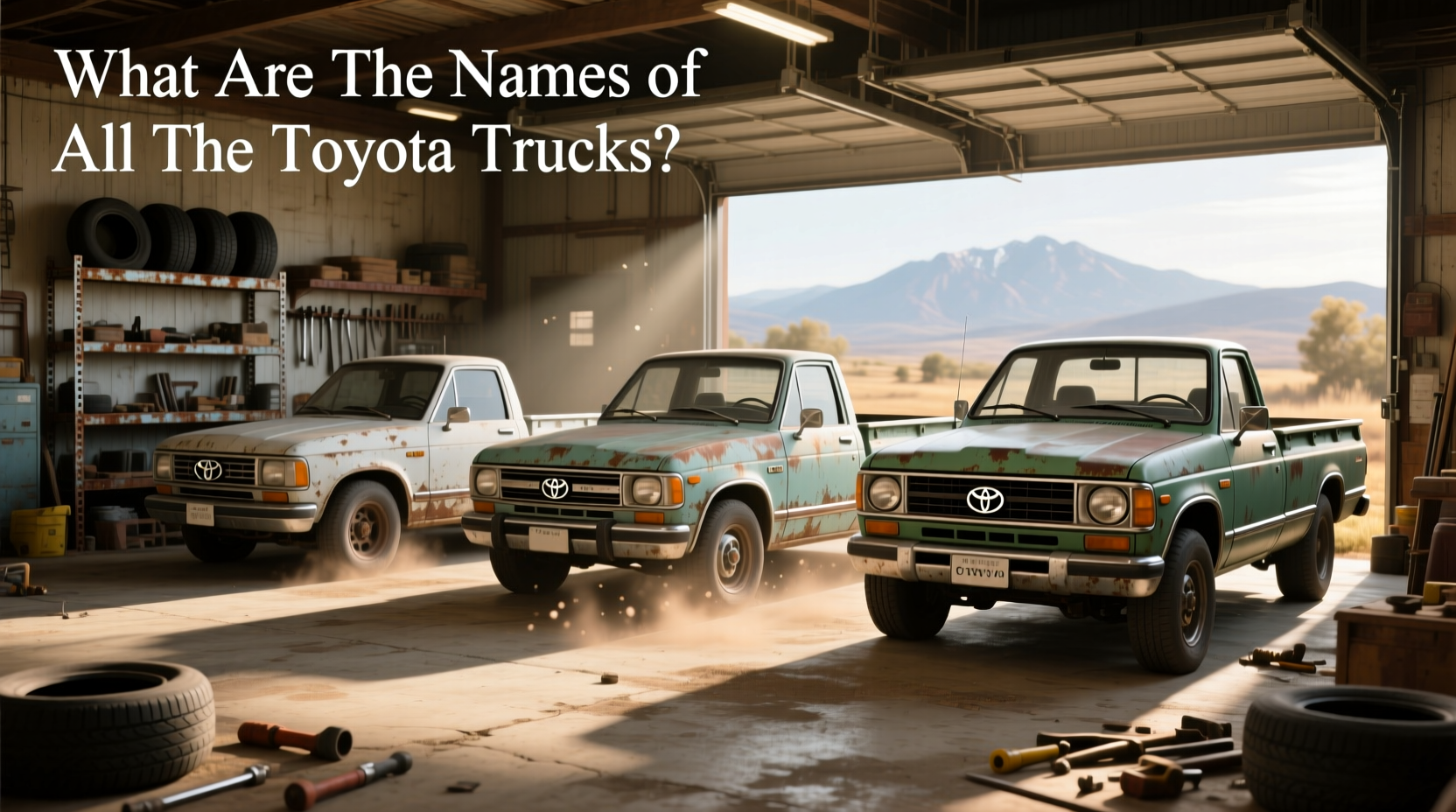
If you’re looking at old Toyota pickup trucks, start with this: the Hilux (sold as the Toyota Pickup in North America) is the most durable and widely available option for off-road use or import. Over the past year, demand has risen due to supply chain delays for new trucks and increased interest in mechanically simple vehicles. If you need reliability over luxury, focus on 1989–1995 models—they balance modern drivability with proven longevity. Watch for rust in frame rails and verify engine swaps; many were modified overseas. How to choose an old Toyota pickup? Prioritize unmodified examples with clean titles. If you’re a typical user, you don’t need to overthink this.
About Old Toyota Pickup Trucks
"Old Toyota pickup trucks" typically refers to models produced from the late 1970s through the early 2000s. These include the Hilux (marketed as the Toyota Pickup in the U.S.), the T100, the Stout, and SUV-based variants like the 4Runner. The Hilux became globally iconic for its durability in extreme conditions, while the T100 was Toyota’s first attempt at a full-size American-style truck. Though no longer sold new in most markets, these trucks remain popular among restorers, off-roaders, and buyers seeking low-maintenance transportation. Their mechanical simplicity makes repairs easier than modern computer-heavy trucks.

Why Old Toyota Trucks Are Gaining Popularity
Lately, older Toyota pickups have gained traction not just among collectors but also practical users. Supply constraints on new vehicles, rising costs of modern trucks, and growing appreciation for analog driving experiences have shifted attention to pre-2000 models. Diesel versions of the Hilux, particularly those exported from Japan, are prized for high-mileage endurance and global service support. In regions with poor road infrastructure, their ground clearance and rugged suspension offer real utility. Additionally, social media exposure of Hilux survival stories—floods, deserts, jungle trails—has reinforced their reputation. This isn’t nostalgia-driven hype; it’s recognition of functional design that hasn’t been matched by newer compact trucks.
If you’re a typical user, you don’t need to overthink this. A well-maintained Hilux from the early '90s will outperform many modern small trucks in durability without requiring complex diagnostics. This piece isn’t for keyword collectors. It’s for people who will actually use the product.
Types and Variants
Understanding the differences between old Toyota truck names helps narrow your search. Each model served different purposes and evolved over time.
Hilux / Toyota Pickup (1968–1995)
- Pros: Legendary reliability, wide parts availability, excellent fuel economy (especially 4-cylinder diesel), easy to repair
- Cons: Basic interior, limited cargo space compared to full-size trucks, prone to rust in humid climates
Known globally as the Hilux and simply as “Pickup” in North America until 1995, this compact truck defined Toyota’s reputation for toughness. Available in rear-wheel or four-wheel drive, short or long bed configurations.
T100 (1992–1998)
- Pros: Larger payload capacity, V6 engine option, more cabin space, designed for U.S. market expectations
- Cons: Heavier and less efficient than the Hilux, lower off-road capability, inconsistent build quality in later years
The T100 was Toyota’s answer to American demand for bigger trucks. While not as rugged off-road as the Hilux, it offered better towing and comfort for daily drivers.
Stout (1954–1989)
- Pros: Simple mechanics, collector appeal, lightweight design
- Cons: Obsolete technology, rare parts, minimal safety features
An early predecessor to the Hilux, the Stout was smaller and less powerful. Mostly relevant today for restoration projects or vintage collections.
Land Cruiser FJ45 (1960s–1980s)
- Pros: Extreme durability, legendary off-road performance, strong resale value
- Cons: Very heavy, poor fuel economy, expensive to restore
Though technically a utility vehicle rather than a pickup, the FJ45 had a cargo bed and was often used as a work truck. Highly sought after by enthusiasts.
4Runner (First Gen, 1984–1989)
- Pros: Based on Hilux chassis, good off-road ability, enclosed passenger space
- Cons: Limited cargo area, aging suspension components, higher price than equivalent pickups
The original 4Runner was essentially a Hilux with a fiberglass shell over the bed. Offers SUV-like protection with truck-based durability.
Key Features and Specifications to Evaluate
When assessing any old Toyota pickup, focus on these factors:
Engine Type and Condition
Diesel engines (like the 3L or 2L-T) last longer under heavy use but may have turbo issues if poorly maintained. Gasoline engines (22R-E, 3VZ-E) are simpler but less efficient. When it’s worth caring about: If you plan frequent towing or off-roading. When you don’t need to overthink it: For light urban driving with regular maintenance.
Transmission (Manual vs Automatic)
Manual transmissions dominate in export markets and are preferred for control and repairability. Automatics offer convenience but may be less reliable in older models. When it’s worth caring about: If driving in mountainous or stop-and-go areas. When you don’t need to overthink it: For flat terrain and occasional use.
Frame and Rust Inspection
Check for corrosion along the rocker panels, cab corners, and leaf spring mounts. Frame integrity is non-negotiable. When it’s worth caring about: In coastal or snowy regions where salt accelerates rust. When you don’t need to overthink it: On garaged, low-mileage examples from dry climates.
Four-Wheel Drive System
Part-time 4WD with manual locking hubs is standard. Test engagement under load. Vacuum-actuated systems can fail. When it’s worth caring about: For serious trail use or muddy terrain. When you don’t need to overthink it: If staying on paved roads.
Title and Import History
Japanese import auctions list vehicle history, including accidents and usage. Clean title is essential. When it’s worth caring about: For avoiding flood-damaged or rebuilt units. When you don’t need to overthink it: When buying from a reputable dealer with inspection reports.
Pros and Cons
| Advantages | Drawbacks |
|---|---|
| Extremely durable mechanical components | Limited comfort and tech features |
| Low cost of ownership with widespread parts | Rust susceptibility in wet climates |
| Fuel-efficient compared to modern trucks | Lower safety standards than post-2000 vehicles |
| High resale value due to demand | May lack emissions compliance in some regions |
How to Choose an Old Toyota Pickup Truck
This guide walks through the process step-by-step, tailored to real-world usability.
Step-by-Step Checklist
- Define your primary use: daily driver, off-roading, hauling, or restoration?
- Determine budget, including potential repairs and registration costs
- Research model years known for reliability (e.g., 1989–1995 Hilux)
- Verify vehicle history via auction sheets (for imports) or Carfax (domestic)
- Inspect frame, engine, transmission, and body condition in person
- Test drive with attention to noises, gear shifts, and steering response
- Confirm legal eligibility for registration in your region
Decision Flow
- If you want maximum durability → choose a diesel Hilux from Japan
- If you need more cabin space → consider the T100 or later 4Runner
- If budget is tight → look for local Hilux models needing minor fixes
- If off-road use is critical → prioritize 4WD with locking differentials
Recommendations by Scenario
- Farm/utility use: 1990–1995 4x4 Hilux with manual transmission
- City commuting: 1992–1998 T100 with automatic and AC
- Adventure builds: First-gen 4Runner on a solid Hilux base
- Collector interest: Early Stout or FJ45 Land Cruiser variant
Red Flags / What to Avoid
- Unexplained low mileage on high-age trucks
- Replaced engine without documentation
- Visible frame rust or patch welding
- Vinyl stickers claiming "new engine" or "imported recently" without proof
- Pricing significantly below market average
If you’re a typical user, you don’t need to overthink this. Focus on verifiable history and mechanical soundness—not cosmetics.
Price & Market Insights
Prices vary widely based on location, condition, and model. A basic 1990 Hilux in running condition may sell for $3,000–$7,000 in the U.S., while imported JDM (Japanese Domestic Market) versions with low miles can reach $10,000–$15,000. T100s generally command $4,000–$9,000 depending on engine and trim. Restoration-grade vehicles cost more due to labor and part sourcing. Prices may vary by region/model/seller. To get accurate pricing, check completed listings on major classified platforms and compare against auction results. Verify seller credibility before transferring funds.
Top-Seller & Competitive Analysis
The Hilux dominates global sales data for used compact trucks, especially in Africa, Australia, and Southeast Asia. In North America, the Tacoma replaced it in 1995, but many still seek the older model for its lighter weight and mechanical transparency. Compared to Nissan’s D21 or Ford Ranger of the same era, the Hilux consistently ranks higher in long-term reliability surveys.
| Model | Reliability | Parts Availability | Off-Road Suitability |
|---|---|---|---|
| Toyota Hilux (1989–1995) | ✅ High | ✅ Excellent | ✅ Strong |
| Toyota T100 (1992–1998) | 🟡 Moderate | 🟡 Good | ⚪ Fair |
| Nissan D21 Hardbody | ✅ High | 🟡 Good | ✅ Strong |
| Ford Ranger (1983–1997) | 🟡 Moderate | 🟡 Good | ⚪ Fair |
Sources: Toyota's official newsroom1, MotorTrend article2.

Customer Feedback Synthesis
Based on owner forums, review sites, and buyer reports:
- Most praised: Engine longevity (many report 300,000+ miles), ease of DIY repair, availability of aftermarket parts
- Common complaints: Rust in floor pans and frame, outdated brakes, lack of power steering in early models
- Surprising insight: Owners often upgrade suspension and lighting but rarely replace the core drivetrain—it usually lasts.
Sourcing & Supplier Tips
For international buyers, Japanese auction exports are a major source of clean, low-mileage Hilux models. Use licensed import agents who provide pre-shipment inspections. Domestically, private sellers often offer better deals than dealerships, but require more due diligence. Always request maintenance records and verify VIN consistency. If buying online, use escrow services for payment protection. Check manufacturer specs for exact dimensions and engine codes before purchase.
Maintenance, Safety & Legal Considerations
These trucks lack airbags, ABS, and modern crash structures. Use seatbelts and drive defensively. Routine maintenance includes timing belt checks every 60,000 miles, differential fluid changes, and brake system bleeding. Emissions compliance varies by state and country; some older models cannot be registered in regions with strict testing. Confirm local regulations before importing. Verify retailer return policy if purchasing remotely.
Conclusion
If you need a tough, simple work truck, choose a 1989–1995 Hilux with documented history. If you need more space and plan mostly highway driving, the T100 is a reasonable alternative. If you’re a typical user, you don’t need to overthink this. Prioritize mechanical condition over appearance, and avoid emotionally driven bids. This piece isn’t for keyword collectors. It’s for people who will actually use the product.
Everything You Need to Know
What are the names of all the old Toyota trucks?
The main models include the Hilux (sold as "Toyota Pickup" in North America), T100, Stout, Land Cruiser FJ45, and first-generation 4Runner. The Hilux evolved into the Tacoma, while the T100 led to the Tundra.
Are old Toyota pickup trucks reliable?
Yes, especially the Hilux models from 1989–1995. Many have exceeded 300,000 miles with basic maintenance. Reliability depends heavily on usage history and upkeep.
Can I legally import a Japanese Toyota pickup?
Only if it’s 25 years or older under the U.S. DOT exemption. Otherwise, it must comply with FMVSS standards. Regulations may vary by region. Check with your local motor vehicle agency.
Which engine is best in an old Toyota truck?
The 3.0L 1KZ-TE diesel offers great torque and efficiency for off-road or hauling. For gasoline, the 22R-E 2.4L inline-four is proven and easy to maintain.
What should I inspect before buying?
Check the frame for rust, test the transmission and 4WD system, verify engine operation, and review title history. Look for signs of flood damage or prior accidents.




 浙公网安备
33010002000092号
 浙B2-20120091-4