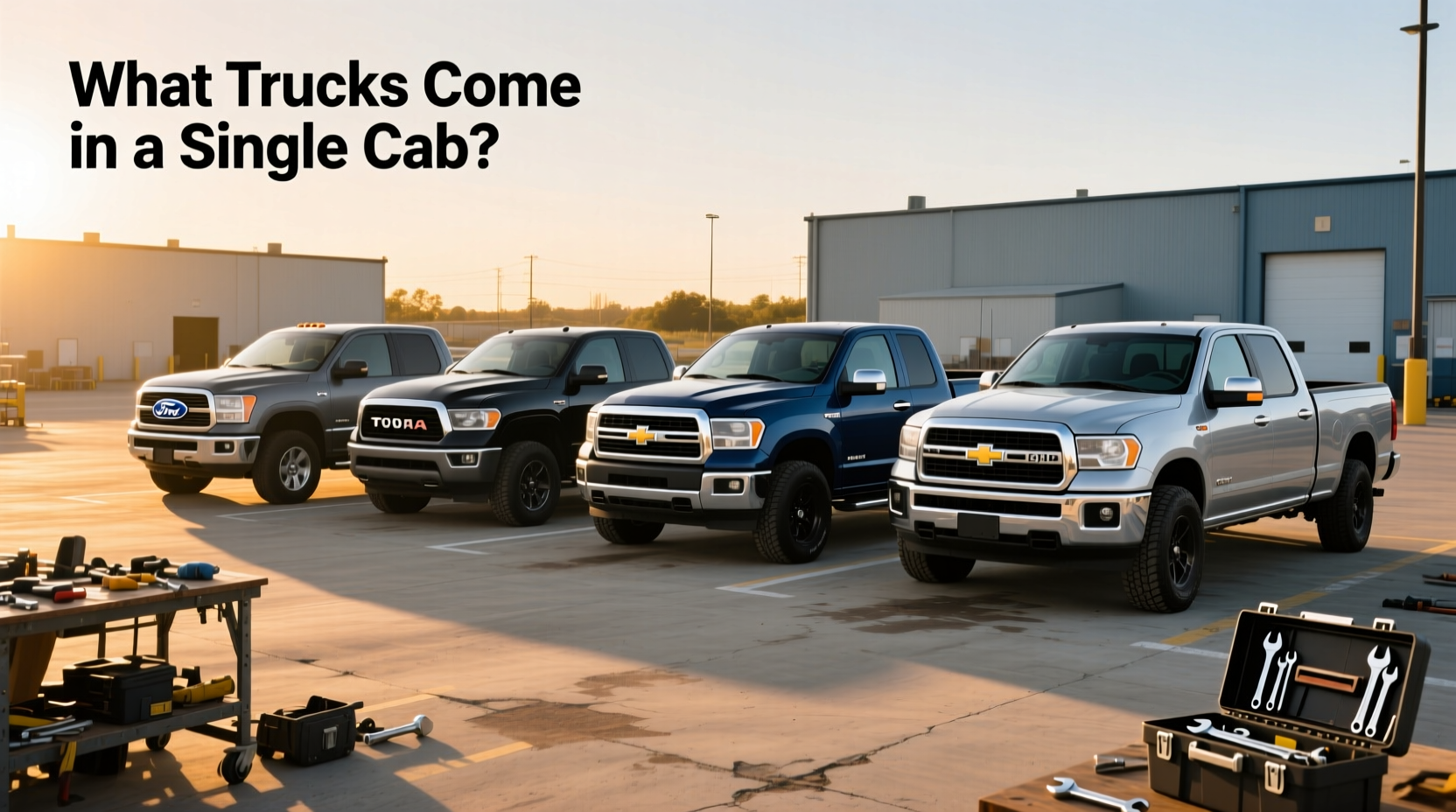
If you’re a typical user, you don’t need to overthink this. For work-first drivers who prioritize cargo space, durability, and upfront cost over passenger comfort, a single cab (also known as regular or standard cab) pickup remains the most straightforward choice. Recently, demand has quietly shifted back toward these stripped-down models—not because they’ve changed, but because how people use trucks has. Over the past year, more small business owners and tradespeople have opted for base-model configurations to cut costs without sacrificing payload or bed utility.
What to look for in a single cab truck? Focus on three things: bed length (typically 8 feet), drivetrain reliability, and resale value in the used market. Avoid models with limited availability—like Ram 1500 or Toyota Tundra, which no longer offer single cabs—and stick with manufacturers still committed to them: Ford, Chevrolet, and GMC. If you're hauling equipment daily and rarely carry passengers, skip crew and extended cabs entirely. This piece isn’t for keyword collectors. It’s for people who will actually use the product.
About Single Cab Trucks
A single cab truck features two full-size doors, one row of seating, and no rear-hinged access doors or jump seats. Also called a regular or standard cab, it's the original pickup configuration—simple, functional, and built around utility rather than comfort. Most models seat two to three adults on a bench front seat (often split 40/20/40), with minimal interior storage and basic infotainment options.
These trucks are designed primarily for commercial use or solo operators who need maximum bed length without paying for unused cabin space. Unlike crew cabs that emphasize ride quality and family usability, single cabs make no pretense about luxury. They exist to move gear, not people.
Why Single Cab Trucks Are Gaining Popularity
Lately, economic pressures and supply chain adjustments have made fleet managers and independent contractors reevaluate their vehicle choices. The rise isn’t dramatic, but it’s measurable in dealer inventory turnover and commercial leasing patterns. Companies aren't upgrading to larger cabs—they're downsizing from crew to regular cabs to reduce initial outlay and insurance premiums.
The change signal? Simplicity is becoming a selling point again. With rising interest rates and tighter margins, businesses can’t justify spending thousands extra on features they won’t use. A single cab F-150 or Silverado 1500 may lack rear legroom, but it delivers the same engine, frame, and towing capacity as its pricier siblings—at a lower price point.
If you’re a typical user, you don’t need to overthink this. Need long-bed capability and low operating cost? The regular cab answers both needs directly.
Types and Variants
While all single cab trucks share core traits, there are meaningful differences based on manufacturer, trim level, and intended use case.
Ford F-Series Standard Cab
Ford refers to its entry-level model as the “Standard Cab,” available on F-150 and F-250 Super Duty lines. These come exclusively with an 8-foot bed and rear-wheel drive unless upgraded.
- ✅ Pros: Strong V6 and V8 engine options; proven durability; wide service network
- ❌ Cons: Limited tech features in base trims; fewer color choices
Chevrolet Silverado Regular Cab
Chevy offers the Silverado 1500 and 2500HD in regular cab form, usually paired with an 8-foot box. Known for smooth ride quality even when empty.
- ✅ Pros: Spacious front seat; intuitive controls; available diesel option on HD models
- ❌ Cons: Lower fuel economy on gas V8s; some trims discontinued recently
GMC Sierra Regular Cab
Functionally identical to the Silverado under the skin, but typically priced higher due to brand positioning. Still offered in 1500 and HD variants.
- ✅ Pros: Premium materials in higher trims; strong resale among vocational users
- ❌ Cons: Higher MSRP than equivalent Silverado; limited availability in certain regions
If you’re a typical user, you don’t need to overthink this. Between these three, mechanical differences are negligible. Choose based on local dealer support and warranty terms, not badges.
Key Features and Specifications to Evaluate
When comparing single cab trucks, focus only on what impacts daily operation. Ignore flashy add-ons unless they serve your workflow.
Bed Length and Configuration
Most single cabs come with an 8-foot bed—a key advantage over crew cabs, which often cap at 6.5 feet. An 8-foot bed fits standard 4x8 sheets without overhang, crucial for contractors.
When it’s worth caring about: Hauling lumber, drywall, ladders, or large tools.
When you don’t need to overthink it: If you mostly tow trailers or haul loose debris in bins.
Engine and Drivetrain
All major brands offer at least one efficient V6 and a powerful V8. Diesel engines are rare in light-duty single cabs but available on heavy-duty versions (F-250, Silverado 2500).
When it’s worth caring about: Frequent towing over 8,000 lbs or off-road worksite access.
When you don’t need to overthink it: Daily driving under 50 miles with occasional weekend loads.
Interior Materials and Durability
Base trims use vinyl upholstery and hard plastics. Cloth seats are optional. Prioritize ease of cleaning over aesthetics.
When it’s worth caring about: Working in muddy/dirty conditions where spills and grime are inevitable.
When you don’t need to overthink it: If you park indoors and maintain a clean workspace.
Pros and Cons
- Lowest purchase price among cab types
- Longest available bed length (usually 8 ft)
- Simpler maintenance and fewer electronics to fail
- Better fuel efficiency than crew cabs (lighter weight)
- Ideal for mounting toolboxes, ladder racks, or flatbeds
- No rear passenger access or seating flexibility
- Limited storage behind seats
- Fewer advanced safety features in base models
- Harder to resell privately (smaller buyer pool)
- Discontinued by several major brands (Ram, Toyota, Nissan)
How to Choose a Single Cab Truck
Selecting the right model comes down to matching your real-world usage to available specs. Follow this checklist to avoid costly mismatches.
Step-by-Step Checklist
- Determine primary use: work, personal, or mixed?
- Confirm required bed length (6.5 ft vs 8 ft)
- Decide whether 4x4 is necessary
- Review payload and towing requirements
- Check local availability of preferred brand
- Evaluate financing options and total cost of ownership
Decision Flow
- Do you regularly carry passengers? → Consider extended cab instead.
- Need maximum bed space? → Stick with single cab + 8-ft box.
- Operating in snowy/muddy terrain? → Upgrade to 4x4, even if RWD suffices otherwise.
- Buying for resale later? → Opt for Ford or Chevrolet over niche configurations.
Recommendations by Scenario
- Landscaper or roofer: Ford F-150 Standard Cab with 8-ft box and 4x4
- Electrician or plumber: Chevrolet Silverado 1500 Regular Cab with lockable storage
- Fleet manager: GMC Sierra 2500HD Regular Cab for durability across multiple users
- Weekend hobbyist: Reconsider—single cab may be overkill; explore compact pickups
Red Flags / What to Avoid
- Buying a used single cab from a private seller with aftermarket modifications—verify legality and structural integrity
- Assuming all "regular cab" labels mean the same thing—some older models had shorter beds
- Skipping a test drive just because it's a work truck—ride harshness matters after eight hours
- Overlooking rust protection in cold-weather states—check undercarriage coating
- Selecting a model no longer in production—parts and software updates may become scarce
If you’re a typical user, you don’t need to overthink this. Your job doesn’t require leather seats or lane assist—it requires reliability and space. Build your decision around those.
Price & Market Insights
New single cab trucks start around $35,000 for base Ford F-150 and Chevrolet Silverado 1500 models, though prices may vary by region/model/seller. Heavy-duty versions (F-250, Silverado 2500HD) range from $42,000–$55,000 depending on drivetrain and engine.
Premium badging (e.g., GMC Sierra) adds $2,000–$4,000 over mechanically identical counterparts. Used models from 2020–2023 appear frequently in trade-in cycles, offering better value for budget-conscious buyers.
Note: Dealer markups and regional incentives can significantly affect final cost. Always check manufacturer specs and verify current rebate programs before committing.
Top-Seller & Competitive Analysis
The competitive landscape for single cab trucks is narrow but stable. Three domestic manufacturers dominate, while others have exited the segment entirely.
| Model | Starting MSRP | Max Bed | Availability | Notable Feature |
|---|---|---|---|---|
| Ford F-150 Standard Cab | $35,195 | 8 ft | National | Widest trim selection |
| Chevrolet Silverado 1500 Regular Cab | $35,695 | 8 ft | Regional | Smooth ride tuning |
| GMC Sierra 1500 Regular Cab | $37,895 | 8 ft | Limited | Premium interior options |
| Ford F-250 Standard Cab | $42,495 | 8 ft | National | Available diesel engine |
| Chevrolet Silverado 2500HD Regular Cab | $43,195 | 8 ft | National | Strong towing (up to 18k lbs) |
Source: Manufacturer websites and dealership inventories as of early 2025 12.
Ram, Toyota, and Nissan no longer offer single cab configurations in their half-ton lines, reducing competition but also limiting consumer choice. This consolidation means Ford and GM now control nearly 100% of new single cab sales.
Customer Feedback Synthesis
Based on aggregated owner reviews and dealer surveys, here are the most common sentiments:
- High praise: "Perfect for my roofing crew—fits ladders and shingles easily."
- Common complaint: "Can’t fit my kids in the back—even with a bench, it’s tight."
- Unexpected benefit: "Gets better mileage than my old SUV despite being larger."
- Recurring issue: "Base stereo lacks Bluetooth; had to install an aftermarket unit."
- Maintenance note: "Simple design means fewer electronic gremlins during winter.”
The clearest pattern? Satisfaction correlates strongly with accurate expectations. Buyers who treat these trucks as tools report high retention. Those expecting car-like comfort express disappointment.
Sourcing & Supplier Tips
Single cab trucks are less commonly stocked than crew cabs, so sourcing requires planning.
- Contact dealers directly and request inventory reports—don’t rely solely on online listings
- Consider fleet-order channels if buying multiple units
- Ask about unregistered demo models that haven’t been converted to crew cabs
- Verify return policy and customization lead times before deposit
- Check whether paint colors or wheel options are exclusive to higher trims
If you’re a typical user, you don’t need to overthink this. Order what works, not what looks good in photos.
Maintenance, Safety & Legal Considerations
These trucks follow standard automotive maintenance schedules, though duty cycle affects intervals. Commercial use may require more frequent oil changes and brake inspections.
Safety-wise, base trims often lack modern driver aids like blind-spot monitoring or automatic emergency braking. If these matter to you, confirm availability before purchase—or plan for aftermarket solutions.
Legally, ensure any modifications (e.g., flatbeds, crane mounts) comply with local regulations. While federal standards govern emissions and lighting, load security and vehicle classification vary by state. Always check local DMV guidelines before outfitting.
Conclusion
If you need maximum bed space, low acquisition cost, and proven reliability for daily work tasks, choose a single cab truck from Ford, Chevrolet, or GMC. If you regularly transport coworkers, value tech features, or want higher resale appeal, consider other configurations. This guide isn’t about trends—it’s about matching machinery to mission.
Everything You Need to Know
What trucks come in a single cab?
+Ford F-150 and F-250, Chevrolet Silverado 1500 and 2500HD, and GMC Sierra 1500 and Sierra HD are currently available in single (regular) cab configurations. Ram, Toyota, and Nissan have discontinued single cab options for their light-duty pickups.
Is a regular cab the same as a single cab?
+Yes, regular cab and single cab refer to the same configuration: two doors, one row of seats, and no rear-hinged access. Ford uses "Standard Cab" instead of "Single Cab," but the design is functionally identical.
Are single cab trucks cheaper than crew cabs?
+Yes, single cab trucks are generally the least expensive configuration due to reduced materials, simpler assembly, and lower feature content. The price difference can range from $4,000–$10,000 depending on brand and trim.
Can you carry passengers in a single cab truck?
+Most single cab trucks seat two to three people on a front bench seat. There is no rear seat access, so carrying additional passengers requires another vehicle. If you routinely transport workers, an extended cab may be more practical.
Why did some brands stop offering single cab trucks?
+Consumer demand shifted toward larger cabs with greater comfort and versatility. As lifestyle use grew, automakers phased out single cabs to focus on higher-margin crew and extended cab models. However, commercial demand keeps them alive in Ford and GM lineups.




 浙公网安备
33010002000092号
 浙B2-20120091-4