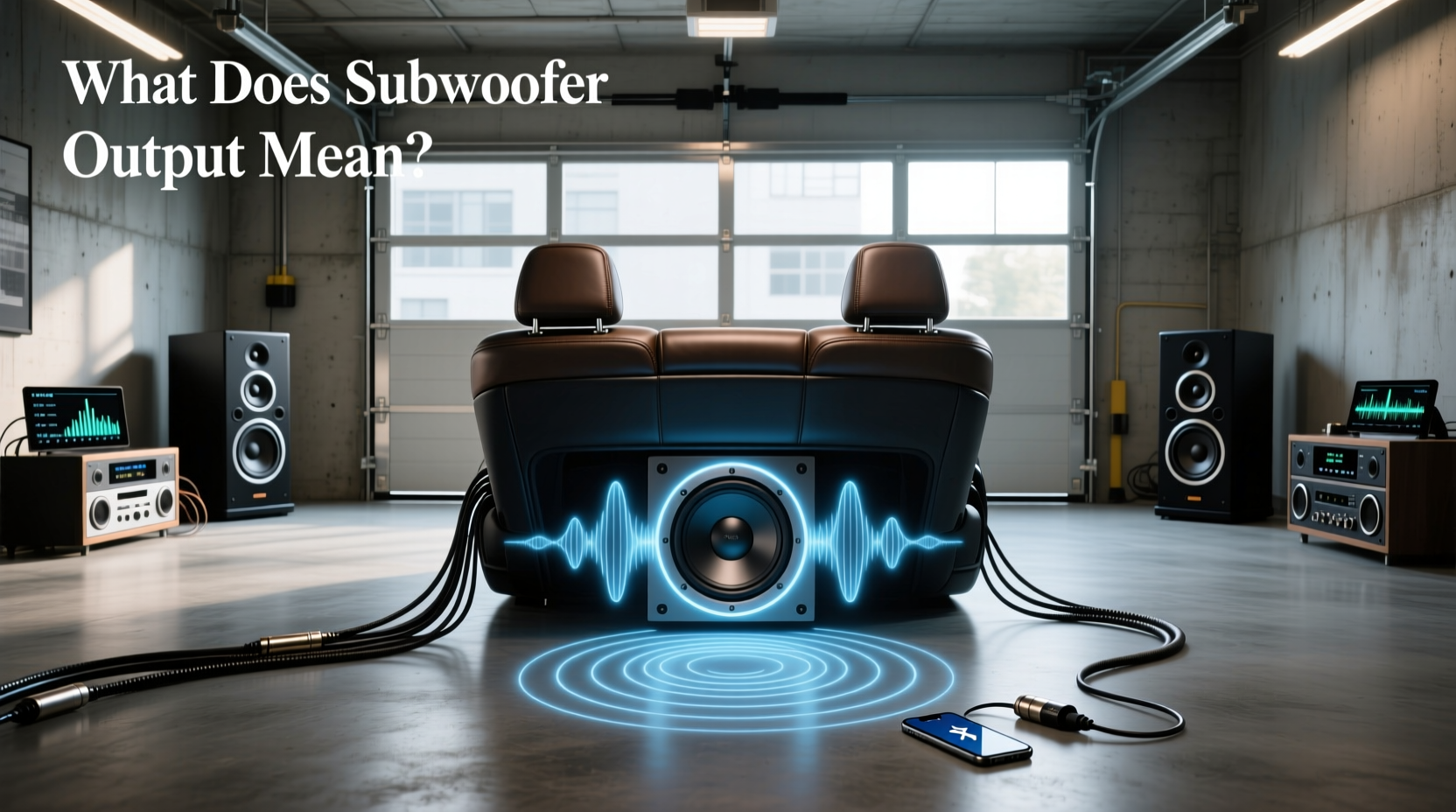
If you’re a typical user, you don’t need to overthink this. A subwoofer output on a car stereo sends a low-frequency signal to a powered subwoofer via an RCA connection, improving bass response and freeing main speakers from handling deep lows. If you want richer, more balanced sound in your vehicle—especially if you listen to music with heavy basslines or enjoy movies on the go—this feature matters. How to choose a head unit with proper subwoofer output? Focus on line-level RCA outputs (not speaker-level), built-in crossover controls, and compatibility with your amplifier or powered sub. Avoid units that only offer fixed bass boosts without adjustable frequency filtering—it limits tuning precision.
Lately, factory-installed infotainment systems have begun including dedicated subwoofer pre-outs even in mid-tier vehicles, reflecting increased consumer demand for better in-cabin audio experiences. This shift makes understanding what a subwoofer output actually does more relevant than ever—not just for enthusiasts, but for everyday drivers upgrading their sound.
About Subwoofer Output
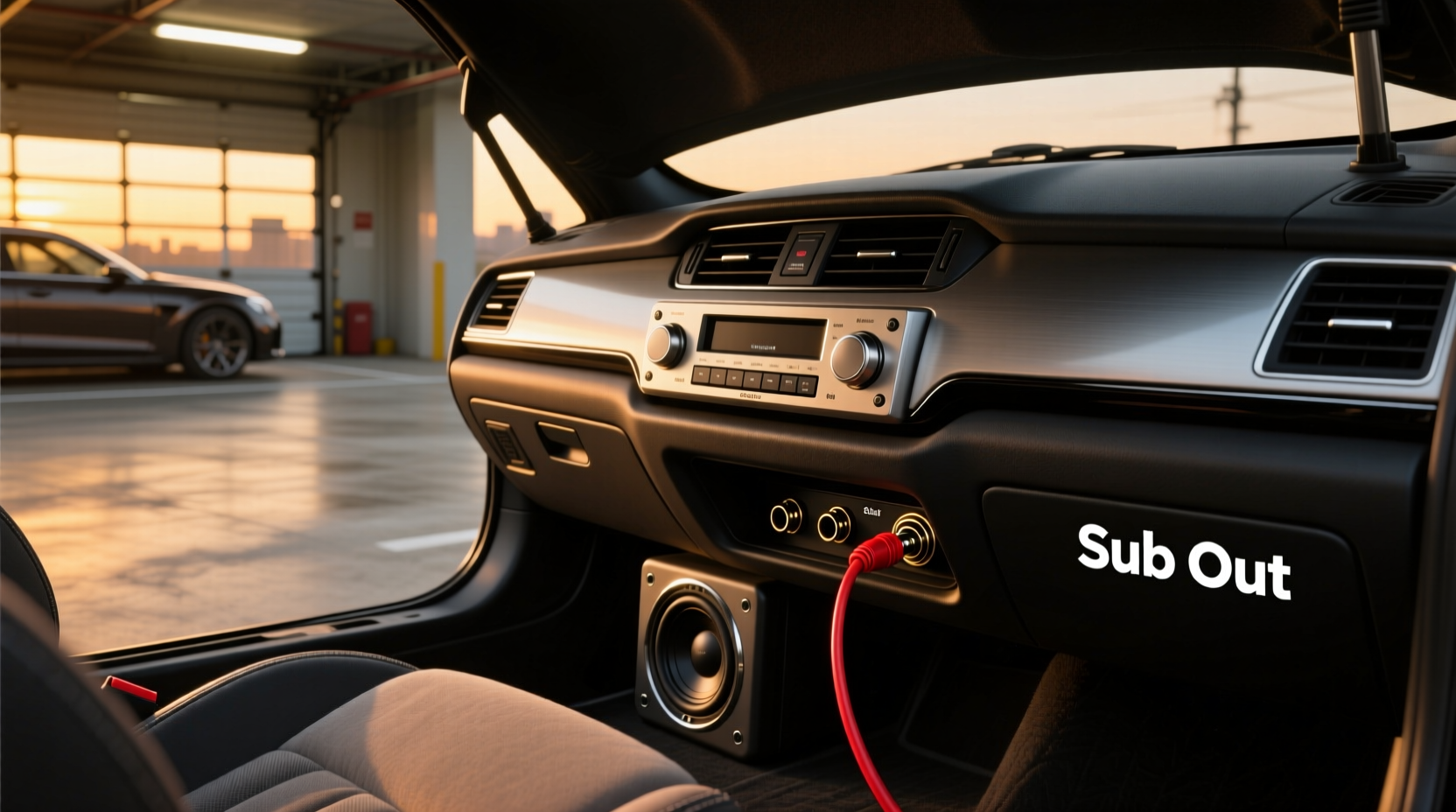
A subwoofer output is a specialized audio port—usually an RCA jack—on a car stereo (head unit) that transmits only low-frequency signals (typically below 120 Hz). Unlike regular speaker outputs, which send full-range audio, the subwoofer output routes only the bass portion of the track, based on internal crossover settings. That signal goes to an external amplifier or directly to a powered subwoofer, allowing deeper, cleaner, and more dynamic low-end performance.
This setup reduces strain on door speakers, which aren’t efficient at reproducing deep bass. Instead of trying to push air for kick drums or synth drops, they focus on mids and highs—resulting in clearer vocals and instrument separation. The subwoofer handles what it’s built for: powerful, felt-low frequencies.
It's important not to confuse subwoofer output with speaker-level outputs. Some older or basic head units lack true RCA-based sub pre-outs and instead require a high-to-low level converter if connecting to an amplifier. True subwoofer outputs are line-level, meaning they carry a small voltage signal (0.5V–4V) ideal for amplifiers’ input stages.

Why Subwoofer Output Is Gaining Popularity
Over the past year, more drivers have sought improved in-car entertainment beyond basic Bluetooth streaming. With podcasts, audiobooks, and high-resolution music apps becoming standard, audio clarity and immersion are now key purchase factors—even in non-luxury models.
The rise of compact powered subwoofers (like enclosed bass boxes under seats) has made integration easier. These units often include built-in amps and accept line-level inputs directly from the head unit’s sub output. No complex wiring needed. As a result, consumers expect modern stereos to support seamless expansion.
Additionally, digital signal processing (DSP) features in newer receivers allow users to fine-tune crossover points, phase, and sub level—all through intuitive menus. This accessibility removes previous technical barriers, making sub integration less intimidating for average users.
If you’re a typical user, you don’t need to overthink this. You don’t need a lab-grade measurement mic to benefit from a subwoofer output. What matters is having the right type of output and knowing how to use it.
Types and Variants
Not all subwoofer outputs work the same way. Here are the main types found across car stereos today:
✅ Single Mono Sub Output
Description: One RCA jack that carries a summed mono signal (left + right channels mixed).
- Best for: Most single-sub installations
- Pros: Simple wiring, avoids phase issues, widely supported
- Cons: Cannot independently control dual subs without Y-splitter or processor
⚡ Dual Sub Outputs (Left + Right)
Description: Two separate RCAs carrying channel-specific low-frequency signals.
- Best for: Advanced setups with dual subs or DSP tuning
- Pros: Preserves stereo imaging in bass layer (rarely audible), useful for bi-amping or advanced crossovers
- Cons: Overkill for most cars; requires additional gear to utilize fully
🎛️ Variable vs Fixed Level
Description: Variable outputs let you adjust sub volume from the head unit; fixed ones run at full output.
- Best for: Variable = any serious upgrade; Fixed = budget systems with external control
- Pros (Variable): Direct gain matching, smoother integration
- Cons (Fixed): Forces reliance on amp dials, harder to balance
🌀 Built-in Crossover Control
Description: Allows setting the cutoff frequency (e.g., 80Hz) so only those tones go to the sub.
- Best for: All upgraded systems
- Pros: Prevents overlap between sub and main speakers, reduces muddiness
- Cons: Absent in entry-level units; may lack slope adjustment
If you’re a typical user, you don’t need to overthink this. A single variable-level sub output with adjustable crossover covers 95% of real-world needs.
Key Features and Specifications to Evaluate
When comparing head units or planning an upgrade, here’s what actually impacts performance—and when you can safely ignore it.
Output Type: Line-Level vs Speaker-Level
When it’s worth caring about: If you're adding an external amplifier or powered sub. Line-level (RCA) outputs are essential for clean signal transfer.
When you don’t need to overthink it: If your receiver already includes a powered sub output terminal or uses proprietary connectors with compatible OEM modules.
Crossover Adjustability (Frequency & Slope)
When it’s worth caring about: When integrating with existing speakers. Setting the correct crossover point ensures smooth blending between sub and mains.
When you don’t need to overthink it: If using a standalone DSP or amplifier with superior filtering—the head unit’s crossover becomes redundant.
Signal-to-Noise Ratio (SNR)
When it’s worth caring about: In quiet vehicles or high-gain systems where hiss might be noticeable.
When you don’t need to overthink it: In most cars with ambient road noise; engine and tire sounds mask minor background noise.
Phase Control
When it’s worth caring about: If the sub is placed far from main speakers (e.g., rear cargo area), phase misalignment can cancel bass.
When you don’t need to overthink it: For center-mounted enclosures or test-and-adjust workflows using music with consistent kick drums.
Pros and Cons
Advantages
- Clearer overall sound by offloading bass from component speakers
- Better dynamic range and lower distortion at high volumes
- More immersive listening experience for music and media
- Supports future upgrades without replacing the entire system
- Reduces wear on factory speakers by eliminating bass stress
Drawbacks
- Requires additional components (amp or powered sub) to function
- Adds complexity to installation (wiring, power, grounding)
- May void warranty if installed improperly in some OEM systems
- Can introduce noise (hum/buzz) if ground loops exist
- Not all aftermarket units support delay or advanced DSP features
This piece isn’t for keyword collectors. It’s for people who will actually use the product.
How to Choose the Right System (Buying Guide)
Follow this step-by-step checklist to make a confident decision—whether you're replacing your factory radio or building a premium audio suite.
Decision Flow
- You want better bass → Add powered sub → Need line-level sub output → Choose head unit with RCA pre-out
- No space for big enclosure → Use compact powered sub → Still need pre-out → Same requirement applies
- Keeping factory stereo → Use high-to-low converter → Possible, but adds cost and potential noise
Recommendations by Scenario
- Basic Upgrade: Pioneer DMH-W2770NEX – reliable single sub output, adjustable crossover, solid build
- Budget-Conscious: Kenwood KMM-BT305 – includes sub pre-out despite lower price point
- High-End Integration: Alpine iLX-F509 – supports dual sub outs, advanced DSP, customizable EQ
- Units advertising 'bass boost' instead of true subwoofer output—this only increases overall low-end, not a dedicated signal
- No crossover control—means poor integration with door speakers
- Speaker-level-only connections for subs—requires extra hardware and risks noise
- Vague specifications like 'enhanced bass mode' without mention of RCA pre-outs
Price & Market Insights
Head units with subwoofer outputs vary widely in price—from $120 for basic double-DIN models to over $700 for high-end receivers with integrated DSP. Prices may vary by region/model/seller, especially when factoring in local taxes or bundled accessories.
The presence of a subwoofer output doesn’t always correlate with higher cost. Many mid-tier units include this feature as standard. However, finer controls (like parametric EQ or time alignment) tend to appear in pricier models.
To get the best value, focus on verified specs rather than marketing terms. Don’t assume touchscreen size or app integration relates to audio output quality.
Top-seller & Competitive Analysis
Below is a comparison of popular head units known for strong subwoofer integration:
| Model | Sub Output Type | Crossover Control | Variable Level? | Approx. Price |
|---|---|---|---|---|
| Pioneer DMH-W2770NEX | Mono RCA | Yes (50–120Hz) | Yes | $280 |
| Kenwood KMM-BT305 | Mono RCA | Yes (fixed 100Hz) | Limited | $150 |
| Alpine iLX-F509 | Dual RCA | Yes (fully adjustable) | Yes | $650 |
| Sony XAV-AX6000 | Mono RCA | Yes (80Hz default) | Yes | $400 |
Data sourced from manufacturer websites and retailer listings as of 2024. May vary by region/model/seller.
Customer Feedback Synthesis
Analyzing recent user discussions 1, common themes emerge:
- High Praise: Users appreciate clear labeling of sub outputs and intuitive menu access for crossover settings. Those upgrading from factory systems report “night-and-day” improvements in clarity and bass depth.
- Frequent Complaints: Some find that preset crossovers are too aggressive (cutting too high), requiring manual adjustment. Others note confusion between “subwoofer output” and “rear speaker output,” leading to incorrect wiring.
- Surprise Insight: Several users initially thought a Y-splitter was required for dual-amplifier setups—but learned a single output works fine with proper distribution.
If you’re a typical user, you don’t need to overthink this. Real-world satisfaction comes from functional design, not spec-sheet bragging rights.
Sourcing & Supplier Tips
When purchasing a head unit or subwoofer system:
- Buy from authorized dealers to ensure firmware updates and warranty coverage
- Check return policy before installation—some shops won’t accept opened electronics
- Verify compatibility with your car’s harness; mismatched connectors add labor costs
- Look for bundle deals that include mounting kits, faceplates, or RCA cables
- Consider refurbished units from reputable brands—they often undergo full testing
Always check manufacturer specs directly instead of relying solely on third-party descriptions, which may oversimplify technical details.
Maintenance, Safety & Legal Considerations
Once installed:
- Inspect RCA and power connections annually for looseness or corrosion
- Ensure amplifiers are mounted securely and ventilated to prevent overheating
- Use inline fuses on power wires close to the battery terminal
- Avoid grounding to painted surfaces—scrape paint for metal-to-metal contact
While no universal law bans subwoofers, some regions regulate sound pressure levels inside vehicles. To stay compliant:
- Keep volume at levels that don’t disturb pedestrians or other drivers
- Confirm local noise ordinances if frequently parked while playing music
- Be aware that excessive bass vibrations may affect loose panels or trim over time
These guidelines help maintain both system longevity and community goodwill.
Conclusion
If you need deeper, cleaner bass and clearer midrange audio in your car, choose a head unit with a dedicated, variable-level subwoofer output and adjustable crossover. For most users, a single mono RCA pre-out is sufficient. Avoid units that rely only on speaker-level signals or vague 'bass boost' features. Integration simplicity, not feature overload, leads to the best daily driving experience.
Everything You Need to Know
What does subwoofer output mean?
A subwoofer output is a dedicated RCA jack on a car stereo that sends only low-frequency audio (bass) to an external amplifier or powered subwoofer. It uses internal filtering (crossover) to remove higher frequencies, ensuring the sub plays only deep tones while main speakers handle mids and highs.
Do I need a Y-cable if my radio has one subwoofer output?
Only if you’re connecting to two amplifiers or devices that don’t support pass-through. A single subwoofer output can drive multiple powered subs via daisy-chaining or a distribution amplifier. Using a Y-cable splits the signal but doesn’t increase power or clarity.
Can I add a subwoofer without a subwoofer output?
Yes, but it requires additional hardware. You can use a high-to-low level converter that taps into speaker wires to create a line-level signal. However, this method may introduce noise or impedance issues. A head unit with native sub pre-out is simpler and more reliable.
Is a dual subwoofer output better than a single?
Not necessarily. Dual outputs are useful for advanced setups with independent sub zones or DSP processing. For most cars, a single mono output provides identical performance when properly configured. Don’t pay extra for dual unless you have a specific technical need.
How do I set the crossover frequency on my subwoofer output?
Access your head unit’s audio settings menu and look for “Crossover,” “LPF” (low-pass filter), or “Sub Out.” Set the frequency between 80–120 Hz depending on your main speakers’ capabilities. Smaller door speakers may require a higher cutoff (100–120 Hz); larger components can go lower (60–80 Hz).




 浙公网安备
33010002000092号
 浙B2-20120091-4