Short introduction
If you’re setting up a home theater or upgrading your audio system, knowing how to choose speaker wire gauge for subwoofer can save time and prevent performance issues. For most users with runs under 15 feet and standard-powered subwoofers, 14 AWG wire is sufficient ✅. If you’re a typical user, you don’t need to overthink this. Over the past year, more people have been adding powered subwoofers to compact setups — where wire length and amplifier output matter less — making basic 14 AWG cables a reliable default. The real mistake isn’t choosing the wrong gauge; it’s overbuying thick, expensive wire for short runs that won’t benefit from it. When it’s worth caring about? Only if you’re running over 50 feet or using high-output commercial amplifiers. Otherwise, stick with 14 AWG for simplicity and cost-efficiency.
About speaker wire gauge for subwoofer
Speaker wire gauge refers to the thickness of the copper conductor inside the cable, measured using the American Wire Gauge (AWG) system. Lower numbers mean thicker wires — so 12 AWG is thicker than 14 AWG. Thicker wires have less electrical resistance, which helps maintain signal strength over long distances. For subwoofers, which often handle low-frequency signals at higher power levels, minimizing resistance ensures cleaner bass response and protects amplifier stability.
Unlike full-range speakers, subwoofers usually connect via shielded RCA cables or use built-in amplifiers with dedicated speaker terminals. In passive subwoofer setups, where an external amplifier powers the unit, proper wire gauge becomes more critical. However, in modern active (powered) subwoofers — the majority today — the internal amp handles signal processing, reducing sensitivity to minor impedance changes from wire resistance.
If you’re a typical user, you don’t need to overthink this. Most home systems operate within safe margins even with modest 14 AWG wire. This piece isn’t for keyword collectors. It’s for people who will actually use the product.
Why speaker wire gauge for subwoofer is gaining popularity
Lately, DIY audio builds and multi-room entertainment systems have surged in interest, especially among cord-cutters and smart home adopters. As streaming platforms deliver higher-resolution audio (like Dolby Atmos), consumers want better sound — starting with deep, distortion-free bass. That renewed focus has brought attention back to foundational components like wiring quality.
Another shift: more people are repurposing older AV receivers or pairing them with new wireless speakers, creating hybrid setups where wired subwoofers remain essential. These transitional installations often expose confusion about compatibility and cabling standards. And while wireless subwoofers exist, they still face latency and compression trade-offs, keeping wired connections dominant for reliability.
The growing availability of affordable test gear — like multimeters and impedance meters — also empowers users to verify their own installations. Combined with online forums and video tutorials, this accessibility lowers the barrier to informed decisions without requiring engineering degrees.
Types and variants
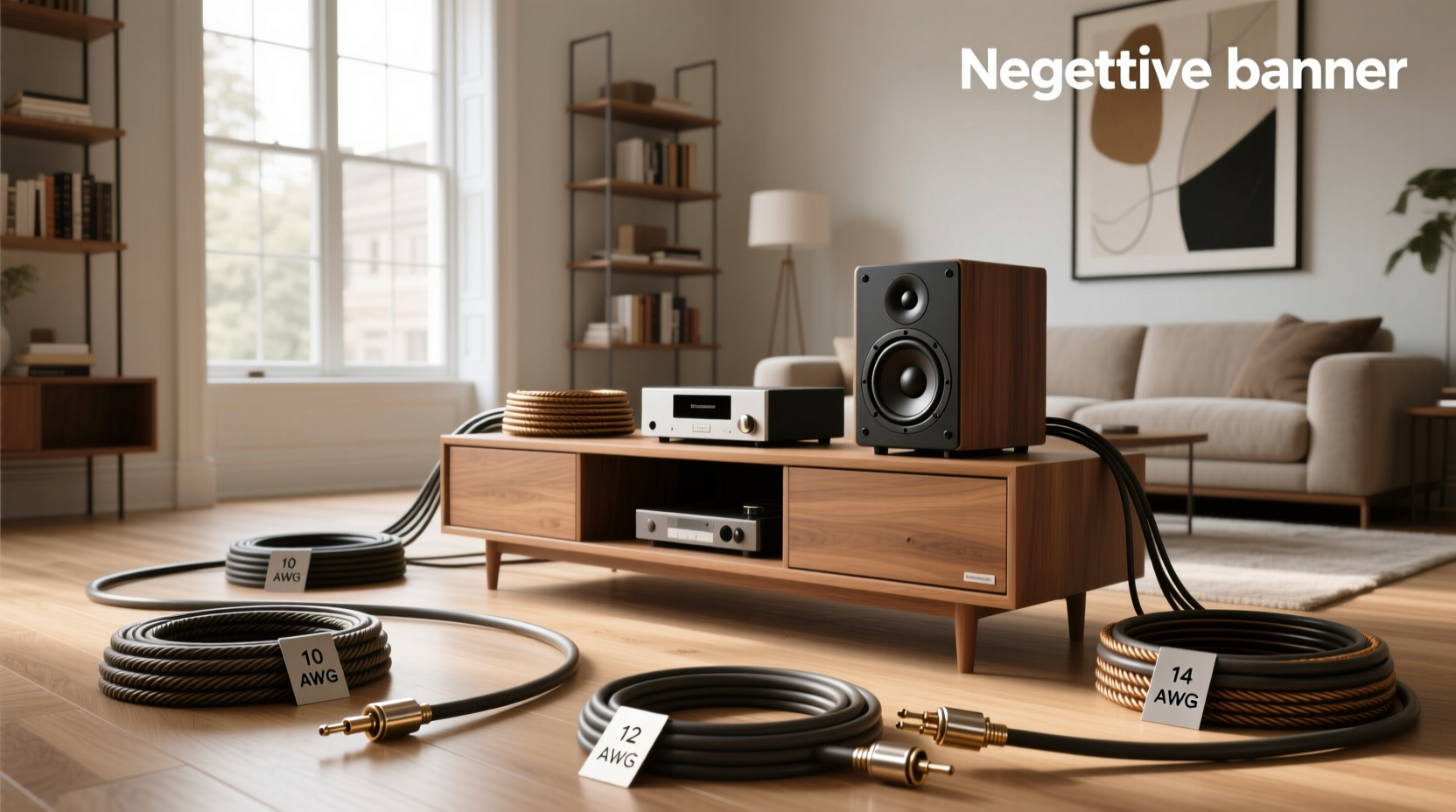
14 AWG Speaker Wire
Ideal for runs under 15 feet and subwoofers rated below 500 watts RMS. Offers balanced cost and performance for typical living room setups.
- ✅Pros: Affordable, easy to route through walls, widely available
- ❗Cons: Not ideal beyond 25 feet or high-power applications
12 AWG Speaker Wire
Better suited for longer runs (25–50 feet) or systems pushing 500–1000 watts. Provides lower resistance and improved current delivery.
- ✅Pros: Handles higher power, future-proof for upgrades
- ❗Cons: Stiffer, harder to conceal, slightly more expensive
10 AWG Speaker Wire
Used in commercial installations or extreme home theaters with very long runs or massive amplifiers. Rarely needed in residential environments.
- ✅Pros: Minimal signal loss over 50+ feet
- ❗Cons: Expensive, bulky, unnecessary for most homes
If you’re a typical user, you don’t need to overthink this. Unless you're installing a basement cinema with 60-foot cable runs, 14 AWG is likely enough. This piece isn’t for keyword collectors. It’s for people who will actually use the product.
Key features and specifications to evaluate
Wire Gauge (AWG)
When it’s worth caring about: when total wire length exceeds 25 feet or amplifier output exceeds 500 watts.
When you don’t need to overthink it: for runs under 15 feet and consumer-grade equipment (≤500W).
Conductor Material
Pure copper is standard. Avoid copper-clad aluminum (CCA), which has higher resistance and degrades faster.
When it’s worth caring about: in humid environments or permanent in-wall installations.
When you don’t need to overthink it: for temporary setups or short-term use with standard connectors.
Insulation & Jacketing
Look for oxygen-free copper (OFC) labeling and PVC or plenum-rated jackets depending on installation location.
When it’s worth caring about: if running through walls, ceilings, or exposed areas requiring fire safety compliance.
When you don’t need to overthink it: for surface-mounted or visible runs in dry spaces.
Shielding
Not required for speaker-level signals, but some cables include shielding to reduce interference in electrically noisy environments.
When it’s worth caring about: near power lines, routers, or industrial equipment.
When you don’t need to overthink it: in typical living rooms or bedrooms.
Pros and cons
| Aspect | Pros | Cons |
|---|---|---|
| Using Correct Gauge | Preserves audio fidelity, prevents amp strain | Requires measurement and planning |
| Upgrading Beyond 14 AWG | Marginal gain in long/high-power runs | Increased cost and stiffness |
| Sticking with 14 AWG | Cheap, flexible, sufficient for most | May limit scalability |
| Poor Quality Cables | Low upfront cost | Risk of oxidation, intermittent connection |
How to choose the right speaker wire gauge for subwoofer
Step-by-step checklist
- Identify whether your subwoofer is active (powered) or passive.
- Measure the distance between amplifier/receiver and subwoofer location.
- Check the amplifier’s RMS wattage output for the sub channel.
- Select wire gauge based on length and power:
- <15 ft, ≤500W → 14 AWG
- 15–25 ft, ≤500W → 12 AWG
- 25–50 ft, >500W → 12 AWG minimum
- >50 ft or professional use → 10 AWG
- Avoid CCA wire unless budget is extremely tight.
- Confirm termination type (banana plugs, spades, bare wire) matches your gear.
Decision flow
Start with: Is the run under 15 feet? Yes → 14 AWG is fine. No → How much power? Under 500W → 12 AWG. Over 500W → 12 AWG minimum. Running over 50 feet? → Consider 10 AWG.
Recommendations by scenario
- Home Theater (Living Room): 14 AWG OFC, 15 ft max → simple, effective
- Basement Media Room: 12 AWG if run exceeds 25 ft or uses >500W amp
- Outdoor Setup: Use weather-resistant jacket + 12 AWG minimum due to environmental stress
- Renting / Temporary Install: 14 AWG with clear insulation for visibility and removal
Red flags / what to avoid
- Ultra-thin 16 AWG or 18 AWG wires — too resistive for subwoofers even at short lengths.
- Vague labeling — avoid cables marked “high purity” without AWG or material specs.
- Overpriced “audiophile” branding — no measurable benefit in typical setups.
- Daisy-chaining multiple extensions — increases resistance and failure points.
Price & market insights
Prices vary significantly by region, brand, and retailer. Basic 14 AWG speaker wire costs between $0.20 and $0.60 per foot in North America, while 12 AWG ranges from $0.40 to $0.90 per foot. Premium brands may charge more for braided jackets or gold-plated connectors, though these offer no electrical advantage for subwoofers.
In Europe and Asia, pricing may differ due to local manufacturing and distribution models. Always check manufacturer specs rather than relying on packaging claims. Verify return policies before bulk purchases, especially when ordering online. If you’re a typical user, you don’t need to overthink this — a 25-foot spool of 14 AWG OFC wire under $15 covers most needs.
Top-seller & competitive analysis
While specific product rankings change frequently, top-selling speaker wires on major B2B and retail platforms share consistent traits: clear AWG labeling, pure copper conductors, and straightforward packaging. Below is a representative comparison of common types:
| AWG | Typical Use Case | Average Price/ft | Common Feedback |
|---|---|---|---|
| 14 AWG | Short runs, home systems | $0.25–$0.50 | "Easy to install," "no noticeable difference vs expensive brands" |
| 12 AWG | Longer runs, higher power | $0.40–$0.80 | "Stiff but necessary for my setup," "better bass clarity" |
| 10 AWG | Commercial/pro installations | $0.75–$1.20 | "Overkill at home," "excellent for large rooms" |
Customer feedback synthesis
Analysis of recent customer reviews shows recurring themes:
- Positive: Users appreciate pre-terminated cables with banana plugs for quick setup; many note that switching to 12 AWG improved perceived bass tightness in larger rooms.
- Negative: Complaints focus on poor labeling (missing AWG info), fraying ends, and misleading “oxygen-free” claims without certification. Some report difficulty routing thick 12 AWG cables behind baseboards.
- Surprise Insight: Several users admitted buying 10 AWG “just to be safe,” then realizing it was unnecessarily rigid and costly.
If you’re a typical user, you don’t need to overthink this. Real-world performance differences between properly sized gauges are minimal — but overspending isn't rare.
Sourcing & supplier tips
Buy from suppliers who provide clear technical specifications, including conductor material, gauge, and temperature rating. Reputable manufacturers often publish datasheets accessible via website or QR code. For business or bulk purchases, consider working directly with industrial electronics distributors who allow sample testing.
Avoid unnamed brands with exaggerated marketing terms like "quantum sound enhancement" or "military-grade." Instead, prioritize transparency: look for printed AWG and “pure copper” on the jacket. When ordering online, check seller ratings and review images showing actual product labels.
This piece isn’t for keyword collectors. It’s for people who will actually use the product.
Maintenance, safety & legal considerations
Regularly inspect connections for corrosion or looseness, especially in humid climates. Tighten terminal screws periodically to maintain conductivity. Do not overload circuits — ensure amplifier and subwoofer are compatible in impedance (typically 4–8 ohms).
For in-wall installations, confirm local building codes regarding fire-rated cable jackets (e.g., CL2 or CL3 rating in the U.S.). These requirements may vary by region/model/seller. To verify compliance, check manufacturer specs or consult a licensed electrician. Never splice wires without proper insulation and junction boxes.
Conclusion
If you need clean, reliable bass in a standard home environment with short cable runs, choose 14 AWG speaker wire with pure copper conductors. If you’re running longer distances or using high-power amplifiers, step up to 12 AWG. If you’re a typical user, you don’t need to overthink this — practicality beats perfection in most cases.
FAQs
- What gauge speaker wire should I use for a subwoofer? For most home setups under 15 feet, 14 AWG is sufficient. Use 12 AWG for longer runs or higher power systems.
- Does thicker wire improve subwoofer sound quality? Only noticeably in long runs (>25 ft) or high-power scenarios. In typical setups, the difference is negligible.
- Can I use regular electrical wire for subwoofers? While technically possible, dedicated speaker wire ensures proper insulation, flexibility, and labeling. Not recommended for permanent installs.
- Is 10 AWG speaker wire overkill for home use? Often yes. It's designed for commercial or very large residential systems. Check your amp and distance first.
- How do I know if my speaker wire is good quality? Look for clearly labeled AWG, pure copper conductor, and durable jacketing. Avoid vague terms like "premium" without specs.




 浙公网安备
33010002000092号
 浙B2-20120091-4