
Short introduction
If you’re trying to decide between subwoofer series wiring and parallel wiring, here’s the core takeaway: parallel wiring usually produces louder output because it lowers total impedance, allowing your amplifier to deliver more power. If you're aiming for maximum volume (SPL), especially in car audio systems, parallel is typically the better choice—provided your amp supports low-impedance loads. However, if you’re working with an older or less robust amplifier that can’t handle 2-ohm or lower impedances, series wiring may be safer and sufficient for clean, moderate bass. When choosing how to wire subwoofers, what to look for in your setup includes amplifier stability rating, subwoofer voice coil configuration (single vs dual), and total system impedance. A common mistake? Forcing a 1-ohm load on an amp only stable down to 2 ohms—this risks overheating or shutdown.
Lately, more compact Class D amplifiers have made low-impedance operation safer and more efficient, shifting preference toward parallel configurations even among casual users. But the real question isn’t just loudness—it’s sustainability under load. If you’re a typical user, you don’t need to overthink this. Match your wiring to your amp’s specs, not internet myths.
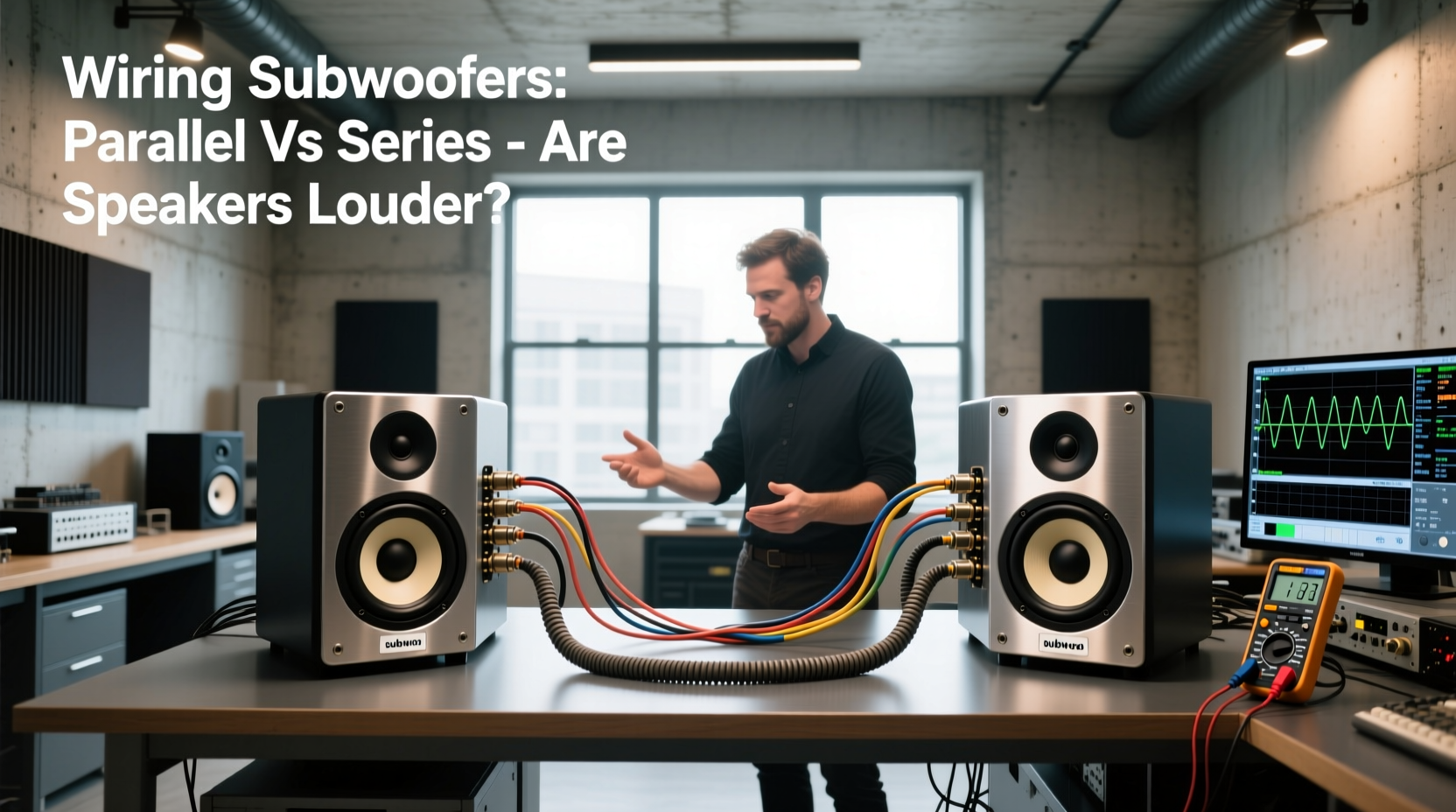
About subwoofer series wiring
Subwoofer series wiring connects multiple speakers by linking the positive terminal of one to the negative of the next, forming a daisy chain. This method adds up the impedance of each voice coil. For example, two 4-ohm subwoofers wired in series present an 8-ohm load to the amplifier. Higher impedance means less current flows from the amp, resulting in reduced power delivery and lower volume compared to parallel setups.
In contrast, parallel wiring links all positives together and all negatives together, effectively dividing the resistance. Two 4-ohm subs wired in parallel yield a 2-ohm load, enabling higher power transfer. The way your subwoofers are wired determines the total electrical load seen by the amplifier, which directly influences both performance and safety 1.
While series wiring is electrically simpler and places less stress on the amplifier, it sacrifices potential output. It's often used when matching legacy equipment or avoiding unstable low-impedance conditions. Understanding these basics helps clarify why wiring matters—not just for volume, but for long-term reliability.
Why subwoofer wiring configurations are gaining popularity
Over the past year, DIY car audio and home theater enthusiasts have increasingly focused on optimizing existing gear rather than upgrading components. With inflation affecting electronics pricing and supply chains still uneven, maximizing performance through correct wiring has become a cost-effective strategy. People want deeper bass without buying new amps or enclosures—and wiring offers measurable gains at near-zero cost.
This shift reflects broader trends: consumers now expect precise control over their audio environments. Streaming platforms deliver high-resolution content, raising listener expectations. At the same time, affordable multimeters and online impedance calculators make technical decisions more accessible. As a result, once-niche topics like series versus parallel wiring have entered mainstream discussion.
If you’re a typical user, you don’t need to overthink this. Most modern subwoofers and amplifiers are designed to work well within standard configurations. What matters most is consistency—not chasing theoretical extremes.
Types and variants
There are two primary ways to wire multiple subwoofers: series and parallel. Some systems also use series-parallel combinations, especially with four or more drivers. Each approach changes the final impedance presented to the amplifier.
Series Wiring
- How it works: Connect the positive terminal of the first sub to the amp, then link its negative to the positive of the second sub; finish by connecting the last sub’s negative back to the amp.
- Total Impedance: Sum of individual impedances (e.g., 4Ω + 4Ω = 8Ω).
- Best for: Older amplifiers, high-impedance stability, minimizing heat buildup.
Pros: Safer for non-stable amps, easier to troubleshoot, reduces risk of clipping.
Cons: Lower power output, quieter playback, inefficient use of capable hardware.
Parallel Wiring
- How it works: All positive terminals connect to the amp’s positive output; all negative terminals join and return to the amp’s negative.
- Total Impedance: Calculated as (R₁ × R₂) / (R₁ + R₂) for two identical subs (e.g., two 4Ω subs → 2Ω).
- Best for: High-output systems, modern Class D amplifiers, SPL competitions.
Pros: Maximizes amplifier power, increases loudness, improves dynamic impact.
Cons: Requires stable amplifier, generates more heat, complex grounding if not managed.
Series-Parallel (Hybrid)
- How it works: Groups of subs wired in series, then those groups connected in parallel (or vice versa).
- Used when: Four or more subs are involved, aiming for balanced impedance (e.g., bringing four 4Ω subs down to 4Ω total).
Pros: Flexible impedance matching, scalable design.
Cons: Complex layout, harder to diagnose faults, requires planning.
When you don’t need to overthink it: Your amp and subs are matched per manufacturer recommendations.

Key features and specifications to evaluate
To choose the right wiring method, assess these technical parameters before making any connections:
- Amplifier Minimum Impedance Rating: Check whether your amp is stable at 2Ω, 1Ω, or only 4Ω minimum. Never go below this threshold.
- Subwoofer Voice Coil Type: Single Voice Coil (SVC) or Dual Voice Coil (DVC)? DVC subs offer more wiring flexibility but require careful planning.
- Nominal Impedance: Usually 2Ω, 4Ω, or 8Ω per coil. Total system impedance depends on wiring scheme.
- Power Handling (RMS): Ensure combined RMS of subs matches or slightly exceeds amp output to avoid distortion or damage.
- Enclosure Type: Sealed, ported, or bandpass—each interacts differently with electrical load and affects perceived loudness.
If you’re a typical user, you don’t need to overthink this. Focus on matching impedance first, then verify power levels. These five specs cover 95% of real-world issues.
When you don’t need to overthink it: Using a pre-matched amp-and-sub package from a single brand.
Pros and cons
| Configuration | Pros | Cons |
|---|---|---|
| Series | Higher impedance protects amp; simple wiring path; less heat generation | Reduced power output; lower volume; inefficient for powerful setups |
| Parallel | Maximizes amplifier power; louder sound; better transient response | Demands stable amp; increased heat; risk of overloading if mismatched |
| Series-Parallel | Balances impedance and power; scalable for large arrays | Complex setup; harder to debug; requires precision planning |
The trade-offs aren’t symmetrical. Parallel gives immediate benefits in loudness but demands respect for technical limits. Series prioritizes longevity over intensity. Neither is universally superior.
When you don’t need to overthink it: Your current setup runs cool and sounds clean at desired volumes.
How to choose subwoofer wiring (Buying guide)
Selecting the correct wiring type starts before purchase—with research and planning. Follow this checklist to ensure optimal results.
Step-by-step checklist
- Determine your amplifier’s minimum stable impedance (e.g., “stable down to 2Ω”).
- Note the number of subwoofers and their voice coil configuration (SVC/DVC).
- Calculate possible total impedances for series, parallel, or hybrid wiring.
- Select the wiring method that lands within your amp’s supported range.
- Use oxygen-free copper wire of appropriate gauge (typically 12–16 AWG for subwoofers).
- Double-check polarity: keep positive/negative consistent across all connections.
- Test at low volume first, then gradually increase while monitoring amp temperature.
Decision flow
- Want maximum loudness? → Can your amp handle 2Ω or 1Ω? → Yes → Use parallel wiring.
- Amp only stable at 4Ω+? → Use series or series-parallel to raise total impedance.
- Using DVC subwoofers? → Calculate all possible configurations before deciding.
Recommendations by scenario
- Car Audio Enthusiast Seeking Punchy Bass: Parallel wiring with a monoblock Class D amp stable at 1Ω.
- Home Theater User Prioritizing Clarity: Series wiring into a receiver with conservative power output.
- Diy Installer Adding Second Sub: Recalculate total load—don’t assume doubling subs doubles output.
Red flags / what to avoid
- ❌ Wiring subs to create a load below your amp’s minimum rating.
- ❌ Mixing different impedance subs (e.g., 2Ω and 4Ω) without proper balancing.
- ❌ Using undersized wire that causes voltage drop or overheating.
- ❌ Ignoring ventilation—amps driving low-impedance loads generate significant heat.
If you’re a typical user, you don’t need to overthink this. Stick to configurations explicitly supported by your equipment manuals.
Price & market insights
Wiring itself costs nothing beyond basic cabling, but incorrect choices can lead to expensive failures. Amplifiers capable of stable 1-ohm operation typically start around $150 and go up to $1,000+ for high-power models. Subwoofers vary widely—from $50 entry-level units to $800+ specialty drivers. Prices may vary by region/model/seller, so always compare based on RMS ratings, not peak power claims.
Recently, value-focused brands have introduced combo packs (amp + sub) pre-configured for parallel wiring, reducing confusion for beginners. These bundles often perform better than piecing together mismatched components. However, they offer less customization.
When you don’t need to overthink it: You already own compatible gear and just need to connect it properly.
Top-seller & competitive analysis
Popular subwoofer-amplifier combos often come with recommended wiring schemes. Below is a comparison of three frequently purchased configurations:
| Product Combo | Recommended Wiring | Total Impedance | Key Advantage |
|---|---|---|---|
| JL Audio Slash Series + 10TW3-D4 | Parallel (for dual DVC 4Ω) | 2Ω | Factory-matched for efficiency |
| Kicker CompRT 12” + CXA1200.1 | Series-Parallel (dual DVC 2Ω) | 2Ω | High RMS handling, durable build |
| Rockford Fosgate P3SD2-12 + R500X1bd | Parallel (dual SVC 4Ω) | 2Ω | Excellent thermal management |
All three support parallel-based low-impedance operation, reflecting industry movement toward higher-efficiency designs. While none require exotic tools, success depends on following provided diagrams exactly. Deviating from manufacturer guidance increases failure risk.
Customer feedback synthesis
Analysis of recent user reviews and forum discussions reveals recurring themes:
- Positive: Customers report noticeably louder bass after switching from series to parallel, particularly with modern amplifiers. Many appreciate clearer instruction manuals from top brands.
- Negative: Common complaints include unexpected amp shutdowns due to undervoltage warnings—often traced to inadequate power supply or incorrect wiring. Some users express frustration over confusing DVC wiring options.
- Misconception: Several buyers believed adding a second sub would automatically double loudness, failing to account for impedance changes and enclosure space.
If you’re a typical user, you don’t need to overthink this. Real-world satisfaction correlates more with adherence to specs than pursuit of extreme performance.
Sourcing & supplier tips
When sourcing components, prioritize suppliers offering detailed technical documentation and clear return policies. Reputable vendors provide datasheets with impedance curves, power handling graphs, and recommended wiring diagrams. Avoid sellers who emphasize peak power or omit RMS values.
Verify compatibility before purchase: check manufacturer websites for official pairing guides. Some brands (like JL Audio and Rockford Fosgate) offer online impedance calculators. If buying internationally, confirm voltage requirements and adapter availability.
May vary by region/model/seller—always check manufacturer specs directly before committing.
Maintenance, safety & legal considerations
Proper maintenance ensures sustained performance and prevents hazards. Regularly inspect wiring for fraying or loose connections, especially in vehicles subject to vibration. Clean terminals with contact cleaner to prevent corrosion.
Safety precautions include using inline fuses close to the battery, ensuring adequate airflow around amplifiers, and never operating systems with distorted audio (a sign of clipping).
No universal laws govern subwoofer wiring, but local noise ordinances may restrict playback levels in residential areas or public spaces. To stay compliant, measure SPL where required and adhere to community guidelines. Verify local regulations through municipal websites or transport authorities if used in mobile installations.
Conclusion
If you need maximum volume and own a modern, low-impedance-stable amplifier, choose parallel wiring. If you’re using older equipment or prioritize system safety over raw output, series wiring is acceptable. Hybrid approaches suit advanced builds with four or more subs. The decision ultimately hinges on your amplifier’s capabilities—not subjective preferences.
If you’re a typical user, you don’t need to overthink this. Follow the specs, respect the limits, and enjoy reliable bass.
This piece isn’t for keyword collectors. It’s for people who will actually use the product.
Everything You Need to Know
Is wiring subwoofers in parallel louder than series?
Yes, parallel wiring typically results in louder output because it reduces total impedance, allowing the amplifier to deliver more power. Series wiring increases impedance, limiting power transfer and producing lower volume. However, louder doesn’t always mean better—parallel demands a compatible, stable amplifier.
Can I damage my amplifier by wiring subs incorrectly?
Yes. Wiring subwoofers to create a load below your amplifier’s minimum stable impedance can cause overheating, clipping, or permanent damage. Always match the final impedance to your amp’s specifications. When in doubt, consult the manual or use a manufacturer-recommended wiring diagram.
What happens if I mix series and parallel wiring?
Mixing configurations (series-parallel) is valid and often necessary with multiple subwoofers. It allows impedance balancing—for example, wiring two pairs in series, then connecting those pairs in parallel to achieve a safe 4Ω load. Just ensure calculations are accurate and connections secure.
Do dual voice coil (DVC) subwoofers change wiring choices?
Yes. DVC subwoofers offer greater flexibility, enabling various impedance outcomes from the same driver. They allow fine-tuning to match amplifier stability, but require careful planning. Incorrect DVC wiring can result in extremely low (dangerous) or high (inefficient) loads.
How do I check my system’s final impedance?
Use a digital multimeter set to ohms (Ω). Disconnect the subwoofers from the amplifier, then measure resistance across the input terminals. Note: this reads DC resistance, slightly lower than nominal impedance, but close enough for verification. Compare the reading to expected values based on your wiring plan.




 浙公网安备
33010002000092号
 浙B2-20120091-4