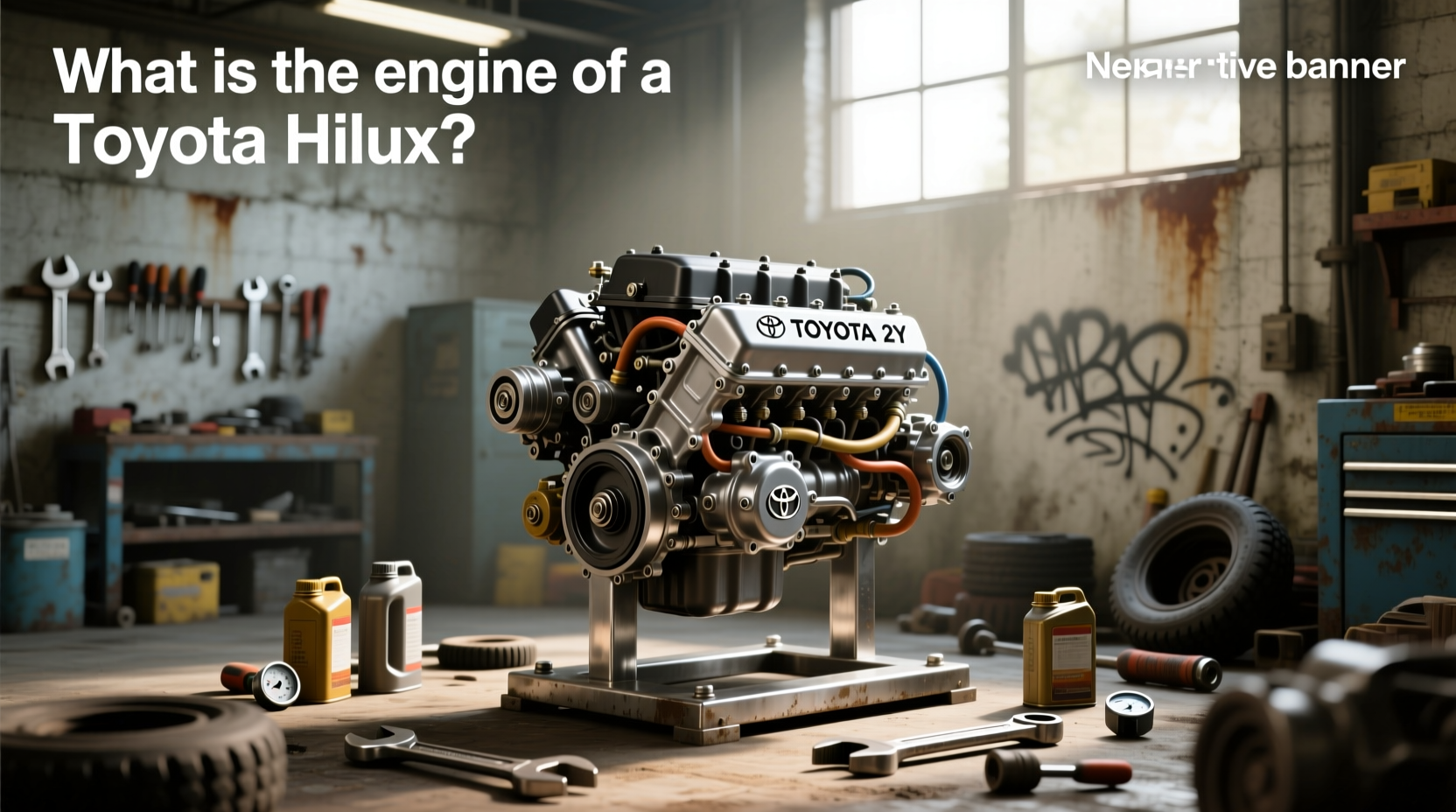
If you're looking for a durable, low-cost gasoline engine for older Toyota HiLux models (1983–1997), the 2Y engine is a solid choice—especially for light-duty work or restoration projects where modern performance isn’t critical. This guide covers how to choose a Toyota HiLux 2Y engine, what to look for in terms of condition and compatibility, and whether it fits your needs compared to newer diesel or hybrid variants. The 2Y is an 1.8L OHV inline-four petrol engine known for simplicity and repairability, but it lacks power and fuel efficiency by today’s standards 1. Avoid using it for heavy towing or off-road adventures requiring sustained torque.
🛒 About the Toyota HiLux 2Y Engine
The Toyota 2Y engine is part of the Y-series family of overhead valve (OHV) four-cylinder gasoline engines produced from 1982 to 1996. It was primarily used in commercial and utility vehicles, most notably the fourth and fifth-generation Toyota HiLux (1983–1997). With a displacement of 1,812 cc (1.8L), bore/stroke of 86 mm × 78 mm, and a compression ratio of 8.8:1, the 2Y delivers modest output—typically between 75 and 90 horsepower depending on market and tuning 1.
This engine features an 8-valve configuration and carbureted fuel delivery in most applications, making it mechanically simple and easy to maintain with basic tools. It was often chosen in developing markets or rural areas where fuel quality varies and access to advanced diagnostics is limited. The 2Y also powered other Toyota models like the HiAce van and the Volkswagen Taro, which was a rebadged version of the Hilux sold in Europe.
Typical use cases:
- Light cargo transport in urban or rural settings
- Restoration of classic HiLux trucks
- Backup or secondary vehicle in regions with poor infrastructure
- DIY mechanics seeking a repairable, non-electronic engine
📌 Key takeaway: The 2Y engine suits buyers prioritizing mechanical simplicity over power or fuel economy. It's not ideal for high-load tasks or long-distance highway driving.
📈 Why the 2Y Engine Is Still Relevant Today
Despite being discontinued nearly three decades ago, interest in the 2Y engine persists due to several factors:
- Reliability through simplicity: Fewer electronic components mean fewer failure points. Many 2Y engines have surpassed 300,000 km with regular maintenance.
- Aftermarket support: Replacement parts are widely available globally, especially in Africa, Southeast Asia, and Latin America.
- Low acquisition cost: Used 2Y engines can be found for under $500 USD in some markets, making them attractive for budget builds.
- Cultural nostalgia: Enthusiasts restoring vintage HiLux models seek original-spec engines for authenticity.
In regions where modern diesels face import restrictions or high taxes, the 2Y remains a practical alternative. However, its popularity does not imply suitability for all users—especially those needing strong torque or better emissions performance.
🔧 Types and Variants of the 2Y Engine
While the base 2Y design remained consistent, several variants were offered across different markets and model years:
| Variant | Features | Pros | Cons |
|---|---|---|---|
| 2Y (Carbureted) | Standard version with single-barrel carburetor | Simple, easy to tune, low repair cost | Limited power, poor cold starts, higher fuel consumption |
| 2Y-E (EFI) | Rare electronic fuel injection variant (late production) | Better fuel control, smoother idle, improved cold start | More complex, harder to source parts, sensitive to voltage spikes |
| Rebuilt/Refurbished Units | Overhauled engines from salvage yards or workshops | Lower cost than new, tested functionality | Unknown prior usage, potential hidden wear |
Most 2Y engines in circulation today are carbureted units. The EFI version (2Y-E) is rare and typically only found in select export markets or late-model Japanese domestic versions.
⚙️ Key Features and Specifications to Evaluate
When evaluating a 2Y engine for purchase, focus on these measurable and observable criteria:
- Compression Test: Should read between 130–160 psi per cylinder. Below 110 psi indicates significant wear.
- Oil Condition: Check for metal shavings or milky residue (sign of coolant leak).
- Visual Inspection: Look for cracks in the block, exhaust manifold, or head; corrosion on mounts.
- Timing Chain Tension: Excessive noise suggests chain stretch or guide wear.
- Carburetor Function: Ensure smooth throttle response and no fuel leaks.
- Mounting Compatibility: Confirm alignment with transmission and chassis of your specific HiLux model year.
Also verify VIN or engine code stamping matches documentation if purchasing used. Mismatched numbers may indicate salvage or insurance write-off history.
✅ Pros and Cons of the 2Y Engine
| Aspect | Advantages | Limitations |
|---|---|---|
| Reliability | Proven durability with proper care | Ages poorly without consistent maintenance |
| Maintenance | Basic tools suffice; common knowledge among mechanics | Parts availability varies by region |
| Fuel Type | Runs on regular unleaded gasoline | Less efficient than modern engines (~12–15 L/100km) |
| Performance | Adequate for city driving and light loads | Struggles uphill or when towing; slow acceleration |
| Emissions | No DPF or EGR complexity | Does not meet Euro 3+ standards; may fail inspections |
📋 How to Choose a Toyota HiLux 2Y Engine
Follow this step-by-step checklist when sourcing a 2Y engine:
- Determine Your Use Case: Are you restoring a classic? Need a temporary replacement? Or building a work truck?
- Verify Model Year Compatibility: The 2Y fits 1983–1988 (4th gen) and 1988–1997 (5th gen) HiLux models. Cross-reference chassis codes (e.g., RN50, RN60).
- Inspect in Person (if possible): Start the engine, listen for knocking, check smoke color (blue = oil burn, white = coolant leak).
- Ask for Service History: Engines with documented oil changes and timing adjustments are preferable.
- Test Compression and Leak-Down: Request recent test results or perform one yourself.
- Check Accessories: Ensure alternator, water pump, and starter motor are included and functional.
Red flags to avoid:
- Engine sold “as-is” without testing
- Visible oil leaks or overheating damage
- No documentation or unclear ownership history
- Price significantly below market average (may indicate hidden issues)
💰 Price & Market Insights
Pricing for a 2Y engine varies widely based on condition, location, and supply chain:
- Used (running): $300–$700 USD
- Rebuilt: $800–$1,200 USD
- New-old-stock (NOS): Rare, priced up to $2,000+ USD
In countries like Kenya, Indonesia, or Colombia, local rebuilders offer lower-cost options with labor warranties. In contrast, North American or European imports may carry premium pricing due to shipping and compliance costs. Always compare prices against local labor rates—if installation exceeds $500, factor that into total cost.
📊 Top-Seller & Competitive Analysis
While the 2Y itself is outdated, understanding how it compares to contemporary alternatives helps contextualize its role:
| Engine | Displacement | Power Output | Fuel Type | Best For |
|---|---|---|---|---|
| 2Y | 1.8L | 75–90 hp | Gasoline | Restoration, light duty |
| 2RZ-FE | 2.4L | 135 hp | Gasoline | Balanced performance (6th gen) |
| 1KD-FTV | 2.8L | 177 hp | Turbo Diesel | Towing, off-road |
| 2GD-FTV | 2.4L | 150 hp | Turbo Diesel | Fuel efficiency, daily use |
The 2Y lags behind in power and efficiency but wins in mechanical accessibility. Modern turbo-diesel engines dominate current Hilux sales due to superior torque and longevity.
👥 Customer Feedback Synthesis
Based on owner reports and mechanic forums, here’s a summary of common experiences:
Frequent Praises:
- “Easy to fix even in remote villages.”
- “Lasted over 25 years with basic upkeep.”
- “Perfect for keeping an old truck alive.”
Common Complaints:
- “Too weak for highways or hills.”
- “Drinks fuel compared to diesel models.”
- “Hard to find OEM parts in Western markets.”
Owners consistently note that success with the 2Y depends heavily on maintenance discipline and realistic expectations about performance.
🏭 Sourcing & Supplier Tips
When buying a 2Y engine:
- Source locally first: Reduces shipping risk and allows pre-purchase inspection.
- Use reputable dismantlers: Look for shops specializing in JDM (Japanese Domestic Market) parts with return policies.
- For bulk purchases: Contact exporters in Japan or Thailand who deal in recycled auto parts.
- Verify authenticity: Match engine serial number with seller claims and cross-check with Toyota’s public databases if available.
- Consider a trial run: If buying online, request a video of the engine running before shipment.
Avoid suppliers who refuse returns or provide no warranty—even short-term (30-day) coverage adds buyer protection.
🔧 Maintenance, Safety & Legal Considerations
Maintenance: Change oil every 5,000 km, inspect belts and hoses annually, clean carburetor periodically. Use non-synthetic 10W-30 or 15W-40 oil unless modified.
Safety: Secure engine properly during transport and installation. Use jack stands—not just lifts. Disconnect battery before working near electrical components.
Legal/Compliance: Installing a 2Y engine in a newer vehicle may violate emissions regulations in countries like the U.S., EU, or Australia. Always check local rules before swapping engines. In many regions, grandfather clauses allow older engines in pre-1990 vehicles, but modifications require certification.
✨ Conclusion
The Toyota HiLux 2Y engine is a dependable, straightforward powerplant best suited for light-duty applications, restorations, or markets with limited technical infrastructure. If you need a low-cost, easy-to-repair gasoline engine for a classic HiLux build or backup truck, the 2Y remains a viable option. However, if you prioritize fuel economy, towing capacity, or emissions compliance, consider upgrading to a modern diesel variant like the 1KD-FTV or 2GD-FTV instead. Ultimately, choosing the right engine depends on your specific needs, location, and long-term goals.
❓ Frequently Asked Questions
- What is the engine of a Toyota HiLux?
- The Toyota HiLux has used various engines since 1968, including gasoline (like the 2Y), diesel, and hybrid powertrains. The specific engine depends on generation, market, and model year.
- Can the 2Y engine be upgraded for more power?
- Limited upgrades exist—such as performance carburetors or exhaust headers—but gains are modest. Significant improvements require conversion to EFI or engine swap.
- Is the 2Y engine reliable?
- Yes, when maintained regularly. Its mechanical simplicity contributes to long-term reliability, though it lacks the durability of modern diesel engines under heavy load.
- When did Toyota stop using the 2Y engine?
- Production ended around 1996, with final installations in 1997 model-year vehicles.
- How do I know if a used 2Y engine is in good condition?
- Perform a compression test, inspect for leaks, verify smooth idle, and review service history. Avoid engines with excessive smoke or knocking sounds.




 浙公网安备
33010002000092号
 浙B2-20120091-4