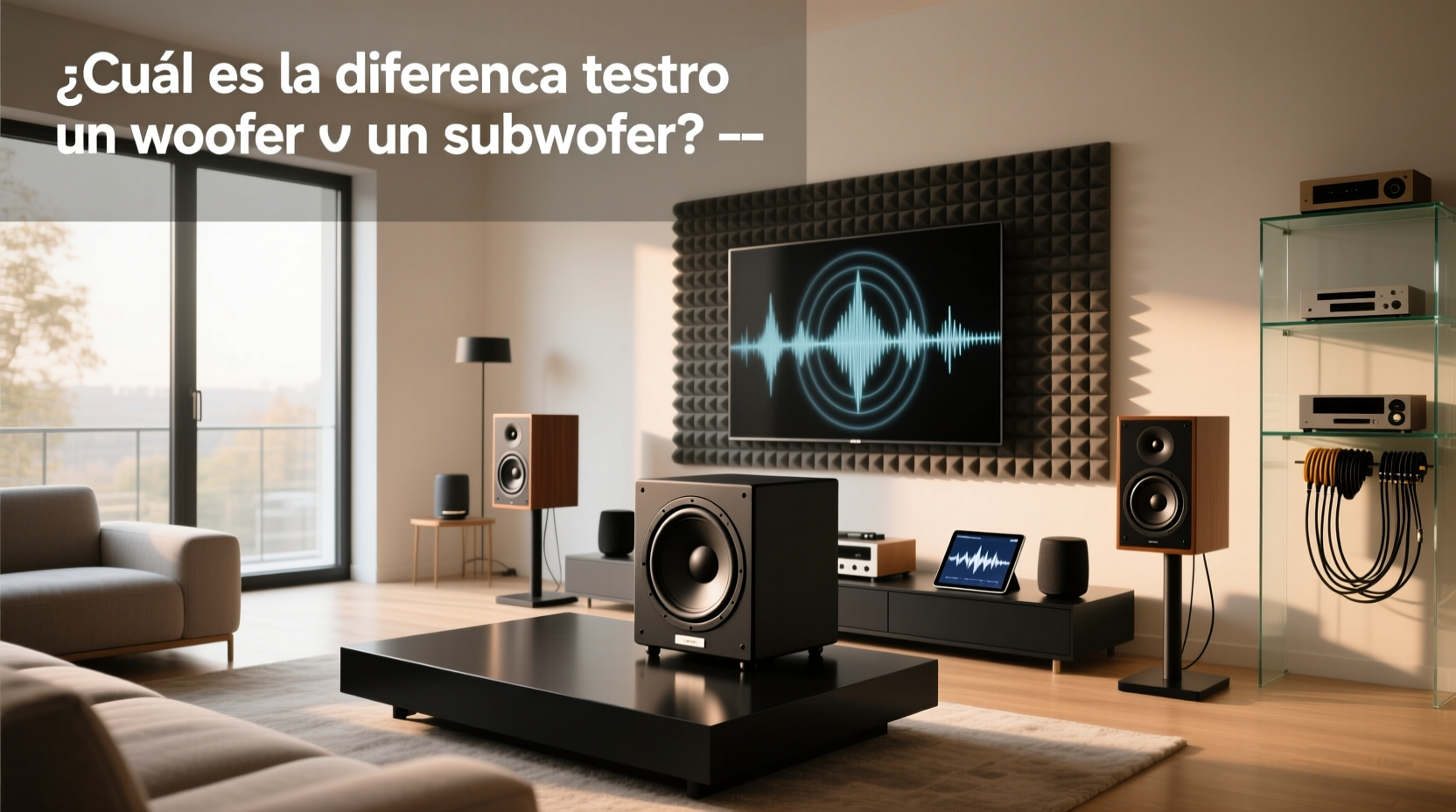
If you're wondering how to choose a subwoofer and what sets it apart from a standard woofer, the answer lies in frequency range, power, and system integration. A subwoofer specializes in reproducing deep bass below 100 Hz—frequencies that regular speakers and woofers can't effectively deliver 1. While a woofer handles mid-bass and lower-mid frequencies (typically 40–2,500 Hz), a subwoofer focuses on sub-bass (20–100 Hz), adding physical impact to movies and music 2. For users with compact speakers, large rooms, or home theater setups, adding a subwoofer significantly improves audio fidelity by offloading low-frequency reproduction from main speakers 3. Avoid models with poor cabinet sealing or mismatched amplifier power, as these lead to distorted bass or room-shaking resonance.
About subwoofer,¿Cuál es la diferencia entre un woofer y un subwoofer?
🔍Understanding the distinction between a woofer and a subwoofer is essential when building or upgrading an audio system. A woofer is a speaker driver designed to reproduce low-to-mid bass frequencies, typically ranging from 40 Hz to 2,500 Hz. It’s a core component of most bookshelf, floor-standing, and car audio speakers, working alongside tweeters and midrange drivers to cover the full audible spectrum 3.
✅In contrast, a subwoofer is a dedicated speaker system engineered to reproduce only the lowest frequencies—usually between 20 Hz and 100 Hz or 200 Hz. These ultra-low sounds are often felt more than heard and include cinematic explosions, pipe organ notes, and electronic bass drops. Subwoofers are standalone units, typically larger and more powerful than internal woofers, and are crucial for accurate LFE (Low-Frequency Effects) channel reproduction in surround sound formats like Dolby Digital and DTS 1.
Why subwoofer,¿Cuál es la diferencia entre un woofer y un subwoofer? is gaining popularity
📈The demand for subwoofers has grown due to rising interest in immersive entertainment experiences. With the proliferation of high-resolution audio content, streaming platforms offering Atmos and DTS:X soundtracks, and the popularity of bass-heavy music genres like EDM, hip-hop, and film scores, consumers increasingly expect deeper, more impactful bass 4.
✨Additionally, modern speaker design trends favor compact, minimalist cabinets, which often sacrifice deep bass response. This makes external subwoofers not just desirable but necessary for balanced sound. Home theater enthusiasts, audiophiles, and gamers alike benefit from the added depth a subwoofer provides, especially in medium to large rooms where bass dispersion becomes critical.
Types and variants
Subwoofers come in several configurations, each suited to different environments and performance goals:
- Active (Powered) Subwoofers: Include a built-in amplifier optimized for the driver. They offer plug-and-play convenience and consistent performance. Pros: Easier setup, better control over crossover and phase. Cons: Less flexibility in amplifier pairing, usually higher cost.
- Passive Subwoofers: Require an external amplifier. Common in custom installations and high-end systems. Pros: Greater customization. Cons: More complex setup, need for compatible amp.
- Sealed Enclosures: Tightly closed boxes. Deliver tight, accurate bass with fast transient response. Ideal for music listening. Pros: Precision, compact size. Cons: Lower efficiency, less output at extreme lows.
- Ported (Bass Reflex) Enclosures: Feature a tuned port to enhance low-frequency extension. Pros: Louder output, deeper bass. Cons: Can sound boomy if poorly placed.
- Down-Firing vs Front-Firing: Driver orientation affects placement flexibility and room interaction. Down-firing subs blend well in corners; front-firing models allow easier tuning via direct access.
Key features and specifications to evaluate
When assessing subwoofers, focus on measurable and functional attributes:
- Frequency Response: Look for a range starting at or below 20 Hz for true sub-bass reproduction. Check both -3dB and -10dB points for real-world performance.
- Driver Size: 10", 12", and 15" are common. Larger drivers move more air but require more space. Smaller drivers (8") suit compact setups with moderate bass needs.
- 4 Amplifier Power (RMS): Measured in watts. Higher RMS indicates cleaner output at volume. Match power to room size—200–500W suits average rooms; 800W+ for large spaces.
- Cabinet Design: Sealed vs. ported affects tonal character. Ported offers louder bass; sealed provides tighter control.
- Crossover Controls: Adjustable low-pass filter allows seamless blending with main speakers. Look for variable settings (50–150 Hz).
- Phase Control: Ensures bass waves align with main speakers. Adjustable phase (0°/180°) helps minimize cancellation in certain room positions.
- Inputs/Outputs: RCA line-level inputs are standard. High-level inputs allow connection to speaker terminals. Wireless kits add convenience.
Pros and cons
✅ Advantages
- Enhances realism in movies and games
- Reduces strain on main speakers by handling low frequencies
- Improves overall clarity and dynamic range
- Essential for home theater LFE channel playback
- Adds physical sensation to music with deep basslines
❌ Limitations
- Requires careful placement to avoid uneven bass
- Can be bulky and difficult to integrate aesthetically
- Poorly matched subs may cause muddy or boomy sound
- Needs calibration (crossover, phase, volume) for optimal results
- May increase system complexity and cost
How to choose subwoofer,¿Cuál es la diferencia entre un woofer y un subwoofer?
🛒Follow this step-by-step guide to make an informed decision:
- Assess Your System: Are you using small satellite or bookshelf speakers? If they roll off below 60–80 Hz, a subwoofer will restore missing low end 3.
- Determine Primary Use: For home theater, prioritize deep extension and high output. For music, focus on accuracy and integration.
- Measure Room Size: Small rooms (<150 sq ft) work well with 10"–12" subs. Large rooms (>300 sq ft) benefit from 12"–15" models with higher amplifier power.
- Choose Active vs Passive: Most consumers should opt for active subwoofers due to integrated amplification and simplified setup.
- Select Enclosure Type: Sealed for precise music reproduction; ported for louder, deeper bass in movies.
- Check Connectivity: Ensure compatibility with your AV receiver or preamp. Look for adjustable crossover and phase controls.
- Avoid These Red Flags: No frequency response specs, non-adjustable crossover, poorly braced cabinets, or exaggerated peak power claims (focus on RMS).
Price & market insights
Subwoofer pricing varies widely based on brand, size, amplifier quality, and materials:
- Budget ($100–$300): Entry-level models with 8"–10" drivers. Suitable for small rooms and casual use. May lack fine-tuning options.
- Mid-Range ($300–$800): 10"–12" drivers with robust amplifiers (300–600W). Best value for most users, offering good extension, control, and connectivity.
- Premium ($800–$2,000+): High-excursion drivers, advanced DSP, premium cabinets. Ideal for critical listening and large rooms.
Prices may vary by region and retailer. Always verify manufacturer specifications and return policies before purchase.
Top-seller & competitive analysis
Popular models often balance performance, reliability, and ease of integration. Below is a comparison of representative units across categories:
| Model Type | Driver Size | Amplifier (RMS) | Frequency Range | Key Features |
|---|---|---|---|---|
| Entry-Level (e.g., Monoprice 9723) | 10" | 150W | 28–120 Hz | Ported, basic controls, compact |
| Mid-Tier (e.g., SVS SB-1000) | 12" | 200W | 24–200 Hz | Sealed, app control, DSP tuning |
| Premium (e.g., REL Acoustics T/5i) | 8" + passive radiator | 200W | 30–140 Hz | High build quality, stereo input, fast response |
Note: Performance depends on room acoustics and calibration. Always check current model specs as designs evolve.
Customer feedback synthesis
Analysis of user reviews reveals recurring themes:
- Positive Feedback: Deep, clean bass; easy integration with existing systems; noticeable improvement in movie immersion; compact designs that fit small spaces.
- Common Complaints: Inconsistent bass response across room positions; difficulty calibrating phase/crossover; underpowered amps in budget models; excessive port noise in cheap ported designs.
- Frequent Suggestions: Use room correction software (like Audyssey or Dirac); experiment with placement (e.g., corner vs. mid-wall); consider dual subwoofers for smoother response.
Sourcing & supplier tips
Subwoofers are available through electronics retailers, specialty audio stores, and online marketplaces. When sourcing:
- Buy from authorized dealers to ensure warranty validity.
- For bulk purchases (e.g., integrators), contact distributors directly for pricing and availability.
- Inspect packaging upon delivery—look for dents or moisture damage.
- Test unit within return window: play test tones (20–80 Hz sweep) to check for distortion or rattles.
Maintenance, safety & legal considerations
To ensure longevity and safe operation:
- Place on stable, level surfaces away from moisture and direct sunlight.
- Avoid continuous operation at maximum volume to prevent thermal damage.
- Ensure proper ventilation around the cabinet, especially for powered models.
- Use surge protectors to guard against power spikes.
- Verify compliance with local electrical safety standards (e.g., UL, CE, RoHS)—check product labeling or datasheet.
Conclusion
Choosing the right subwoofer starts with understanding how it differs from a standard woofer: while a woofer covers broad bass frequencies within a multi-driver speaker, a subwoofer specializes in reproducing the deepest, most impactful low-end sound. If you’re using compact speakers, have a large room, or enjoy movies and bass-rich music, a subwoofer is a worthwhile addition. Prioritize models with adjustable crossover, adequate amplifier power, and solid cabinet construction. For most users, a 10"–12" active subwoofer in the $300–$800 range offers the best balance of performance and value. Avoid units lacking clear specifications or calibration options. Ultimately, proper placement and system integration matter as much as the hardware itself.
Frequently Asked Questions
- What is the main difference between a woofer and a subwoofer?
- A woofer is a driver within a speaker that handles low-to-mid bass (40–2,500 Hz), while a subwoofer is a standalone unit focused on very low frequencies (20–100 Hz), delivering deeper, more powerful bass.
- Do I really need a subwoofer for my home audio system?
- You may benefit from one if you have small speakers, watch movies with deep sound effects, listen to bass-heavy music, or have a large room where main speakers struggle with low frequencies.
- Can I use a subwoofer with bookshelf speakers?
- Yes. A subwoofer complements bookshelf speakers by reproducing frequencies they can’t handle, improving overall sound balance and reducing distortion in the main speakers.
- Where should I place a subwoofer in my room?
- Start in the front near your main speakers or in a corner for stronger bass. Use the “subwoofer crawl” method—place it at your listening position and move around the room to find where bass sounds smoothest, then swap locations.
- Are active subwoofers better than passive ones?
- Active subwoofers are generally easier to set up and better integrated for most users. Passive models offer more customization but require an external amplifier and are typically used in specialized installations.




 浙公网安备
33010002000092号
 浙B2-20120091-4