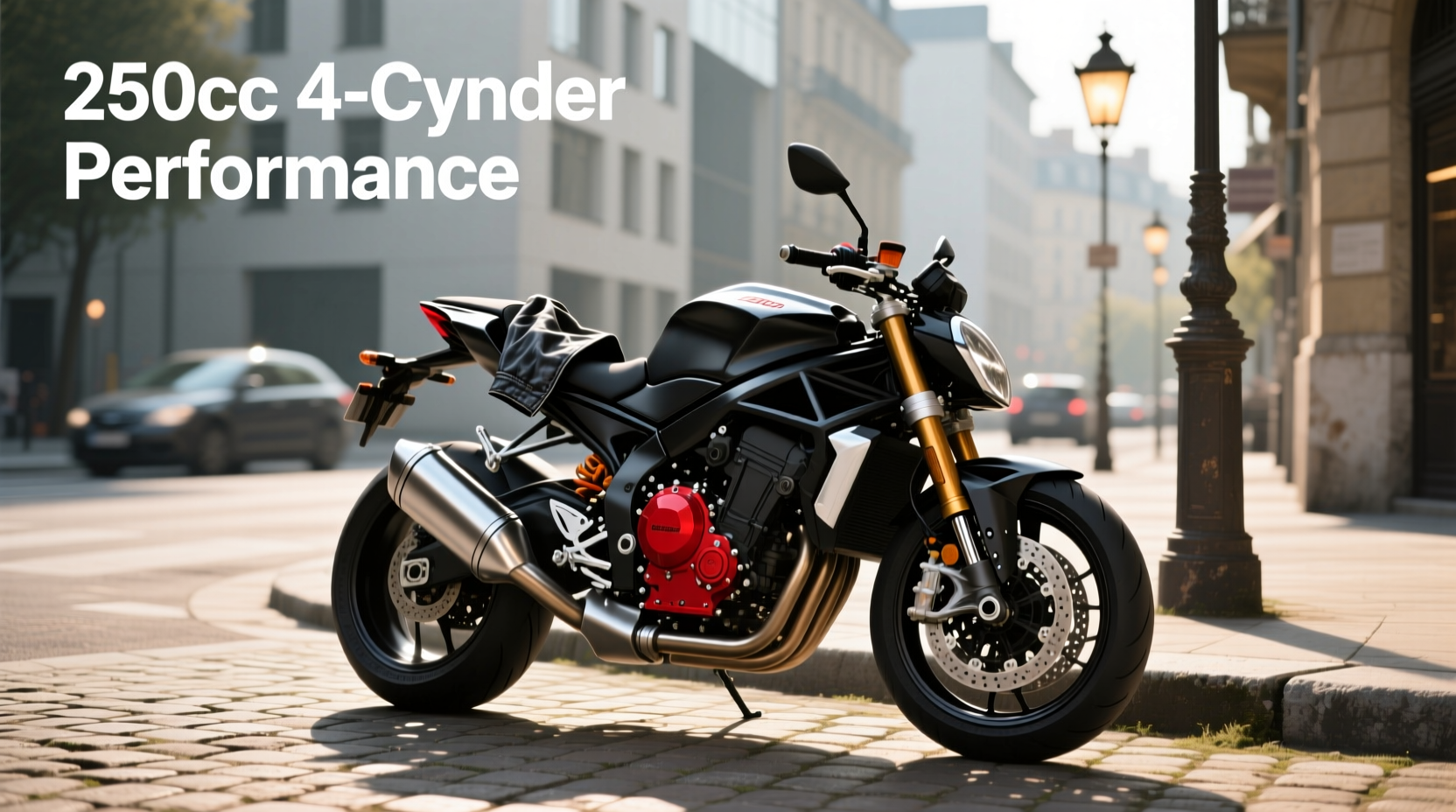
If you've been searching for a 250cc 4-cylinder motorcycle, you're not alone—but you've likely noticed how few options exist. Despite decades of engineering capability, the modern market offers almost no production models with this configuration. The recent QJMotor SRK250 RD prototype sparked excitement as a potential revival of the inline-four 250cc sportbike concept ✨, but it remains an outlier rather than a trend. This article breaks down why 250cc four-cylinder motorcycles are exceptionally rare today, explores historical examples that did exist, analyzes technical and economic factors behind their absence, and helps riders understand realistic alternatives and expectations when considering high-performance small-displacement bikes.
Understanding the 250cc 4-Cylinder Concept
The idea of a 250cc inline-four motorcycle is rooted in high-revving performance engineering. By dividing displacement across four cylinders, each cylinder can be smaller, allowing higher engine speeds (RPM), smoother power delivery, and a more responsive throttle feel compared to twin or single-cylinder engines of similar total displacement ⚙️. Historically, these machines were designed to mimic the character of larger superbikes—delivering thrilling top-end power and a distinctive scream from their exhaust notes.
However, producing a functional 250cc inline-four presents significant engineering challenges. Each cylinder would displace only about 62.5cc, requiring extremely compact components, precise manufacturing tolerances, and advanced materials to handle sustained high RPM operation. For example, the Kawasaki Ninja ZX-25R achieves a redline of 15,500 RPM 1. Maintaining reliability at such speeds demands extensive development and testing, increasing production costs significantly.
A Brief History of Real 250cc Inline-Four Motorcycles
While rare today, several manufacturers produced genuine 250cc inline-four motorcycles in the past, primarily during the 1980s and early 1990s:
- Honda CBR250RR (MC17/MC22): Introduced in Japan in 1990, this was one of the most famous 250cc inline-fours. With a 12,000 RPM redline and 47 horsepower, it offered race-bred performance in a lightweight package 🔧.
- Kawasaki Ninja ZX-250 (EX250-D): Sold internationally as a middleweight learner bike, though technically a parallel-twin, confusion often arises due to naming similarities. True four-cylinder ZX-250 models were limited to racing homologation versions.
- Yamaha FZR250: Released in 1986, this model featured a liquid-cooled inline-four engine with Yamaha’s Genesis design principles, delivering over 50 horsepower and setting benchmarks for handling and aerodynamics 🌐.
- Suzuki RGV250 Gamma: Though technically a two-stroke, its high-revving V-twin character influenced perceptions of what a small-displacement performance bike should feel like.
These models were largely restricted to markets with strict licensing tiers (like Japan's class-limited licensing system), where riders sought maximum performance within displacement caps. As licensing regulations evolved and consumer preferences shifted toward larger, more versatile twins, production of these complex small fours ceased by the late 1990s.
Why Modern 250cc Inline-Four Motorcycles Are Extremely Rare
Despite nostalgia and enthusiast demand, there are compelling reasons why mainstream manufacturers have avoided reviving the 250cc inline-four platform:
Economic Viability and Production Costs ⚠️
An inline-four engine requires twice as many valves, camshafts, pistons, and associated components as a twin-cylinder design. Even at 250cc total displacement, the complexity increases manufacturing costs substantially. These costs must be passed on to consumers, making the final product more expensive than simpler alternatives without offering proportional gains in real-world usability.
For instance, a hypothetical modern 250cc inline-four might retail for $7,000–$9,000, while a capable parallel-twin like the KTM RC 390 or Honda CB300R sells for under $6,000 with better low-end torque and lower maintenance requirements. From a business perspective, automakers prioritize volume sales over niche appeal, especially in emerging markets where cost sensitivity is high.
Performance vs. Practicality Trade-offs
Inline-four 250cc engines excel at high-RPM power delivery but suffer in everyday riding conditions. Their narrow powerband means frequent gear changes in city traffic, and peak torque arrives too high in the rev range for relaxed commuting ⚡. In contrast, modern 300–400cc twins offer broader power curves, better fuel efficiency, and lighter overall weight.
Additionally, four-cylinder engines tend to be longer and taller, affecting chassis design, center of gravity, and ground clearance. This compromises cornering ability and maneuverability—critical factors for entry-level riders who form the primary market for sub-500cc bikes.
Regulatory and Emissions Challenges
Tighter global emissions standards (Euro 5, BS6, etc.) make small-displacement multi-cylinder engines harder to certify. More cylinders mean more exhaust ports, catalytic converters, sensors, and calibration points—all increasing compliance complexity. Liquid cooling, essential for thermal management in high-strung fours, adds further cost and weight.
Market Demand Is Niche
Most new riders prioritize ease of use, affordability, and fuel economy over track-focused performance. Forums like Reddit show passionate discussions among enthusiasts longing for a return of the 'screamer' 250cc four 2, but actual purchase intent remains limited. Manufacturers respond to mass trends, not forum sentiment alone.
The QJMotor SRK250 RD: A Glimmer of Hope?
In 2025, Chinese manufacturer QJMotor unveiled the SRK250 RD prototype, reigniting interest in the segment. Videos suggest a high-revving inline-four layout with claimed outputs near 50 horsepower and a redline exceeding 15,000 RPM 🚀. However, key questions remain unanswered:
- Will it meet international emissions and safety standards?
- What will the final price be, and will it undercut established rivals?
- Can QJMotor ensure long-term reliability and parts availability?
Even if launched, widespread distribution outside Asia is uncertain. Brand recognition, service networks, and consumer trust all pose barriers for non-Japanese/European brands entering developed markets.
Where Do People Find '250cc 4-Cylinder Engines'? (And Why Most Aren't Real)
A search for “250cc 4-cylinder motorcycle engines” yields numerous results on platforms like Alibaba.com, listing so-called complete engine assemblies for $300–$1,000 💸. However, most of these are misleading:
- Misleading Listings: Many advertised “250cc four-cylinder” engines are actually single-cylinder units mislabeled or sold as kits.
- Non-Street-Legal Components: These engines are typically intended for ATVs, go-karts, or custom builds—not certified for road use.
- Quality Concerns: Castings may be inconsistent, balancing shafts missing, and tolerances poor, leading to vibration and premature failure.
| Feature | True 250cc Inline-4 (e.g., ZX-25R) | Common 'Clone' Engine (Alibaba-type) |
|---|---|---|
| Actual Configuration | Inline-four, DOHC, 16-valve | Single-cylinder, SOHC, 2-valve |
| Displacement Accuracy | Precisely 249cc | Often undersized (e.g., 212cc labeled as 250cc) |
| Cooling System | Liquid-cooled with radiator | Air-cooled, no thermostat |
| Balance Shaft | Yes, for smoothness | Rarely included |
| Intended Use | Street-legal motorcycle | Kart, generator, DIY project |
Buying such engines carries risks: lack of warranty, no support documentation, and potential legal issues if used in unregistered vehicles. Always verify specifications through independent reviews or direct manufacturer contact before purchase.
Alternatives to a 250cc Four-Cylinder Motorcycle
If your goal is spirited performance in a lightweight package, consider these viable alternatives:
Modern 300–400cc Twins (Best Balance)
- KTM RC 390: 44 HP, sharp handling, track-ready geometry.
- Honda CB300R: Neo-retro styling, smooth ride, excellent fuel economy.
- Kawasaki Ninja 400: 45 HP, wide powerband, ideal for beginners and intermediates.
These deliver strong acceleration, manageable weights (~360 lbs), and proven reliability—all at competitive prices.
Used High-Performance 250cc Models
Seek out discontinued inline-fours on the secondhand market:
- Yamaha FZR250 (1986–1994)
- Honda CBR250RR (1990–1996)
- Kawasaki ZX-6R 250 (rare JDM model)
Be cautious: parts scarcity, outdated electronics, and wear from high-RPM usage are common issues. Inspection by a qualified mechanic is essential before purchase.
Track-Focused Lightweight Bikes
Bikes like the Aprilia RS 457 or Benelli TRK 251 offer modern technology, ABS, and strong mid-range power without the fragility of ultra-high-revving fours.
Key Buying Advice: What to Watch For
If exploring any small-displacement performance bike, keep these guidelines in mind:
- Verify Engine Specs: Ask for compression test results, dyno sheets, or service records.
- Check Legal Compliance: Ensure the vehicle meets DOT/FMVSS (USA) or equivalent standards if imported.
- Assess Service Network: Can local dealers perform maintenance? Are spare parts available?
- Avoid Too-Good-to-Be-True Deals: If a “250cc four-cylinder engine” sells for $400, it’s almost certainly not what it claims.
Conclusion: The Future of Small Inline-Fours?
The dream of an affordable, modern 250cc inline-four motorcycle persists, driven by nostalgia and a desire for pure mechanical excitement. While technically feasible—as shown by the Kawasaki Ninja ZX-25R and rumored QJMotor SRK250 RD—the combination of high cost, low practicality, and limited market demand keeps them rare exceptions rather than mainstream offerings.
For most riders, modern 300–400cc parallel-twin motorcycles provide a better balance of performance, reliability, and value. Those determined to own a true screamer should look to well-maintained classics or await broader adoption of new models from emerging manufacturers. Until then, understanding the realities behind the allure helps avoid costly mistakes and sets realistic expectations.
Frequently Asked Questions
- ❓ Can a 250cc motorcycle have four cylinders?
- Yes, technically. Several production models like the Honda CBR250RR and Yamaha FZR250 existed in the 1980s–90s. However, they are extremely rare today due to cost and practicality constraints.
- ❓ How fast can a 250cc four-cylinder motorcycle go?
- A true 250cc inline-four, like the Kawasaki Ninja ZX-25R, can reach speeds up to 100–105 mph (160–170 km/h), depending on gearing, wind resistance, and road conditions.
- ❓ Why don’t manufacturers make 250cc four-cylinder bikes anymore?
- Mainly due to high production costs, narrow power delivery unsuitable for daily riding, stricter emissions rules, and stronger consumer preference for simpler, more versatile twin-cylinder models.
- ❓ Are engines sold on Alibaba.com reliable for building a 250cc four-cylinder bike?
- Most are not. Listings often misrepresent single-cylinder engines as four-cylinder units. Even legitimate engines lack quality control, warranties, and compatibility with street-legal vehicle systems.
- ❓ Is the QJMotor SRK250 RD a real production bike?
- As of 2025, it remains a prototype. While videos suggest a working inline-four engine, official release details, pricing, and global availability have not been confirmed.




 浙公网安备
33010002000092号
 浙B2-20120091-4