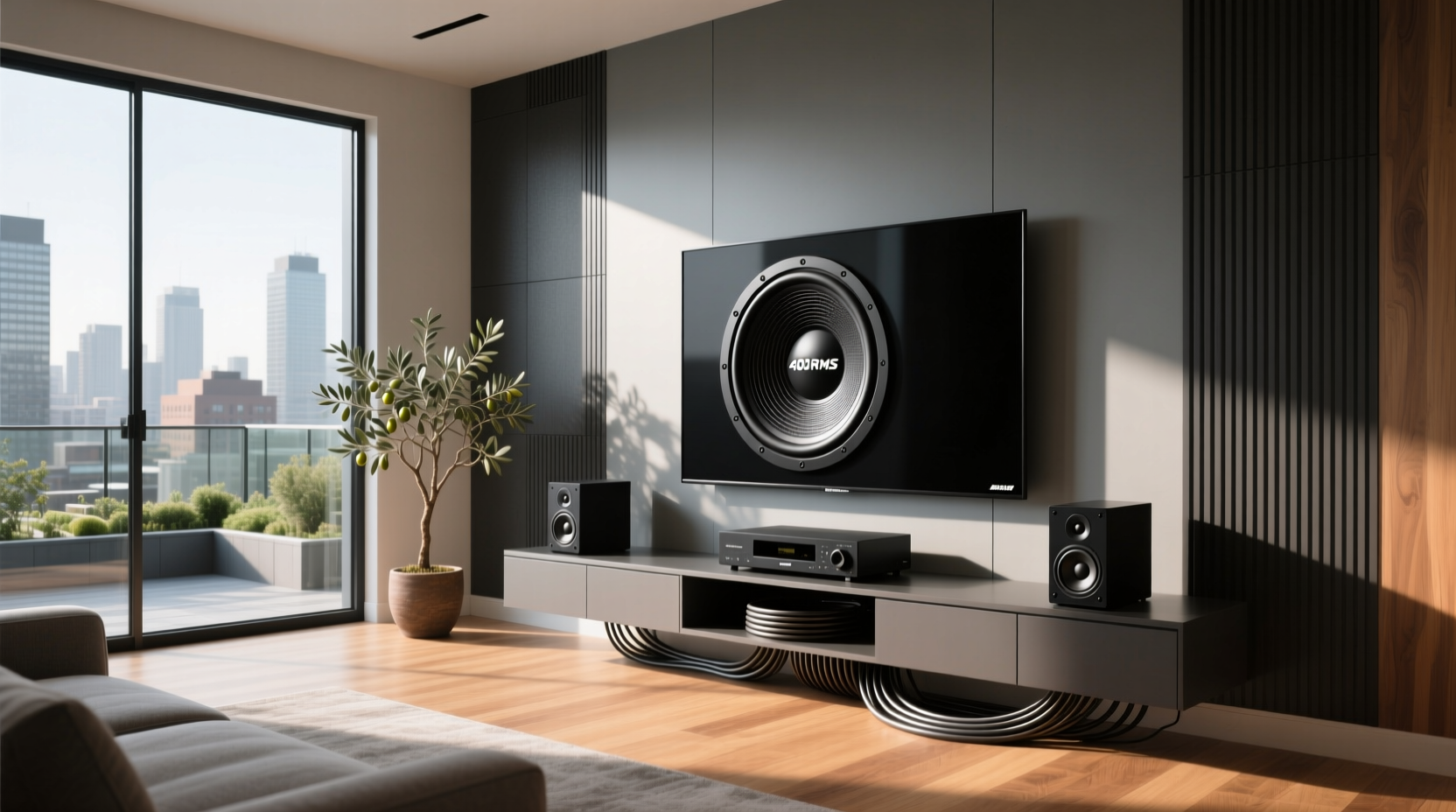
When shopping for a car audio upgrade, one of the most common questions is: what does 400 watts RMS mean for a subwoofer? Unlike peak power ratings, which can be misleading, RMS (Root Mean Square) measures the continuous power a subwoofer can handle or produce over time — making it a far more reliable indicator of real-world performance. A 400 RMS subwoofer delivers consistent, clean bass without distortion, especially when paired with an appropriately matched amplifier. This guide breaks down everything you need to know about 400-watt RMS subwoofers, including how they compare to higher- or lower-powered models, ideal enclosure types, wiring configurations, and key considerations like impedance, sensitivity, and vehicle compatibility.
Understanding RMS vs. Peak Power in Subwoofers
One of the biggest sources of confusion among consumers is the difference between RMS and peak power ratings. Many manufacturers advertise subwoofers using peak power because the number looks more impressive — but this figure represents only short bursts of energy, not sustained output. ⚡
RMS (Root Mean Square) is a mathematical method used to calculate the average continuous power a subwoofer can handle or an amplifier can deliver. For example, a subwoofer rated at 400 watts RMS is designed to operate safely and efficiently with a constant input of 400 watts. This makes RMS the standard by which professionals and audiophiles evaluate system compatibility and long-term reliability.
In contrast, peak power might list the same subwoofer as "800W peak," suggesting it can briefly withstand spikes during loud transients like drum hits. However, relying on peak ratings alone can lead to mismatched systems, underpowered amplification, or even damage due to clipping or overheating.
✅ Key takeaway: Always match your amplifier’s RMS output to your subwoofer’s RMS rating for optimal performance and longevity. If your sub is rated for 400W RMS, aim for an amp that outputs between 350W and 450W RMS into the correct load (e.g., 2 ohms or 4 ohms).
Is a 400-Watt RMS Subwoofer Enough for Good Bass?
This is one of the most frequently asked questions: "Can a 400-watt RMS subwoofer provide deep, powerful bass?" The answer depends on several factors beyond raw wattage, including:
- 🔊 Speaker efficiency (sensitivity rating in dB)
- 📏 Enclosure type (sealed, ported, bandpass)
- 🔌 Impedance (ohm load: 2Ω, 4Ω, dual voice coil)
- 🎛️ Amplifier quality and stability
- 🚗 Vehicle size and interior acoustics
A high-sensitivity subwoofer (e.g., 88 dB or higher) will produce louder sound with less power than a low-sensitivity model (e.g., 84 dB), meaning a 400W RMS driver with good efficiency can outperform a 600W RMS unit with poor sensitivity. Similarly, a well-designed ported enclosure can enhance bass output significantly compared to a basic sealed box, allowing a 400-watt sub to feel much more powerful.
For compact to midsize vehicles, a single 10-inch or 12-inch subwoofer handling 400W RMS is often sufficient for enjoyable, room-filling bass. In larger SUVs or trucks, adding a second subwoofer or upgrading to a slightly higher-powered system may be preferable.
Choosing the Right Subwoofer Size for 400 Watts RMS
Subwoofer size plays a major role in how a given amount of power translates into perceived bass. Common sizes include 8", 10", 12", and 15" drivers. Each has its strengths depending on space constraints and sonic goals.
| Subwoofer Size | Best For | Bass Characteristics | Space Required |
|---|---|---|---|
| 8-inch | Small cars, stealth installs | Tight, fast bass; limited deep extension | Minimal |
| 10-inch | Most sedans and hatchbacks | Balanced punch and depth | Moderate |
| 12-inch | SUVs, trucks, enthusiasts | Strong low-end response, impactful thump | Significant |
| 15-inch | Larger vehicles, competition audio | Maximum air movement, deepest bass | Large enclosure needed |
A 400-watt RMS input works well with 10" and 12" subwoofers in typical daily-driven vehicles. An 8-inch may struggle to move enough air for satisfying bass despite adequate power, while a 15-inch typically benefits from higher wattage (600W+ RMS) to reach full potential.
Enclosure Types and Their Impact on 400W RMS Performance
The enclosure (or box) your subwoofer is mounted in dramatically affects sound quality, efficiency, and frequency response. There are three primary types:
Sealed Enclosures
📦 Sealed boxes are airtight and generally smaller in volume. They offer tight, accurate bass reproduction with excellent transient response — ideal for music genres like jazz, rock, or vocal-heavy tracks where clarity matters more than sheer volume.
With a 400W RMS sub, a sealed enclosure ensures controlled cone movement and reduced risk of mechanical failure. These are also easier to install in limited spaces like trunk shelves or under seats.
Ported (Bass Reflex) Enclosures
🎵 Ported boxes feature a tuned vent or port that enhances low-frequency output. They are more efficient than sealed designs, meaning they can produce louder bass with the same amplifier power — a significant advantage for maximizing impact from a 400-watt system.
However, ported enclosures are larger and require precise tuning based on the subwoofer’s Thiele/Small parameters (like Fs, Qts, Vas). Misalignment can result in boomy, muddy bass or reduced output.
Bandpass Enclosures
🎯 Bandpass designs combine elements of both sealed and ported boxes, routing sound through a chamber before exiting via a port. They’re highly directional and efficient within a narrow frequency range, making them popular for SPL (Sound Pressure Level) competitions.
While capable of extreme loudness with 400W input, bandpass enclosures sacrifice musical accuracy and flexibility. They’re best suited for users focused solely on maximum perceived volume rather than fidelity.
Impedance and Amplifier Matching for 400W RMS Subwoofers
One of the most critical aspects of setting up a subwoofer is ensuring proper impedance matching between the sub and amplifier. Impedance, measured in ohms (Ω), determines how much electrical load the amplifier sees.
Common configurations for a 400W RMS sub include:
- Dual 2-ohm voice coils
- Single 4-ohm
- Dual 4-ohm
An amplifier's power output varies depending on the load. For instance, many Class D mono amps double their output when impedance is halved:
| Amplifier Output @ 4Ω | Output @ 2Ω | Ideal Subwoofer Match |
|---|---|---|
| 200W RMS | 400W RMS | Dual 2-ohm DVC wired to 2Ω total |
| 300W RMS | 600W RMS | May overpower a 400W RMS sub if not gain-controlled |
| 400W RMS | N/A (stable only at 4Ω) | Single 4-ohm SVC sub |
To safely drive a 400W RMS sub, choose an amplifier whose output closely matches that rating at the intended impedance. Avoid gross mismatches — such as pairing a 1000W RMS amp with a 400W RMS sub — unless you carefully adjust the gain and use low-pass and subsonic filters to prevent distortion and overexcursion.
Real-World Applications: Where Does a 400W RMS Subwoofer Fit?
🛒 While high-power subwoofers (e.g., 1000W or 3000W RMS) dominate online marketplaces and YouTube videos, most daily drivers don’t need that level of output. A 400-watt RMS system strikes a practical balance between performance, cost, and electrical demands.
Consider these scenarios:
- Commuter sedan: A 10-inch sealed sub with 400W RMS provides rich, unobtrusive bass without draining the battery or requiring extensive modifications.
- Family SUV: A 12-inch ported sub on 400W RMS fills the cabin with energetic bass for movies and music, suitable for both adults and teens.
- Budget-conscious upgrade: Users replacing factory speakers can achieve dramatic improvements without investing in high-output alternators or capacitor banks.
In contrast, systems advertised with 3000W RMS (often found on global B2B platforms like Alibaba.com1) are typically aimed at commercial installations, marine environments, or competitive audio setups where extreme SPL is the goal — not everyday listening.
Common Misconceptions About Subwoofer Power Ratings
❗ Despite widespread availability of technical data, misconceptions persist:
Misconception #1: Higher RMS always means better bass.
Not true. A 600W RMS sub with poor sensitivity and incorrect enclosure tuning may sound weaker than a well-matched 400W RMS system.
Misconception #2: All 400W RMS subwoofers perform the same.
False. Build quality, cone material (paper, polypropylene, carbon fiber), surround type (rubber, foam), magnet size, and cooling design all influence durability and sound character.
Misconception #3: You need massive power to hear bass.
Human hearing is less sensitive to low frequencies, but proper placement (e.g., rear deck, trunk corner) and cabin gain in enclosed spaces naturally boost bass perception — reducing the need for excessive wattage.
How to Verify True RMS Ratings Before Buying
🔍 Not all RMS ratings are created equal. Some budget manufacturers inflate specs or use non-standard testing methods. To verify legitimacy:
- Check for CEA-2006 compliance (for marine/audio equipment), which standardizes power measurement.
- Look for independent reviews or third-party bench tests measuring actual power delivery.
- Avoid products listing only "maximum" or "peak" power without RMS values.
- Review product manuals or spec sheets for test conditions (e.g., frequency range, THD level).
If a subwoofer claims 400W RMS but lacks supporting documentation or comes from an unknown brand with no technical support, proceed with caution.
Maintenance and Longevity Tips for 400W RMS Subwoofers
🔧 Even well-designed subwoofers can fail prematurely if misused. Follow these tips to extend lifespan:
- Set amplifier gain correctly to avoid clipping (distorted signal damages voice coils).
- Use a low-pass filter (typically 80–120 Hz) to block midrange frequencies.
- Engage a subsonic filter (< 30 Hz) to prevent excessive cone movement from inaudible tones.
- Ensure proper ventilation around the motor structure to dissipate heat.
- Inspect wiring periodically for loose connections or corrosion.
Regional Differences in Subwoofer Preferences and Availability
🌍 Consumer preferences vary globally. In North America, larger subs (12"–15") with ported enclosures dominate. In Europe and urban Asian markets, compact powered subwoofers or stealth boxes are favored due to smaller vehicle sizes and parking constraints.
Additionally, voltage standards and electrical system capacity differ. Vehicles in regions with frequent stop-start driving may benefit from stiffening capacitors or upgraded charging systems when running any amplified audio — even moderate 400W RMS setups.
Conclusion: Is a 400-Watt RMS Subwoofer Right for You?
After reviewing power ratings, enclosure options, impedance matching, and real-world usage, the evidence suggests that a 400-watt RMS subwoofer is a smart choice for most car audio upgrades. It offers strong, clean bass without excessive complexity or strain on your vehicle’s electrical system. When properly matched to an amplifier and installed in the right enclosure, it delivers performance that exceeds expectations — especially compared to factory audio systems.
The key is focusing on system synergy rather than chasing inflated power numbers. Prioritize build quality, correct installation, and personal listening preferences over marketing claims.
Frequently Asked Questions
❓ Can I run a 400W RMS subwoofer with a smaller amplifier?
Yes, but you’ll get reduced output. Just ensure the amp is stable at the sub’s impedance. Underpowering is safer than overpowering, as long as you avoid distortion from turning the gain too high.
❓ What happens if I exceed 400W RMS on my subwoofer?
Exceeding the RMS rating risks overheating the voice coil, leading to warping, melting, or complete failure. Short bursts near peak rating are acceptable, but continuous overdriving causes permanent damage.
❓ Do I need a capacitor for a 400W RMS subwoofer?
Usually not. Most factory alternators and batteries handle 400W loads without issue. Capacitors help mainly in systems over 800–1000W RMS or when headlights dim noticeably during heavy bass notes.
❓ How do I know if my car can fit a 400W RMS sub setup?
Measure available space in the trunk or under seats. Pre-fabricated enclosures are available for common sub sizes. Alternatively, custom fiberglass enclosures can maximize space utilization in tight areas.
❓ Are dual voice coil (DVC) subwoofers better for 400W RMS applications?
DVC subs offer greater wiring flexibility (e.g., 2Ω or 4Ω final load), making them easier to pair with different amplifiers. Whether they’re “better” depends on your specific amp and installation goals.




 浙公网安备
33010002000092号
 浙B2-20120091-4