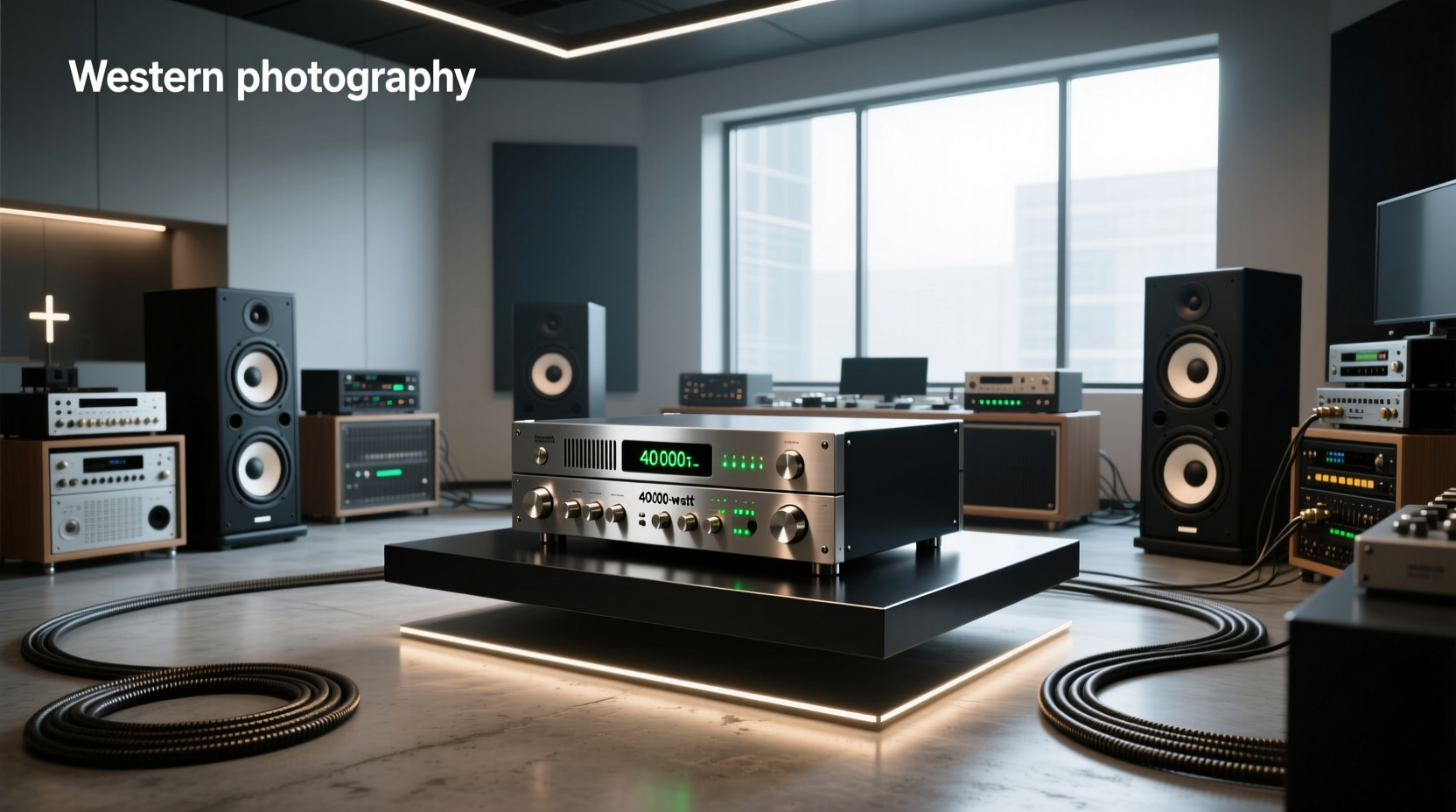
When you search for a 40000 watt amplifier, it’s critical to understand that most products labeled with this number are not delivering 40,000 watts RMS under real-world conditions. Instead, many use exaggerated peak or PMPO (Peak Music Power Output) ratings that don’t reflect usable power. True high-power amplifiers in the 30,000–40,000 watt range—such as the Taramps BASS 30K or The Loud Factory FP30000Q—are typically Class D monoblock designs rated at 1-ohm loads and marketed for extreme car audio competitions, not daily driving. These systems demand massive electrical upgrades, including multiple batteries, high-output alternators, and heavy-duty cabling, making them impractical for average users.
What Does a 40000 Watt Amplifier Really Mean?
The term 40000 watt amplifier is often misleading due to inconsistent industry standards in power rating. In reality, there are three primary ways manufacturers report amplifier output:
- RMS (Root Mean Square): This measures continuous power output and is the most accurate indicator of real performance. A true 40,000-watt RMS amplifier would be extremely rare and prohibitively expensive.
- Peak Power: Reflects short bursts of energy, often double or triple the RMS value. Many so-called 40,000-watt amps list this figure instead of RMS.
- PMPO (Peak Music Power Output): An outdated and inflated metric used primarily on budget equipment. It has no standardized test method and can be hundreds of times higher than actual output.
For example, an amp advertised as a “40000 watt amplifier” might only deliver 5,000–7,000 watts RMS into a 1-ohm load. Always check the RMS rating at specific impedances (e.g., 2Ω, 1Ω) and ensure it's verified by independent testing if possible.
Why Do Manufacturers Use Such High Numbers?
Marketing plays a significant role in the use of terms like 40000 watt amplifier. Consumers often equate higher wattage with better sound quality or louder volume, even though efficiency, speaker sensitivity, and system tuning matter more in practice. Some brands exploit this perception by highlighting unrealistic numbers to attract attention online.
This trend is especially prevalent in niche markets such as competitive sound pressure level (SPL) vehicles, where builders push amplifiers beyond normal limits using elevated voltages (e.g., 20V+ from capacitor banks). Under these non-standard conditions, brief outputs may approach 30,000–40,000 watts, but they’re unsustainable and unsafe for regular use.
Technical Feasibility of a 40000 Watt System
To run a system capable of producing close to 40,000 watts of audio output, several technical and safety considerations must be addressed:
🔋 Electrical Requirements
A 40,000-watt RMS amplifier would require enormous current draw. Using Ohm’s Law (P = V × I), we can estimate the amperage needed:
- At 14.4 volts (typical car voltage):
40,000W ÷ 14.4V ≈ 2,778 amps - Even at 20 volts (with boosted systems):
40,000W ÷ 20V = 2,000 amps
No standard vehicle electrical system can support this without extensive modifications. Most high-end competition builds use:
- Multiple deep-cycle AGM or lithium batteries (6–12 units)
- Dual or triple high-output alternators (300A+ each)
- Capacitor banks to handle transient spikes
- 0-gauge or larger power/ground cables (often paralleled)
Without these, attempting to drive such an amplifier will result in voltage drops, blown fuses, or fire hazards.
🌡️ Heat Dissipation & Reliability
Class D amplifiers are preferred for high-power applications due to their efficiency (~80–90%), but even then, a 40,000-watt unit could generate 4,000–8,000 watts of heat. Proper ventilation, heatsinks, and sometimes forced air or liquid cooling are necessary to prevent thermal shutdown or component failure.
🔊 Speaker Compatibility
No single subwoofer can handle 40,000 watts continuously. Even robust competition-grade drivers like the Sundown Audio SA-1 or Rockford Fosgate ProSonic series are typically rated up to 5,000–8,000 watts RMS each. To distribute 40,000 watts safely, you’d need multiple voice coils wired in parallel across dozens of subs—an arrangement seen only in SPL record attempts.
Are There Real 40000 Watt Amplifiers Available?
As of now, no commercially available amplifier delivers 40,000 watts RMS under standard operating conditions. However, some models come close under ideal, non-automotive settings:
- Taramps BASS 30K: Advertised as 30,000 watts at 1 ohm, though independent tests suggest ~15,000–20,000 watts RMS depending on input voltage.
- The Loud Factory FP30000Q: A 4-channel pro audio amplifier claiming 30,000 watts total output; again, likely peak or bridged power rather than per-channel RMS.
- Marts Digital MXD-30000W-1-V2: Marketed as a 30,000-watt monoblock, popular among YouTube testers pushing modified systems.
While none reach 40,000 watts RMS, these amplifiers represent the upper edge of consumer-available technology. Claims exceeding 30,000 watts should be treated skeptically unless backed by third-party bench testing.
Common Misconceptions About Ultra-High-Wattage Amps
Several myths persist around amplifiers labeled as 40000 watt amplifier. Understanding these helps avoid costly mistakes:
❌ More Watts = Better Sound Quality
Wattage relates to loudness potential, not fidelity. A well-tuned 1,000-watt system with efficient speakers often sounds clearer and deeper than a poorly configured 10,000-watt setup. Distortion increases rapidly when amplifiers are overdriven or mismatched to speakers.
❌ Any Car Can Handle a 40,000-Watt System
Most factory electrical systems max out at 100–150 amps. Adding a 1,000-watt amplifier already strains them. A theoretical 40,000-watt system would require rewiring the entire vehicle, upgrading the alternator, and adding auxiliary power storage—costing tens of thousands of dollars.
❌ All Channels Deliver Full Power Simultaneously
In multi-channel amps, total power is often shared across channels. A “30,000-watt 4-channel” amp doesn’t mean 7,500 watts per channel; it may only deliver full power when two or fewer channels are active.
❌ Voltage Boosting Is Safe and Sustainable
Some enthusiasts use DC-DC boosters to increase system voltage to 18–24V, artificially inflating power output. While this works temporarily, it risks damaging amplifiers, batteries, and electronics not designed for overvoltage operation.
Practical Alternatives to a 40000 Watt Amplifier
For most users, aiming for a realistic and functional audio system makes more sense. Consider these alternatives based on your goals:
🚗 Daily Drivers & Street Sound Systems
- Target Power: 500–2,000 watts RMS
- Recommended Setup: 1–2 high-efficiency subwoofers powered by a reliable Class D monoblock (e.g., 1,000–1,500W)
- Electrical Needs: Upgraded battery and 4-gauge wiring usually sufficient
- Benefits: Balanced bass response, minimal strain on vehicle, lower cost
🏆 SPL Competitions & Extreme Builds
- Target Power: 10,000–30,000 watts RMS
- Recommended Setup: Multiple amplifiers, custom enclosures, lightweight vehicles optimized for acoustics
- Electrical Needs: Dual alternators, 6+ batteries, 0000-gauge cabling, professional installation
- Benefits: Record-breaking decibel levels, competitive edge
🎵 Home or Stage Audio Applications
If your goal isn’t vehicle-based, consider commercial PA amplifiers designed for large venues. Brands like Crown, QSC, and Yamaha offer rack-mountable units with combined outputs reaching 10,000+ watts RMS—more practical and safer than automotive solutions.
How to Evaluate High-Power Amplifier Claims
Before investing in any amplifier advertised near the 40,000-watt mark, follow these verification steps:
🔍 Check the Specifications Sheet
Look for:
- RMS power at 2Ω, 1Ω, and 4Ω loads
- Test conditions (voltage, THD level, frequency range)
- Efficiency rating and thermal protection features
Absence of detailed specs suggests unreliable claims.
📊 Seek Independent Testing
Websites like 1 and YouTube channels specializing in car audio bench tests (e.g., CarAudioFabrication, BoostedBoys) often measure actual output. Compare advertised vs. tested results.
🔧 Assess Installation Complexity
Ask yourself:
- Do I have space for multiple batteries and amplifiers?
- Can my garage accommodate welding or fabrication for mounting?
- Am I prepared for ongoing maintenance and troubleshooting?
If not, scaling down is advisable.
💰 Total Cost Evaluation
Beyond the amplifier price ($1,000–$3,500 for top-tier 30K-class units), factor in:
- Batteries: $200–$500 each
- Alternators: $400–$1,000+
- Cabling and fuses: $300–$800
- Professional labor: $1,000–$5,000+
Total project costs can exceed $20,000—even for a 30,000-watt system.
Regional Differences and Legal Considerations
Extreme audio systems face legal restrictions in many regions:
- United States: Most states limit interior noise levels (e.g., 80–90 dB at 50 feet). Exceeding these can result in fines.
- European Union: Strict noise pollution laws under Directive 2002/49/EC restrict public operation of excessively loud vehicles.
- Australia & Canada: Similar regulations apply, with enforcement varying by province/state.
Additionally, insurance providers may refuse coverage for modified electrical systems causing fire risks.
Conclusion: Should You Buy a 40000 Watt Amplifier?
In short: only if you're building a dedicated competition vehicle. For everyday listening, home theater, or mobile entertainment, a 40,000-watt amplifier is unnecessary, dangerous, and economically unjustifiable. Focus instead on matching amplifier power to speaker capabilities, ensuring clean signal delivery, and optimizing enclosure design.
The pursuit of extreme wattage often distracts from what truly matters: musical accuracy, dynamic range, and system reliability. By understanding the realities behind labels like 40000 watt amplifier, you can make informed decisions that align with your actual needs—not marketing hype.
Frequently Asked Questions
- Can a 40000 watt amplifier be used in a regular car?
- No. A typical passenger vehicle cannot support the electrical demands of a 40,000-watt amplifier. Doing so would cause immediate voltage collapse, blown components, or fire hazards. Only heavily modified competition vehicles with upgraded power systems can attempt such setups.
- What size alternator do I need for a 30,000-watt amplifier?
- Assuming 50% efficiency and 14.4V operation, a 30,000-watt RMS amplifier draws roughly 2,000+ amps. You’d need at least three 300–400A high-output alternators combined with 6–12 AGM batteries and a capacitor bank. Single alternator systems are insufficient.
- Is 30,000 watts enough for a sound competition?
- Yes, in specialized SPL events, 30,000 watts is competitive. When paired with optimized enclosures, lightweight vehicles, and precise tuning, such systems have achieved over 180 dB. However, success depends more on engineering than raw power alone.
- Are 40000 watt amplifiers real or just marketing?
- They are largely marketing exaggerations. No verified amplifier delivers 40,000 watts RMS under standard conditions. Most operate between 15,000–30,000 watts peak in boosted environments. Always verify RMS ratings through independent testing.
- How much does it cost to build a 30,000-watt car audio system?
- Total costs typically range from $15,000 to $30,000+, including amplifiers ($2,000–$4,000), batteries ($3,000+), alternators ($2,000+), cabling, capacitors, subs, and professional installation.




 浙公网安备
33010002000092号
 浙B2-20120091-4