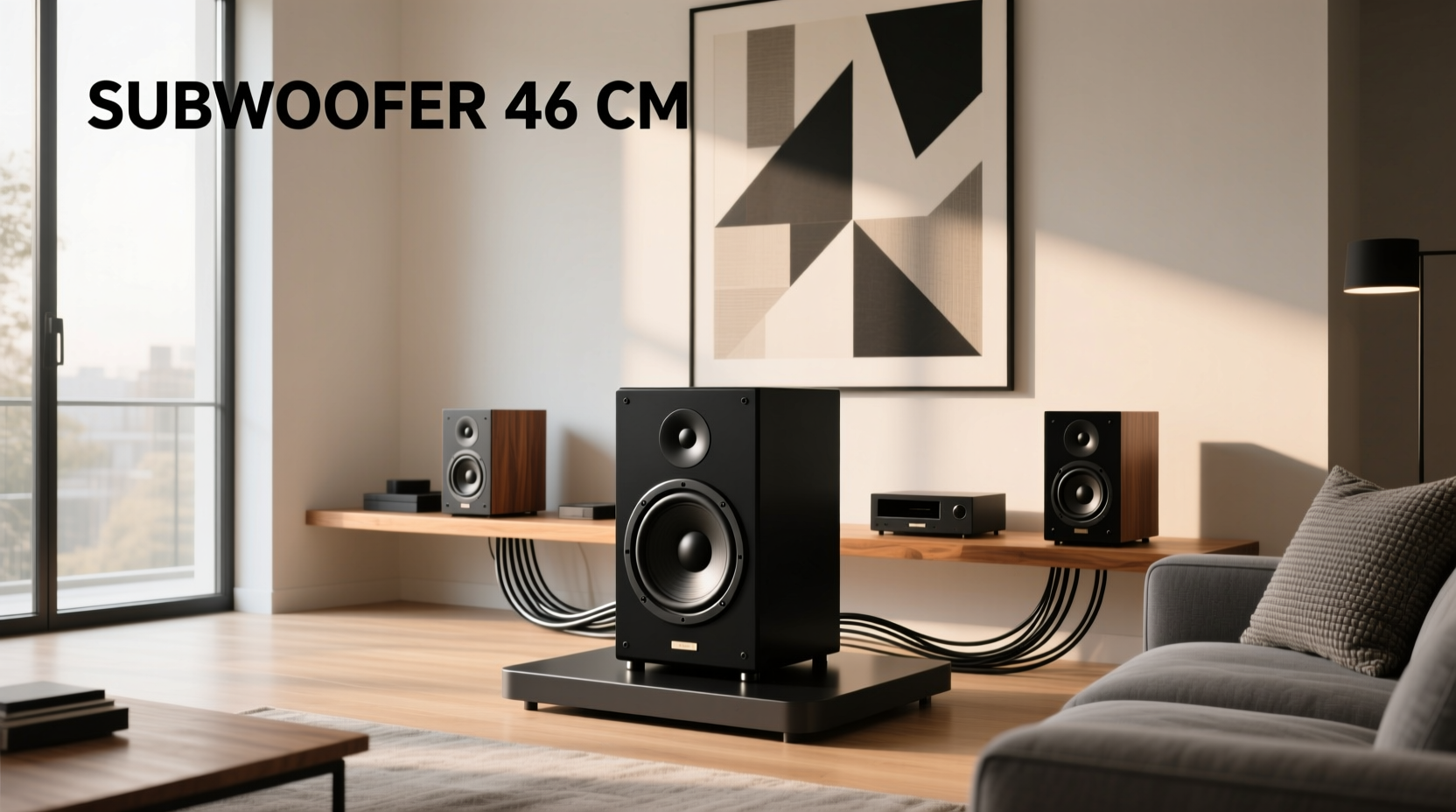
When searching for deep, powerful bass—especially in competitive audio environments or high-output live sound setups—the subwoofer 46 cm (commonly known as an 18-inch subwoofer) stands out as a top choice. This size corresponds exactly to 18 inches in diameter, making it a standard in both car audio SPL (Sound Pressure Level) competitions and professional sound reinforcement systems. But what makes a 46 cm subwoofer different from smaller models? And how do you choose the right one based on your needs—whether for maximum loudness, low-frequency extension, or reliability under continuous use?
A 46 cm subwoofer is typically designed to move large volumes of air, enabling it to produce extremely high SPLs, often exceeding 130 dB when properly configured1. These subs are commonly used in SPL car audio builds, mobile DJ rigs, and touring PA systems where sheer output matters. However, size alone doesn’t guarantee performance—factors like voice coil design, cone material, magnet structure, power handling (RMS vs peak), enclosure type, and impedance all play critical roles in real-world results.
Understanding Subwoofer Sizing: What Does 46 cm Mean?
The term "subwoofer 46 cm" refers to the nominal diameter of the speaker’s cone, which equals approximately 18 inches. While this may seem like a simple conversion, it's important to note that actual mounting dimensions can vary slightly between manufacturers due to differences in frame design and flange width.
In practical terms, a 46 cm (18”) subwoofer is among the largest commonly available sizes for consumer and semi-professional applications. It sits at the upper end of the spectrum, just below 21” and 24” drivers that are rarer and mostly used in extreme SPL competitions or specialized installations.
🔍 Key Insight: Not all 46 cm subwoofers are built the same. Some prioritize maximum SPL (e.g., competition-grade models like the Ground Zero GZPW 18SPL with 15,000 watts RMS capability), while others focus on musical accuracy or compact form factors for stage monitoring2.
Passive vs Active 46 cm Subwoofers: Which Should You Choose?
One of the first decisions you'll face when selecting a 46 cm subwoofer is whether to go with a passive or active (powered) model.
🔧 Passive Subwoofers
Passive 46 cm subwoofers require an external amplifier to function. They offer greater flexibility in system tuning since you can pair them with amplifiers that match your desired power output and DSP capabilities.
- Pros: Customizable power delivery, better integration into multi-component systems, often more cost-effective at high power levels.
- Cons: Require additional space for amplifiers and cabling; setup complexity increases with impedance matching and crossover configuration.
- Best for: Advanced users building custom enclosures or competing in SPL events.
Examples include the Dayton Audio RSS460HO-4 and Eighteen Sound 18TLW3000—both designed for high-excursion, high-SPL applications.
⚡ Active (Powered) Subwoofers
Active 46 cm subwoofers come with a built-in amplifier, DSP, and sometimes even thermal protection and auto-signal sensing. These units simplify installation and reduce component clutter.
- Pros: Plug-and-play operation, optimized amp-to-driver matching, often include input filtering and phase controls.
- Cons: Less flexibility in upgrading individual components; heavier due to integrated electronics.
- Best for: Live sound engineers, DJs, and home theater integrators who value reliability and quick deployment.
The RCF SUB 18-AS and Yamaha DXS18XLF are examples of professional-grade active 46 cm subwoofers offering up to 136 dB max SPL3.
SPL Explained: Why It Matters for 46 cm Subwoofers
SPL, or Sound Pressure Level, measures how loud a sound is perceived, expressed in decibels (dB). In the context of a subwoofer 46 cm for SPL competitions, the goal is often to achieve the highest possible dB reading at specific frequencies (typically around 50–60 Hz).
However, higher SPL doesn’t always mean better bass quality. Here’s what you need to know:
| Factor | Impact on SPL | Considerations |
|---|---|---|
| Power Handling (RMS) | Higher wattage supports louder output | Ensure amplifier matches RMS rating, not peak |
| Voice Coil Size & Type | Larger dual coils allow better heat dissipation | Dual 2Ω or 4Ω configurations offer wiring flexibility |
| Cone Material | Carbon fiber or polypropylene affects stiffness and weight | Lighter cones respond faster but may lack punch |
| Excursion (Xmax) | Greater linear travel moves more air | High excursion requires robust suspension |
| Enclosure Design | Bass reflex vs sealed impacts efficiency and tuning | Reflex ports boost output near resonance frequency |
📌 Note: Many listings advertise "max power" or "peak wattage," which can be misleading. Always check the RMS (continuous) power handling for realistic performance expectations.
Frequency Response and Deep Bass: Can a 46 cm Sub Go Lower Than Smaller Models?
A common misconception is that larger subwoofers automatically reproduce lower frequencies. While a 46 cm driver has the physical potential to reach deeper than a 10” or 12”, its actual low-end extension depends heavily on several factors:
- Free-air resonance (Fs): A lower Fs indicates better ability to reproduce very low notes.
- Enclosure tuning: Sealed boxes roll off gradually but control the driver well; ported (bass reflex) designs extend lower but require precise tuning.
- Group delay and phase coherence: Important in live sound to maintain timing accuracy across the system.
For example, some 46 cm subwoofers are tuned to operate effectively down to 20 Hz (like the Ground Zero GZPW 18SPL), while others may only dip reliably to 40 Hz depending on the application.
Installation Considerations for 46 cm Subwoofers
Due to their size and weight—often over 40 kg—a 46 cm subwoofer demands careful planning during installation.
📍 Physical Space Requirements
Check these measurements before purchasing:
- Mounting depth: Some models exceed 290 mm, requiring deep enclosures or recessed mounting.
- Cutting diameter: Typically around 410–430 mm; verify compatibility with your cabinet or vehicle cutout.
- Clearance behind cone: Avoid placing near walls or obstructions if using in free-standing mode.
🚚 Portability and Mounting
In live sound applications, consider:
- Integrated handles or rigging points
- Tour-grade birch plywood cabinets with durable coatings
- Floor glides or caster kits for easier movement
Many professional 46 cm active subs, such as the RCF SUB 18-AS, feature rugged construction suitable for frequent transport.
Common Misconceptions About 46 cm Subwoofers
Despite their popularity, several myths persist about large-format subwoofers:
❌ Myth 1: Bigger Always Means Louder
Not true. An inefficient 46 cm sub driven by an underpowered amp will perform worse than a well-matched 15” system. Efficiency (measured in dB/W/m) and system synergy matter more than raw size.
❌ Myth 2: All 18-Inch Subs Are for SPL Competitions
While many 46 cm subs excel in SPL scenarios, they’re also widely used in concerts, festivals, and fixed installations where full-range extension and headroom are needed.
❌ Myth 3: Higher Wattage = Better Performance
A 15,000-watt RMS subwoofer isn't inherently better unless your electrical system and listening environment can support it. Overpowering leads to distortion, overheating, and mechanical failure.
How to Evaluate 46 cm Subwoofer Specifications Honestly
Manufacturers often highlight best-case numbers. To make informed comparisons, focus on standardized metrics:
- Sensitivity (dB @ 1W/1m): Indicates efficiency. Look for values between 92–98 dB for passive models.
- Impedance: Common options are 2Ω, 4Ω, or dual-coil variants. Lower impedance allows more power draw but stresses amplifiers.
- Xmax (maximum linear excursion): Critical for SPL. Values above 20 mm indicate strong air-moving capability.
- Thiele/Small parameters: Used by engineers to model performance in various enclosures.
⚙️ Pro Tip: Request full T/S parameter sheets from reputable suppliers when designing custom enclosures.
Regional Differences and Availability
The availability of 46 cm subwoofers varies by region. In Europe, brands like RCF, Ground Zero, and Eighteen Sound dominate the professional market, while North American users often favor JL Audio, Sundown Audio, or Hifonics for car audio SPL builds.
Pricing also reflects regional taxes, shipping costs, and import duties. For instance, a Ground Zero GZPW 18SPL priced at €1,994 in Italy might carry a significantly higher retail tag in non-EU countries due to logistics and tariffs.
Real-World Use Cases: Where Do 46 cm Subwoofers Shine?
Here are three primary scenarios where a 46 cm subwoofer delivers unmatched performance:
👥 SPL Car Audio Competitions
In dB drag races, every fraction of a decibel counts. High-power 46 cm drivers in tightly sealed or bandpass enclosures are engineered to maximize output at narrow frequency bands.
🏭 Live Sound Reinforcement
Concert venues and outdoor events rely on arrays of 46 cm active subs to deliver chest-thumping bass across large audiences. Their ability to sustain high SPL over long durations makes them ideal for touring systems.
🏠 High-Impact Home Theaters
Enthusiasts seeking cinematic rumble—from explosions to thunder—opt for 46 cm subs paired with proper room treatment and calibration tools like REW (Room EQ Wizard).
Shopping Tips: What to Watch Out For
Before buying a subwoofer labeled as “46 cm” or “18 inch,” keep these red flags in mind:
- 🚫 Vague power ratings (e.g., “up to 8000W”) without RMS specification
- 🚫 Missing sensitivity or Thiele/Small data
- 🚫 No information on recommended enclosure volume or tuning
- 🚫 Poor customer reviews regarding build quality or burnout rates
✅ Always cross-reference product specs across multiple vendor sites and forums like Reddit’s r/hometheater or Facebook groups focused on mobile audio.
Maintenance and Longevity
To extend the life of your 46 cm subwoofer:
- 🔋 Avoid clipping by ensuring clean gain staging
- 🌡️ Allow adequate ventilation, especially for powered models with Class D amps
- 🧼 Clean dust caps periodically to prevent debris buildup
- 🎛️ Use high-pass filters to protect against subsonic content
Overdriving a subwoofer—even briefly—can lead to voice coil damage, surround tearing, or spider deformation.
Conclusion: Is a 46 cm Subwoofer Right for You?
A 46 cm (18-inch) subwoofer offers exceptional air-moving capability and is a proven solution for applications demanding high SPL and impactful bass. Whether you're building a competition-level car audio system, deploying a live event PA, or enhancing a premium home theater, understanding the technical specifications, enclosure requirements, and realistic performance limits is crucial.
Ultimately, success comes not from choosing the biggest subwoofer, but from selecting the right one for your acoustic goals, power supply, and physical constraints. Prioritize verified RMS ratings, proven brand engineering, and honest user feedback over marketing hype.
Frequently Asked Questions
- ❓ What does SPL mean in subwoofers?
- SPL stands for Sound Pressure Level, measured in decibels (dB). It indicates how loud a subwoofer can play. High-SPL subwoofers are designed for maximum output, often used in competitions or large venues.
- ❓ Are 18-inch subwoofers better than 12-inch ones?
- Not necessarily. 18-inch subwoofers move more air and can produce higher SPL and deeper bass *if properly powered and enclosed*, but 12-inch models may offer tighter, faster response in smaller spaces.
- ❓ Can I install a 46 cm subwoofer in my car?
- Yes, but it requires significant space—usually in the trunk or via a custom enclosure. Ensure your vehicle’s electrical system can handle the amplifier load (high-current alternator, upgraded battery).
- ❓ What is the difference between RMS and peak power in subwoofers?
- RMS (Root Mean Square) represents continuous power handling, while peak power indicates short bursts. Always base your amplifier selection on RMS ratings for reliable performance.
- ❓ Do bigger subwoofers always hit harder?
- No. "Hitting harder" depends on SPL, tuning, power delivery, and enclosure design—not just size. A well-tuned 15” system can outperform a poorly set-up 18” sub.




 浙公网安备
33010002000092号
 浙B2-20120091-4