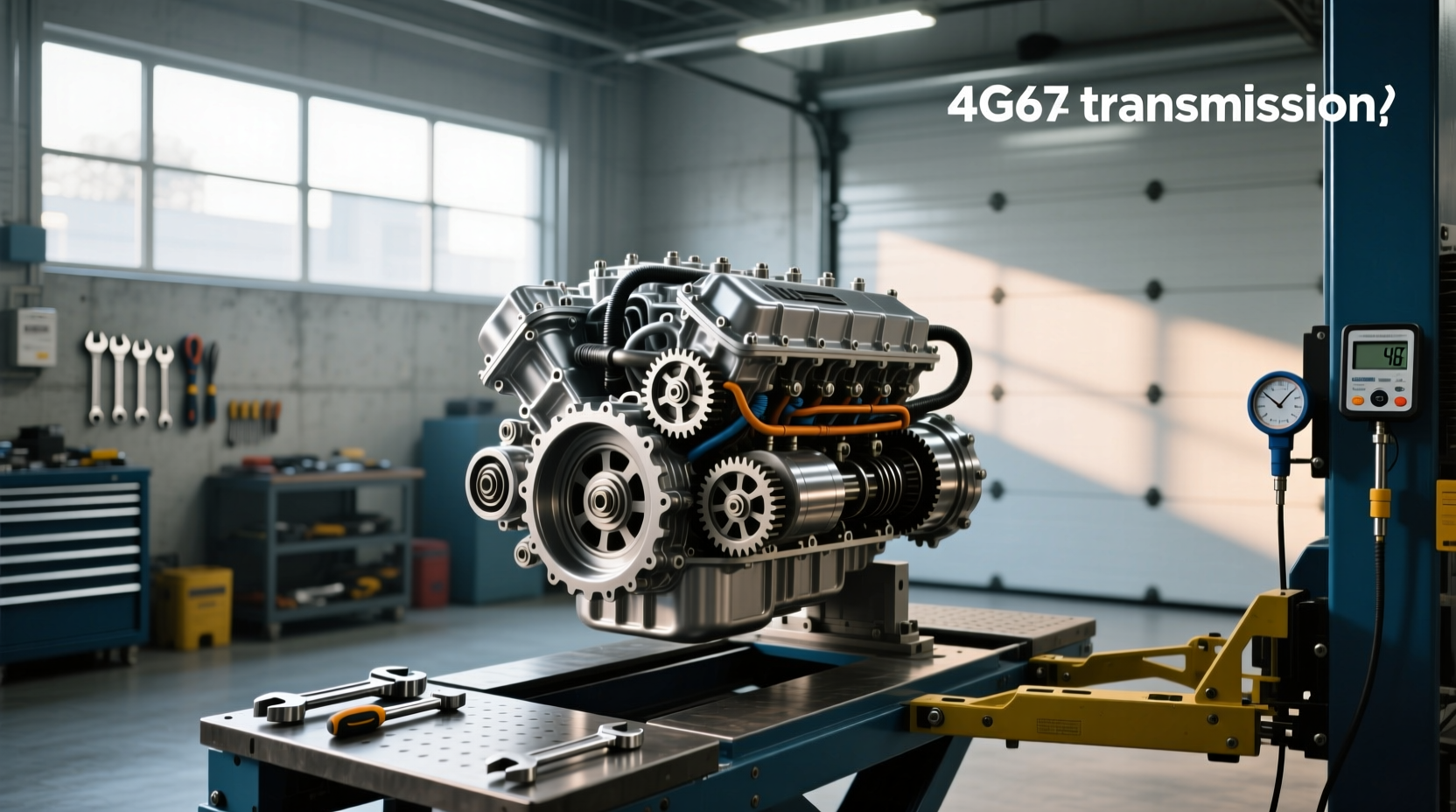
If you're working on a Mitsubishi 4G63 engine swap or sourcing a replacement transmission, one of the most frequently asked questions is whether the 4G63 transmission can be used with similar engines like the 4G64. The short answer is: yes, in many cases—but with critical caveats. Compatibility depends on the bellhousing pattern, engine block type (7-bolt vs. 8-bolt), drivetrain layout (FWD vs. RWD), and model year. This guide breaks down everything you need to know about the 4G63 transmission—including interchangeability with the 4G64, common applications, mechanical differences, and real-world installation tips—so you can avoid costly mistakes during your project.
What Is the 4G63 Transmission?
The 4G63 engine, particularly the turbocharged 4G63T found in DSM vehicles like the Mitsubishi Eclipse, Eagle Talon, and Plymouth Laser, has long been a favorite among performance enthusiasts. While much focus is placed on the engine itself, the transmission paired with it plays an equally vital role in reliability and drivability. The term “4G63 transmission” typically refers to the manual or automatic units designed for use with the 4G63-series inline-four engines, especially those from the 1990–1999 DSM generation.
These transmissions are known for their robust design, but they were engineered for specific configurations. Most commonly, the 5-speed manual transmission used behind the 4G63T is the F5M52 (also called W5A51 in automatic variants), which features a narrow bellhousing pattern unique to certain FWD DSM platforms. Understanding this foundation is essential when considering cross-compatibility with other engines such as the non-turbo 4G64.
4G63 vs. 4G64: Key Differences That Affect Transmission Fitment
To determine whether a 4G63 transmission will work with a 4G64 engine—or vice versa—you must first understand how these two engines differ mechanically. Both belong to Mitsubishi’s 4G family of SOHC/DOHC four-cylinder engines, but there are crucial distinctions:
- Bore and Stroke: The 4G63 has a bore of 85 mm and stroke of 88 mm (1997 cc), while the 4G64 increases displacement to 2.4L via a longer stroke (92 mm) and slightly larger bore (87 mm).
- Block Height: The 4G64 block is approximately 6 mm taller than the 4G63 due to its increased stroke 1. However, external mounting points—including transmission bolt patterns—are often identical.
- Bellhousing Pattern: Both engines typically use the same narrow-pattern FWD bellhousing, meaning the physical interface between engine and transmission matches across many models.
- Mounting Points: Engine mounts may vary slightly depending on chassis application (e.g., Eclipse vs. Galant), so direct swaps might require adapter brackets or modified subframes.
Despite internal differences, the external dimensions and flywheel alignment allow for potential interchangeability—especially within the same vehicle platform and drivetrain configuration.
Will a 4G63 Transmission Bolt Up to a 4G64 Engine?
In most cases involving front-wheel-drive (FWD) applications, yes—a 4G63 transmission can bolt directly onto a 4G64 engine, provided both are 7-bolt main cap variants and share the same bellhousing pattern. This compatibility is well-documented in forums and technical communities 2.
For example:
- A 1995–1999 Mitsubishi Eclipse GSX with a 4G63T engine uses a transmission that can be swapped onto a naturally aspirated 4G64-powered Eclipse RS or GS model.
- Likewise, upgrading a 4G64-equipped Galant or Outlander with a stronger 4G63 manual transmission (like the F5M52) is a feasible way to improve durability under mild forced induction.
However, key factors must be verified before proceeding:
| Factor | Why It Matters | How to Verify |
|---|---|---|
| Bellhousing Pattern | Determines physical fitment; narrow vs. wide matters | Check manufacturer specs or compare housings side-by-side |
| Drivetrain Layout (FWD/RWD) | 4G63 transmissions are mostly FWD; RWD requires adapters | Confirm original vehicle setup |
| Input Shaft Length & Spline Count | Mismatch causes clutch engagement issues | Measure or consult service manuals |
| ECU & Wiring Harness | Automatics need correct signal mapping | Match harnesses or reprogram ECU |
| Transmission Mount Position | Variations affect clearance and vibration | Compare subframe locations |
Common Applications Using the 4G63 Transmission
The 4G63 transmission was factory-installed in several high-performance and mainstream Mitsubishi and Dodge/Chrysler vehicles. Knowing where these units originated helps identify compatible donor cars when sourcing parts.
- Mitsubishi Eclipse (1G & 2G): Turbo models (GS-T, GSX) came with the F5M52 5-speed manual; NA trims had lighter-duty versions.
- Eagle Talon TSi (AWD/FF): Mechanically identical to Eclipse; excellent donor for transmission swaps.
- Plymouth Laser RS/TSi: Same drivetrain components as Talon/Eclipse twins.
- Mitsubishi Galant (certain 2.0L DOHC models): Some late-'90s VOs used 4G63-based engines with matching gearboxes.
- Lancer Evolution I–III (JDM): Early Evo models used close relatives of the F5M52, though not always directly interchangeable without modification.
When searching for a used 4G63 transmission, prioritize units from turbocharged, all-wheel-drive (AWD) DSM models—they’re built to handle higher torque loads and often feature upgraded synchronizers and bearings.
Manual vs. Automatic 4G63 Transmissions: Which Should You Choose?
While the manual 4G63 transmission (F5M52) is more popular among tuners, automatic variants (W5A51) also exist and serve different needs.
Manual (F5M52) – Best for Performance Builds ⚙️
- Pros: Stronger internals, better control, easier to modify, widely supported by aftermarket upgrades.
- Cons: Requires clutch maintenance; less smooth in daily driving; harder to find in good condition after decades of abuse.
- Torque Rating: Factory-rated around 265–280 ft-lbs, but can be upgraded to 400+ ft-lbs with aftermarket internals.
Automatic (W5A51) – Practical for Daily Drivers ✅
- Pros: Smoother shifting, better low-end response, ideal for street-driven builds or conversions where ease of use matters.
- Cons: Weaker stock form; prone to overheating under boost; limited tuning support compared to manuals.
- Torque Rating: Stock units handle ~250 ft-lbs reliably; beyond that, valve body upgrades and cooler installations are mandatory.
Your choice should depend on intended use: track-focused builds benefit from the precision of a manual, while cruiser-style restomods may prefer the comfort of an automatic.
Myths and Misconceptions About 4G63 Transmission Swaps
Over time, misinformation has spread in enthusiast circles. Let’s clarify some common myths:
❌ Myth: All 4G63 Transmissions Are Interchangeable
Reality: Not true. There are multiple variants—including FWD vs. AWD, cable vs. hydraulic clutch actuation, and different final drive ratios. Always verify model-specific compatibility.
❌ Myth: Any Mitsubishi 2.4L Can Use a 4G63 Transmission Without Modification
Reality: While bolt patterns may match, later models (e.g., 2003+ Outlander) may have electronic controls or CAN bus systems incompatible with older mechanical transmissions.
❌ Myth: The 4G63 Transmission Is Bulletproof
Reality: While robust for its era, the stock F5M52 can fail under sustained high horsepower (>350 hp) or aggressive launch conditions. Upgrades like chromoly shift forks, reinforced countershafts, and improved lubrication extend life significantly.
Tips for Successfully Installing a 4G63 Transmission
Whether you're doing a full engine-transmission swap or just replacing a worn unit, follow these best practices:
- Inspect Before Installation 🔍: Check for input shaft play, grinding noises, or fluid contamination. Look for wear on the clutch fork, pilot bearing, and throw-out bearing.
- Use the Correct Clutch Kit 🧰: Match the clutch disc diameter, spline count, and pressure plate type (organic, ceramic, puck-style) to your engine’s output and driving style.
- Align Flywheel Properly 🔧: Torque flywheel bolts in a star pattern to OEM specs (~58–64 ft-lbs). Misalignment causes vibration and premature failure.
- Verify Shifter Linkage Fitment 🛠️: On swapped applications, ensure the shifter mechanism clears the tunnel and provides accurate gate selection.
- Update Fluid Regularly ✨: Use high-quality manual transmission fluid (e.g., Red Line MT-90) every 30,000 miles to maintain syncro health and reduce wear.
Can You Use a 4G63 Transmission in a RWD Vehicle?
This is a more complex scenario. The standard 4G63 transmission is designed for transverse FWD layouts. To use it in a rear-wheel-drive (RWD) application—such as a custom truck or kit car—you’ll need:
- A transfer case adapter or custom bellhousing
- A chain-driven extension housing to reverse rotation
- Custom driveshaft and differential alignment
Some fabricators have successfully adapted the 4G63 transmission to RWD setups using Toyota or Nissan differentials, but this requires advanced fabrication skills and significant investment. For most users, opting for a purpose-built RWD transmission (like a Toyota W58 or GM T5) is more practical unless authenticity or packaging constraints demand otherwise.
Where to Source a Reliable 4G63 Transmission
Finding a trustworthy source is critical. Here are recommended approaches:
- Junkyard Pulls from Low-Mileage Donors: Eclipse GSX or Talon TSi AWD models with documented history offer the strongest stock units.
- Rebuilt Units from Specialty Shops: Companies like Real Street Performance or Raptor Transmissions offer refreshed or upgraded 4G63 transmissions with warranties.
- Online Marketplaces (eBay, Facebook Groups): Exercise caution—ask for VIN, service records, and video proof of operation before purchasing.
- Alibaba Suppliers for New Old Stock (NOS): Some global suppliers list new or remanufactured 4G64-compatible gearboxes, which may include 4G63-compatible models 3. Verify compatibility carefully.
Regardless of source, always test or inspect thoroughly upon arrival.
Final Thoughts: Making the Right Decision for Your Build
The 4G63 transmission remains a solid choice for anyone restoring or modifying a DSM-era Mitsubishi or performing an engine swap into a compatible platform. Its proven design, availability of parts, and strong community support make it a logical option—especially when matched correctly with a 4G64 or similar engine.
However, success depends on attention to detail: confirm bellhousing pattern, drivetrain layout, input shaft specs, and ECU compatibility. Blindly assuming interchangeability can lead to expensive setbacks. Take time to research your specific model combination, consult technical forums, and whenever possible, physically test-fit components before final assembly.
By understanding both the capabilities and limitations of the 4G63 transmission, you can build a reliable, high-performing drivetrain tailored to your goals—whether that’s spirited weekend driving or a competitive time attack machine.
Frequently Asked Questions
- Can I put a 4G63 transmission on a 4G64 engine?
- Yes, in most FWD applications with matching 7-bolt blocks and narrow bellhousing patterns. Confirm input shaft length and clutch compatibility before installation.
- What is the torque rating of a stock 4G63 manual transmission?
- The factory F5M52 manual transmission is rated for approximately 265–280 ft-lbs of torque. With upgrades, it can reliably handle over 400 ft-lbs.
- Is the 4G63 transmission the same as the F5M52?
- The F5M52 is the most common 5-speed manual transmission used with the turbocharged 4G63 engine in DSM vehicles. When people refer to the "4G63 transmission," they usually mean this unit.
- Will a 4G63 automatic transmission work with a 4G64?
- Generally yes, if both are FWD, narrow-pattern engines from the same generation. However, ECU and wiring harness compatibility must also be addressed.
- How do I identify a 4G63 transmission?
- Look for the model number stamped on the casing (e.g., F5M52 for manual, W5A51 for automatic), and verify against OEM part charts or vehicle application guides.




 浙公网安备
33010002000092号
 浙B2-20120091-4