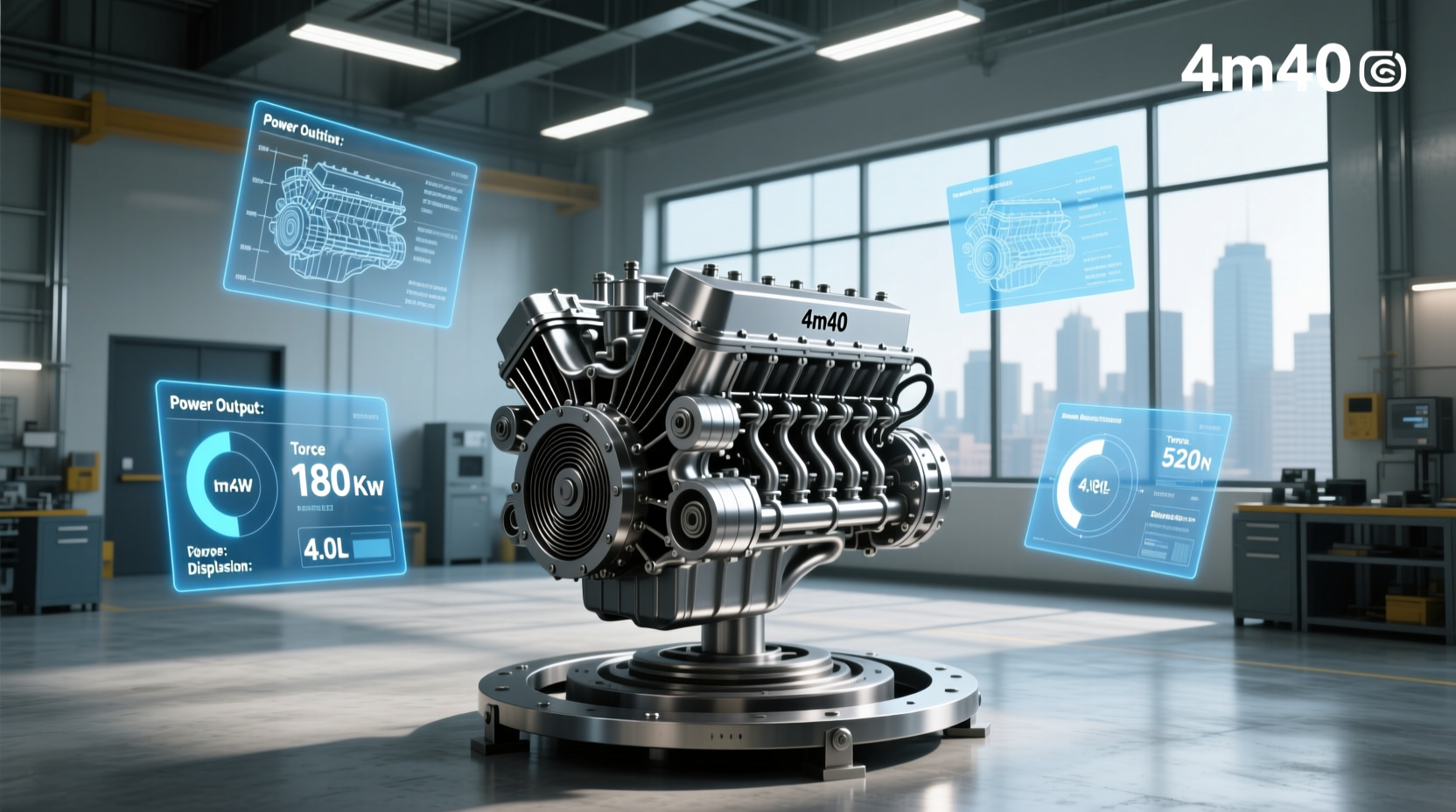
If you're researching the 4M40 engine specs, you're likely evaluating a used Mitsubishi Pajero, L200, or Montero with this durable but aging diesel powerplant. The 4M40 is a 2.8L inline-four turbocharged diesel engine produced by Mitsubishi from 1986 through the early 2000s, known for its robust low-end torque and off-road suitability. However, understanding its full technical specifications, common failure points, and long-term reliability is critical before purchase or maintenance. This guide delivers precise displacement, compression ratio, horsepower, torque, fuel system type, and key differences between mechanical and electronic injection variants — all essential data for diagnosing, restoring, or upgrading a 4M40-powered vehicle.
Overview of the Mitsubishi 4M40 Engine
The Mitsubishi 4M40 is part of the 4M4 family of four-cylinder diesel engines, introduced in the mid-1980s as a replacement for earlier models like the 4D56. Designed primarily for SUVs and light trucks, it powered several iconic Mitsubishi models including the Pajero (Montero/Shogun), L200 (Strada/Fortuner platform), and various commercial derivatives across global markets 1. While not as technologically advanced as modern common-rail diesels, the 4M40 remains popular among overland travelers and JDM importers due to its mechanical simplicity and repairability in remote conditions.
⚙️ Key facts at a glance:
- Engine Code: 4M40
- Configuration: Inline-4, SOHC, 8-valve
- Displacement: 2,835 cc (2.8L)
- Bore × Stroke: 95 mm × 100 mm
- Compression Ratio: 21:1 (early mechanical), ~16.5:1 (later electronic)
- Fuel System: Distributor-type injection pump (Zexel or Denso)
- Turbocharging: Yes (wastegated turbo, intercooler on later models)
- Max Power Output: 100–110 hp (75–82 kW) depending on market and year
- Peak Torque: 210–245 Nm (155–181 lb-ft)
- Cooling System: Water-cooled
- Block Material: Cast iron
- Head Material: Aluminum alloy
Technical Specifications Breakdown
To fully understand what makes the 4M40 unique, let’s examine each specification in detail and how it impacts real-world use.
Displacement and Internal Dimensions
The 4M40 has a displacement of exactly 2,835 cubic centimeters, achieved via a bore of 95 mm and stroke of 100 mm. This long-stroke design prioritizes low-end torque over high-RPM power, making it ideal for towing, climbing, and off-road crawling where throttle response matters more than peak output.
This configuration also contributes to higher cylinder pressures and increased stress on head gaskets — a known weak point discussed later. Despite being labeled a 2.8L engine, some later versions were slightly modified, though no official variant exceeded 2.9L.
Fuel Delivery Systems: Mechanical vs. Electronic Injection
One of the most important distinctions when discussing 4M40 engine specs is the evolution of its fuel system.
| Variants | Fuel Pump Type | Control Method | Years Produced | Common Applications |
|---|---|---|---|---|
| 4M40-T (Mechanical) | Zexel VE-type rotary pump | Mechanical governor | 1986–1997 | Pajero V20/V30, early L200 |
| 4M40-E (Electronic) | Denso ECD-V3 common rail precursor | ECU-controlled timing | 1998–2006 | Pajero V60/V70, late L200 |
The older mechanical 4M40 uses a Zexel distributor injection pump, which relies entirely on mechanical linkages and centrifugal advance. These engines are simpler to diagnose and repair in field conditions but lack precision under variable loads. In contrast, the electronic 4M40 introduced around 1998 features an electronically controlled Denso pump that adjusts injection timing based on sensor inputs (coolant temp, boost pressure, RPM). This improves cold starts, emissions, and drivability but adds complexity and potential ECU-related failures.
Power and Torque Output by Market
Output varies significantly depending on regional tuning, emission standards, and whether the model includes an intercooler.
| Region/Model | Horsepower (hp) | Torque (Nm) | Aspiration | Year Range |
|---|---|---|---|---|
| Japan Domestic Market (JDM) Pajero | 105 hp | 245 Nm | Intercooled Turbo | 1993–1997 |
| European Spec L200 | 100 hp | 210 Nm | Non-intercooled | 1990–1995 |
| Australian Spec Pajero GLX | 110 hp | 235 Nm | Intercooled Turbo | 1998–2000 |
| South American Export Model | 103 hp | 225 Nm | Turbo only | 1996–2002 |
Note: Intercooling was gradually adopted starting in the mid-1990s, improving thermal efficiency and reducing detonation risk. Vehicles equipped with intercoolers typically show better sustained performance during off-road use or hot climates.
Reliability: What Owners Should Know
While many users praise the 4M40 for longevity, others report recurring problems — especially related to overheating and head integrity. Let's separate myth from reality.
✅ Strengths of the 4M40
- Durable Block: The cast-iron block withstands high compression and abuse typical in off-road environments.
- Simple Design: Early mechanical variants can be maintained with basic tools; no need for dealership-level diagnostics.
- Good Low-End Pull: Excellent torque curve below 3,000 RPM suits slow-speed rock crawling and sand driving.
- Spare Parts Availability: Common in JDM export markets; rebuild kits, injectors, and turbos remain accessible globally.
❗ Common Problems and Failure Points
Despite strengths, certain weaknesses persist across forums and repair logs:
Head Gasket Failures
📍 One of the most frequently reported issues is premature head gasket blowout, particularly in pre-1998 models. Causes include:
- High compression ratio (21:1) increasing cylinder pressure
- Poor coolant flow design leading to hot spots
- Use of non-OEM gaskets during repairs
- Overheating from clogged radiators or failed thermostats
🔧 Prevention tip: Always perform a cooling system flush every 2 years and inspect hoses and radiator fins regularly. When replacing the head gasket, use OEM or multi-layer steel (MLS) aftermarket units designed specifically for high-diesel-load applications.
Fuel Pump Wear and Timing Drift
⚙️ The Zexel VE-type pump in mechanical models wears over time, causing erratic idle, hard starts, and black smoke. Unlike modern systems, these pumps cannot self-adjust — so timing must be manually recalibrated using a strobe light and dial gauge.
📌 Recommended service interval: Inspect pump condition and injection timing every 80,000 km (50,000 miles), especially if experiencing rough running.
Oil Leaks Around Valve Cover and Rear Main Seal
✨ Minor oil seepage is common after 150,000+ km. While not immediately dangerous, persistent leaks attract dirt and increase fire risk near exhaust manifolds. Replacing valve cover gaskets and rear main seal during major services helps avoid future messes.
Injector Clogging in Low-Quality Fuel Regions
🌐 In countries with inconsistent diesel quality, injector nozzles may clog due to contaminants or water ingress. Symptoms include misfiring, white smoke, and reduced power.
🧼 Solution: Use fuel additives containing cetane boosters and demulsifiers monthly. Consider installing a dual-stage fuel filter system (pre-filter + secondary) if operating in rural areas.
Comparison: 4M40 vs. 4D56 vs. 4M41
Many buyers struggle to choose between similar Mitsubishi diesel engines. Here’s how they compare:
| Engine | Displacement | Max Power | Key Advantages | Known Weaknesses |
|---|---|---|---|---|
| 4M40 | 2.8L | 110 hp | Strong low-end torque, durable block | Head gasket issues, heavier weight |
| 4D56 | 2.5L | 85 hp | Lighter, simpler, cheaper parts | Less power, shorter lifespan under load |
| 4M41 | 3.2L | 160 hp | Modern common rail, smoother operation | Higher repair cost, complex electronics |
📌 Verdict: Choose the 4M40 if you want a balance of strength and simplicity. Opt for the 4D56 for budget builds or light-duty use. Go with the 4M41 for daily driving comfort and higher performance — assuming access to reliable servicing.
Aftermarket Support and Upgrades
🛠️ The 4M40 benefits from a mature aftermarket ecosystem. Popular modifications include:
- Upgraded Turbo (TD05 or GT22): Increases boost and responsiveness without requiring ECU remapping (on mechanical models).
- Performance Injectors: Improve atomization and allow safer increases in fuel delivery.
- Exhaust Manifold Upgrade: Replace stock cast iron manifold with tubular stainless header for better flow.
- Intercooler Retrofit: Add an intercooler to non-intercooled models using kits from specialized vendors.
- Reinforced Head Studs: Prevent gasket failure under mild tuning.
🛒 Note: Always ensure compatibility with your specific 4M40 variant (mechanical vs. electronic) before purchasing parts. Mixing components from different generations can lead to improper fitment or operational errors.
Buying a Used Vehicle with a 4M40 Engine
🧭 If you’re considering a used Pajero or L200 with this engine, follow these steps to assess condition:
- Check Service History: Look for records of head gasket replacement, injector servicing, and cooling system maintenance.
- Inspect for Coolant Loss: White smoke on startup or frequent top-ups suggest internal leakage.
- Listen for Knocking or Diesel Clatter: Excessive noise could indicate worn injectors or piston slap.
- Test Drive Cold and Hot: Observe starting behavior, idle stability, and turbo spool-up.
- Scan for Error Codes (if electronic version): Use an OBD-II scanner compatible with Mitsubishi protocols.
- Verify VIN and Engine Number Match: Ensure the engine hasn’t been swapped unexpectedly.
⏱️ Time investment: A thorough inspection should take at least 1–2 hours, including a short highway run to evaluate transmission and drivetrain health.
Geographic Variations and Regulatory Impact
🌍 Emission regulations influenced 4M40 tuning across regions:
- Japan: Stricter noise and smoke limits led to refined injection tuning and earlier adoption of intercoolers.
- Europe: Euro 1 and Euro 2 compliance required minor EGR integration, though most remained mechanically simple.
- Australia/NZ: Focus on durability; models often feature upgraded cooling fans and heavy-duty radiators.
- Latin America/Africa: Simpler configurations with minimal emissions gear, easier to maintain but potentially louder and smokier.
🔍 Tip: When importing a JDM-spec Pajero, verify local registration requirements — some countries require emissions testing that older 4M40s may fail without modification.
Maintenance Schedule Recommendations
📅 Follow this preventive schedule to maximize 4M40 lifespan:
| Component | Service Interval | Notes |
|---|---|---|
| Engine Oil & Filter | Every 7,500 km or 6 months | Use API CF-4 or CI-4 rated oil |
| Fuel Filter | Every 15,000 km | Double-check for water separation |
| Air Filter | Every 30,000 km | Clean or replace based on environment |
| Coolant Flush | Every 40,000 km or 2 years | Prevents corrosion and overheating |
| Timing Belt | Every 80,000–100,000 km | Includes water pump and tensioners |
| Injection Pump Inspection | Every 80,000 km | Check timing accuracy and wear |
| Valve Clearance Check | Every 40,000 km | SOHC design requires periodic adjustment |
Frequently Asked Questions (FAQs)
- ❓ What vehicles use the 4M40 engine?
- The 4M40 engine was primarily used in the Mitsubishi Pajero (Second and Third Generations), Mitsubishi L200 pickup truck, Mitsubishi Montero, and some industrial equipment. It was widely exported in Japan Domestic Market (JDM), European, Australian, and South American configurations.
- ❓ How much horsepower does a 4M40 engine have?
- Depending on the model and market, the 4M40 produces between 100 and 110 horsepower. Intercooled versions, especially those from JDM or Australian markets, tend to produce closer to 110 hp with peak torque around 245 Nm.
- ❓ Is the Mitsubishi 4M40 engine reliable?
- The 4M40 is generally reliable when properly maintained, particularly the mechanical injection variants. However, it is prone to head gasket failures if overheated or poorly serviced. With regular maintenance, many examples exceed 300,000 km.
- ❓ What is the difference between 4M40 and 4M41?
- The 4M40 is a 2.8L mechanical or electronically controlled diesel with distributor-type injection, while the 4M41 is a 3.2L common-rail direct-injection engine with higher output (160 hp), smoother operation, and more complex electronics. The 4M41 is more modern but less field-serviceable than the 4M40.
- ❓ Can I improve the fuel economy of my 4M40-powered vehicle?
- Yes. Maintaining clean air and fuel filters, using correct viscosity oil, ensuring proper tire inflation, and avoiding excessive idling can improve efficiency. Adding an intercooler (if not present) and upgrading injectors may also help combustion efficiency.




 浙公网安备
33010002000092号
 浙B2-20120091-4