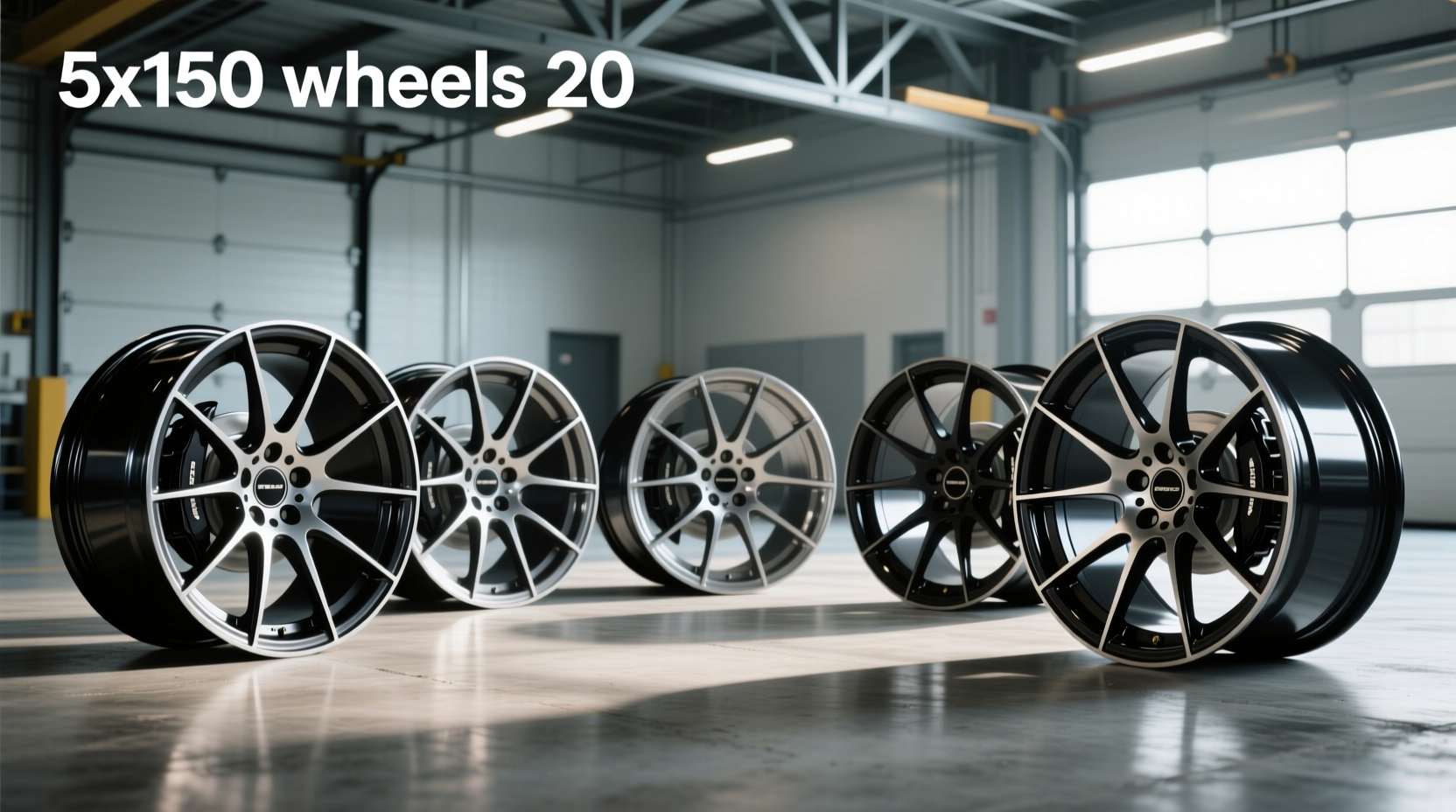
If you're searching for 20-inch wheels with a 5x150 bolt pattern, your primary concern is likely vehicle compatibility and safe installation. The 5x150 (5-lug, 150mm diameter) bolt pattern is most commonly found on full-size trucks and SUVs from Toyota, Lexus, and some GM models—especially the Toyota Tundra, Sequoia, and Land Cruiser from the early 2000s through 2020. However, fitting 20-inch rims requires careful attention to center bore, offset (ET), and tire clearance. Simply matching the bolt pattern isn’t enough; incorrect specs can lead to vibration, poor handling, or even safety risks. This guide breaks down everything you need to know about 5x150 wheels in 20-inch sizes—from compatible vehicles to critical fitment factors and common misconceptions.
Understanding the 5x150 Bolt Pattern
The term 5x150 refers to a wheel’s lug pattern: five lug nuts arranged in a circle with a 150mm diameter. This measurement is also known as the pitch circle diameter (PCD). It's crucial because it determines whether a wheel will physically bolt onto your vehicle’s hub. A mismatch here means the wheel won't mount at all.
🔧 How to Measure 5x150 Manually:
If you don’t have access to your vehicle’s manual, you can measure the bolt pattern yourself. For odd-numbered lug patterns like 5-lug, measure from the back of one lug hole to the center of the second hole away. If the distance is approximately 150mm (about 5.9 inches), you have a 5x150 setup.
📌 Note: Do not confuse 5x150 with similar patterns such as 5x5.5 (which equals 139.7mm)—a common configuration on Ford and Dodge trucks. Despite appearing close, these are not interchangeable without adapters, which come with their own trade-offs.
Common Vehicles That Use 5x150 Bolt Pattern
🛒 Primary Applications:
The 5x150 bolt pattern is predominantly used by Toyota and Lexus in North America, particularly on larger models designed for towing and off-road capability. Here are the most common vehicles that accept 5x150 wheels:
- Toyota Tundra (2000–2021): All generations prior to the current model use 5x150. The 2022+ Tundra switched to 6x139.7.
- Toyota Sequoia (2001–2022): Same as Tundra—pre-2023 models use 5x150.
- Toyota Land Cruiser (100 Series) (1998–2007): Popular among off-roaders; original steel wheels were often 16x7.5 with 5x150.
- Lexus LX 470 (1998–2007): Shares platform with 100 Series Land Cruiser.
- Chevrolet SSR (2003–2006): A niche pickup with GM front suspension but 5x150 rear hubs.
- Some Isuzu Models: Including the Hombre and certain Axiom trims.
📍 Important: Always confirm fitment using your VIN or existing wheel markings before purchasing. Trim levels and model years can vary—even within the same generation.
Can You Run 20-Inch Wheels on a 5x150 Vehicle?
⚡ Yes—but only if multiple fitment criteria align.
While many 5x150-equipped trucks came stock with 16-, 17-, or 18-inch wheels, upgrading to 20-inch rims is possible and increasingly popular for aesthetic and performance reasons. However, several technical aspects must be considered:
1. Center Bore (Hub Bore)
The center bore is the hole in the middle of the wheel that fits over the axle hub. On factory Toyota/Lexus 5x150 wheels, this is typically 106mm. Aftermarket 20-inch wheels may have smaller bores (e.g., 101.6mm or 100mm), requiring hub-centric rings to ensure proper alignment. Running non-hub-centric setups increases vibration risk.
2. Offset (ET Value)
Offset determines how far the wheel sits in relation to the fender well. Factory offsets for 5x150 vehicles usually range between +30mm to +45mm. Many aftermarket 20-inch wheels offer lower offsets (e.g., +15mm to +25mm), which push the wheel outward for an aggressive stance—but may cause rubbing on suspension components or inner fenders, especially when turning.
| Vehicle Model | Stock Wheel Size | Typical Offset (ET) | Center Bore | Max Recommended Tire Width |
|---|---|---|---|---|
| Toyota Tundra (2007–2021) | 18x8.5 | +45mm | 106mm | 295mm |
| Toyota Sequoia (2008–2022) | 18x8 | +40mm | 106mm | 285mm |
| Land Cruiser 100 Series | 16x7.5 | +35mm | 106mm | 275mm |
| Lexus LX 470 | 16x7.5 | +35mm | 106mm | 275mm |
3. Load Rating and Construction
🚛 Heavy-duty applications matter. Full-size trucks like the Tundra carry significant payloads. Ensure any 20-inch wheel has a load rating exceeding your vehicle’s Gross Axle Weight Rating (GAWR). Look for JWL or VIA certification marks stamped on the back of the wheel.
4. Tire Clearance and Fender Modifications
Even with correct offset, large tires on 20-inch rims (e.g., 275/55R20 or wider) may rub during articulation or sharp turns. Some owners opt for minor trimming or leveling kits to gain extra space. Avoid forcing installation without test-driving under real conditions.
Steel vs. Alloy Wheels: Which Is Better for 5x150 20-Inch Setup?
⚙️ While steel wheels dominate OEM configurations—especially in 16-inch sizes—they are rare in 20-inch diameters due to weight and design limitations. Most 20-inch options are cast or flow-formed aluminum alloys.
Steel Wheels (Pros & Cons)
- ✅ Durable and repairable after impacts
- ✅ Lower cost for replacement
- ✅ Ideal for off-road or winter use where damage is likely
- ❌ Heavier, reducing fuel economy and braking performance
- ❌ Limited availability in 20-inch size
- ❌ Fewer style options
Alloy Wheels (Pros & Cons)
- ✅ Lightweight, improving acceleration and ride quality
- ✅ Wide variety of finishes: gloss black, machined, bronze, etc.
- ✅ Better heat dissipation than steel
- ❌ More expensive to replace if cracked
- ❌ Susceptible to curb damage
- ❌ May require balancing more frequently
✨ Bottom Line: For 20-inch applications, alloy wheels are standard. Steel versions exist but are typically custom or specialty imports, sometimes sourced via global suppliers 1.
Where to Buy 5x150 Wheels in 20-Inch Sizes?
🌐 Reputable sources include manufacturer-direct sites (like Fifteen52 or KMC Wheels), regional wheel retailers, and commercial marketplaces focused on international trade. When shopping:
- 🔍 Verify exact specifications: bolt pattern, center bore, offset, load rating.
- 🚚 Check shipping costs and delivery timelines—especially for bulk orders.
- 📎 Ask for fitment guides specific to your make/model/year.
- 🧰 Confirm return policy in case of fitment errors.
❗ Caution: Be wary of listings advertising “universal” 5x150 wheels without specifying center bore or offset. These may require modifications or adapters, potentially voiding warranties or affecting safety.
Common Misconceptions About 5x150 Wheels
Misconception #1: All 5-Lug Toyotas Are 5x150
No. Smaller models like the Tacoma, 4Runner, and FJ Cruiser use 5x114.3, which is completely different. Confusing them leads to incompatible purchases.
Misconception #2: Bolt Pattern Is the Only Fitment Factor
False. As previously noted, center bore, offset, and wheel width are equally important. Two wheels with identical 5x150 patterns can behave very differently on the same truck.
Misconception #3: Adapters Solve Everything
While hub-centric adapters can convert from 5x150 to other patterns (or vice versa), they add stress points and increase unsprung weight. Long-term reliability decreases, especially under heavy loads or off-road use.
Tips for Installing 20-Inch 5x150 Wheels Safely
- Use a torque wrench when installing lugs—typically 85–110 ft-lbs for full-size trucks. Under-tightening risks loosening; over-tightening can warp rotors.
- Re-torque after 50 miles to ensure stability.
- Balance the wheels professionally—improper balance causes vibration at highway speeds.
- Test drive slowly at first, checking for rubbing during full lock turns and over bumps.
- Align the vehicle afterward if you notice uneven tire wear or steering pull.
Aftermarket Trends and Availability in 2024
📈 Demand for 20-inch wheels remains strong, especially among Tundra and Sequoia owners seeking modern aesthetics. However, since Toyota transitioned newer models to a 6-lug system, the 5x150 segment is now largely supported by the used and specialty aftermarket.
🏭 Manufacturers continue producing 5x150 wheels in 16”, 17”, and 18” sizes for OEM replacements, but 20-inch offerings are mostly limited to performance and lifestyle brands. Expect higher prices due to lower production volume.
Final Considerations Before Buying
📋 Before purchasing 20-inch 5x150 wheels, ask yourself:
- Do I need this size for practical reasons (towing, ground clearance), or is it primarily cosmetic?
- Will my current brake system accommodate larger wheels?
- Am I prepared for potential tire cost increases? Larger rims often require pricier, lower-profile tires.
- Have I verified compatibility with my exact model year and trim?
👥 Community forums like IH8MUD and Tacoma World are excellent resources for real-world feedback on specific wheel models and fitment experiences.




 浙公网安备
33010002000092号
 浙B2-20120091-4