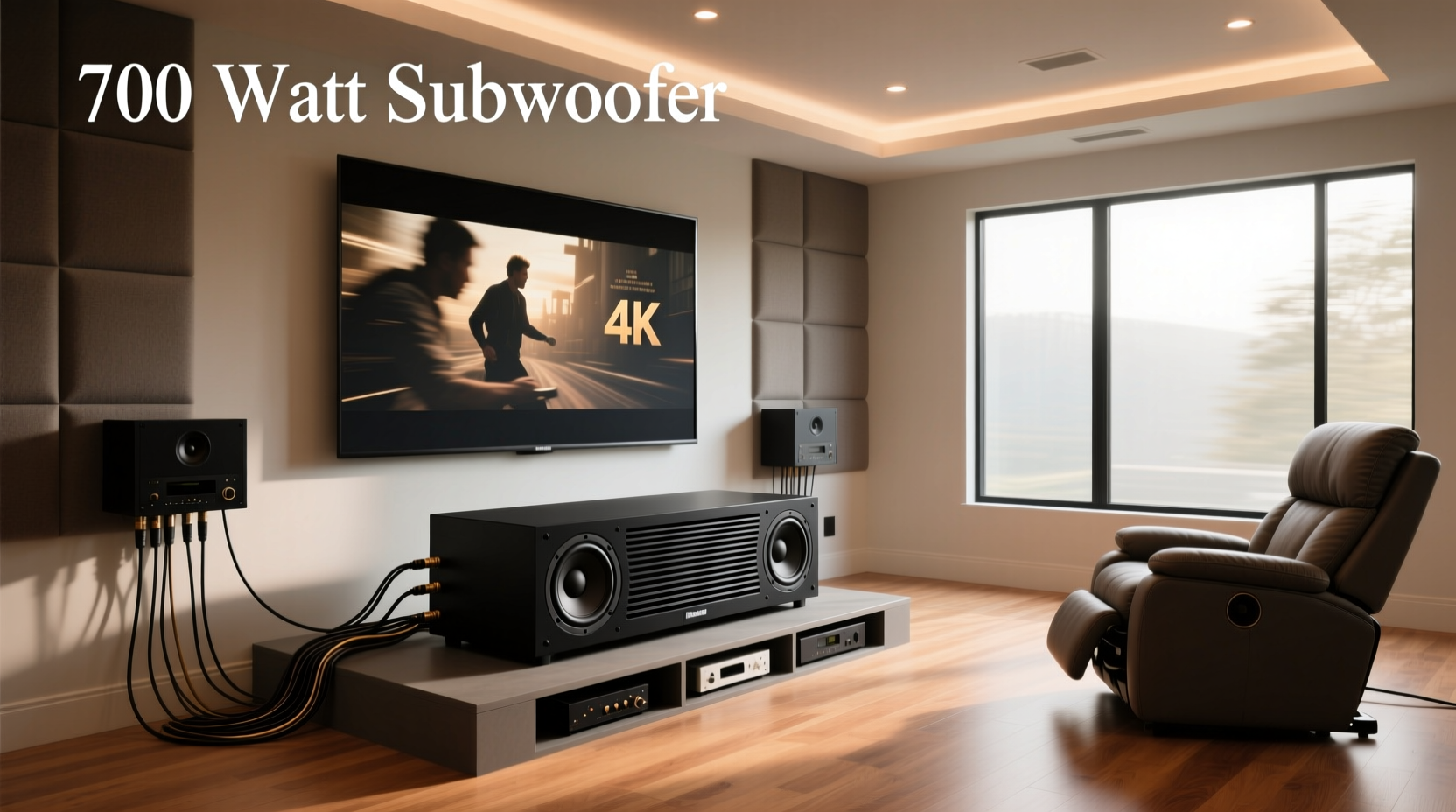
When shopping for deep, powerful bass in car or home audio systems, the term 700 watt RMS subwoofer frequently appears. But what does that actually mean? In short, a 700 watt RMS (Root Mean Square) rating indicates the continuous power a subwoofer can handle without overheating or distorting—making it a key benchmark for reliability and sustained performance under real-world conditions. Unlike peak wattage, which reflects brief power surges, RMS gives a more accurate picture of how loud and clean a subwoofer can perform over time. This guide breaks down everything you need to know about 700 watt RMS subwoofers: how they compare to other models, why impedance and enclosure design matter, common misconceptions about power ratings, and what factors truly influence sound quality beyond just wattage.
Understanding RMS vs. Peak Power in Subwoofers
One of the most common sources of confusion among consumers is the difference between RMS and peak power ratings. A 700 watt RMS subwoofer is not the same as a subwoofer labeled "700 watts peak." RMS measures the average power output or handling capability over an extended period, simulating actual listening conditions. It's a standardized way to compare amplifiers and speakers on equal footing.
In contrast, peak power refers to the maximum short-term burst a device can handle—often double or triple the RMS value—but only for milliseconds during intense transients like drum hits. Manufacturers sometimes emphasize peak numbers because they look more impressive, but these figures are less useful when evaluating long-term performance and durability.
For example, a subwoofer rated at 700 watts RMS with a peak capacity of 1400 watts tells you it’s built to deliver consistent, distortion-free bass at high volumes. If two subs have similar sensitivity and frequency response, the one with higher RMS power will generally play louder and cleaner when driven hard. However, this doesn’t automatically mean better sound quality—it depends on matching components correctly.
Why 700 Watts RMS Is a Sweet Spot for Many Audio Setups
The 700 watt RMS range has become increasingly popular in both aftermarket car audio and compact home theater applications. It strikes a balance between raw power and practicality. Subwoofers in this category are powerful enough to produce impactful bass for genres like hip-hop, EDM, and action movies, yet typically don’t require extreme electrical modifications or massive enclosures.
This makes them ideal for users who want noticeable improvement over factory systems without entering ultra-high-power territory (e.g., 1000+ watts), where additional considerations like alternator upgrades, secondary batteries, or dedicated cooling systems may be necessary.
Moreover, many modern Class D monoblock amplifiers are designed to output around 700 watts RMS into 2-ohm or 1-ohm loads, making them a natural match for 700W-rated subs. When properly paired, such setups offer efficient power delivery, lower heat generation, and reliable operation even during prolonged use.
How Subwoofer Size Affects Performance at 700 Watts RMS
Subwoofer size—commonly 8", 10", 12", or 15"—plays a significant role in how a 700 watt RMS unit performs. While power handling is important, driver diameter influences air displacement, low-frequency extension, and overall tonal character.
- 8-inch subwoofers: At 700 watts RMS, these are relatively rare but exist in compact SPL (Sound Pressure Level) competition builds. They rely on high excursion and stiff suspensions to move sufficient air. Best suited for tight spaces or ported boxes tuned for punch rather than deep rumble.
- 10-inch subwoofers: Perhaps the most balanced option. A 10" 700W RMS subwoofer offers strong output, decent low-end reach (down to ~30Hz depending on enclosure), and fits in most vehicles without major modifications. Ideal for daily drivers wanting enhanced bass without sacrificing trunk space.
- 12-inch subwoofers: The most common size in this power class. Provides excellent cone area and excursion capabilities, capable of producing both deep bass and high SPL. Often found in dual voice coil (DVC) configurations for flexible wiring options.
- 15-inch subwoofers: Typically seen in larger enclosures or home/stage applications. While powerful, they require more airspace and benefit from robust box designs. May roll off earlier in frequency response if not properly tuned.
It's important to note that a smaller driver with superior motor structure and suspension can outperform a larger one with poor engineering—even at the same power level. So while size matters, it shouldn't be the sole deciding factor.
Voice Coil Configuration: Single vs. Dual, Impedance Matching
Another critical aspect of selecting a 700 watt RMS subwoofer is understanding voice coil configuration and impedance (measured in ohms). Most subs come with either single voice coil (SVC) or dual voice coil (DVC) options, each affecting how they interact with amplifiers.
A dual 2-ohm or dual 4-ohm voice coil allows multiple wiring configurations. For instance:
- Dual 2-ohm DVC: Can be wired in series to present a 4-ohm load, or parallel to present 1 ohm.
- Dual 4-ohm DVC: Series = 8 ohms; Parallel = 2 ohms.
This flexibility lets users match their subwoofer to available amplifier outputs. Since many 700W monoblocks are stable down to 1 ohm, pairing them with a dual 2-ohm sub in parallel maximizes power transfer. Conversely, using a dual 4-ohm sub in parallel yields 2 ohms—a safer load for amps not 1-ohm stable.
Mismatching impedance can lead to underperformance or amplifier shutdown due to overheating. Always verify your amp’s minimum impedance rating before finalizing the setup.
Enclosure Types and Their Impact on Bass Output
No discussion of subwoofers is complete without addressing enclosure design. The box type significantly affects efficiency, frequency response, and overall 'feel' of the bass. Common types include sealed, ported (vented), bandpass, and free-air installations.
| Enclosure Type | Efficiency | Bass Character | Best For |
|---|---|---|---|
| Sealed | Moderate | Tight, accurate, controlled | Music with precise bass lines (jazz, rock) |
| Ported | High | Loud, boomy, extended low end | Hip-hop, electronic, movies |
| Bandpass | Variable | Focused mid-bass punch | SPL competitions |
| Free-Air | Low | Natural, open | Factory locations, minimal modification |
For a 700 watt RMS subwoofer, a **ported enclosure** is often preferred when maximum volume and perceived loudness are priorities. These designs amplify output around the tuning frequency (typically 30–40Hz), giving the impression of much higher power. However, they sacrifice some transient accuracy compared to sealed boxes.
Pre-built loaded enclosures—like those marketed as “party packs” or “bass boxes”—often combine a 700W sub with a compatible amplifier and wiring kit. While convenient, buyers should verify component quality and ensure proper tuning for their vehicle or room acoustics.
Real-World Performance: Does Higher RMS Always Mean Louder?
A common misconception is that a higher RMS rating directly translates to louder sound. While power contributes to potential output, several other factors determine actual loudness and clarity:
- Sensitivity (dB rating): Measured in decibels at 1 watt/1 meter, sensitivity indicates how efficiently a sub converts power into sound. A 700W sub with 88 dB sensitivity may be quieter than a 500W sub with 92 dB sensitivity.
- Frequency Response: A subwoofer extending down to 20Hz will feel deeper than one rolling off at 40Hz, even at the same power level.
- Distortion Levels (THD): Lower total harmonic distortion means cleaner sound, especially at high volumes.
- Amplifier Quality: Clean, regulated power matters more than raw wattage. A poorly filtered amp may clip signals, damaging the sub even below its RMS limit.
Therefore, focusing solely on the “700 watt” label can mislead buyers. Two subs with identical RMS ratings can perform very differently based on design, materials, and system integration.
Installation Considerations for 700 Watt RMS Subwoofers
Installing a 700 watt RMS subwoofer requires careful planning to avoid electrical issues or damage. Key steps include:
- Power Supply Check: Ensure your vehicle’s alternator can support the additional load. A typical 700W RMS amplifier draws about 60–70 amps at full output. Factory charging systems may struggle, leading to voltage drops or headlight dimming.
- Gauge of Wiring: Use at least 4-gauge power wire for runs over 10 feet. Smaller gauges increase resistance, reducing efficiency and generating heat.
- Fusing: Install an inline fuse within 18 inches of the battery terminal to protect against shorts.
- Grounding: Connect the ground wire to a clean, unpainted metal surface near the amplifier. Poor grounding causes hum and instability.
- Signal Source: Use RCA cables or high-level inputs with noise suppression. Avoid running signal wires parallel to power cables.
Improper installation can negate even the best hardware. Taking time to plan routing, secure connections, and test gradually prevents costly mistakes.
Common Misconceptions About 700 Watt Subwoofers
Several myths persist around subwoofer power ratings. Addressing them helps set realistic expectations:
- Myth: "More watts always mean better bass." Reality: Efficiency, enclosure tuning, and room/vehicle acoustics matter more than wattage alone.
- Myth: "A 700W sub needs exactly a 700W amp." Reality: Slight mismatches are acceptable. A 600W amp driving a 700W sub is safe; a 1000W amp risks clipping if gain isn’t set carefully.
- Myth: "RMS and peak are interchangeable." Reality: Only RMS provides a reliable measure of continuous performance.
- Myth: "All 700W subs sound the same." Reality: Brand, materials, motor strength, surround type, and cone composition create audible differences.
Understanding these points helps avoid overspending on mismatched gear or unrealistic expectations.
Applications: Car Audio vs. Home/Stage Use
A 700 watt RMS subwoofer serves different roles depending on context:
Car Audio: In vehicles, space constraints favor compact, high-efficiency designs. Ported enclosures are common for maximizing impact. Thermal management is crucial since confined spaces trap heat. Look for subs with good ventilation and durable voice coils.
Home Theater: In rooms, boundary gain (from walls/floors) enhances bass response. Sealed or bass-reflex cabinets work well. Integration with AV receivers and room calibration (e.g., Audyssey, YPAO) ensures smooth frequency response.
Live Sound/Stages: Used in PA systems for outdoor events or clubs, where high SPL is essential. Often paired with horn-loaded designs or stacked arrays. Durability and weather resistance become important factors.
While the core technology is similar, application-specific optimization ensures optimal results.
How to Choose the Right 700 Watt RMS Subwoofer for Your Needs
Selecting the best 700 watt RMS subwoofer involves balancing several variables:
- Intended Use: Daily driving? Movie nights? Competition? Each scenario favors different characteristics.
- Available Space: Measure your trunk or cabinet dimensions before choosing size and box type.
- Budget: Prices vary widely—from budget Chinese OEM units to premium American-made drivers. Research reviews and build quality.
- Existing Equipment: Match impedance and power handling to your amplifier. Don’t overload or underdrive the sub.
- Brand Reputation & Support: Established brands often provide better customer service, warranty terms, and technical documentation.
Reading user forums (like Reddit’s r/audiophile1) and watching real-world testing videos can offer insights beyond spec sheets.
Maintenance and Longevity Tips
To extend the life of your 700 watt RMS subwoofer:
- Avoid clipping by setting amplifier gains correctly.
- Use a low-pass filter to block midrange frequencies that could damage the cone.
- Keep the subwoofer clean and dry, especially in humid environments.
- Inspect wiring periodically for fraying or corrosion.
- Allow cooling time after extended high-volume sessions.
Proper care ensures years of reliable performance.
Frequently Asked Questions (FAQs)
Below are answers to common questions about 700 watt RMS subwoofers:
- What does 700 watts RMS mean?
- It means the subwoofer can continuously handle 700 watts of power without overheating or distorting, reflecting its real-world performance capability.
- Is 700 watts RMS enough for car audio?
- Yes, 700 watts RMS is sufficient for most car audio applications, offering strong bass impact without requiring extensive electrical upgrades.
- Can I run a 700 watt RMS subwoofer with a 500 watt amp?
- Yes, as long as the impedance matches and the amp doesn’t clip, running slightly underpowered is safer than overpowering with distortion.
- Does higher RMS mean deeper bass?
- No, depth depends more on frequency response and enclosure design. RMS affects loudness and sustain, not low-frequency extension.
- How do I know if my car can handle a 700 watt sub?
- Check your alternator output (ideally 100A+), use proper gauge wiring, and monitor voltage while playing music at high volume to detect strain.




 浙公网安备
33010002000092号
 浙B2-20120091-4