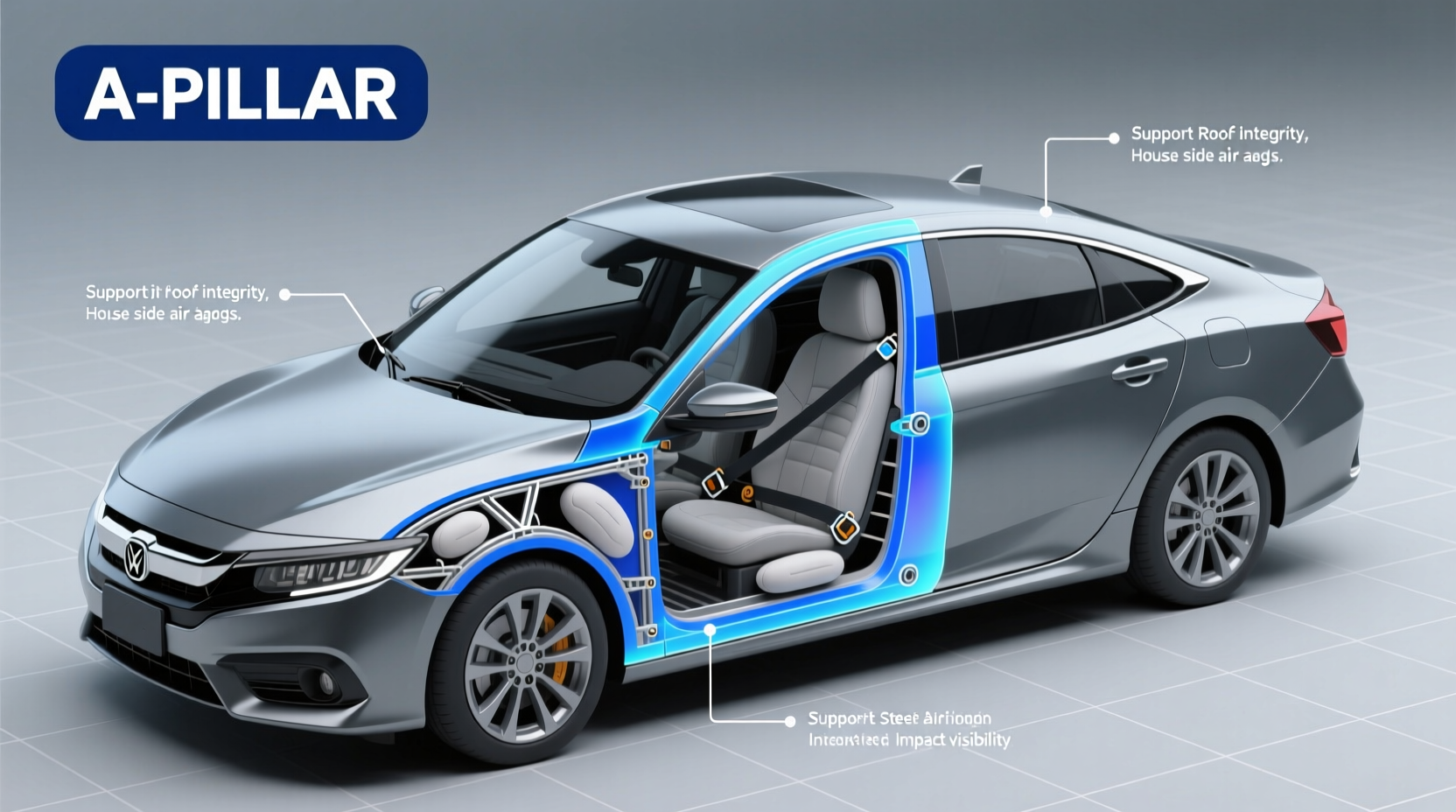
The A-pillar in a car is the structural pillar located on either side of the windshield that supports the roof and provides critical crash protection. Often referred to as the windshield pillar, this component plays a vital role in vehicle safety, structural integrity, and driver visibility. While essential for occupant protection during rollovers and front-end collisions, the A-pillar can also create blind spots that affect driving safetyâespecially at intersections. Understanding the design, function, and potential limitations of the A-pillar car structure helps drivers make informed decisions about vehicle selection and safe driving habits.
Understanding the A-Pillar: Location and Function
The A-pillar is one of several vertical support structures in a vehicleâs frame, specifically positioned at the front of the passenger compartment. It connects the roof to the chassis and runs between the front doors and the windshield. Each car has two A-pillarsâone on the driverâs side and one on the passenger side. These pillars are engineered using high-strength steel or aluminum alloys to withstand significant forces during accidents.
Beyond structural support, the A-pillar houses components such as side airbags (in many modern vehicles), sun visor mounts, and sometimes sensors for advanced driver assistance systems (ADAS). Its primary engineering purpose is to maintain cabin integrity during rollover crashes and frontal impacts, preventing roof collapse and protecting occupants.
Safety Benefits of the A-Pillar
One of the most critical roles of the A-pillar is enhancing occupant safety. In rollover accidents, which account for approximately 2% of all crashes but nearly 35% of passenger vehicle fatalities (according to NHTSA), strong A-pillars help prevent the roof from caving in. Modern vehicles undergo rigorous roof strength testing, where manufacturers must meet federal standards requiring the roof to support at least 1.5 times the vehicle's weight (with some exceeding 4x).
In frontal collisions, the A-pillar works in tandem with the front crumple zones and B-pillars to manage energy transfer away from the passenger compartment. High-tensile steel used in A-pillar construction absorbs impact energy while maintaining survival space inside the cabin.
Additionally, side curtain airbags often deploy along the inner edge of the A-pillar, offering head protection during side impacts or rollovers. This integration enhances passive safety significantly, especially in SUVs and crossover models with higher centers of gravity.
Visibility Challenges and Blind Spots
Despite their safety advantages, A-pillars can create notable blind spotsâcommonly called A-pillar obstructions or pillar shadows. These occur because thicker, stronger materials are needed to meet safety regulations, resulting in wider pillars that block parts of the driverâs forwardè§é (though written here in English context, the concept applies universally).
Studies by the Insurance Institute for Highway Safety (IIHS) show that A-pillar blind spots can obscure up to 3â6 degrees of peripheral vision, potentially hiding pedestrians, cyclists, or other vehicles when turning at intersections. The obstruction is more pronounced in larger vehicles like trucks and SUVs due to steeper windshield angles and increased pillar thickness.
To mitigate this issue, drivers should adopt proactive scanning techniques:
- Move your head slightly left and right before turning to peek around the pillar.
- Use mirrors and camera systems if available. \li>Pause briefly at stop signs or crosswalks to ensure no one is hidden behind the pillar.
Design Evolution Over Time
A-pillar design has evolved significantly over the decades. Older cars from the 1970s and 1980s typically had thinner pillars due to less stringent safety standards. However, these vehicles offered far less protection in crashes. As rollover and side-impact regulations tightened globallyâespecially after the 2000sâautomakers reinforced A-pillars with boron steel, hydroformed tubes, and multi-layer composites.
Modern trends include:
- Narrower visual profiles: Some brands use blacked-out trim or slanted designs to reduce perceived bulk.
- Camera-based solutions: Luxury models like certain Mercedes-Benz and BMWs offer virtual window views via embedded cameras.
- Hybrid materials: Carbon fiber inserts in performance cars reduce weight without sacrificing strength.
However, even with aesthetic improvements, physical limitations remain. You cannot eliminate the A-pillar entirely without compromising safetyâa trade-off engineers continue to balance.
Regional Differences in A-Pillar Standards
Safety regulations vary by region, influencing A-pillar design. For example:
| Region | Regulatory Body | Key Requirement Impacting A-Pillar |
|---|---|---|
| United States | NHTSA (FMVSS 216) | Rolled roof must support 1.5x vehicle weight |
| European Union | UNECE Regulation 64 | Roof strength test with dynamic loading criteria |
| Japan | MLIT | Mandatory side impact and rollover resistance |
| Australia | ANCAP | Requires robust A-pillar performance in crash tests |
These differences mean that vehicles sold in North America may have slightly thicker A-pillars than those designed primarily for European markets, although global platforms tend to standardize designs across regions.
Common Misconceptions About the A-Pillar
Several myths persist about the A-pillar and its impact on driving:
- "Thicker A-pillars always mean better safety": While strength matters, poor engineering can still lead to failure. Material quality, joint design, and overall frame integration are equally important.
- "You can remove or modify the A-pillar for better visibility": Absolutely not. Tampering with structural pillars compromises the entire safety cage and is illegal in most jurisdictions.
- "All A-pillars block the same amount of vision": Visibility varies widely between models. Compact hatchbacks often have narrower pillars than full-size SUVs.
How to Evaluate A-Pillar Design When Buying a Car
If visibility and safety are priorities, consider these steps when evaluating a new or used vehicle:
- Sit in the driverâs seat: Position yourself as you would while driving and turn your head slightly toward the A-pillar. Note how much of the corner view is blocked.
- Test drive in urban settings: Drive through busy intersections to assess real-world visibility challenges.
- Check for ADAS features: Look for lane departure warnings, blind spot monitoring, or front-cross traffic alerts that compensate for limited sightlines.
- Review IIHS or Euro NCAP reports: These evaluations often mention structural performance, including pillar strength during rollover tests.
- Ask about airbag placement: Confirm whether side airbags deploy from the A-pillar area, adding another layer of protection.
Tips for Safer Driving with A-Pillar Obstruction
No matter how advanced the vehicle, human behavior remains key. Here are practical tips to overcome A-pillar limitations:
- Adopt the 'S-shape' turn technique: Before making a left or right turn, gently swing the steering wheel to shift your upper body forward and sideways, allowing you to see past the pillar.
- Install additional mirrors: Small convex mirrors attached to the side windows can help detect movement near the pillar zone.
- Use technology wisely: Enable 360-degree camera systems or pedestrian detection alerts if your car offers them.
- Stay alert in low-light conditions: A-pillar shadows become more pronounced at dawn, dusk, or under streetlights. Increase scanning frequency.
- Educate teen or new drivers: Teach them about pillar blindness early so they develop safe habits from the start.
Future Innovations in A-Pillar Technology
The automotive industry is exploring ways to minimize A-pillar blind spots without sacrificing safety. Emerging technologies include:
- Transparent pillars: Experimental concepts use camera-projected displays on the inside surface of the pillar, making it appear âinvisibleâ.
- Augmented reality windshields: HUDs (head-up displays) could overlay hidden objects detected by sensors directly into the driverâs line of sight.
- Smart glass: Electrochromic panels that darken only when necessary, improving contrast and reducing glare near the pillar base.
While these innovations are still in development or limited to concept cars, they represent a promising direction for balancing safety and visibility.
Frequently Asked Questions (FAQs)
What does the A-pillar do in a car?
The A-pillar supports the roof, maintains structural integrity during crashes, and often houses side airbags. It is crucial for occupant protection in rollovers and frontal collisions.
Can the A-pillar cause blind spots?
Yes, due to its width and positioning, the A-pillar can obstruct part of the driverâs forwardè§é, particularly at intersections. This is known as A-pillar blindness and affects all vehicles to varying degrees.
Are thicker A-pillars safer?
Not necessarily. While thicker pillars can indicate stronger construction, safety depends on material type, engineering design, and integration with the overall frameânot just size.
Is it possible to make A-pillars transparent?
Currently, no production cars have fully transparent A-pillars, but prototypes using camera-display systems exist. These are not yet widely available due to cost and reliability concerns.
How can I reduce A-pillar blind spot risks?
Mitigate risks by moving your head to check around the pillar, using backup and surround-view cameras, installing auxiliary mirrors, and practicing defensive driving techniques at intersections.





 浙公网安备
33010002000092号
浙公网安备
33010002000092号 浙B2-20120091-4