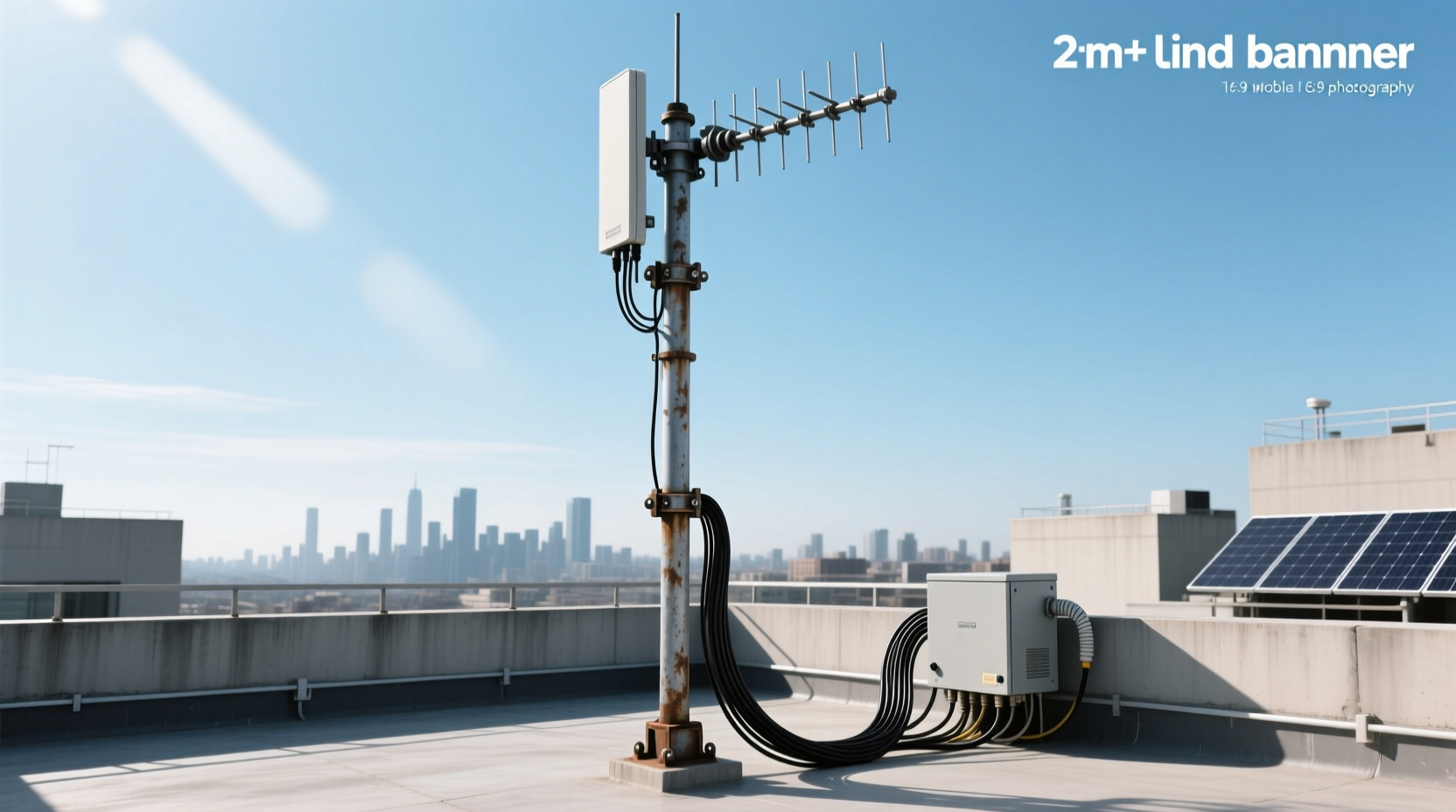
When setting up a mobile amateur radio system, selecting the right 2 meter antenna mobile solution is critical for reliable communication. Whether you're using it for emergency response, off-grid travel, or local repeater access, a properly chosen 2m mobile antenna directly impacts transmission clarity and reception range. Most users search for antennas that support both the 144–148 MHz VHF band (2 meters) and the 420–450 MHz UHF band (70 cm), making dual-band performance a top priority1. This guide breaks down key selection factors—frequency coverage, gain, mounting type, cable quality, and vehicle compatibility—to help you make an informed decision without falling into common traps like overpaying for exaggerated claims or choosing incompatible mounts.
Understanding the 2 Meter Band and Its Uses
The term “2 meter” refers to the approximate wavelength of signals in the 144–148 MHz portion of the VHF spectrum, commonly used by amateur radio operators in North America. This band is popular due to its balance between propagation characteristics and antenna size. Unlike HF bands that rely on ionospheric bounce for long-distance communication, the 2 meter band primarily supports line-of-sight (LOS) transmission, typically reaching 5–20 miles depending on terrain and power output1.
In urban environments, buildings and obstructions limit effective range, while open rural areas allow better signal penetration. Repeaters located on high ground extend this reach significantly, often enabling regional coverage when accessed via elevated antennas. Because of this, many hams install a 2 meter mobile antenna on their vehicle to maintain connectivity while traveling. These setups are also used in public service events, search-and-rescue operations, and storm spotting networks like SKYWARN.
Dual-Band vs. Monoband: Which One Do You Need?
One of the first decisions you’ll face is whether to choose a monoband (VHF-only) or dual-band (VHF/UHF) antenna. A dual-band 2 meter and 70cm mobile antenna allows operation on both the 2m (144–148 MHz) and 70cm (420–450 MHz) bands using a single radiator. This is convenient if your transceiver supports both bands and you want to access UHF repeaters, which are increasingly common in dense urban zones where UHF performs better through concrete structures.
However, dual-band antennas involve compromises. The physical design must accommodate two resonant frequencies, often resulting in slightly reduced efficiency on one or both bands compared to dedicated monoband models. For example, some dual-band antennas exhibit weaker performance on 70cm due to shorter radiating elements and tighter coupling requirements. If you operate mostly on 2 meters and rarely use UHF, a high-gain monoband antenna may deliver superior results.
Conversely, if portability and simplicity matter more than peak performance, a dual-band model reduces clutter and installation complexity. Always verify frequency match: not all “dual-band” antennas cover the full amateur allocations—some are tuned for commercial GMRS or FRS use instead.
Antenna Gain: What It Means and When It Matters
Gain, measured in dBi (decibels relative to an isotropic radiator), indicates how effectively an antenna focuses energy in specific directions. Higher gain doesn’t mean more power; it means redistribution of the radiation pattern. A standard quarter-wave whip has about 0–1 dBi gain with a broad vertical lobe ideal for omnidirectional coverage. As gain increases (e.g., 3–6 dBi), the main lobe flattens, extending range horizontally but reducing coverage at steep angles.
This trade-off affects real-world usability. In mountainous regions or cities with tall buildings, lower-angle radiation may miss nearby repeaters overhead. High-gain antennas excel on flat highways where distant stations lie near the horizon. However, they perform poorly in valleys or winding roads where signals arrive from multiple elevations.
Avoid misleading marketing terms like “super gain” or “long-range optimized” without technical specs. Stick to documented dBi ratings from reputable manufacturers. Also consider that excessive gain can overload nearby receivers or violate local regulations if combined with amplifiers.
Mounting Types: Choosing the Right Installation Method
The mount determines mechanical stability, grounding effectiveness, and RF performance. Common types include magnetic, trunk lip, NMO, and permanent bolt-on installations.
- Magnetic Mounts (Mag-Mount): Ideal for temporary or rental vehicles. They attach via strong magnets and require no drilling. However, they often lack a solid RF ground plane, reducing efficiency—especially on fiberglass or plastic-bodied cars. Use only with vehicles having metal roofs or decks.
- NMO Mounts: Provide a flush-mounted, weatherproof connection with excellent grounding. Requires drilling a hole but offers professional-grade performance. NMO is widely considered the gold standard for permanent mobile installations.
- Trunk Lip or Mirror Mounts: Attach to existing seams or side mirrors. Convenient but may suffer from poor coax routing and limited ground plane. Best suited for compact antennas on sedans.
- Bolt-On Base Mounts: Used with larger collinear antennas (e.g., Hustler CG series). Offer robust grounding and durability but require careful placement to avoid interference with doors or sensors.
Your vehicle’s construction matters. Modern cars with composite panels, solar-tinted windows, or aluminum bodies may interfere with RF grounding. Test antenna SWR (Standing Wave Ratio) after installation to ensure safe transmitter operation.
Cable Length and Connector Types
Coaxial cable quality significantly impacts signal loss, especially at VHF/UHF frequencies. Longer cables increase attenuation. A 16-foot RG-58 cable can lose up to 3 dB on 2 meters and over 6 dB on 70cm—effectively halving your transmit power before it reaches the antenna.
For runs longer than 10 feet, use low-loss alternatives like LMR-240 or RG-8X. While more expensive and less flexible, these cables preserve signal integrity. Avoid coiling excess cable; loops act as chokes and distort impedance.
Connector types must match your radio and mount. PL-259 (UHF connector) is common on older gear, while NMO is standard for modern mobile antennas. Adapters introduce points of failure and signal reflection—minimize their use. Ensure connectors are waterproofed, especially for exterior mounts exposed to rain.
SWR and Tuning: Why It Can't Be Ignored
SWR (Standing Wave Ratio) measures how well your antenna system matches the transmitter’s output impedance (typically 50 ohms). An SWR below 1.5:1 is ideal; above 2:1 risks damaging your radio over time. Never operate a transmitter without checking SWR first.
To test SWR:
- Connect an SWR meter between the radio and antenna.
- Transmit low power on channel edges and center of the band (e.g., 144 MHz, 146 MHz, 148 MHz).
- Record readings and adjust antenna length or position if needed.
Some antennas allow tuning via adjustable tips or spring bases. Others require physical trimming—a permanent change. If SWR remains high despite adjustments, check for poor grounding, damaged coax, or incorrect mount placement.
Top Brands and Model Comparisons
No single brand dominates across all use cases. Reputable manufacturers include Diamond, Comet, Hustler, MFJ, and Tram. Each offers distinct advantages:
| Model | Type | Gain (2m/70cm) | Mount | Power Rating |
|---|---|---|---|---|
| Diamond NR240C | Dual-band | 3.8 dBi / 6.2 dBi | PL-259 | 50W |
| Comet CA-2X4SRNMO | Dual-band | 4.2 dBi / 6.0 dBi | NMO | 75W |
| Hustler CG-144 | Monoband (2m) | 5.0 dBi | Bolt-on | 200W |
| MFJ-1722 | Dual-band | 3.0 dBi / 5.0 dBi | Mag-mount | 50W |
While user reviews often praise the Comet CA-2X4SR for consistent performance across varied conditions, mag-mount options like the MFJ-1722 serve well for beginners or temporary setups. High-power applications (e.g., base station hybrids) benefit from Hustler’s robust construction.
Common Misconceptions About 2 Meter Mobile Antennas
Several myths persist in the amateur radio community:
- “Taller antennas always perform better.” Not necessarily. Height affects radiation angle, but beyond a certain point (e.g., 5/8 wave), diminishing returns set in. Excessive height creates wind load and clearance issues.
- “More gain equals longer range.” Only true within the optimal radiation lobe. Overly directional patterns can miss nearby stations.
- “All dual-band antennas work equally on both bands.” Many favor one band over the other. Check datasheets for actual SWR curves and gain plots.
- “Any antenna works on any car.” Vehicles with non-metallic bodies (e.g., Jeep Wrangler, Corvette) disrupt ground planes. Solutions include mirror mounts or remote ground kits.
Installation Tips and Safety Considerations
Proper installation ensures longevity and performance:
- Always disconnect the battery before drilling or wiring near fuel lines or sensors.
- Route coax away from power cables to prevent noise coupling.
- Seal all exterior penetrations with silicone or rubber grommets to prevent leaks.
- Use star washers or grounding straps to ensure electrical continuity between mount and chassis.
- Keep antenna clear of garage doors, bridges, and automated toll systems to avoid breakage.
Test operation at low power initially. Monitor for unusual heating, distortion, or SWR spikes during movement.
Cost vs. Performance: Is Expensive Always Better?
Pricing ranges from under $30 for basic mag-mounts to over $150 for premium NMO models. Generally, higher cost reflects better materials (stainless steel, UV-resistant fiberglass), refined engineering, and rigorous testing. However, budget antennas can perform adequately in moderate conditions.
Before upgrading, optimize what you have: improve grounding, shorten coax runs, and recheck SWR. Often, small tweaks yield better results than costly replacements. Conversely, investing in a quality antenna pays off in reliability during emergencies or extended field use.
Regional and Regulatory Factors
Licensing and power limits vary by country. In the U.S., amateur radio operators may use up to 1500 watts PEP, though most mobile setups run 25–75 watts. Canada, the UK, and Australia have similar frameworks but differ in permitted frequencies and emission types. Always confirm your privileges with national regulators like the FCC, ISED, Ofcom, or ACMA.
No license is required to receive signals, but transmitting without authorization is illegal. Some jurisdictions restrict antenna height on public roads—verify local transportation laws before installing tall whips.
FAQs About 2 Meter Mobile Antennas
- What is the typical range of a 2 meter mobile antenna?
- Under normal conditions, expect 5–20 miles line-of-sight. With repeater access, coverage can extend hundreds of miles.
- Can I use a 2 meter antenna for GMRS or FRS radios?
- Only if the antenna is tuned for those frequencies (around 462–467 MHz). Amateur antennas may not be optimized for commercial use.
- Do I need a ground plane for my mobile antenna?
- Yes, especially for quarter-wave and half-wave verticals. Metal vehicle bodies usually suffice, but non-conductive surfaces require artificial grounds.
- How do I know if my antenna is compatible with my radio?
- Check frequency coverage, connector type (PL-259, NMO), and power rating. Match these to your transceiver’s specifications.
- Why is my SWR high even after tuning?
- Possible causes include poor grounding, damaged coax, incorrect mount location, or nearby metal objects disrupting resonance.




 浙公网安备
33010002000092号
 浙B2-20120091-4