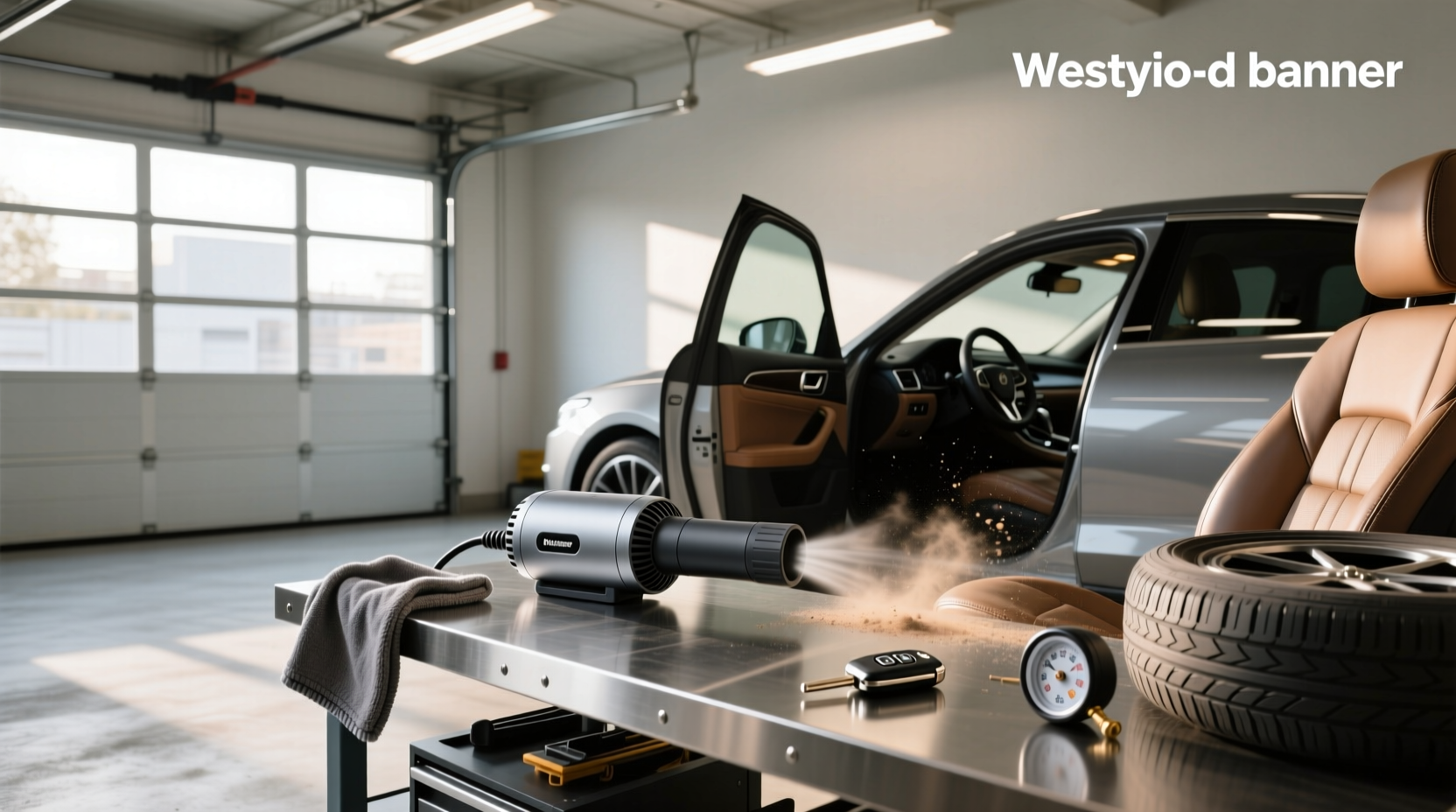
When searching for a portable blower for car detailing, especially for drying after a wash, users often face confusion between power specs, noise levels, and real-world usability. The right handheld blower can save time and prevent water spots without scratching paint—but only if chosen wisely based on airflow (CFM), speed (MPH), weight, and filtration. This guide breaks down exactly how to evaluate cordless car blowers, compares key performance metrics used by professionals, and explains which features actually matter when you're drying a vehicle at home or on the go.
Why Use a Portable Blower for Car Drying?
Many car owners still rely on microfiber towels to dry their vehicles after washing. While effective, this method risks introducing fine scratches or swirl marks—especially if the towel traps grit or isn’t properly maintained1. A portable blower offers a contact-free alternative that safely removes standing water from panels, crevices, wheels, and trim.
🔧 Key Benefits:
- ✅ Reduces risk of paint damage from towels
- ✅ Speeds up drying time significantly
- ✅ Reaches tight areas like door jambs, emblems, and grilles
- ✅ Ideal for mobile detailers or home use without compressed air
However, not all blowers are created equal. Some generate excessive noise or lack sufficient runtime. Others may blow debris onto freshly cleaned surfaces, undoing your work. Understanding technical specs and usage scenarios is essential before investing.
Understanding Key Performance Metrics: CFM vs. MPH
Two primary measurements define blower performance: cubic feet per minute (CFM) and miles per hour (MPH). These numbers appear prominently in product descriptions but are often misunderstood.
What Is CFM and Why It Matters More
📌 CFM (Cubic Feet per Minute) measures the volume of air moved over time. Higher CFM means more total airflow, which translates to better water displacement across broad surfaces like hoods and roofs.
For example, a blower rated at 650 CFM will clear large panels faster than one with 400 CFM—even if the latter has a higher MPH rating. In practical terms, high CFM reduces overall drying time.
What About MPH (Air Speed)?
⚡ MPH indicates how fast the air exits the nozzle. High-speed air (e.g., 150+ mph) helps dislodge water from recessed areas like side mirrors or wheel wells. However, extreme velocity without adequate airflow volume can scatter water rather than remove it efficiently.
🔍 Trade-off Insight: A blower with balanced CFM and MPH performs best. Prioritize models offering both strong airflow and directional control through interchangeable nozzles.
Battery Power and Runtime: What You Need to Know
Most modern portable blowers for cars are cordless, powered by lithium-ion batteries. Voltage (V) and amp-hours (Ah) determine run duration and motor strength.
🔋 Common Battery Configurations:
- 18V–20V: Standard for compact tools; compatible with many drill/trimmer batteries
- 36V–56V: Found in premium models; delivers longer runtime and higher torque
⏱️ Typical Runtime: Ranges from 10 to 30 minutes depending on power mode and battery capacity. Some units offer dual-speed settings to extend use.
⚠️ Important: Always check whether the blower includes a battery and charger. Many kits sell the tool body only, requiring separate purchase of compatible packs—an added cost that impacts value.
Noise Levels: Can You Use It Residentially?
📍 One overlooked factor is sound output, measured in decibels (dB). Blowers can range from 65 dB (moderate conversation level) to over 90 dB (equivalent to a lawnmower).
🔊 Noise Comparison Guide:
| Decibel Level | Sound Equivalent | Suitability for Home Use |
|---|---|---|
| 60–70 dB | Normal conversation | Ideal – safe for garages and neighborhoods |
| 75–85 dB | Vacuum cleaner | Acceptable with ear protection |
| 85+ dB | Gas-powered leaf blower | May disturb neighbors; limit outdoor use |
If using the blower early in the morning or in an attached garage, opt for quieter models (<80 dB). Look for brushless motors—they tend to operate more smoothly and quietly than brushed counterparts.
Filtration and Particle Intake: Protect Your Paint
🌬️ A critical yet under-discussed issue is intake air quality. If the blower sucks in dust, sand, or debris near the ground and expels it toward the car’s surface, it could cause micro-scratches.
✅ Solution: Choose a model with an integrated air filter or elevated intake design. This prevents particulates from entering the fan chamber. Regular cleaning of filters also maintains performance and safety.
🧼 Tip: Never place the blower directly on a dirty driveway or workshop floor. Elevate it on a mat or bench during operation.
Ergonomics and Portability: Weight and Balance
🛒 When evaluating a portable blower for car care, consider how long you’ll hold it. Extended drying sessions demand lightweight, well-balanced tools.
⚖️ Weight Guidelines:
- Under 2 lbs (0.9 kg): Excellent for prolonged use
- 2–3 lbs (0.9–1.4 kg): Manageable but may cause fatigue
- Over 3.5 lbs (1.6 kg): Heavy for overhead work like roof drying
🛠️ Compact size also matters. Smaller units fit easily into detailing bags or trunks, making them ideal for mobile detailers or weekend enthusiasts.
Popular Models and Real-World Comparisons
👥 Online forums such as Reddit’s r/AutoDetailing and Facebook groups frequently compare top contenders. Based on user feedback and testing videos, here's how several widely discussed models stack up:
| Model | CFM | MPH | Battery | Weight | Noise (dB) | User Feedback Summary |
|---|---|---|---|---|---|---|
| Ryobi Compact Blower | 400 | 125 | 18V One+® | 2.4 lbs | 78 | Reliable, affordable, widely available; slightly underpowered for full vehicle drying |
| Adam's Mini Air Cannon | 500 | 130 | 20V Max™ | 2.6 lbs | 82 | Stronger than Ryobi; some report reduced flow due to restrictive nozzles |
| EGO 650 CFM Blower | 650 | 180 | 56V Arc Lithium™ | 3.2 lbs | 86 | High performance; heavier and pricier but excellent for pros |
| Kica Jet Fan Max | 580 | 140 | 21V | 2.8 lbs | 80 | Dual-function (blower/vacuum); good mid-tier option |
| Bigboi Blowr Chargd | 600 | 160 | Custom 40V | 3.0 lbs | 84 | Premium build; limited battery ecosystem; expensive |
📊 Note: While EGO leads in raw power, its weight and price make it less ideal for casual users. For most home detailers, a sub-$150 model with 400–550 CFM strikes the best balance.
Heated vs. Unheated Air: Is Warm Air Better?
✨ Some advanced blowers include heating elements to deliver warm air, accelerating evaporation. Heated models are typically used in professional shops where climate control is limited.
🌡️ Pros of Heated Blowers:
- Faster drying in cold or humid conditions
- Reduces chance of water spotting
❌ Cons:
- Higher energy consumption → shorter battery life
- Increased risk of thermal shock on hot surfaces
- Limited availability in portable formats
For most users, ambient-temperature air suffices, especially in mild weather. Reserve heated options for winter detailing or commercial operations.
Common Misconceptions About Car-Specific Blowers
❗ Despite marketing claims, there’s no fundamental difference between a “car dryer” and a high-quality handheld leaf blower—except branding and price.
🔍 Misconception #1: "Only specialized car blowers are safe."
Reality: Any blower with clean airflow and proper handling is safe. The key is avoiding ground-level suction and using correct technique.
🔍 Misconception #2: "Higher MPH always means better drying."
Reality: Excessive speed without volume just splashes water around. Focus on CFM first, then adjust with nozzle type.
🔍 Misconception #3: "Battery-powered tools can't match shop air.”
Reality: Modern cordless blowers achieve 70–80% of pneumatic dryer performance, sufficient for most personal vehicles.
Step-by-Step: How to Dry a Car Safely with a Portable Blower
📋 Follow this process to maximize efficiency and minimize risks:
- Prep the Vehicle: After rinsing, gently shake off excess water from mirrors and trim. Use a water blade or squeegee on flat surfaces to reduce load.
- Elevate the Blower: Place the unit on a clean bench or bucket—not on the ground—to avoid sucking up dirt.
- Start Low and Wide: Begin with a wide-angle nozzle on low speed to move bulk water off horizontal surfaces.
- Switch to Concentrated Flow: Use a narrow nozzle for crevices, badges, and wheel spokes.
- Work Top to Bottom: Start at the roof, move to hood/trunk, then sides and lower panels.
- Avoid Direct Angles: Hold the nozzle at a 30–45° angle to prevent water spray-back onto dried sections.
- Inspect and Repeat: Check for residual droplets in seams. Re-blown if needed.
✅ Pro Tip: Pair the blower with a quick detailer spray for spot correction after drying.
When NOT to Use a Portable Blower
🚫 While useful, these tools aren’t suitable in every situation:
- On dusty or sandy surfaces—risk of blowing abrasive particles onto paint
- In confined spaces with poor ventilation—noise and air turbulence can be overwhelming
- With damaged or unfiltered intake systems—increases contamination risk
- During rain or high humidity—limited effectiveness due to slow evaporation
In such cases, revert to traditional drying methods using clean, absorbent microfiber towels.
Cost vs. Value: What Price Range Makes Sense?
💰 Pricing varies widely—from $60 for basic models to over $400 for premium units. Here’s how to assess value:
- $60–$100: Entry-level; suitable for occasional use. May lack advanced ergonomics or filtration.
- $100–$200: Mid-range; best value for regular detailers. Often compatible with common battery platforms.
- $200–$400: Professional-grade; powerful, durable, but may be overkill for home use.
📎 Consider existing tool ecosystems. If you already own Ryobi, DeWalt, or EGO tools, choosing a matching brand saves money on batteries and chargers.
Final Recommendations Based on Use Case
🎯 Selecting the right portable blower depends on your specific needs:
- Home Users / Weekend Detailers: Opt for a 400–500 CFM model under 3 lbs with decent battery compatibility (e.g., Ryobi or Kica).
- Mobile Detailers: Prioritize portability, runtime, and durability. EGO or Adam’s models offer solid performance.
- Professionals in Cold Climates: Explore heated options or pair blowers with infrared drying lamps.
Always verify warranty terms and customer support availability before purchasing.
Frequently Asked Questions
- Can I use a leaf blower to dry my car?
- Yes, but only if it has variable speed control, a clean air intake, and is used carefully. Avoid standard gas-powered models—they’re too loud, heavy, and likely to blow debris. Cordless electric handheld blowers designed for yard work can work if filtered and operated at moderate speeds.
- What CFM is good for drying a car?
- A minimum of 400 CFM is recommended for efficient drying. Models between 500–650 CFM provide faster results, especially on larger vehicles like SUVs or trucks.
- Do car blowers scratch paint?
- Not if used correctly. The risk comes from airborne debris, not the air itself. Ensure the blower has a clean filter, elevate it off the ground, and avoid pointing it directly at vertical surfaces from close range.
- How long does a battery last on a cordless car blower?
- Typically 10–30 minutes per charge, depending on power mode and battery size. Larger 56V batteries last longer but add weight. Dual-battery systems extend runtime for professionals.
- Are heated car dryers worth it?
- Only in cold or humid environments. For most users in temperate climates, ambient-air blowers perform adequately and preserve battery life.




 浙公网安备
33010002000092号
 浙B2-20120091-4