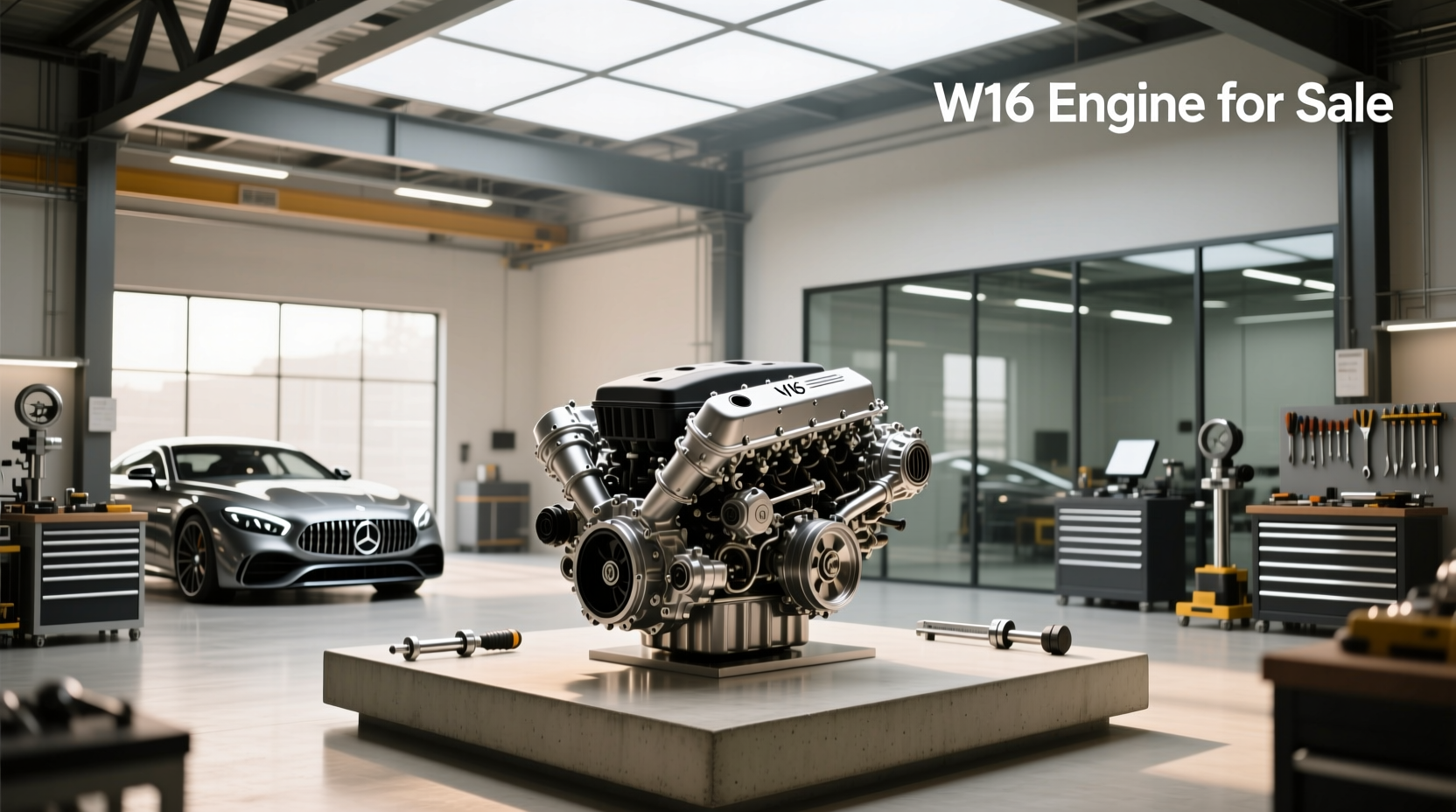
If you're searching for a W16 engine for sale, it's important to understand that genuine, functional W16 engines from manufacturers like Bugatti are almost never legally or practically available to the public. The iconic 8.0-liter quad-turbocharged W16 engine, famously used in the Bugatti Veyron and Chiron, is not sold as standalone replacement or aftermarket units by authorized dealers or OEMs 🚫. Most listings claiming to offer a 'W16 engine for sale' are either scale models, non-functional replicas, or mislabeled V8 or V12 engines. This article breaks down everything you need to know before pursuing such a purchase—covering legality, authenticity, cost factors, alternative options, and common misconceptions surrounding these rare powerplants ⚙️.
What Is a W16 Engine?
The W16 engine is one of the most advanced internal combustion engines ever mass-produced for automotive use ✨. Unlike traditional V-shaped configurations, the W16 features four banks of four cylinders arranged in a compact 'W' layout. In the case of Bugatti’s implementation, this design effectively combines two narrow-angle VR8 engines sharing a single crankshaft, resulting in a highly dense yet relatively compact 16-cylinder powerhouse 🔧.
Bugatti's version displaces 8.0 liters and uses four turbochargers to generate over 1,000 horsepower, with later variants like those in the Chiron Super Sport producing up to 1,600 hp ⚡. It has powered legendary hypercars including:
- Bugatti Veyron (2005–2015)
- Bugatti Grand Sport / Sang Noir editions
- Bugatti Chiron (2016–2024)
- Bugatti Divo, Centodieci, Bolide
In July 2022, Bugatti confirmed the end of W16 production after nearly two decades, marking the final unit assembled as “the last of its kind” 1. Since then, the company has transitioned toward hybrid powertrains, making surviving W16-equipped vehicles even more exclusive.
Why Are Real W16 Engines Not for Sale?
Despite frequent online searches for a W16 engine for sale, actual factory-built examples are not offered through retail channels. There are several key reasons:
No Official Aftermarket Support
Unlike common performance engines (e.g., Chevrolet LS series or Ford Coyote V8s), the W16 was never designed for modular reuse or third-party installation. Bugatti does not sell complete W16 engines separately from the vehicle 🏭. These engines are deeply integrated into the chassis, cooling systems, ECU networks, and structural frame of each car, making removal and reinstallation extremely complex.
Legal and Regulatory Barriers
Selling a standalone W16 engine may violate emissions regulations in many countries, especially in regions like the United States (EPA rules) and the European Union (Euro 6 standards). Installing such an engine into another vehicle typically fails to meet certification requirements unless the donor car itself is being restored or preserved under specific exemptions 🌐.
Extreme Value and Rarity
Each W16-powered Bugatti sells new for $2 million to over $10 million. The engine alone represents a significant portion of that value. Owners rarely dismantle these cars, and when they do, parts—including the engine—are usually kept within private collections or sold privately among high-net-worth individuals 👥. Public auctions of complete engines are exceedingly rare.
Where Do 'W16 Engines for Sale' Listings Come From?
When browsing platforms showing results for w16 engine for sale, most listings fall into one of the following categories:
| Listed As | Reality Check | Risk Level |
|---|---|---|
| Used W16 Engine – $90,000 | Likely a scam or placeholder; no verifiable transaction history | ❗ High |
| New W16 Motor Assembly | Impossible—Bugatti doesn’t manufacture standalone units | ❗ Critical |
| W16 Engine Model Kit | Saleable item: detailed scale replica (1:4 or 1:8) | ✅ Low |
| Engine Block Only (No Internals) | Possible museum/display piece; lacks functionality | ⚠️ Medium |
| Chiron Powertrain Removal | May be authentic but requires import/export permits and verification | 📍 Jurisdiction-dependent |
Many e-commerce sites mistakenly categorize model kits or educational displays as functional engines due to keyword tagging errors. Always verify whether the product includes:
- Functional pistons, crankshaft, turbochargers
- ECU, wiring harness, fuel system compatibility
- Documentation proving origin (e.g., VIN-linked removal certificate)
How Much Does a Real W16 Engine Cost?
There is no official price list for a standalone W16 engine because none are sold commercially. However, estimates based on整车残值 and auction data suggest:
- A complete Bugatti Veyron starts at ~$1.3 million used
- A Chiron can exceed $3 million on the secondary market
- Salvage titles with damaged bodies but intact W16 engines have traded between $500,000–$800,000
In essence, acquiring a working W16 means buying an entire hypercar—and often restoring it—which involves far more than just the engine itself. Additional costs include:
- Import duties (up to 25% in some countries) 💰
- Custom fabrication for mounting and cooling 🛠️
- Fuel system upgrades (requires high-flow gasoline delivery)
- Diagnostics tools compatible with Bugatti’s proprietary software
Alternatives to Buying a Functional W16 Engine
For enthusiasts seeking a similar experience without the impracticality of owning a real W16, consider these alternatives:
Scaled Replicas and Display Models
Detailed 1:4 or 1:8 scale W16 model kits are available from brands like Amalgam Collection and AutoArt 🎯. These hand-assembled replicas showcase every component—from camshafts to intercoolers—and serve as impressive display pieces for garages or offices. Prices range from $300 to $2,000 depending on detail level and materials used 🛒.
VR8-Based Engine Projects
Since the W16 is derived from two VR8 blocks, some engineering hobbyists explore building mockups using Volkswagen Group architecture. While not a true W16, combining two Audi R8 4.2L V8s (or Lamborghini Gallardo units) offers a visually comparable project with better parts availability 🔗.
Museum Exhibits and Factory Tours
Bugatti offers limited-access factory visits in Molsheim, France, where guests can view original W16 engines up close. Similarly, auto museums like the Petersen Automotive Museum in Los Angeles occasionally feature disassembled W16 displays with interactive explanations 🌍.
Common Misconceptions About W16 Engines
Several myths persist around the W16 configuration, often fueled by misleading marketing or incomplete technical understanding:
Myth: A W16 Is Just Two V8 Engines Bolted Together
❌ False. While conceptually inspired by pairing VR8 layouts, the W16 is a fully integrated monobloc design with shared cylinder heads, valvetrain, and lubrication systems. It cannot be constructed simply by joining two separate V8s ❗.
Myth: You Can Swap a W16 Into Any Supercar
❌ False. Due to size, weight (~450 lbs), cooling demands, and electronic integration, installing a W16 into a non-Bugatti chassis would require complete redesign of the front subframe, radiator placement, transmission tunnel, and ECU network. No known successful swaps exist publicly 📋.
Myth: W16 Engines Are More Powerful Than V12s
✅ Partially true. Horsepower depends on tuning and forced induction. For example:
- Ferrari 812 Competizione: 819 hp (naturally aspirated V12)
- Bugatti Chiron: 1,500+ hp (quad-turbo W16)
However, the W16 achieves higher output primarily due to turbocharging, not cylinder count alone. A naturally aspirated W16 would face immense packaging and thermal challenges.
How to Verify Authenticity If a W16 Becomes Available
Should a legitimate opportunity arise—such as through a salvage auction or private collector sale—follow these steps to ensure authenticity:
- Request Documentation: Ask for service records, build sheet, and proof of removal from a registered Bugatti chassis.
- Check Serial Numbers: Cross-reference engine number with Bugatti’s registry or authorized service centers.
- Hire a Specialist Inspector: Use a certified technician familiar with Bugatti systems to assess condition.
- Confirm Legal Import Status: Ensure compliance with local emissions and safety laws before purchase.
- Avoid Upfront Payments: Use escrow services for high-value transactions to prevent fraud.
Even if the engine appears complete, wear from prior usage (especially turbocharger fatigue or oil sludge buildup) can render it unsafe for restart without full rebuild.
Future of the W16: Will It Return?
As of 2024, Bugatti has shifted focus to hybrid technology under its partnership with Rimac. The upcoming Tourbillon model features a naturally aspirated V16 developed with Cosworth—marking a return to large-displacement engines, but abandoning the W-layout entirely 🔄.
This new 8.3L V16 will produce around 1,000 hp and rev to 9,000 rpm, emphasizing driver engagement over brute force. While still extremely rare, this engine may eventually appear in salvage markets—but again, only as part of a complete vehicle, not as a standalone unit for sale 📈.
Final Advice: Should You Pursue a W16 Engine Purchase?
Unless you are a certified restorer, museum curator, or ultra-high-net-worth collector with access to specialized facilities, purchasing a functional W16 engine is neither practical nor advisable. Instead:
- Set realistic expectations about availability and legality ✅
- Consider scale models for educational or decorative purposes 🧰
- Explore VR8/W16 engineering through simulations or 3D animations 🖥️
- Attend auto shows featuring Bugatti exhibits for firsthand exposure 📍
Always prioritize verified sources and avoid deals that seem too good to be true. The dream of owning a W16 engine remains alive—but only within very narrow, expert-driven contexts.




 浙公网安备
33010002000092号
 浙B2-20120091-4