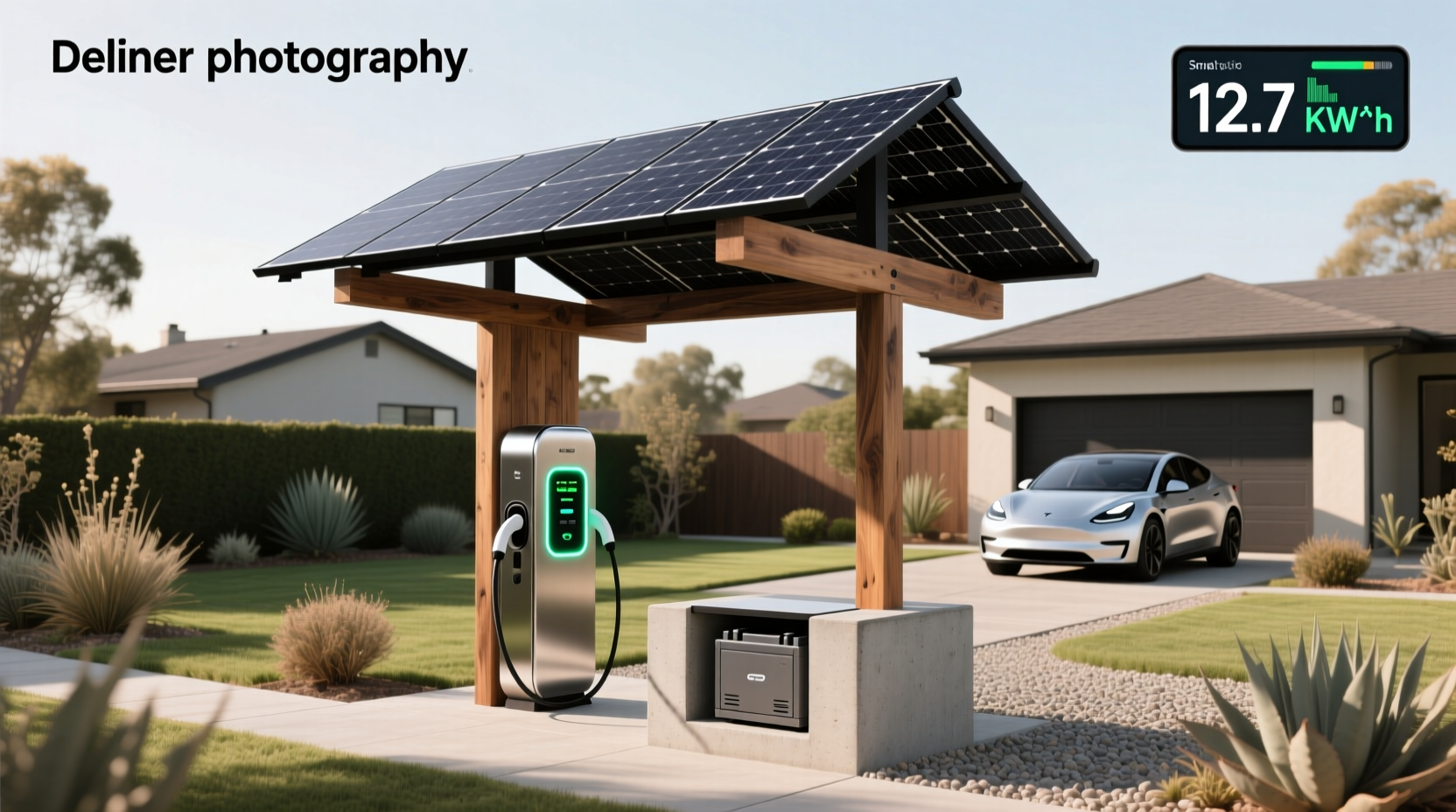
Building a DIY solar EV charging station is an increasingly popular way for homeowners to reduce reliance on the grid, lower electricity bills, and support sustainable transportation. By harnessing sunlight to charge your electric vehicle (EV), you can achieve greater energy independence—especially when combining solar panels with battery storage and a compatible EV charger. This guide walks through every critical aspect of creating a functional off-grid or grid-tied solar-powered EV charging setup, covering component selection, system sizing, installation considerations, safety standards, and real-world limitations.
Why Consider a DIY Solar EV Charging Station?
Many EV owners are exploring solar as a way to offset charging costs and environmental impact. While public and home Level 2 chargers typically draw power from the utility grid—which may be sourced from fossil fuels—a solar-based system allows direct use of renewable energy. A well-designed off-grid solar EV charging station can operate independently during outages or in remote locations, making it ideal for rural properties, cabins, or emergency preparedness scenarios.
However, it's important to understand that simply connecting solar panels directly to an EV is not feasible due to voltage, current, and communication protocol mismatches. Instead, a complete system requires several integrated components working together safely and efficiently.
Core Components of a DIY Solar EV Charging System
To build a reliable solar EV charging solution, you need more than just photovoltaic (PV) panels. The following elements form the foundation of any effective setup:
Solar Panels (Photovoltaic Array)
The number and type of solar panels depend on your daily driving habits and local sun exposure. Most residential systems range from 3 kW to 10 kW. For example, if you drive 40 miles per day (requiring ~12 kWh), and receive 5 peak sun hours daily, you’d need roughly a 2.5 kW array—about 7–8 standard 370W panels.
- Monocrystalline vs. Polycrystalline: Monocrystalline panels offer higher efficiency and better performance in low-light conditions but come at a slightly higher cost.
- Roof vs. Ground Mount: Roof-mounted systems save space but require structural assessment; ground mounts allow optimal tilt and orientation but take up yard space.
- Maintenance: Keep panels clean and free of shading from trees or debris to maximize output.
Charge Controller
This device regulates the voltage and current coming from the solar panels to prevent overcharging batteries. Two main types exist:
- PWM (Pulse Width Modulation): Less expensive but less efficient, best suited for small systems.
- MPPT (Maximum Power Point Tracking): More costly but can increase energy harvest by up to 30%, especially under variable weather conditions. Recommended for EV-scale applications.
Battery Storage System
Since solar generation peaks during midday while most EV charging occurs overnight, battery storage is essential for time-shifting energy use. Without batteries, excess solar power must be exported to the grid (if permitted).
- Lithium-ion (LiFePO4 preferred): Offers long cycle life, high depth of discharge (DoD), and compact size. Typical home setups use 10–20 kWh capacity.
- Lead-acid: Cheaper upfront but shorter lifespan and lower DoD; not recommended for frequent cycling in EV applications.
- Integration: Batteries must be paired with inverters capable of handling bidirectional flow (AC/DC conversion).
Inverter / Inverter-Charger
An inverter converts DC power from solar panels and batteries into AC power used by most EV chargers. For advanced setups, consider a hybrid inverter-charger that supports generator backup, grid-tie functionality, and smart load management.
- Continuous Output Rating: Must match or exceed the EVSE (Electric Vehicle Supply Equipment) demand. A Level 2 charger drawing 7.2 kW needs at least a 8–10 kW inverter.
- Surge Capacity: Some inverters can briefly handle higher loads, useful during motor startup or fast charging transitions.
EV Charger (EVSE)
The final link in the chain is the EVSE, which communicates with your car to manage safe charging. There are two primary levels:
- Level 1 (120V): Delivers 2–5 miles of range per hour; suitable for occasional top-ups but impractical for full daily recharges via solar alone.
- Level 2 (240V): Provides 10–60 miles of range per hour depending on amperage (16A–80A). Requires dedicated circuit and permits in most jurisdictions.
Note: EVSE units do not convert power—they rely on external AC supply. Therefore, your solar+battery system must deliver stable 240V power to operate them.
Monitoring & Energy Management Systems
Advanced systems include monitoring tools that track solar production, battery state of charge, household loads, and EV charging status. Brands like Enphase, SolarEdge, and Sol-Ark offer platforms that enable dynamic load balancing—prioritizing solar energy for EV charging when surplus is available.
| Component | Function | Typical Specs for EV Use |
|---|---|---|
| Solar Panels | Convert sunlight to DC electricity | 6–10 kW total array, monocrystalline, 370W+ each |
| Charge Controller | Regulate solar input to batteries | MPPT, 80A+, compatible with battery chemistry |
| Battery Bank | Store solar energy for later use | 10–20 kWh LiFePO4, scalable design |
| Inverter | Convert DC to AC for EVSE | 8–10 kW continuous, 240V split-phase |
| EVSE (Charger) | Deliver controlled power to EV | Level 2, 32A–48A, J1772 or CCS |
Can You Charge an EV Directly from Solar Panels?
No—you cannot charge an EV directly from solar panels without intermediate components. Solar panels produce variable DC power based on sunlight intensity, while EVs require stable, regulated power delivered through standardized protocols (like SAE J1772 or CCS). Attempting direct connection would risk damaging both the vehicle and equipment.
Instead, solar energy must be conditioned through a charge controller, stored in batteries, converted to AC via an inverter, and then supplied to a compliant EVSE unit. Even in grid-tied systems with solar credits, the actual charging still draws from either the grid or stored energy—not directly from panels.
System Design: Off-Grid vs Grid-Tied Configurations
Your location, budget, and goals will determine whether an off-grid or grid-tied configuration makes sense.
Off-Grid Solar EV Charging Station
An off-grid system operates independently of utility infrastructure. It’s ideal for remote homes, workshops, or areas with unreliable grid access.
- Pros: Complete energy independence, resilience during blackouts, no electricity bills.
- Cons: High initial cost, requires oversized solar and battery arrays, complex maintenance.
- Design Tip: Size the system for winter months when solar insolation is lowest, even if summer production exceeds needs.
Grid-Tied with Net Metering
Most homeowners opt for grid-connected systems where excess solar feeds back into the utility network in exchange for credits (net metering).
- Pros: Lower upfront cost, no need for large battery banks, seamless integration with existing service.
- Cons: Dependent on grid stability; some utilities limit export or impose interconnection fees.
- Design Tip: Use a smart EVSE that schedules charging during periods of high solar production or low time-of-use rates.
How Many Solar Panels Do I Need to Charge an Electric Car?
The answer depends on three key factors: your vehicle’s efficiency, daily mileage, and local solar resource availability.
For example:
A Tesla Model 3 Standard Range consumes about 0.25 kWh/mile. Driving 30 miles/day uses ~7.5 kWh. With 5 peak sun hours, you’d need a 1.5 kW solar array (~4 panels). However, accounting for inefficiencies (inverter losses, battery charging losses, panel degradation), a safer estimate is 2–2.5 kW (~6–7 panels).
Use this formula:
Total Daily Energy Needed (kWh) = Miles Driven × kWh/mile
Required Solar Array Size (kW) = (Daily Energy Needed ÷ Peak Sun Hours) × 1.3 (system loss factor)
Peak sun hours vary widely: Phoenix might get 6.5, whereas Seattle averages 3.5. Tools like the National Renewable Energy Laboratory’s PVWatts Calculator1 help estimate production by ZIP code.
Common Challenges and Misconceptions
While building a DIY solar EV charging station is technically possible, several misconceptions lead to frustration or unsafe installations.
Misconception: Portable Solar Panels Can Charge EVs Quickly
Some marketing claims suggest portable kits (e.g., foldable 200W panels) can meaningfully charge EVs. In reality, such systems generate minimal energy—enough for trickle charging auxiliary systems, not propulsion batteries. A single 200W panel produces ~1 kWh per day in ideal conditions—less than 4 miles of range for most EVs.
Challenge: Voltage and Phase Compatibility
North American homes use split-phase 120/240V service. Many off-the-shelf inverters are designed for 120V only, which limits compatibility with 240V EVSE units. Ensure your inverter supports 240V output or use a transformer-compatible model.
Challenge: Electrical Code Compliance
All permanent installations must comply with the National Electrical Code (NEC), particularly Article 690 (Solar Photovoltaic Systems) and Article 625 (Electric Vehicle Charging Systems). Key requirements include:
- Proper grounding and disconnect switches
- Arc-fault and ground-fault protection
- Labeling of all system components
- Permitting and inspection processes vary by municipality
Failing to meet code can void insurance coverage and create fire hazards.
Cost Breakdown: What to Expect
Building a DIY solar EV charging station involves significant investment. Here’s a realistic estimate for a 7 kW solar + 10 kWh battery + Level 2 EVSE system:
- Solar Panels (7 x 370W): $1,750
- MPPT Charge Controller: $400
- Lithium Battery (10 kWh): $7,000
- Hybrid Inverter (8 kW): $3,500
- Level 2 EVSE: $600
- Wiring, Conduit, Mounting Hardware: $800
- Permits and Inspection Fees: $300–$600
Total: ~$14,350–$15,000 before incentives.
Federal tax credits (e.g., U.S. Residential Clean Energy Credit) may cover 30% of eligible costs if installed by a professional or self-installer meeting IRS guidelines. State and utility rebates can further reduce net cost.
Is a DIY Approach Right for You?
DIY solar projects appeal to technically skilled individuals comfortable with electrical work, roofing, and mechanical assembly. However, missteps can result in equipment damage, injury, or non-compliance.
Consider DIY if:
- You have experience with solar or electrical systems
- You’re willing to study local codes and obtain permits
- You want maximum customization and control
Consider hiring a licensed contractor if:
- You lack technical expertise
- Your roof is difficult to access or aging
- You plan to claim warranties or incentives requiring professional installation
Alternatives to Full DIY: Plug-and-Play Kits
For those seeking simplicity, pre-engineered kits from companies like EcoFlow, NAZ Solar Electric, or Sol-Ark offer modular solutions that simplify integration. These often include:
- All-in-one inverter-battery units
- Pre-wired solar inputs
- EVSE compatibility modes
While more expensive per watt than sourcing parts individually, these kits reduce design complexity and accelerate deployment.
Safety First: Critical Precautions
Working with high-voltage DC and AC circuits poses serious risks. Always follow these safety practices:
- Turn off all sources before servicing equipment
- Use insulated tools and personal protective equipment (PPE)
- Install rapid shutdown devices per NEC 690.12
- Label all breakers and disconnects clearly
- Never work alone on live systems
If unsure, consult a qualified electrician or solar installer.
Final Thoughts: Balancing Feasibility and Goals
A DIY solar EV charging station is a rewarding project that aligns sustainability with energy autonomy. However, it requires careful planning, realistic expectations, and respect for technical and regulatory constraints. While it won’t eliminate your need for grid power entirely—especially during extended cloudy periods or high-mileage weeks—it can significantly reduce carbon emissions and long-term operating costs.
Start small: Begin with a rooftop solar system tied to your home panel, then add battery storage and smart charging controls. As technology improves and prices decline, incremental upgrades make solar EV charging more accessible every year.
Frequently Asked Questions (FAQs)
- Can I charge my EV with solar panels at night?
- No, solar panels only generate electricity during daylight. To charge at night, you must store energy in batteries or rely on grid power with net metering credits.
- Do I need batteries for a solar EV charging system?
- Not necessarily. If you're grid-tied, excess solar can offset nighttime charging through net metering. But for off-grid or blackout resilience, batteries are essential.
- Can portable solar generators charge an EV?
- Only minimally. Most portable units (like the EcoFlow Delta Pro) can provide emergency Level 1 charging at very slow rates—typically adding just a few miles per hour. They are not practical for daily use.
- How long does it take to install a DIY solar EV charging system?
- Experienced DIYers may complete wiring and mounting in 2–5 days, but permitting and inspections can extend timelines to several weeks depending on jurisdiction.
- Are there solar-powered EV charging stations available commercially?
- Yes, companies like Beam Global and Enphase offer turnkey solar EV charging canopies. These are typically used in commercial or municipal settings due to high cost and scalability.




 浙公网安备
33010002000092号
 浙B2-20120091-4