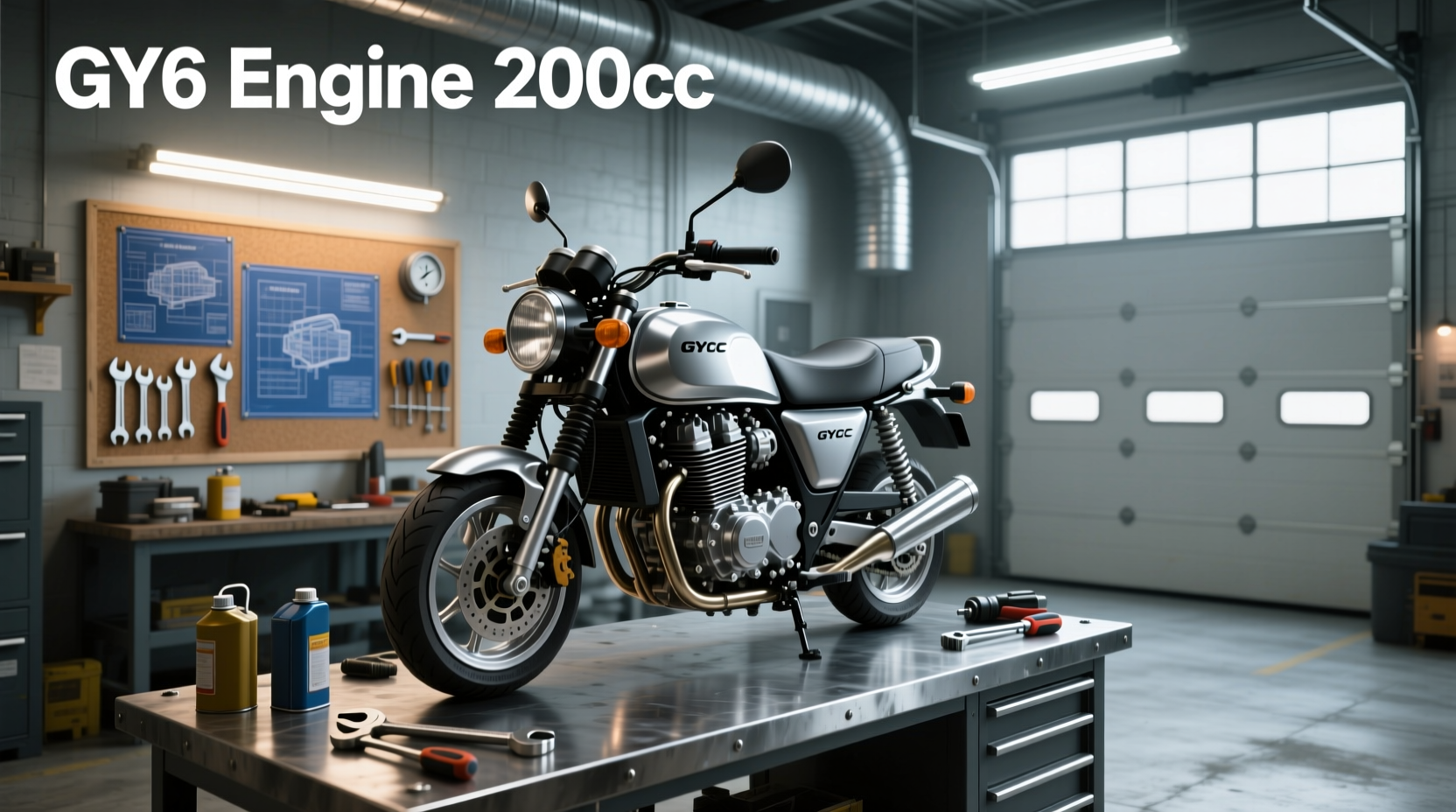
If you're searching for a reliable, cost-effective powerplant for a scooter, ATV, or custom go-kart, the GY6 200cc engine is often a top contender. While originally designed as a 150cc platform, the GY6 architecture has been widely modified and enlarged to 200cc through aftermarket bore kits and long-stroke crankshafts, making it a popular choice for performance upgrades ✅. This guide breaks down everything you need to know about the 200cc variant of the GY6 engine—its design origins, compatibility challenges, performance potential, and maintenance considerations ⚙️.
Understanding the GY6 Engine Platform
The GY6 isn't a single engine made by one manufacturer—it's a generic engine design inspired by Honda’s original QM-series engines from the 1980s, particularly the Honda Elite 150. Over time, this layout became a blueprint used across Chinese and Taiwanese manufacturers for scooters, ATVs, and recreational vehicles 🌍. The core features include:
- 4-stroke, single-cylinder configuration
- Air-cooled (sometimes forced-air with fan shrouds)
- Overhead cam (OHC), two-valve head
- CVT automatic transmission integration
- Horizontal cylinder orientation (lying nearly flat)
This standardized layout allows for broad parts interchangeability—but only within certain limits. Displacement varies from 50cc up to 300cc in modified forms, with 150cc being the most common factory size. When users refer to a “GY6 200cc engine,” they’re typically talking about a stroked or bored version of the standard 150cc unit 🔧.
Is There a Factory 200cc GY6 Engine?
No major OEM produces a stock 200cc GY6 engine. Most factory-built GY6 engines come in 50cc, 125cc, or 150cc displacements. However, the 157QMJ base block—the most common GY6 variant—can be upgraded to 200cc using aftermarket components 🛠️. This is usually achieved in two ways:
- Bore-up kits: Increasing the cylinder diameter from 57mm to 61–66mm
- Long-stroke crankshaft: Replacing the stock crank with one that has a longer throw (e.g., 54mm → 57.8mm)
Combining both methods can push displacement beyond 200cc—some builds reach 210–230cc. These are commonly referred to as “big bore GY6 kits” and are sold as complete engine packages or individual upgrade parts ✨.
Common Applications for a 200cc GY6 Build
While not found in mass-produced scooters, the 200cc GY6 conversion is widely used in:
- Performance scooters: Riders seeking higher top speed and hill-climbing ability
- Go-karts and dune buggies: Where extra torque improves acceleration
- Mini bikes and custom trikes: For street-legal or off-road use
- ATV swaps: Replacing worn-out engines in small utility quads
Because the GY6 mounts are standardized and output shafts often match OEM CVT systems, integrating a 200cc build into existing frames is relatively straightforward—if space allows 🏭.
Key Components in a 200cc GY6 Conversion
Building a reliable 200cc GY6 requires more than just a bigger piston. Critical components include:
| Component | Purpose | Upgrade Needed? |
|---|---|---|
| Cylinder & Piston Kit | Increases bore size (e.g., 61mm–66mm) | ✅ Yes |
| Stroker Crankshaft | Increases stroke length for more displacement | ✅ Yes |
| Performance Head | Improved airflow, higher compression | Recommended |
| Reinforced Connecting Rod | Handles increased stress at high RPM | ✅ Yes |
| Larger Carburetor | Supports increased air/fuel flow (e.g., 28mm–32mm) | Recommended |
| High-Flow Air Filter | Reduces intake restriction | Recommended |
| Performance CDI | Adjusts ignition timing for better power delivery | Optional |
| Clutch & Variator Tuning | Optimizes power transfer under load | ✅ Yes |
Using mismatched or low-quality parts can lead to premature failure, so sourcing from reputable suppliers matters ⚠️. Look for kits labeled “complete big bore” that include all necessary gaskets, hardware, and instructions.
Short Case vs Long Case: Why It Matters
One of the biggest compatibility hurdles when upgrading to 200cc is determining whether your frame fits a short case or long case engine block ❓.
- Short case: Typically used in 10-inch wheel scooters; shorter crankshaft and narrower engine width
- Long case: Found in larger scooters and many go-karts; longer crankshaft, wider mounting pattern
Most 200cc builds are based on long-case blocks due to added internal clearance and stronger construction. If your vehicle was designed for a short-case 150cc engine, installing a long-case 200cc unit may require frame modifications or engine spacers 🛠️. Always verify engine dimensions before purchasing.
How Much Power Does a 200cc GY6 Produce?
A stock 150cc GY6 produces around 9–11 horsepower. With proper tuning, a well-built 200cc version can generate 14–18 HP, depending on setup ⚡. Factors influencing output include:
- Bore and stroke combination
- Compression ratio (ideally 10:1 to 11:1)
- Carburetor size and jetting
- Exhaust system efficiency
- Air filter type
- CDI mapping
Top speeds can range from 65 mph to over 75 mph in lightweight applications, though real-world results depend heavily on gearing, weight, and terrain 📊.
Reliability: Are 200cc GY6 Engines Trustworthy?
The reliability of a 200cc GY6 depends almost entirely on build quality and maintenance habits 🧼. Because these engines operate outside their original design parameters, they generate more heat and mechanical stress. Common failure points include:
- Connecting rod bearings (especially with cheap rods)
- Piston scuffing (from overheating or poor oiling)
- Crankshaft seal leaks
- Valve train wear (if not adjusted regularly)
To maximize lifespan:
- Use high-quality synthetic 10W-40 or JASO MA2 oil
- Change oil every 500–750 miles (800–1,200 km)
- Inspect valves every 1,000 miles
- Avoid sustained high-RPM operation without cooling breaks
- Monitor exhaust temperature—excessive heat indicates tuning issues
When properly maintained, a 200cc GY6 can last thousands of miles, but neglect leads to rapid degradation ❗.
Fueling Options: Carbureted vs EFI Conversions
Most GY6 engines—including 200cc builds—are carbureted. However, some enthusiasts opt for EFI (Electronic Fuel Injection) retrofits using throttle-body injection systems paired with programmable ECUs 🔗. Benefits include:
- Better fuel economy
- Smoother throttle response
- Improved cold starts
- Reduced emissions
Drawbacks:
- Higher initial cost
- Complexity in installation and tuning
- Need for battery and sensors
For most users, a properly jetted 30mm or 32mm constant-velocity carburetor remains the simplest and most cost-effective option ✅.
Legal and Registration Considerations
In many regions, modifying an engine to increase displacement affects its legal status 🌐. For example:
- In the U.S., some states require emissions certification for street use
- Canada mandates compliance with Transport Canada standards
- European Union regulations restrict unapproved engine swaps
If your vehicle is registered and insured, confirm whether a 200cc conversion voids compliance or impacts insurance coverage 📋. Some jurisdictions classify vehicles by displacement—for instance, above 150cc may require a motorcycle license instead of a moped endorsement.
Where to Buy a 200cc GY6 Engine or Kit
Complete 200cc GY6 engines and upgrade kits are available from specialty online retailers focusing on scooter and mini-vehicle performance parts 🛒. Look for vendors offering:
- Detailed product specifications (bore, stroke, stud spacing)
- Customer support and technical documentation
- Warranty policies (even if limited)
- Clear return procedures
Avoid sellers who don’t specify whether the engine is short or long case, or who provide no performance data. Reputable brands often partner with engine builders who publish dyno results and installation guides 📎.
Troubleshooting Common 200cc GY6 Issues
Even well-built engines can develop problems. Here are frequent complaints and fixes:
- Overheating: Check cooling fan operation, clean fins, verify oil level, ensure adequate airflow
- Loss of power: Inspect air filter, carburetor jets, spark plug condition, and exhaust blockage
- Hard starting: Test battery voltage, check choke function, inspect CDI and coil
- Noise from bottom end: Likely rod bearing wear—requires teardown and inspection
- Oil leakage: Replace crankshaft seals and valve cover gasket
Keeping a log of maintenance intervals helps identify patterns before major failures occur ⏱️.
Alternatives to the GY6 200cc Platform
While the GY6 is versatile, other options exist for similar applications:
- Loncin 200cc engines: OEM-grade builds with better tolerances
- Generic 200cc horizontal shaft engines: Often used in generators but adaptable
- Yamaha Zuma 125-based builds: Higher stock reliability, easier tuning
- Four-stroke dirt bike engines: More complex but durable
The GY6 remains popular due to its low cost and vast aftermarket support, but alternatives may offer better longevity in demanding uses 👥.
Maintenance Checklist for 200cc GY6 Owners
To keep your engine running smoothly, follow this routine:
- Every 250 Miles:
- Check oil level, inspect belts and pulleys, test brake operation
- Every 500 Miles:
- Change engine oil, clean air filter, inspect spark plug
- Every 1,000 Miles:
- Adjust valve clearance, inspect clutch shoes, check chain tension (if applicable)
- Every 2,000 Miles:
- Replace spark plug, clean carburetor, inspect wiring harness
Regular attention prevents small issues from becoming expensive repairs 🧰.
Conclusion: Is a 200cc GY6 Right for You?
The GY6 200cc engine is a practical upgrade for those seeking more power from a proven platform. It’s not a factory engine but a widely supported modification that leverages the simplicity and availability of the original design. Success depends on choosing quality components, ensuring compatibility with your vehicle, and committing to regular maintenance ✅.
If you're building a go-kart, upgrading a scooter, or replacing a failed engine, a well-executed 200cc GY6 build offers solid performance at a low cost. Just remember: reliability follows preparation—not luck ⚙️.
Frequently Asked Questions
- Can I install a 200cc GY6 engine on a 150cc scooter?
- Yes, but only if the frame accommodates a long-case engine and there’s enough clearance for the larger components. You may also need to reinforce the rear suspension due to increased weight and torque.
- How fast will a 200cc GY6 engine go?
- Top speed ranges from 65 to 75+ mph depending on gearing, vehicle weight, and aerodynamics. Light go-karts reach higher speeds than heavy scooters.
- Are 200cc GY6 engines reliable?
- They can be reliable if built with quality parts and maintained properly. However, they operate under greater stress than stock engines, so regular oil changes and inspections are critical.
- What’s the difference between GY6A and GY6B engines?
- GY6A and GY6B refer to minor internal variations in case design, stud spacing, and crankshaft configuration. They affect part compatibility—always verify which type your engine is before ordering upgrades.
- Do I need a new carburetor for a 200cc GY6?
- Yes, the stock 20mm–24mm carburetor is too small. A 28mm to 32mm performance carburetor is recommended to support the increased airflow demands.




 浙公网安备
33010002000092号
 浙B2-20120091-4