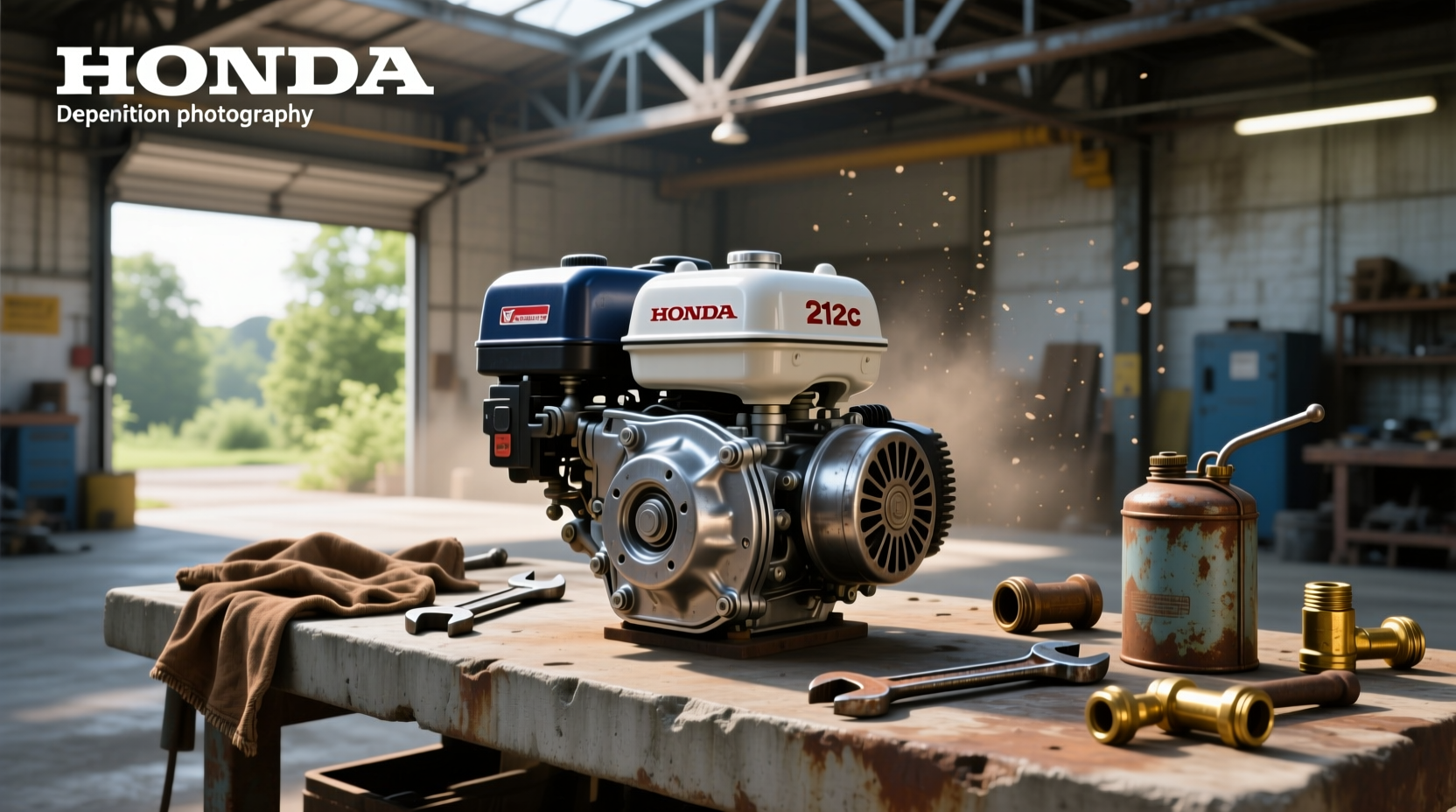
If you're searching for a Honda 212cc engine, you may be surprised to learn that Honda never actually produced a 212cc model under its own brand for aftermarket or go-kart applications. Instead, the term \u201cHonda 212cc\u201d is often a misnomer used to describe popular 212cc horizontal-shaft OHV engines from third-party manufacturers like Harbor Freight\u2019s Predator\u2014frequently mistaken for Honda due to their similar design and reliability reputation. This article clarifies the confusion around the so-called \u2018Honda 212cc engine\u2019, explores actual 212cc engine options on the market, compares performance specs, identifies compatible applications (such as go-karts, mini bikes, pressure washers, and generators), and helps you make an informed decision when selecting or upgrading a small 4-stroke engine.
Why There Is No True Honda 212cc Engine
Despite widespread online searches for a \u201cHonda 212cc engine,\u201d Honda Motor Co. does not manufacture a 212cc engine in its standard small engine lineup. Honda\u2019s closest equivalent is the GX200, which has a displacement of 196cc and delivers approximately 6.5 horsepower. The GX200 is widely respected for its durability, fuel efficiency, and clean emissions, making it a benchmark in commercial-grade equipment such as pumps, generators, and construction tools 1.
The confusion arises because many universal replacement engines—especially the Predator 212cc by Harbor Freight—are modeled after Honda\u2019s proven overhead-valve (OHV) design. These clones offer similar dimensions, shaft orientation, and mounting patterns, allowing them to serve as drop-in replacements for Honda-powered machines. However, they are neither manufactured nor endorsed by Honda.
This distinction matters for several reasons:
- Parts compatibility: While some components may interchange, OEM Honda parts are engineered to tighter tolerances.
- Warranty and support: Honda offers superior customer service and longer warranty coverage compared to generic brands.
- Resale value: Equipment with genuine Honda engines typically retains higher resale value.
Common 212cc Engines: Predator and Other Popular Models
When people search for a \u201cHonda 212cc engine,\u201d they're usually looking for affordable, high-performance replacements for lawn mowers, go-karts, or DIY projects. Below are the most commonly available 212cc engines today:
Predator 212cc Engine (Harbor Freight)
The Predator 6.5 HP 212cc OHV Horizontal Shaft Gas Engine is one of the most popular small engines in North America for hobbyists and fabricators. It features:
- Overhead valve design for improved cooling and efficiency ⚙️
- Horizontal crankshaft configuration ✅
- Recoil start (some models include electric start) ⚡
- Durable cast-iron cylinder sleeve 🛠️
- EPA-compliant emissions system 🌍
While not California-certified, the Predator engine is known for its balance of affordability (~$150), performance, and modularity. Aftermarket support is extensive, with performance kits available for carburetors, exhausts, and ignition systems.
DuroMax XP7HPX 212cc Dual Fuel Engine
A step up in versatility, the DuroMax 212cc engine offers dual-fuel capability (gasoline or propane), electric start, and recoil backup. Priced around $350, it targets users needing reliability in off-grid or emergency power scenarios. Its 7 HP output makes it suitable for heavier-duty applications like water pumps or portable generators.
Lifan, Zongshen, and Ducar 212cc Engines
Chinese manufacturers like Lifan, Zongshen, and Ducar produce 212cc OHV engines that closely mirror the Predator/Honda GX format. These are often sold through specialty retailers for go-karts and minibikes. Performance varies by build quality, but many deliver comparable power (6.5\u20137.5 HP) at competitive prices. Lifan engines, in particular, have gained a reputation for better-than-average longevity in non-commercial settings.
| Engine Model | Displacement | Horsepower | Start Type | Price Range | Best For |
|---|---|---|---|---|---|
| Predator 212cc | 212cc | 6.5 HP | Recoil / Electric | $140\u2013$200 | Go-karts, Mini Bikes, DIY Projects |
| DuroMax XP7HPX | 212cc | 7 HP | Electric + Recoil | $340\u2013$380 | Generators, Dual-Fuel Needs |
| Honda GX200 | 196cc | 6.5 HP | Recoil | $280\u2013$330 | Commercial Equipment, Longevity |
| Lifan 212cc | 212cc | 7 HP | Recoil / Electric | $160\u2013$190 | Karts, Agricultural Tools |
| Ducar Racing 212cc | 212cc | Up to 9+ HP (modified) | Recoil | $250\u2013$300 | Racing Karts, High-Performance Builds |
Performance Comparison: How Much Power Does a 212cc Engine Produce?
One of the most frequently asked questions about 212cc engines is: \u201cHow much horsepower does a 212cc engine have?\u201d The answer depends on the model and whether it\u2019s stock or modified.
In factory condition, most 212cc OHV engines produce between 6.5 and 7.5 horsepower. For example:
- The Predator 212cc is rated at 6.5 HP.
- Some upgraded versions (like HEMI-head variants) claim 7 HP.
- With performance modifications (ported heads, performance carburetors, exhaust headers), outputs can reach 9\u201311 HP 2.
For context, a stock Honda GX200 (196cc) also produces about 6.5 HP, meaning the extra 16cc in a 212cc engine results in only marginal gains unless combined with tuning upgrades.
Top Speed: How Fast Can a 212cc Engine Go?
Another common query is: \u201cHow fast is a 212cc engine?\u201d Top speed isn't determined by the engine alone—it depends heavily on the vehicle\u2019s weight, gearing, tire size, and aerodynamics.
In a typical go-kart or mini bike setup:
- Bone stock Predator 212cc on a lightweight frame: ~35\u201340 mph ⚡
- With torque converter and taller tires: up to 45 mph
- Performance-tuned builds (clutch upgrades, big bore kits): 50+ mph
To estimate potential speed, use this rule of thumb: each 1 HP can move about 20 lbs at highway speeds. So a 400-lb go-kart with a 7 HP engine could theoretically reach ~56 mph under ideal conditions—but real-world factors like drag and drivetrain loss reduce that significantly.
Applications: What Can You Use a 212cc Engine For?
The versatility of 212cc engines makes them suitable for a wide range of applications beyond just recreation:
🛒 Recreational Vehicles
- Go-karts: Most popular use case; easy to mount and tune.
- Mini bikes: Lightweight frames benefit from compact size and decent torque.
- Drift trikes: High-torque output allows controlled slides.
🏭 Utility & Worksite Equipment
- Pressure washers: Require consistent RPM and cooling; best with vertical shaft adapters.
- Water pumps: Ideal for irrigation or flood removal.
- Generators: Can be paired with alternator kits for off-grid power.
- Log splitters: Need high torque at low RPM—perfect for OHV engines.
🔧 Custom Fabrication Projects
- Mud motors: Mounted on jon boats for shallow water navigation.
- ATVs or sand rails: Used in DIY dune buggies with CVT transmissions.
- Concrete mixers: Require steady power delivery and durability.
When adapting a 212cc engine, ensure proper shaft alignment (horizontal vs. vertical), cooling airflow, and vibration damping to prevent premature wear.
⚙️ Key Features to Evaluate Before Buying a 212cc Engine
Not all 212cc engines are created equal. Here\u2019s what to check before making a purchase:
Shaft Orientation
Most 212cc engines have a horizontal shaft, designed for direct drive to wheels or belts. If you need to power a pump or generator (which often require vertical shafts), you'll need a right-angle drive adapter or a different engine model.
Fuel System & Carburetion
Look for engines with adjustable needle valves and float bowls that allow fine-tuning. Some budget models have fixed jets, limiting performance optimization.
Cooling Method
All common 212cc engines are air-cooled. Ensure your build includes adequate shrouding and fan clearance to avoid overheating during extended operation.
Mounting Pattern Compatibility
Many 212cc engines follow the Honda GX200\u2013style 4-bolt pattern. Verify hole spacing (typically 3.94" x 3.15") and center distance to confirm fitment with your chassis or equipment.
Emissions Compliance
In California and other regulated states, certain engines must meet CARB (California Air Resources Board) standards. The standard Predator 212cc is not CARB-compliant, so check local regulations before installation.
🔧 Common Issues and How to Avoid Them
While 212cc engines are generally reliable, users report recurring issues:
- Overheating: Caused by poor airflow, dirty fins, or prolonged full-throttle use. Install a temperature gauge or thermal sticker for monitoring.
- Carburetor flooding: Often due to faulty floats or incorrect fuel pressure. Use a fuel pump or inline regulator if gravity feed isn't sufficient.
- Vibration damage: Rubber mounts degrade over time. Replace every 1\u20132 years or upgrade to polyurethane bushings.
- Ignition coil failure: Especially in humid environments. Keep wiring dry and grounded properly.
- Oil leaks: Check gaskets regularly; overfilling oil can also cause seepage.
Regular maintenance—including air filter cleaning, spark plug replacement, and oil changes every 25 hours—can extend engine life significantly.
✨ Upgrading Your 212cc Engine: Is It Worth It?
Many owners choose to modify their 212cc engines for more power. Common upgrades include:
- Performance carburetor (e.g., Tillotson 38mm): Improves airflow and throttle response.
- High-lift camshaft: Increases valve duration for higher RPM power.
- Ported cylinder head: Smoothes intake/exhaust ports for better flow.
- Big bore kit (223cc or 270cc): Boosts displacement and torque.
- Performance exhaust header: Reduces backpressure and adds tone.
However, increased stress means shorter lifespan unless accompanied by strengthened internals (rods, pistons, bearings). Balance performance goals with expected usage intensity.
📌 Final Recommendation: Should You Buy a 212cc Engine?
If you're seeking a cost-effective, versatile, and widely supported small engine for DIY or recreational use, a 212cc engine like the Predator is an excellent choice. However, if you prioritize long-term reliability, emissions compliance, or commercial-grade durability, consider investing in a genuine Honda GX200—even though it\u2019s slightly smaller in displacement.
Key takeaways:
- No true \u201cHonda 212cc engine\u201d exists; the closest is the 196cc GX200.
- The Predator 212cc is the most common substitute, offering good value and modularity.
- Always verify shaft type, mounting pattern, and emissions compliance before purchase.
- Performance tuning can boost output, but requires additional maintenance.
- For heavy-duty or professional use, Honda remains the gold standard.
❓ Frequently Asked Questions (FAQs)
- Is there a Honda 212cc engine?
- No, Honda does not manufacture a 212cc engine. The closest model is the 196cc GX200. Many users confuse third-party engines like the Predator 212cc with Honda due to similar design and performance.
- What is the difference between a 212cc and a Honda GX200 engine?
- The Predator 212cc has 16cc more displacement than the Honda GX200 (212cc vs. 196cc), but both produce about 6.5 HP. Honda engines offer better build quality, longer warranties, and CARB compliance, while Predator engines are cheaper and easier to modify.
- How fast can a go-kart with a 212cc engine go?
- A stock 212cc engine in a lightweight go-kart can reach 35\u201340 mph. With performance upgrades like a torque converter, clutch, and tuned exhaust, speeds of 50+ mph are achievable.
- Can I replace a Honda engine with a 212cc Predator engine?
- Yes, in most cases. The Predator 212cc uses a similar mounting pattern and shaft size as the Honda GX200, making it a common drop-in replacement. However, verify shaft orientation and check local emissions regulations before swapping.
- Are 212cc engines 2-stroke or 4-stroke?
- Almost all modern 212cc engines used in go-karts, generators, and pumps are 4-stroke. They are more fuel-efficient, quieter, and emit fewer pollutants than 2-stroke engines.




 浙公网安备
33010002000092号
 浙B2-20120091-4