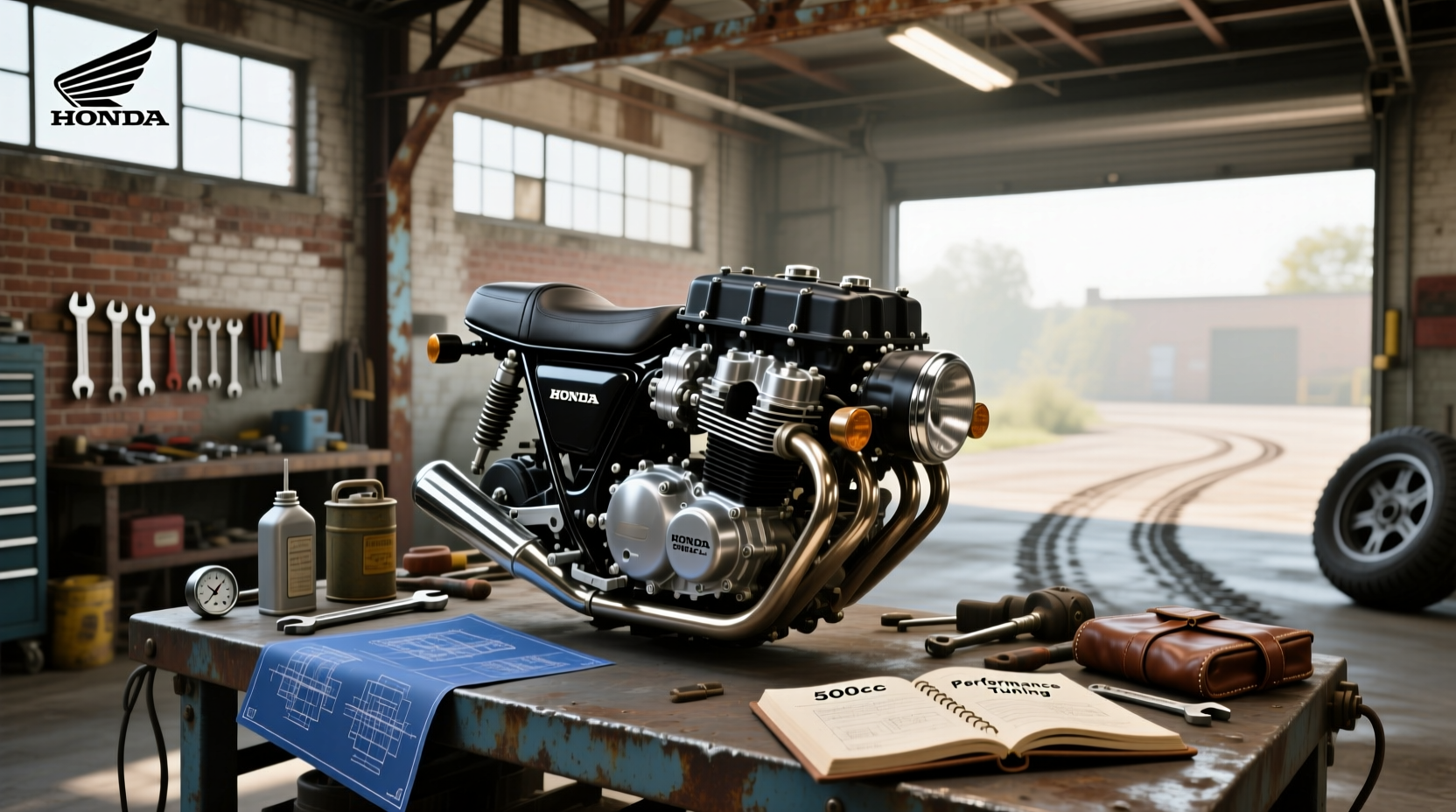
When searching for a Honda 500cc engine, many users are surprised to learn that Honda doesn’t currently manufacture standalone 500cc engines for sale as replacement or industrial units. Instead, the term typically refers to motorcycle platforms like the CBR500R, CB500F, or older racing prototypes such as the NR500. This guide clarifies what a Honda 500cc engine actually is, which models use it, performance specs, common confusion with third-party 500cc engines (like DuroMax), and practical considerations for repair, rebuild, or repurposing in DIY projects.
Understanding the Honda 500cc Engine: Motorcycle Powertrains, Not Industrial Units
Unlike brands such as DuroMax or Briggs & Stratton, which offer generic 500cc single-cylinder OHV engines for go-karts, generators, or agricultural equipment 🛠️, Honda integrates its 500cc engines exclusively into motorcycles. The most well-known modern example is the inline-twin 471cc liquid-cooled engine used across the CBR500R, CB500F, and CB500X series since 2013. Though technically under 500cc, it's commonly referred to as a '500cc engine' due to rounding and market classification.
This engine produces around 47 horsepower and 32 lb-ft of torque, offering smooth power delivery ideal for commuting and beginner riders. It features DOHC, 8-valve design, fuel injection, and a six-speed transmission. These engines are known for reliability, low maintenance, and compliance with global emissions standards ✅.
Historical Context: Honda’s Pioneering 500cc Racing Engines
Honda has a storied history with 500cc displacement, particularly in Grand Prix racing. In the late 1970s and early 1980s, Honda developed the NR500—a revolutionary but ultimately unsuccessful prototype designed to compete in the 500cc class against dominant two-strokes 1. Unlike conventional engines, the NR500 featured an oval-piston V4 configuration, aiming to combine high revving capability with four-stroke efficiency.
Despite advanced engineering, the NR500 struggled with reliability and complexity, failing to win a championship before being retired. However, it laid the groundwork for future innovations like pneumatic valve springs and advanced combustion chamber designs seen in later MotoGP bikes. Today, this engine is celebrated as a bold engineering experiment rather than a commercial product.
Common Misconceptions: Why People Search for a 'Honda 500cc Engine'
A significant portion of searches for “Honda 500cc engine” stem from misunderstanding. Users often assume Honda sells universal 500cc engines similar to those found on Alibaba or Amazon—for applications like:
- Go-kart conversions ⚡
- Home-built mini bikes
- Powering pumps, compressors, or generators 🏭
- ATV or UTV engine swaps
In reality, Honda does not produce such off-the-shelf utility engines at exactly 500cc. Their small engine lineup includes popular models like the GX200 (196cc) or GX690 (688cc), but nothing precisely at 500cc. Therefore, when someone finds a “Honda 500cc engine” listed online (e.g., on eBay), it usually refers to:
- A dismantled motorcycle engine from a CBR500 series bike 🔧
- A mislabeled listing confusing Honda with another brand (e.g., DuroMax)
- A vintage or rare racing unit like the NR500 (collector’s item only)
Aftermarket & Used Market: Finding a Genuine Honda 500cc Motorcycle Engine
If you're looking to replace or rebuild a failed engine in a Honda CBR500R or CB500F, your options include OEM replacements, used cores, or remanufactured units. Many sellers on platforms like eBay list complete engines with varying mileage:
- Used engines: Typically range from $800–$900 USD, with 4,000–6,000 miles reported 👥
- OEM parts engines: Sold as non-running cores for rebuilds, priced around $300–$500
- Rebuilt engines: Offered by specialty shops; may include warranty and dyno testing
Before purchasing, verify compatibility using the vehicle identification number (VIN) or engine code. For example, all post-2013 Honda 500 twins use the NC700 series-derived parallel twin platform. Ensure the engine matches your model year, as minor updates affect ECU mapping and mounting points.
Alternatives to Honda 500cc Engines for DIY Projects
For non-motorcycle applications requiring a 500cc gasoline engine, several manufacturers fill the gap left by Honda’s absence in this niche:
| Brand | Model | Horsepower | Shaft Type | Typical Use Case |
|---|---|---|---|---|
| DuroMax | XP20HP | ~16–18 HP | Vertical/Horizontal | Generators, Go-Karts, Equipment Swaps |
| Briggs & Stratton | 31R907 | 17.5 HP | Vertical | Lawn Equipment, Industrial Tools |
| BRC Racing | TPi 500cc 2-Stroke | ~50+ HP | Motorcycle Crankshaft | Enduro Bikes, Custom Builds |
| Alibaba Suppliers | Generic 500cc 4-Stroke | 15–18 HP | Horizontal/Vertical | Budget Builds, Repairs |
The DuroMax XP20HP is one of the most popular choices, retailing around $500 and featuring a 500cc OHV single-cylinder design with recoil or electric start options 🚚. While not made by Honda, these engines are frequently compared to Honda-powered units due to similar displacement and output.
Performance Comparison: How Fast Is a 500cc Engine?
Speed and performance depend heavily on application and engine type. Here's how different 500cc engines compare:
- Honda CBR500R (471cc twin): Top speed ~109 mph (175 km/h), 0–60 mph in ~5.5 seconds ⏱️
- Kawasaki KX500 (two-stroke): Peak power over 60 HP, capable of exceeding 115 mph
- DuroMax XP20HP (single cylinder): Not vehicle-mounted; power used for mechanical work, not speed
- BRC Racing 500cc 2T TPi: Designed for enduro; lightweight, high-revving, estimated 50+ HP
It’s important to distinguish between engine displacement and actual performance. A 500cc two-stroke can outperform a four-stroke twin due to higher power density, despite identical cc ratings. Additionally, weight, gearing, aerodynamics, and tuning play major roles in real-world speed.
Can You Swap a Honda 500cc Motorcycle Engine Into Another Vehicle?
Yes—but with significant challenges. Enthusiasts have successfully installed CBR500 engines into kit cars, trikes, and custom choppers ✨. Key considerations include:
- Mounting and frame integration: Requires custom motor mounts and chassis reinforcement
- ECU and wiring harness: Full system needed for fuel injection and ignition timing
- Cooling system: Radiator, hoses, and fan must be properly routed
- Transmission interface: Final drive setup (chain, shaft, or CVT) affects drivetrain layout
- Legal compliance: May require inspection or registration changes depending on jurisdiction 🌐
Due to complexity, such swaps are best suited for experienced fabricators. Simpler alternatives include using bolt-on engine kits designed specifically for go-karts or dune buggies.
Maintenance Tips for Honda 500cc Twin Engines
If you own a CBR500 series motorcycle, maintaining the engine ensures longevity and consistent performance. Recommended practices include:
- Oil changes every 6,000 miles or annually: Use JASO MA2-certified 10W-40 wet-clutch oil 🧼
- Valve clearance checks at 12,000-mile intervals: Critical for preventing noise and wear
- Air filter cleaning/replacement: Every 12,000 miles or more frequently in dusty environments
- Chain tension and sprocket inspection: Prevents premature wear on final drive components
- Throttle body synchronization: Especially after battery disconnection or ECU reset
Common issues reported include occasional stalling when cold (often choke-related), minor oil seepage at gaskets, and throttle response hiccups if sensors aren't calibrated. Most problems resolve with routine service or firmware updates via dealership tools.
Why Doesn’t Honda Make a Standalone 500cc Utility Engine?
Honda focuses its small engine production on proven, scalable platforms optimized for reliability and ease of service. Their strategy emphasizes:
- Modular designs (e.g., GX series) adaptable across multiple displacements
- Meeting strict emissions regulations globally 🌍
- Supporting existing equipment ecosystems (lawn mowers, pressure washers, etc.)
Rather than creating a one-off 500cc model, Honda scales up from 390cc (GX390) to 690cc (GX690), covering most mid-range power needs. This reduces manufacturing complexity and parts inventory. As a result, third-party brands dominate the dedicated 500cc utility space, where cost and availability matter more than premium build quality.
Frequently Asked Questions About Honda 500cc Engines
- Is there a Honda 500cc engine available for purchase separately? No, Honda does not sell standalone 500cc engines for industrial or aftermarket use. What’s available are used or salvaged engines from motorcycles like the CBR500R.
- How much horsepower does a 500cc Honda engine have? The Honda CBR500R’s 471cc parallel twin produces about 47 horsepower. Actual output varies slightly by model year and tuning.
- Can I use a DuroMax 500cc engine instead of a Honda? Yes, for non-vehicle applications like generators or go-karts. However, Honda engines generally offer better durability and resale value.
- Are 500cc two-stroke engines still made? Very few manufacturers produce new 500cc two-strokes. BRC Racing in Canada offers modern TPi-injected 500cc two-stroke kits for enduro builds.
- What’s the difference between a 500cc four-stroke and two-stroke? Four-strokes are more fuel-efficient and reliable; two-strokes deliver higher power-to-weight ratios but require more frequent maintenance and oil mixing.




 浙公网安备
33010002000092号
 浙B2-20120091-4