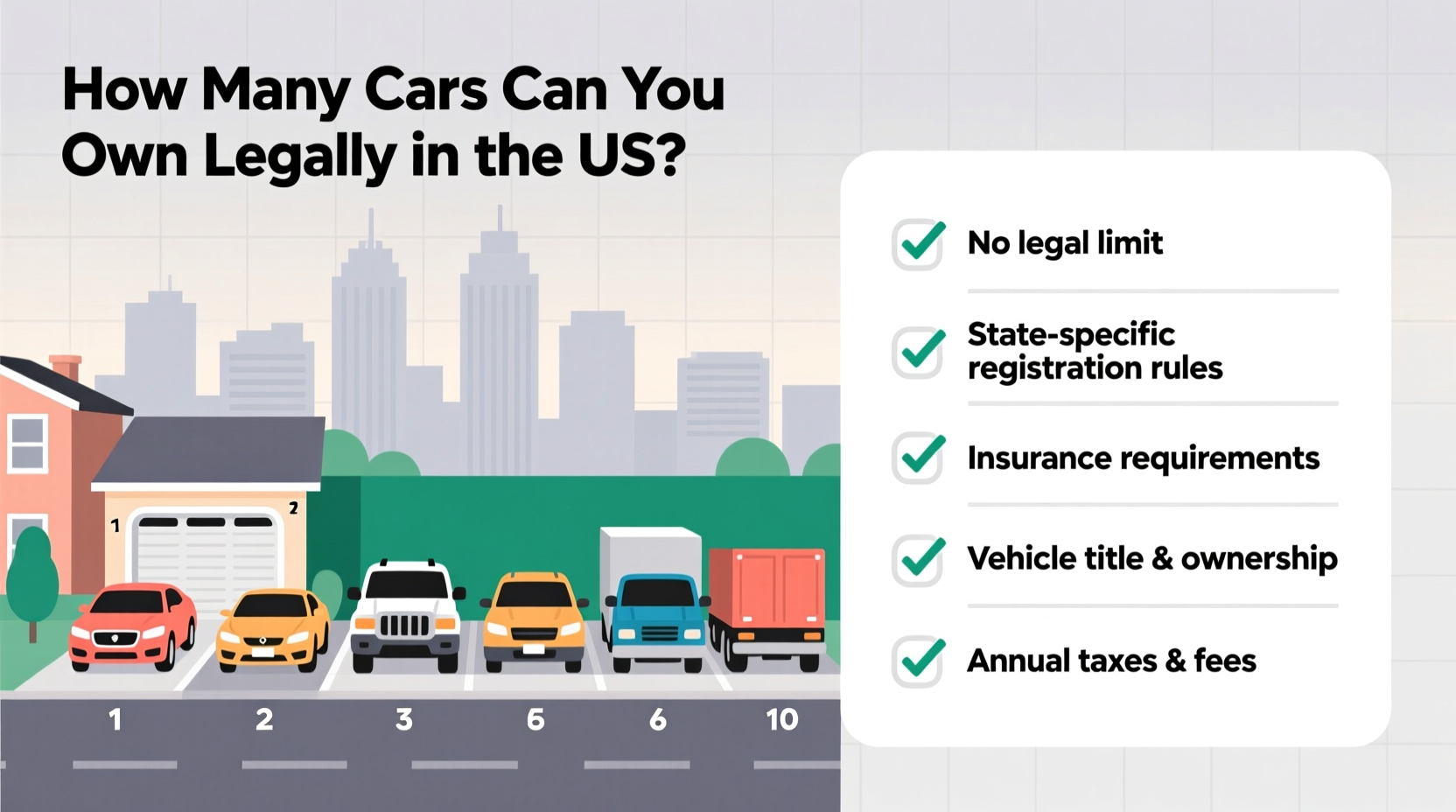
If you're wondering how many cars one person can legally own, the short answer is: there's no federal limit. In the United States, an individual can own as many vehicles as they can afford and register, provided they comply with state-specific registration, insurance, and taxation rules. This makes it possible for car enthusiasts, collectors, or investors to maintain large personal fleets—sometimes numbering in the dozens—without breaking any laws. However, ownership comes with logistical, financial, and regulatory responsibilities that vary by location and usage.
Understanding Legal Limits on Car Ownership
While the idea of owning a massive car collection might seem restricted by law, the reality is quite different. There is no national or state-imposed cap on the number of vehicles a single person can own. Whether you want to own five sedans, ten classic trucks, or thirty luxury imports, it's entirely legal—as long as each vehicle is properly registered, insured (if driven), and complies with local zoning or storage regulations.
The misconception that there’s a legal limit often stems from confusion around registration requirements, property taxes, or residential zoning laws. For example, some municipalities restrict how many vehicles can be parked on private property, especially if they’re not operational or are stored outdoors. These rules don’t limit ownership per se but regulate where and how vehicles are kept.
State-by-State Registration Rules for Multiple Vehicles
Each U.S. state manages vehicle registration independently, which means the process for registering multiple cars can differ significantly depending on your location. Below is a breakdown of key considerations across various states:
| State | Registration Fee (Avg.) | Inspection Required? | Storage Restrictions |
|---|---|---|---|
| California | $60–$120/year | Yes | Limited outdoor storage; non-operational vehicles must be in enclosed structures |
| Texas | $50–$90/year | Yes | Generally none unless violating HOA rules |
| Florida | $70–$140/year | No (safety only) | Up to 3 non-operational vehicles allowed off-street |
| New York | $80–$150/year | Yes | Must be registered and inspected; outdoor storage limited in urban areas |
| Arizona | $40–$80/year | No | Minimal restrictions; ideal for collectors |
As shown, while all states allow unlimited ownership, practical limitations arise through fees, inspections, and local ordinances. For instance, California enforces strict smog checks and limits unlicensed vehicle storage, whereas Arizona offers a more collector-friendly environment with lower costs and fewer restrictions.
Tax Implications of Owning Multiple Cars
One of the most significant factors affecting multi-vehicle ownership is taxation. Most states impose annual personal property taxes on motor vehicles, which are typically based on the vehicle’s value, age, and type. The more cars you own, the higher your cumulative tax burden.
- States with No Personal Property Tax: Texas, Florida, and Nevada do not charge personal property tax on vehicles, making them attractive for high-volume owners.
- High-Tax States: Virginia, Connecticut, and Rhode Island levy substantial annual taxes per vehicle, sometimes exceeding $1,000 annually for luxury models.
- Depreciation & Deductions: If vehicles are used for business (e.g., rideshare, delivery, or rental), partial deductions may offset ownership costs. Consult a tax professional to explore eligibility.
Additionally, when purchasing multiple vehicles, sales tax applies in most states unless exemptions apply (e.g., transferring between family members or importing from another country).
Insurance Considerations for Multiple Vehicle Owners
While insurance doesn’t limit ownership, it does influence cost and feasibility. Most major insurers offer multi-car policies that provide discounts—typically 10% to 25%—when insuring two or more vehicles under one household.
However, insuring more than four or five vehicles may require switching to a commercial policy or specialty insurer, particularly if:
- Vehicles are rarely driven (e.g., classic car collections)
- You operate a fleet for business purposes
- Vehicles are stored long-term or in climate-controlled facilities
Specialty insurers like Hagerty or Grundy offer collector car insurance with agreed-value coverage, lower premiums for low-mileage use, and flexible storage options—ideal for those asking how many cars can I insure under one policy.
Zoning and Residential Storage Laws
Even if you can legally own dozens of cars, your ability to store them may be restricted. Local zoning laws and homeowners’ association (HOA) rules often govern:
- Number of vehicles allowed on driveways or streets
- Outdoor storage of non-operational vehicles
- Use of garages vs. open-air parking
- Commercial use of residential properties (e.g., flipping cars)
For example, many cities prohibit keeping unregistered or inoperable vehicles visible from public roads. Violations can result in fines or mandatory removal orders. To avoid issues:
- Check municipal code before acquiring additional vehicles
- Store non-driven cars in enclosed garages or storage units
- Consider leasing warehouse space for large collections
Common Misconceptions About Car Ownership Limits
Several myths persist about how many cars you can own. Let’s clarify the facts:
- Myth: There’s a federal law limiting car ownership.
Fact: No such law exists. Ownership is governed at the state and local level. - Myth: You need a dealer license to own more than five cars.
Fact: Dealer licenses are required only if you sell vehicles regularly as a business. Private sales (e.g., selling one car per year) don’t require licensing in most states. - Myth: Insurance companies won’t cover more than three cars.
Fact: While standard policies usually cap at four or five vehicles, specialty insurers accommodate larger fleets.
How to Manage a Large Personal Vehicle Fleet
If you're planning to own multiple cars—whether for passion, investment, or utility—effective management is crucial. Here are actionable tips:
- Maintain Detailed Records: Track registration dates, insurance renewals, maintenance schedules, and VINs using digital tools like spreadsheets or apps such as Fuelly or Everlapse.
- Rotate Usage: Drive each vehicle periodically to prevent mechanical issues from prolonged inactivity (e.g., flat spots on tires, battery drain).
- Optimize Storage: Use climate-controlled garages or professional storage facilities for rare or vintage models.
- Bundle Services: Work with one mechanic, insurer, and registration agent to streamline communication and potentially reduce service costs.
- Review Annually: Assess whether each vehicle still serves a purpose. Selling underused cars can free up space and reduce expenses.
Regional Differences Across North America
Ownership norms and regulations also vary beyond U.S. borders:
- Canada: Similar to the U.S., no legal cap on ownership. Provinces like Alberta and British Columbia have favorable registration costs and minimal storage restrictions.
- Mexico: Lower registration fees but stricter emissions testing in urban areas like Mexico City. Foreigners may face import duties on vehicles brought across the border.
- European Union: Countries like Germany and Italy impose higher taxes on large engines, indirectly discouraging multi-vehicle ownership. However, collectors often benefit from historic vehicle classifications with reduced fees.
When Does Owning Too Many Cars Become a Problem?
While legal ownership has no ceiling, practical challenges emerge when managing more than 10–15 vehicles. Issues include:
- Increased risk of missed registration deadlines leading to penalties
- Higher vulnerability to theft, vandalism, or damage due to inconsistent monitoring
- Potential scrutiny from tax authorities if vehicles are frequently bought/sold without proper documentation
- Strain on personal time and budget for upkeep
To stay compliant and organized, consider forming an LLC or trust to hold titles—especially useful for estate planning or business-related ownership.
Final Thoughts: How Many Cars Should You Own?
The question isn't just how many cars can I own, but rather how many should I own? Financial capability, available space, intended use, and emotional attachment all play roles. Enthusiasts might justify 20+ vehicles as part of a curated collection, while average consumers find two or three sufficient for daily needs and recreation.
Ultimately, ownership freedom comes with responsibility. By understanding registration rules, tax obligations, insurance options, and local laws, you can confidently expand your garage without crossing legal lines.
Frequently Asked Questions
Can I own 100 cars legally?
Yes, you can legally own 100 cars in the U.S. if you register each one and comply with local storage and tax laws. However, practicality, cost, and maintenance make this feasible only for serious collectors or businesses.
Do I need a special license to own more than five cars?
No. A standard driver’s license allows ownership of any number of vehicles. A dealer license is only needed if you buy and sell cars regularly as a business.
Can I register multiple cars under one name?
Yes. Individuals can register multiple vehicles under their name. Some states even offer multi-vehicle registration services to simplify renewal processes.
Are there tax breaks for owning multiple cars?
Not directly. However, if vehicles are used for business (e.g., delivery, rentals), portions of depreciation, fuel, and insurance may be deductible. Consult a tax advisor for specifics.
What happens if I don’t register a car I own?
An unregistered vehicle cannot be legally driven and may incur fines. In some states, failure to register leads to penalties, towing, or loss of ownership rights after extended periods.





 浙公网安备
33010002000092号
浙公网安备
33010002000092号 浙B2-20120091-4