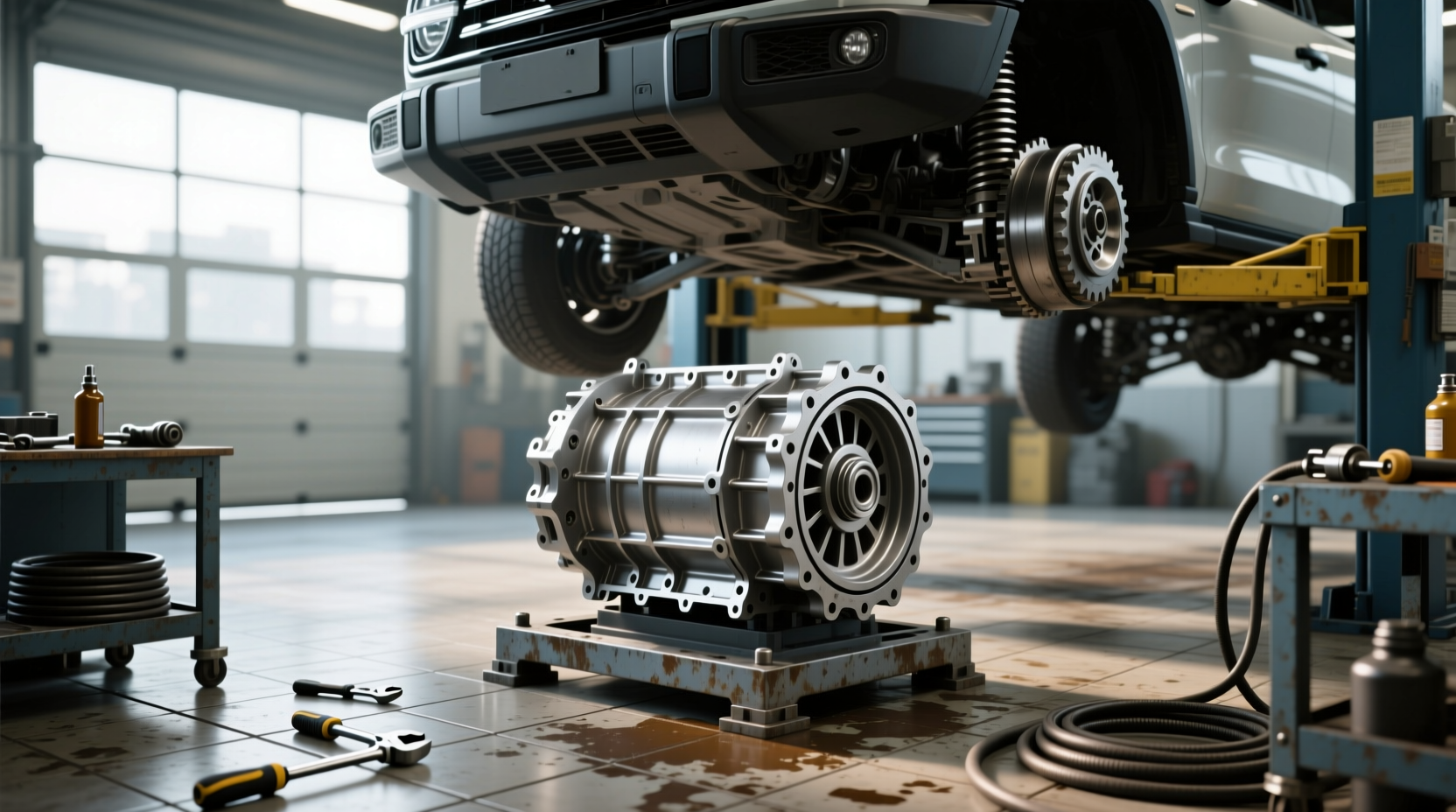
⚙️ The short answer: No, a transfer case is not only for 4WD vehicles. While most commonly associated with four-wheel drive (4WD) systems, transfer cases also play a critical role in many all-wheel drive (AWD) configurations, especially those designed for off-road capability or heavy-duty use. Understanding whether a transfer case is only used in 4WD requires examining drivetrain architecture across vehicle types, including SUVs, trucks, and performance crossovers. This article breaks down the function, design variations, and real-world applications of transfer cases beyond traditional 4x4 setups—helping you recognize their importance regardless of your vehicle’s drive system.
What Is a Transfer Case and Why Does It Matter?
A transfer case is an intermediate gearbox that sits between the transmission and the front and rear differentials in vehicles equipped with multiple driven axles 1. Its primary job is to distribute engine power to both the front and rear axles, enabling either part-time or full-time multi-axle traction. In essence, it's what allows a vehicle to switch between two-wheel drive (2WD) and four-wheel drive (4WD), or manage continuous power split in AWD systems.
While often linked exclusively to off-road trucks and Jeeps, transfer cases are increasingly found in modern AWD platforms—particularly those built on body-on-frame architectures or intended for towing and rugged terrain. So when someone asks, “is a transfer case only for 4WD?”, the technical reality is more nuanced than a simple yes or no.
Transfer Case Basics: Components and Functionality
To fully grasp why transfer cases aren't limited to 4WD, it helps to understand how they work at a mechanical level.
Core Functions of a Transfer Case
- Power Distribution: Splits torque between front and rear drive shafts.
- Drive Mode Selection: Allows drivers to engage 2WD, 4WD high (4H), or 4WD low (4L).
- Gear Reduction: Provides additional leverage via a low-range gear set for crawling over obstacles or steep inclines.
- Synchronization with Transmission: Works in tandem with the main gearbox to maintain driveline harmony.
These functions make the transfer case indispensable in any vehicle where driver-selectable or terrain-responsive traction control is needed.
Common Types of Transfer Cases
Different vehicles use different kinds of transfer cases depending on their intended use:
| Type | Typical Use | Shift Mechanism | Key Features |
|---|---|---|---|
| Chain-Driven | Light-duty trucks, SUVs | Manual or electronic | Quieter operation, lighter weight |
| Gear-Driven | Heavy-duty trucks, off-roaders | Lever or push-button | More durable under stress, louder |
| Active Coupling (AWD-specific) | Performance crossovers | Fully automatic | No driver input; uses clutches/sensors |
As shown above, while chain-driven and gear-driven units dominate 4WD applications, newer active coupling designs blur the line by integrating transfer-case-like functionality into permanent AWD systems.
Do All 4WD Vehicles Have a Transfer Case?
✅ Yes—virtually all traditional 4WD vehicles have a transfer case. Whether it’s a Jeep Wrangler, Toyota Land Cruiser, or Ford F-150 Raptor, these models rely on a physical transfer case to route power to both axles and provide selectable drive modes.
The presence of a transfer case enables features like:
- Low-range gearing for rock crawling or trailer launching
- Driver-controlled engagement of 4WD (on-the-fly or stationary)
- Mechanical locking of front and rear driveshafts for maximum traction
In part-time 4WD systems, the transfer case typically sends 100% of power to the rear axle until 4WD is engaged. In full-time 4WD systems, it continuously splits power—often 50/50—between front and rear, sometimes through a center differential within the case itself.
But What About AWD? Do Full-Time 4WD and AWD Have Transfer Cases?
This is where confusion arises. Many people assume AWD doesn’t involve a transfer case because there’s no selector knob labeled “4H” or “4L.” However, the distinction lies more in terminology and integration than in mechanical absence.
Full-Time 4WD vs. Traditional AWD: Key Differences
Let’s clarify some common misconceptions:
- Full-Time 4WD: Always sends power to all four wheels and usually includes a transfer case with high and low ranges. Found in serious off-road vehicles like the Mercedes G-Class or Nissan Patrol.
- Permanent AWD: Continuously powers all wheels but may use a center differential or clutch pack instead of a conventional transfer case. Common in crossovers like Subaru Outback or Audi Q5.
- On-Demand AWD: Normally operates in 2WD and engages front wheels when slippage is detected. Often lacks a true transfer case, relying on electronic couplings.
So, do full-time 4WD vehicles have transfer cases? ✅ Yes—they almost always do. But does every AWD vehicle have one? ❌ Not necessarily. Some modern AWD systems integrate the power-split function directly into the transmission or use a separate center differential unit without a standalone transfer case housing.
Examples of AWD Systems With Integrated Transfer Cases
Certain high-performance or truck-based AWD systems do include what engineers classify as a transfer case—even if consumers don’t see a shifter:
- Tesla Model X (Dual Motor): While electric, its rear drive unit manages dual-speed gearing in early models, mimicking low-range functionality.
- Chevrolet Tahoe AWD: Uses a two-speed transfer case even in AWD trim, allowing selection between 2WD, AWD, and low range.
- Lexus GX: Features a full-time 4WD system with a locking transfer case and crawl control.
Thus, the boundary between AWD and 4WD has become increasingly fluid, especially as manufacturers adopt hybrid drivetrains and advanced traction management.
Can You Drive Without a Transfer Case?
🔧 In most 4WD vehicles, removing or disabling the transfer case renders the vehicle undrivable unless modified. That’s because the transfer case connects the transmission output to the rear driveshaft. If disconnected, no power reaches the wheels.
However, in some AWD transverse-engine platforms (like Honda CR-V or Ford Escape), the entire drivetrain is integrated into a single unit, eliminating the need for a discrete transfer case. These systems use a power take-off shaft (PTOS) and hydraulic clutch pack to send torque forward or rearward as needed.
📌 Important note: Attempting to operate a vehicle with a failed transfer case can cause severe damage to the transmission, driveshafts, or differentials due to binding or loss of lubrication.
Signs of a Failing Transfer Case
Whether your vehicle uses a traditional 4WD setup or a full-time AWD system with a transfer case, recognizing early warning signs can prevent costly repairs.
Common Symptoms Include:
- Difficulty Shifting Into or Out of 4WD: Sticking levers or unresponsive buttons may indicate internal wear or actuator failure.
- Unusual Noises (Grinding, Whining, Clunking): Especially during acceleration or mode changes, suggesting bearing or gear damage.
- Fluid Leaks Under the Vehicle: Reddish or brownish puddles near the center of the chassis could mean seal failure.
- 4WD Not Engaging Properly: Dashboard lights show 4WD active, but front wheels aren’t receiving power.
- Vibration at High Speeds: Imbalance from worn components or misalignment after servicing.
If you experience any of these issues, it’s crucial to have the system inspected by a qualified technician familiar with driveline diagnostics.
Maintenance Tips for Long Transfer Case Life
Like any gearbox, a transfer case requires periodic maintenance to ensure reliability, especially under demanding conditions.
Recommended Practices:
- Check Fluid Levels Regularly: Most manufacturers recommend inspecting transfer case fluid every 30,000 miles.
- Change Fluid According to Schedule: Intervals vary—some say 30,000 miles, others up to 150,000—but harsh driving warrants earlier changes.
- Use Correct Fluid Type: Never substitute engine oil or transmission fluid unless specified. Some require specialty GL-5 gear oil, while others need ATF or synthetic blends.
- Avoid Prolonged 4WD Use on Dry Pavement: Can cause driveline wind-up and premature wear in part-time systems.
- Engage 4WD Periodically: Prevents seals from drying out and keeps gears moving freely.
🛠️ Pro tip: Keep a log of service dates and fluid types used—especially if you modify your vehicle or tow frequently.
Aftermarket Upgrades and Compatibility
Many off-road enthusiasts upgrade their stock transfer cases for improved strength, gear ratios, or shift speed. Common modifications include:
- Atlas Transfer Cases: Popular in custom builds for extreme reduction ratios and dual input options.
- Slip Yoke Eliminators (SYE): Reduce vibrations and allow longer driveshafts in lifted trucks.
- Electric Shift Motors: Replace manual levers with push-button controls for convenience.
However, compatibility depends heavily on transmission type, frame clearance, and existing driveline angles. Always verify fitment before purchasing.
Regional and Design Variations
Transfer case usage varies globally based on terrain, regulations, and consumer preferences.
- North America: High demand for 4WD trucks and SUVs leads to widespread use of robust, two-speed transfer cases.
- Europe: Emphasis on fuel efficiency favors on-demand AWD with minimal mechanical complexity—fewer standalone transfer cases.
- Australia/New Zealand: Rugged landscapes support popularity of full-time 4WD systems with lockable transfer cases (e.g., Toyota Land Cruiser 70 Series).
- Emerging Markets: Simpler, cost-effective part-time 4WD systems dominate budget-friendly SUVs.
These regional trends influence whether a manufacturer includes a transfer case—even in similarly named trims across markets.
Debunking Common Myths About Transfer Cases
Despite their importance, several myths persist about transfer cases and their role in vehicle dynamics.
Myth #1: "Only Off-Road Vehicles Need Transfer Cases"
False. While essential for off-roading, transfer cases enhance safety and control in adverse weather and towing scenarios—even on paved roads.
Myth #2: "All AWD Systems Work the Same Way"
No. Some use viscous couplings, others electronic clutches, and still others incorporate a true transfer case. Performance and durability differ significantly.
Myth #3: "You Can’t Tow Without a Transfer Case"
Not accurate. Many front-wheel-drive minivans tow small trailers without one. However, for heavy loads or unstable conditions, a 4WD system with a transfer case offers better stability.
How to Verify If Your Vehicle Has a Transfer Case
If you're unsure whether your SUV or truck has a transfer case, here are practical steps to confirm:
- Check the Gear Selector: Look for positions like '4H', '4L', or 'AWD Lock'.
- Inspect Under the Vehicle: A metal box behind the transmission connected to two driveshafts indicates a transfer case.
- Review Owner’s Manual: Search for “transfer case,” “driveline,” or “four-wheel drive system.”
- Call Dealer or Manufacturer: Provide VIN for precise configuration details.
🚘 Example: A 2023 Ford Bronco in Sasquatch trim has a two-speed electronic-shift transfer case with a 4.7:1 low range. Meanwhile, a 2023 Mazda CX-5 AWD uses an on-demand system without a traditional case.
Final Verdict: Is a Transfer Case Only for 4WD?
🔚 After reviewing technical designs, real-world applications, and industry trends, the conclusion is clear: a transfer case is not only for 4WD vehicles. While it remains a defining component of most four-wheel-drive systems—especially those with selectable modes and low-range gearing—it also appears in many full-time 4WD and certain permanent AWD configurations designed for durability and off-pavement performance.
The key takeaway? Don’t assume a vehicle lacks a transfer case just because it’s labeled “AWD.” Conversely, not all 4WD systems use bulky, lever-shifted cases—some are electronically managed and compact. What matters most is understanding how your specific drivetrain manages power distribution and whether it includes a dedicated unit for splitting torque between axles.
Frequently Asked Questions (FAQs)
- ❓ What does a 4x4 transfer case do?
It distributes engine power from the transmission to both front and rear axles, allowing engagement of 4WD modes and providing low-range gearing for enhanced torque. - ❓ Do full-time 4WD vehicles have a transfer case?
Yes, most full-time 4WD systems include a transfer case that continuously splits power between axles, often with a center differential and selectable lock. - ❓ How do I know if my transfer case is failing?
Watch for difficulty shifting into 4WD, strange noises (grinding, whining), fluid leaks, or vibration while driving—these are common signs of internal damage. - ❓ Can a car have AWD without a transfer case?
Yes, many crossovers and sedans use on-demand AWD systems that rely on a center differential or clutch pack instead of a traditional transfer case. - ❓ How much does it cost to repair a 4x4 transfer case?
Repairs range from $200–$500 for minor fixes (fluid, actuators) to $2,000+ for rebuilds or replacements, depending on vehicle and labor rates.




 浙公网安备
33010002000092号
 浙B2-20120091-4