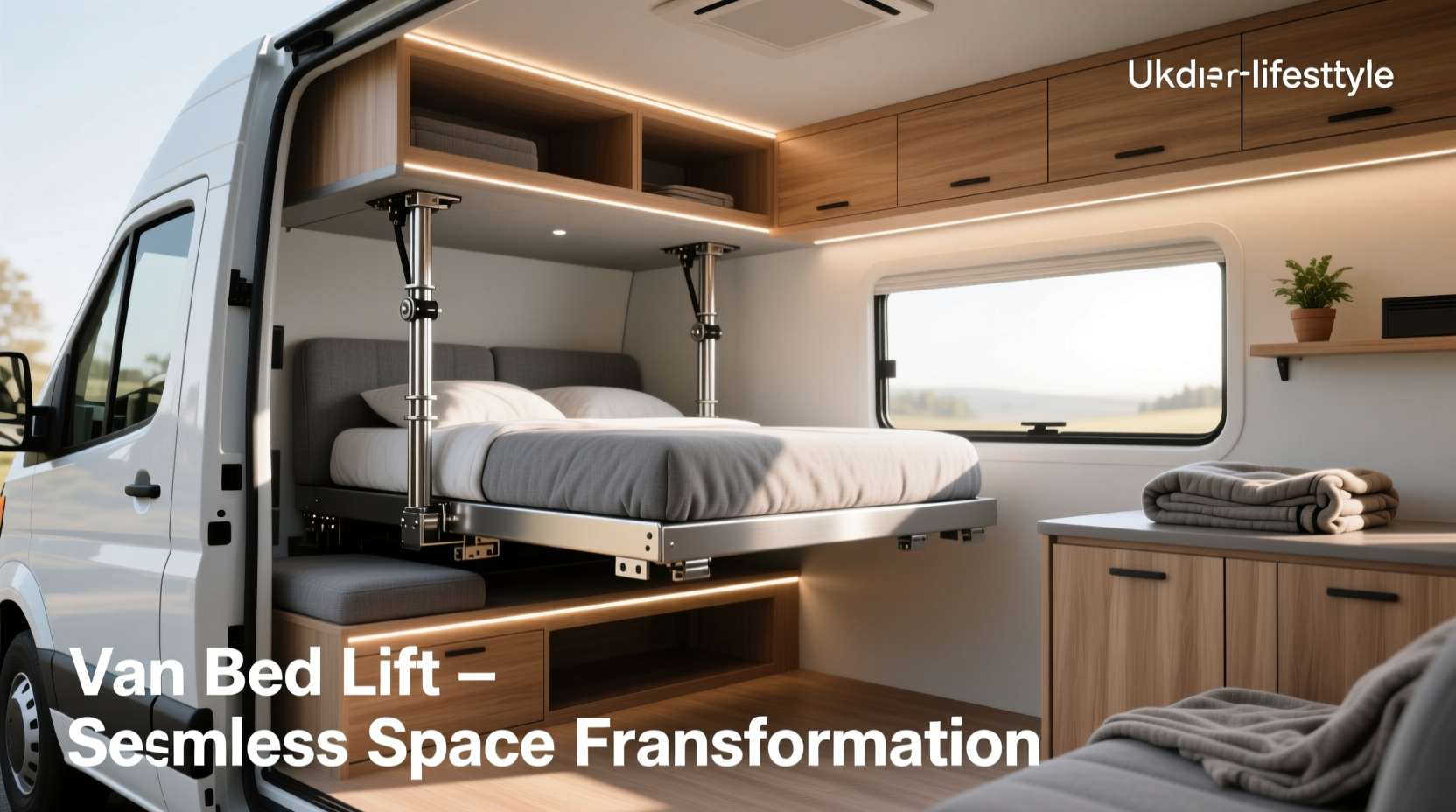
For those converting a cargo van into a livable mobile space, one of the most impactful decisions is how to manage sleeping and storage areas. A van bed lift system offers a smart solution by elevating the bed when not in use, freeing up floor space during the day. This setup is especially valuable in compact vans where every inch counts. Whether you're building a DIY rock-and-roll bed or considering a motorized lift mechanism, understanding structural requirements, weight capacity, and deployment methods is essential to creating a functional, durable layout.
What Is a Van Bed Lift and Why Consider One?
A van bed lift refers to any mechanical or manual system that raises or repositions a bed frame vertically or horizontally within a van. Unlike fixed platforms, lift systems allow users to reclaim interior space—ideal for turning a sleeping area into a lounge, workspace, or storage zone during daylight hours. These are commonly used in custom camper van builds, particularly among full-time vanlifers seeking efficient multi-functional interiors.
The core benefit lies in spatial flexibility. When lowered, the bed provides a comfortable sleeping surface; when raised, it clears the floor for movement or additional furniture like fold-down tables or seating. Some designs integrate with bench seats or cabinets below, enhancing utility without sacrificing comfort.
Types of Van Bed Lift Systems
There are several approaches to lifting a van bed, each suited to different build styles, budgets, and technical skill levels.
1. Manual Rock-and-Roll Beds ⚙️
One of the most popular designs is the rock-and-roll bed, which pivots on hinges at the front and rolls backward toward the rear doors. It doesn’t fully 'lift' but instead tilts upward, sliding slightly as it moves. This design saves significant floor space and can be built from plywood and simple hardware.
- Pros: Low cost, easy to build, no electricity required
- Cons: Requires physical effort, limited headroom when deployed
- Best for: DIYers with basic tools and moderate van height
2. Scissor Lift Mechanisms ⚡
Scissor lifts use interlocking metal arms to raise the bed platform straight up. Often paired with gas struts or electric actuators, they offer smooth vertical motion and precise positioning.
- Pros: Stable lift, consistent alignment, can support heavy mattresses
- Cons: Complex fabrication, higher material cost
- Best for: permanent installations with access to welding or CNC-cut parts
3. Electric Linear Actuator Systems 🔧
These use motorized rods controlled via switch or remote to raise and lower the bed. They’re often integrated into scissor or parallelogram frames and provide hands-free operation.
- Pros: Fully automated, quiet, programmable height settings
- Cons: Requires 12V power supply, more expensive, potential maintenance
- Best for: luxury builds or users with mobility concerns
4. Sliding Under-Bed Storage Platforms 📦
While not technically a 'lift,' some systems slide the entire bed under a raised cabinetry unit. This keeps the bed low to the ground but hides it during daytime use.
- Pros: Maintains low center of gravity, simple mechanics
- Cons: Needs deep under-structure, may limit drawer depth
- Best for: low-profile vans like Ford Transit Connect
Key Design Considerations for Van Bed Lifts
Building a reliable lift system requires careful planning around structure, safety, and usability.
Floor and Wall Mounting Points ✅
The strength of your van’s body determines where you can anchor a lift mechanism. Most cargo vans have reinforced C-channel rails along the floor perimeter—ideal for securing heavy-duty brackets. Walls should be anchored into ribbed steel sections, not just thin sheet metal. Use stud finders or tap tests to locate solid mounting zones.
Weight Capacity & Frame Material 🏭
A standard queen-sized mattress with a person can weigh over 300 lbs (136 kg). Your lift frame must exceed this load, ideally by 50%. Common materials include:
| Material | Strength | Weight | Cost |
|---|---|---|---|
| Steel square tubing | High | Heavy | $$$ |
| Aluminum extrusion | Moderate | Light | $$$$ |
| Plywood + hardwood | Low-Moderate | Medium | $ |
For rock-and-roll beds, 18mm birch plywood is sufficient if supported by cross-bracing. For powered lifts, welded steel ensures long-term durability.
Clearance and Headroom 🌐
Measure your van’s interior height from floor to ceiling. A lifted bed typically needs 18–24 inches (45–60 cm) of vertical clearance. If your van has less than 70 inches (1.78 m) of standing room, a full lift may reduce usable space too much. In such cases, partial lifts or tilt mechanisms are better options.
Accessibility and Daily Use ⏱️
Consider how often you’ll deploy the bed. If you plan to switch between living and sleeping modes multiple times per day, ease of operation becomes critical. Manual systems require effort; electric ones add convenience but depend on battery charge. Always include a manual override option in case of power failure.
DIY vs. Pre-Built Van Bed Lift Systems
You can either fabricate a lift system yourself or purchase a pre-engineered kit.
DIY Builds: Pros and Challenges
Many van converters prefer DIY solutions because they’re customizable and cost-effective. A basic rock-and-roll bed can be built from one sheet of plywood and off-the-shelf hinges for under $100 1. YouTube tutorials show step-by-step processes using common tools.
However, DIY projects require time, precision, and problem-solving. Misaligned hinges or weak joints can lead to wobbling or collapse. Always test-load your frame before adding a mattress.
Pre-Fabricated Kits: Convenience at a Cost
Companies like Flatline Van Co and Flarespace offer modular lift systems designed for specific van models (e.g., Mercedes Sprinter, Ram Promaster). These kits come with laser-cut parts, detailed instructions, and customer support.
While more expensive—ranging from £240 to £350 2—they save time and reduce errors. However, compatibility varies, so verify dimensions and mounting points before ordering.
Integration with Other Van Systems
A well-designed van bed lift shouldn't exist in isolation. It should complement insulation, electrical wiring, and ventilation.
Insulation and Thermal Bridging 🧼
Metal lift components can create thermal bridges, transferring cold from the van shell into the sleeping area. To prevent this, insulate contact points with closed-cell foam or rubber gaskets. Avoid direct metal-to-metal connections between the frame and van body where possible.
Wiring for Electric Lifts 🔋
If using electric actuators, route wires through conduit and connect to a dedicated circuit fused at 10–15 amps. Use marine-grade connectors to resist vibration. Install a switch near the entry point for easy access.
Ventilation and Moisture Control 💨
When the bed is lifted, ensure airflow isn’t blocked. Roof vents or fans should remain unobstructed. Also, elevate the mattress slightly when stored to prevent condensation buildup underneath.
Common Mistakes to Avoid ❗
Even experienced builders make avoidable errors when installing van bed lifts.
- Ignoring weight distribution: Uneven loads can stress hinges or cause tipping.
- Overlooking door clearance: Raised beds must not interfere with rear doors opening.
- Using undersized fasteners: Screws or bolts that are too short won’t grip properly in thin van walls.
- Skipping dry runs: Test the full range of motion with temporary supports before final assembly.
Cost Breakdown and Budget Planning 💰
Project costs vary widely based on complexity and materials.
| Type | Avg. Cost (USD) | Time Required |
|---|---|---|
| Basic Rock-and-Roll Bed | $80–$150 | 8–12 hours |
| Scissor Lift (DIY) | $200–$400 | 20–30 hours |
| Electric Actuator Kit | $500–$900 | 15–25 hours |
| Pre-Built Model-Specific Kit | $600–$1,200 | 10–20 hours |
Labor is the biggest variable. Skilled welders or carpenters may complete jobs faster, but most DIYers spend weekends spread across multiple phases.
Regional and Vehicle-Specific Variations 📍
Design choices may differ depending on local climate, regulations, and van model availability.
In Europe, compact vans like the Renault Trafic or Volkswagen Transporter dominate the market, favoring space-saving solutions like sliding or folding beds. In North America, taller high-roof vans allow for full-height lift systems. Always research OEM specifications for your vehicle’s load limits and interior dimensions.
Real User Insights from Forums and Builds 📋
Online communities such as r/VanLife and r/VanLifeUK frequently discuss bed lift challenges. Users report that simplicity often wins: many abandon complex electric systems after reliability issues. Others praise IKEA-inspired hacks using SKORVA bed sliders for smooth lateral movement 3.
One builder noted: “I thought I needed motors, but after six months, I preferred rolling the bed by hand. It got me moving in the morning.” Another emphasized safety: “Don’t skip the locking pin. Mine disengaged once while driving—it scared me straight.”
Final Recommendations
A van bed lift system enhances functionality in a mobile living space, but success depends on thoughtful design and execution. Start with clear goals: Do you need full automation, or will a manual tilt suffice? Measure twice, cut once, and prioritize structural integrity over aesthetics.
For beginners, a rock-and-roll bed offers an excellent entry point. Intermediate builders might explore scissor lifts with gas struts. Advanced setups with electric controls are best reserved for permanent, high-use conversions.
Regardless of approach, always include safety stops, secure latches, and redundant supports. Your van bed isn’t just furniture—it’s part of your home’s foundation on wheels.
Frequently Asked Questions
- Can I install a van bed lift in a low-roof van?
- Yes, but vertical lifts may not work due to limited headroom. Opt for sliding or tilting mechanisms instead.
- How much weight can a typical van bed lift hold?
- Most well-built systems support 300–500 lbs (136–227 kg), enough for two adults and a memory foam mattress.
- Are electric van bed lifts reliable long-term?
- They can be, but require proper wiring, weatherproofing, and occasional maintenance. Manual systems tend to last longer with zero upkeep.
- Do van bed lifts affect fuel efficiency?
- Not directly. However, added weight from metal frames may slightly reduce mileage—usually less than 1–2 MPG.
- Can I convert my existing fixed bed into a lift system?
- Possibly, but it depends on current framing. You’ll likely need to rebuild the support structure to accommodate hinges or actuators.




 浙公网安备
33010002000092号
 浙B2-20120091-4