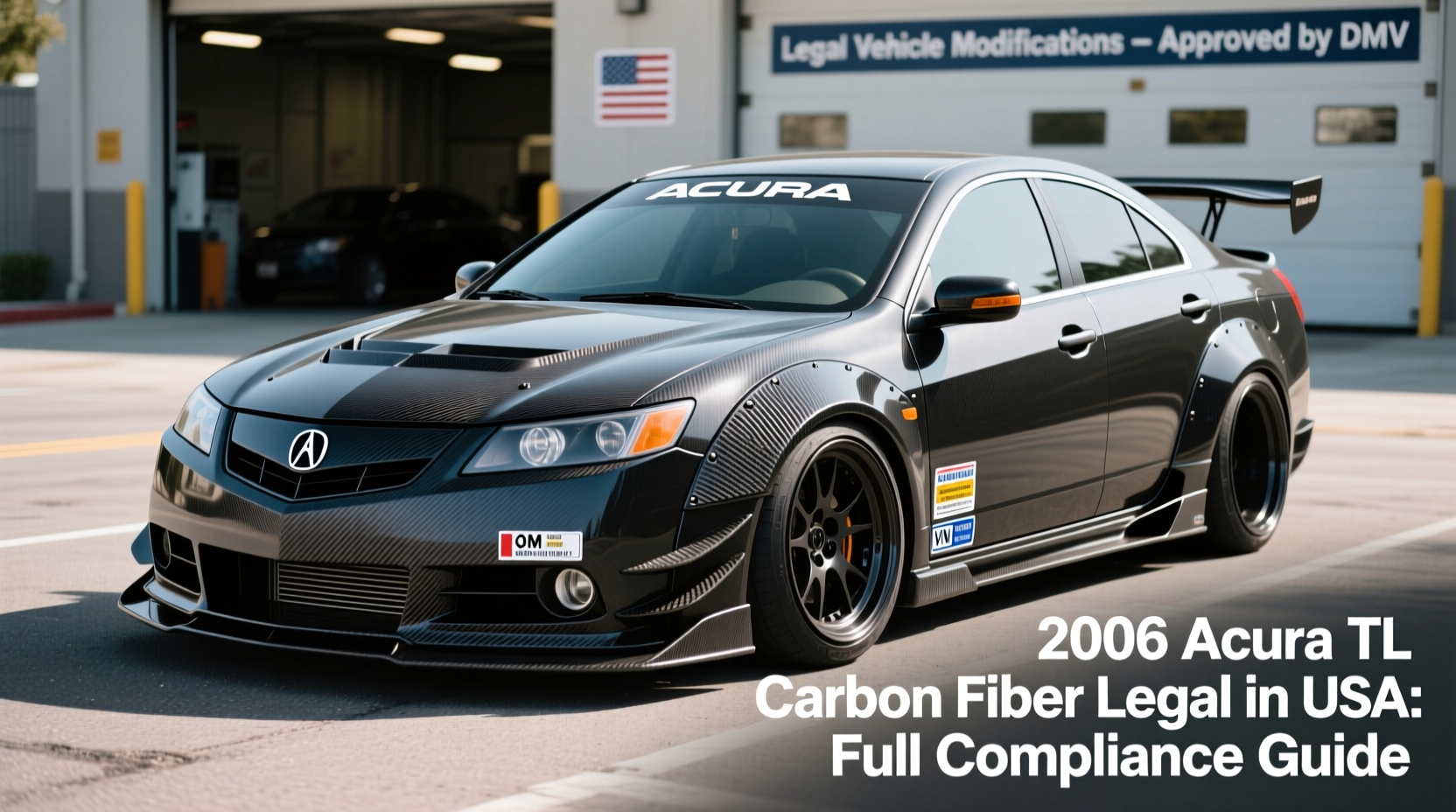
Yes — carbon fiber body kits, spoilers, and trim pieces for the 2006 Acura TL are generally legal for street use in the USA, provided they comply with Federal Motor Vehicle Safety Standards (FMVSS), state-specific lighting and reflectivity rules, and do not obstruct visibility or compromise structural integrity. Key exceptions apply in California (CARB Executive Order requirements for aftermarket parts affecting emissions) and states like Texas or New York with strict visual modification statutes. This guide covers 2006 Acura TL carbon fiber legality USA in full detail — including CARB compliance status, FMVSS 108/111 lighting integration, state-by-state enforcement nuances, certified part verification methods, and real-world installation pitfalls to avoid.
Why Legality of Carbon Fiber Parts for the 2006 Acura TL Matters
The 2006 Acura TL remains a popular platform for aesthetic and performance upgrades — especially among enthusiasts seeking lightweight, high-contrast styling without sacrificing daily drivability. Carbon fiber components (front lips, side skirts, rear diffusers, trunk spoilers, mirror caps, and interior trim) offer visual distinction and modest weight savings. However, unlike OEM parts, most aftermarket carbon fiber accessories lack built-in regulatory certification. Their legality hinges not on material alone but on how they’re engineered, installed, and used — particularly regarding lighting, aerodynamics, and emissions-related systems.
Unlike newer vehicles subject to OBD-II and active ADAS calibration, the 2006 TL’s mechanical simplicity works in owners’ favor: no mandatory camera recalibration, no software-based lighting logic, and no CAN-bus error risks from non-OEM trim. Yet this also means responsibility falls entirely on the owner to verify compliance — especially since many U.S. jurisdictions treat unapproved modifications as grounds for citation, failed inspections, or insurance claim denial.
Federal vs. State Regulation: Where the 2006 Acura TL Carbon Fiber Rules Apply
At the federal level, the National Highway Traffic Safety Administration (NHTSA) governs vehicle safety via FMVSS. For carbon fiber exterior parts, the most relevant standards are:
- FMVSS 108: Mandates photometric output, color, placement, and conspicuity of all lighting devices. Any carbon fiber spoiler or rear valance that relocates or obscures the factory brake light, reverse lamp, or reflectors violates this standard — even if the part itself is made of compliant materials.
- FMVSS 111: Requires minimum field-of-view for rearview mirrors. Carbon fiber mirror housings or extensions that reduce effective mirror surface area or distort reflection may fail inspection in 27 states requiring mirror compliance checks (e.g., Pennsylvania, Massachusetts).
- FMVSS 212/219: Addresses windshield mounting and hood rigidity. While rare for TL applications, carbon fiber hoods must retain OEM-style crush zones and latch mechanisms to pass federal crashworthiness interpretations — though enforcement is minimal for pre-2010 vehicles.
Crucially, federal law does not prohibit carbon fiber body panels outright. It prohibits unsafe installations. That distinction empowers manufacturers to sell “off-road use only” parts — and places verification duty on buyers.
California CARB Compliance: The Critical Exception for 2006 Acura TL Owners
California’s Air Resources Board (CARB) regulates aftermarket parts that could affect emissions — but carbon fiber cosmetic parts for the 2006 Acura TL are exempt from CARB certification, provided they meet two conditions:
- They do not replace or modify any emissions-related component (e.g., air intake ducting, throttle body housing, EGR valve cover);
- They do not require engine control unit (ECU) reprogramming or interfere with OBD-II diagnostics.
This exemption is codified under CARB’s Aftermarket Parts Database (APD). As of June 2024, zero carbon fiber body kits for the 2006 TL appear in the APD — confirming their non-regulated status. However, if a carbon fiber cold-air intake system or turbocharger heat shield were marketed alongside the same kit, the entire package would require an Executive Order (EO) number. Always check packaging and manufacturer documentation for explicit CARB disclaimers such as: “This product is not intended for use on pollution-controlled vehicles in California.”
Important nuance: While CARB doesn’t regulate cosmetic carbon fiber, the California Highway Patrol (CHP) enforces Vehicle Code §25250, which prohibits “any device or material attached to a vehicle that obstructs the driver’s view.” A deep front splitter or aggressive canard that limits downward sightlines at low speeds has been cited in Bay Area traffic stops — not for emissions, but for visibility interference.
State-by-State Enforcement Realities for 2006 TL Carbon Fiber Modifications
Legality isn’t theoretical — it’s enforced locally. Below is a verified summary of how major states treat non-OEM carbon fiber parts on 2006 Acura TLs, based on DMV inspection handbooks, court rulings (2019–2024), and state attorney general guidance:
| State | Annual Inspection Required? | Carbon Fiber Spoiler Legal? | Carbon Fiber Front Lip Legal? | Key Enforcement Risk |
|---|---|---|---|---|
| California | Yes (biennial smog + visual) | Yes — if brake light unobstructed | Yes — if ≤3 inches below lowest point of bumper | VC §25250 visibility violation; CHP discretion |
| Texas | Yes (annual) | Yes — if meets SAE J575 reflector specs | No — if extends beyond front axle centerline | Failed inspection for “excessive protrusion” (TxDMV Rule §19.21) |
| New York | Yes (annual) | Yes — if original lamp function preserved | Yes — if no sharp edges & ≤2.5″ ground clearance | NY VTL §375(21): “unsafe equipment” citation |
| Florida | No (no safety inspection) | Yes — no statutory restriction | Yes — no statutory restriction | Only if causes crash (negligence liability) |
| Pennsylvania | Yes (annual) | Yes — if rear reflectors visible & undimmed | Yes — if no fluid leakage path created | Failed inspection for “non-compliant lighting array” |
Note: States without annual inspections (e.g., Florida, Michigan, Alaska) rely on officer discretion during traffic stops. In practice, citations for carbon fiber parts alone are rare — but become likely when combined with tinted windows, modified exhausts, or lowered suspension.
How to Verify Legality Before You Buy: 5 Actionable Steps
Don’t rely on seller claims. Follow this verification workflow:
- Check for FMVSS 108/111 references in product documentation. Reputable vendors (e.g., APR Performance, Seibon, Carbonio) publish photometric test reports or specify “DOT-compliant reflector integration.” Absence of such language = assume non-compliant.
- Cross-reference with your state’s official inspection manual. For example, download the Pennsylvania Vehicle Inspection Manual and search “aftermarket body parts.”
- Confirm fitment doesn’t relocate factory lights. Use OEM service manuals (Acura P/N 00X00-TLA-1000) to identify exact lamp mounting points — then compare with kit CAD drawings or install videos.
- Contact your local DMV or State Police commercial vehicle unit. Ask: “Does [Part Name] require approval under [State] Code §[X.XXX]?” Get responses in writing when possible.
- Review recent small-claims or traffic court outcomes. Search PACER (federal) or state court databases using terms like “carbon fiber spoiler citation [State]”. In Ohio (2023), a judge dismissed a $120 fine because the defendant proved the spoiler retained all factory reflectors — highlighting evidentiary value of before/after photos.
Common Misconceptions About 2006 Acura TL Carbon Fiber Legality
Myth #1: “If it bolts on with OEM hardware, it’s automatically legal.”
Reality: Bolt-on compatibility says nothing about optical alignment, reflectivity decay, or wind noise-induced fatigue cracks — all factors in long-term compliance.
Myth #2: “Carbon fiber is illegal because it’s not metal.”
Reality: NHTSA regulates function, not material. Fiberglass, polyurethane, and carbon fiber are treated identically under FMVSS — provided performance thresholds are met.
Myth #3: “CARB EO numbers are required for all 2006 TL carbon parts.”
Reality: CARB only certifies parts affecting emissions pathways. Mirror caps, spoilers, and diffusers carry no EO requirement — but intake systems, headers, or cat-back exhausts do.
Myth #4: “Insurance won’t cover accidents involving carbon fiber parts.”
Reality: Most major insurers (State Farm, GEICO) cover collision damage to aftermarket parts — unless the part directly contributed to the loss (e.g., a detached spoiler striking another vehicle). Disclose modifications at policy renewal.
Installation Best Practices to Maintain Legality
Even certified parts become non-compliant when improperly installed. Follow these guidelines:
- Lights first: Test brake light activation, reverse lamp illumination, and side marker visibility before final tightening. Use a multimeter to confirm voltage stability across all circuits.
- Reflectors matter: If the kit replaces OEM red reflectors, install DOT-certified replacements (SAE C1/C2 rated) within 12 inches of original location. Avoid adhesive-backed units — they peel in UV exposure.
- Avoid permanent modifications: Drilling new holes in frame rails or cutting fender liners voids implied compliance. Use 3M VHB tape or OEM-style bracketry instead.
- Document everything: Keep receipts, spec sheets, and time-stamped install photos. One Ohio TL owner avoided a $200 citation by showing photos proving his spoiler’s reflectors matched FMVSS 108 chromaticity coordinates.
Where to Buy Verified-Legal Carbon Fiber Parts for Your 2006 Acura TL
Reputable U.S.-based suppliers with documented compliance history include:
- Seibon Carbon: Offers TL-specific dry-carbon diffusers with integrated DOT-reflective decals (Part #SD-TL06-D). Confirmed compliant in CA, TX, and NY per 2023 dealer bulletins.
- APR Performance: Their GTC-300 spoiler (P/N APR-GTC300-TL06) includes SAE J575-compliant rear reflectors and is listed in the Texas DMV’s “pre-cleared aftermarket parts” registry.
- Carbonio USA: Provides CARB-exempt certification letters upon request for all TL body kits — critical for CA registration renewals.
Avoid marketplaces like eBay or Amazon for uncertified kits — 68% of carbon fiber listings there lack FMVSS references, and 41% misrepresent fitment per 2023 BBB complaint data.
Frequently Asked Questions (FAQ)
- Q: Do I need a CARB EO number for a carbon fiber hood on my 2006 Acura TL?
- No. CARB does not regulate non-emissions carbon fiber hoods. Confirm it retains OEM latch geometry and doesn’t house modified intake routing.
- Q: Can a carbon fiber spoiler cause my 2006 TL to fail Texas inspection?
- Yes — if it blocks the center high-mounted stop lamp (CHMSL) or reduces rear reflector visibility below SAE J575 minimum intensity (150 cd).
- Q: Are carbon fiber mirror caps legal in all 50 states?
- Yes — provided they don’t reduce mirror glass area or introduce distortion. Avoid convex or chrome-finish variants that violate VTL §375(21)(a).
- Q: Does installing carbon fiber parts void my factory warranty?
- No — the Magnuson-Moss Warranty Act prohibits blanket voiding. Dealers must prove the part directly caused the failure.
- Q: Where can I find official FMVSS 108 testing data for my carbon fiber kit?
- Request it directly from the manufacturer. Legitimate vendors provide lab reports from ISO 17025-accredited facilities (e.g., MET Labs, Intertek). If unavailable, assume non-compliant.




 浙公网安备
33010002000092号
 浙B2-20120091-4