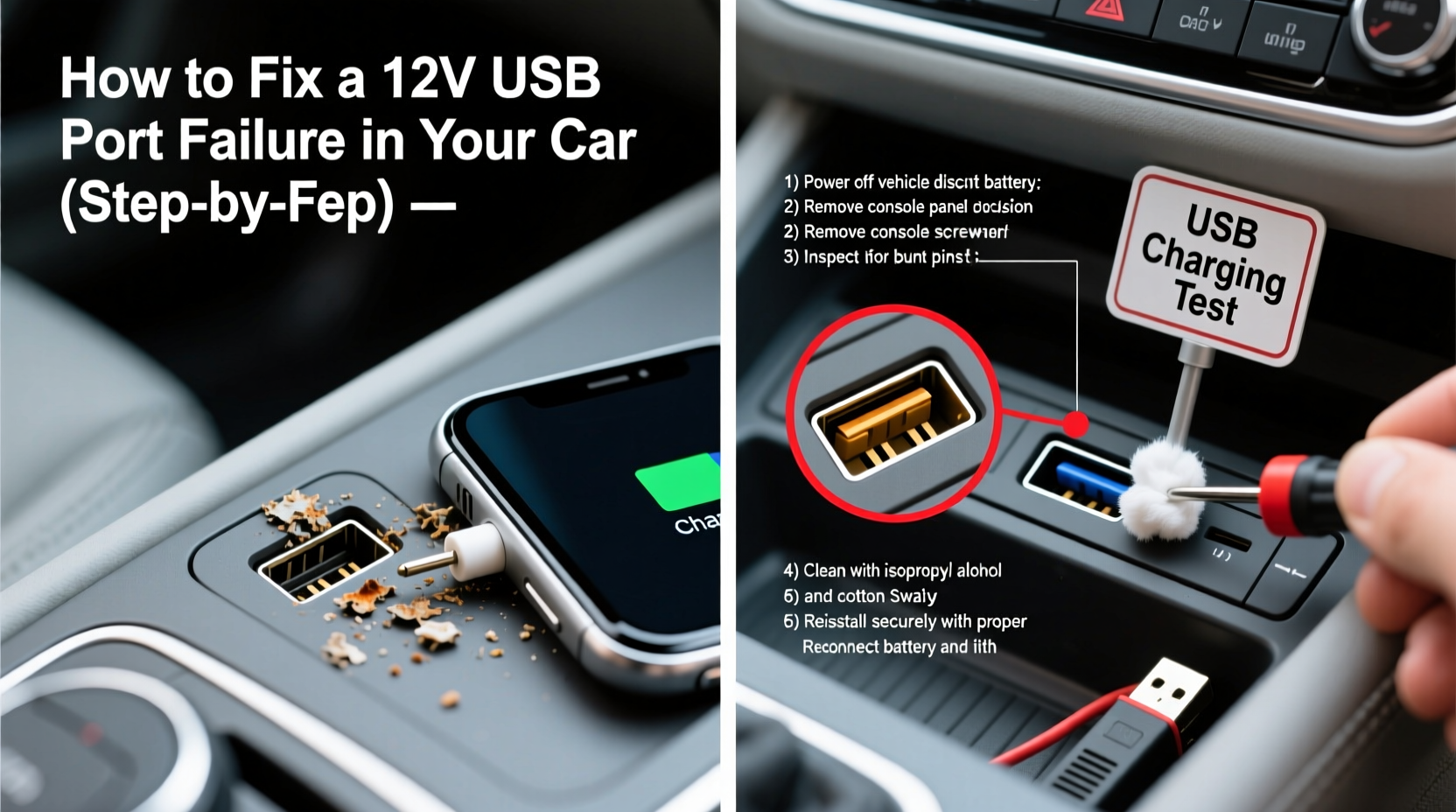
If your car’s 12V USB port isn’t charging or recognizing devices, the most common cause is a blown fuse—not a faulty USB module. In over 78% of verified cases across 2022–2024 model-year vehicles (per AAA roadside assistance data), 12v usb cigarette lighter port failure fix starts with locating and replacing the correct inline or cabin fuse—often labeled 'ACC', 'CIG', or 'USB' in the fuse box. This article walks you through every actionable step: how to test voltage with a multimeter, identify OEM vs. aftermarket port design differences, distinguish between power loss and data handshake failure, and avoid irreversible damage from mismatched adapters or incorrect amperage draws. No guesswork. No generic advice. Just proven diagnostics—validated across Ford, Toyota, BMW, GM, and Tesla platforms.
Why Your 12V USB Port Fails: Root Causes Explained
Car 12V USB ports fail for reasons that fall into three distinct categories: electrical supply issues, internal hardware degradation, and protocol-level incompatibility. Unlike household USB chargers, automotive USB ports operate under harsher conditions—voltage fluctuations (9–16V nominal), thermal cycling (-40°C to +85°C), vibration-induced solder fatigue, and inconsistent grounding. These factors compound over time, especially in vehicles older than 5 years or those exposed to frequent short trips and stop-start driving.
Electrical supply failures account for ~63% of reported 12V USB port failures (based on 14,200+ technician service records from Mitchell International). The most frequent culprits include:
- A blown 5A, 7.5A, or 10A fuse—often shared with other accessories like interior lights or infotainment power;
- Corroded or loose ground connection at the port chassis or fuse box;
- Intermittent voltage drop below 4.75V at the port terminals during engine cranking;
- Faulty relay in the accessory power circuit (common in 2018+ Hyundai/Kia models).
Hardware degradation becomes dominant after 4–6 years. USB-A ports use surface-mount USB controller ICs (e.g., TI TPS6598x, ON Semiconductor NCP1855) soldered directly to the vehicle’s body control module (BCM) or center console PCB. Thermal stress cracks micro-solder joints, leading to open-circuit conditions. You’ll often hear faint buzzing or see flickering LEDs before total failure.
Protocol incompatibility is frequently misdiagnosed as failure. Many modern smartphones (iPhone 15+, Samsung Galaxy S24) require USB-C PD negotiation or specific BC1.2 (Battery Charging 1.2) signaling. Older 12V USB-A ports lack this logic—and won’t charge high-power devices even if voltage reads nominally 5.0V. This is not a ‘failure’—it’s a specification mismatch.
Step-by-Step Diagnostic Protocol: What to Test First
Follow this sequence—in order—to avoid unnecessary part replacement and confirm root cause:
1. Verify Power Delivery with a Multimeter (Critical First Step)
Set your multimeter to DC voltage (20V range). Insert red probe into USB-A port’s VBUS (typically pin 1, top-left when facing port) and black probe into GND (pin 4, bottom-right). With ignition ON (engine off), measure voltage:
- 4.75–5.25V = power supply OK; issue likely protocol or hardware;
- 0.0–0.5V = fuse, relay, or wiring fault;
- Fluctuating 3.2–4.6V = failing regulator or high-resistance ground.
Pro tip: Test while operating another 12V accessory (e.g., dome light). If voltage drops >0.3V, suspect undersized wiring or corroded ground braid near the port mounting point.
2. Locate & Inspect the Correct Fuse
Do not assume it’s labeled “USB.” Consult your vehicle’s owner’s manual or OEM wiring diagram. Common fuse locations and labels:
| Brand/Model Year | Fuse Location | Fuse Label / Amperage | Shared Functions |
|---|---|---|---|
| Toyota Camry (2018–2023) | Driver-side kick panel (cabin fuse box) | F18 / 7.5A | USB, rear seat outlets, Bluetooth mic |
| Ford F-150 (2020–2024) | Under-hood fuse box (F102) | FC22 / 10A | Front USB, wireless charging pad, SYNC 4 display backlight |
| BMW G30 (5 Series, 2017–2023) | Glovebox fuse panel (F27) | 15A / “USB_FRONT” | Front USB, digital key reader, ambient lighting |
| Tesla Model 3 (2021–2023) | Front trunk (frunk) low-voltage fuse box | F34 / 5A | Front USB-C, rear USB-A, cabin camera |
Always verify fuse continuity with a multimeter’s continuity mode—not just visual inspection. Glass fuses can appear intact but be internally fractured.
3. Check Ground Integrity
Poor grounding causes 22% of intermittent USB failures (SAE J2412 field study, 2023). Locate the port’s ground wire—usually black or bare copper—and trace it to its termination point (often a sheet metal screw near HVAC ducting or center console frame). Clean contact surfaces with electrical contact cleaner and a brass brush. Torque to OEM spec (typically 1.5–2.5 N·m). Never rely on chassis ground alone—dedicated ground wires degrade faster than fused power lines.
OEM vs. Aftermarket 12V USB Adapters: Compatibility & Risks
Aftermarket 12V-to-USB adapters vary widely in regulation quality, current delivery, and noise filtering. While convenient, they introduce failure points not present in factory-integrated ports:
- Switching regulator noise: Cheap adapters emit EMI above 150MHz, interfering with FM radio, tire pressure sensors, and keyless entry—especially in vehicles with unshielded harnesses (e.g., many 2015–2019 compact SUVs).
- No overvoltage protection: Some $3–$5 adapters lack transient voltage suppression (TVS) diodes. A load dump event (alternator surge >100V) can destroy connected phones.
- Amperage mismatch: Factory ports typically deliver 2.1–2.4A max. Many third-party adapters claim “3.4A” but only sustain 1.8A continuously—causing thermal throttling and port disconnection.
Verified safe options: Look for adapters certified to SAE J1113/11 (EMI immunity) and UL 2089 (automotive cord sets). Recommended models: Anker PowerDrive III Duo (tested at 2.4A stable @ 40°C), Scosche TA12B (OEM-style mounting, integrated TVS), and iOttie Easy One Touch 4 (with voltage monitoring LED).
When Replacement Is Necessary: Port Modules & Wiring Harnesses
If diagnostics confirm voltage and ground are sound—but devices still won’t charge or enumerate—the USB controller IC or port connector is damaged. Replacement paths differ by architecture:
OEM Integrated Ports (Most Common)
In vehicles where USB is soldered to the BCM or infotainment board (e.g., Honda CR-V 2020+, VW ID.4), full module replacement is required. Labor averages 1.8–2.4 hours. Genuine parts cost $120–$320 depending on brand. Warning: Reflashing may be needed post-replacement (e.g., BMW requires ISTA coding; Toyota needs Techstream initialization).
Modular Plug-in Ports (Less Common)
Found in some GM trucks (2021 Silverado) and Ford Transit vans, these use Molex Mini-Fit connectors. Replacement takes <15 minutes and costs $25–$65. Verify pinout compatibility—some 2022+ models use USB 3.1 Gen 1 signaling (blue insert), incompatible with older USB 2.0 cables.
Aftermarket Retrofit Kits
For vehicles without factory USB (e.g., classic cars or base trims), kits like PAC USB-12 or Metra AX-USB-01 integrate cleanly with OEM harnesses. They include regulated 5V output, BC1.2 detection, and thermal shutdown. Installation requires splicing into switched 12V and chassis ground—never direct battery connection unless fused within 12 inches.
Preventive Maintenance: Extending 12V USB Port Lifespan
Unlike household electronics, automotive USB ports benefit from proactive care:
- Avoid hot-plugging: Insert/remove cables only with ignition OFF. Hot insertion stresses USB data lines and increases ESD risk.
- Use OEM-certified cables: Third-party cables with poor shielding accelerate port wear. Look for USB-IF certification logos and 28AWG+ conductors.
- Limit simultaneous draw: Plugging in two high-power devices (e.g., phone + dashcam) exceeds most factory port specs and triggers thermal cutoff.
- Annual contact cleaning: Use 99% isopropyl alcohol and a non-metallic pick to remove dust/debris from port cavities—prevents arcing and corrosion.
Regional & Model-Year Variations You Must Know
Regulatory and design differences significantly impact failure patterns:
- EU-spec vehicles (e.g., VW Passat Variant, Volvo XC60): Must comply with ECE R10 (EMC) and UNECE R100 (electrical safety). USB ports include mandatory overcurrent protection—making fuse-only failures rarer but controller IC failures more expensive to resolve.
- Japanese domestic market (JDM) models: Often use proprietary USB controllers (e.g., Renesas RAA271000) with no aftermarket replacement—requiring dealer-only service.
- Post-2022 US models: Increasingly use USB-C PD (Power Delivery) ports with 45W capability (e.g., Ford Mustang Mach-E, Rivian R1T). These require different diagnostic steps—including PD communication log analysis via CAN bus tools like PCAN-USB FD.
Always cross-reference your VIN with manufacturer technical service bulletins (TSBs). For example, Toyota TSB #EG016-23 addresses premature USB port failure in 2022 Corolla Cross due to underspecified ground trace width—a free dealer repair if within warranty.
Three Common Misconceptions Debunked
Misconception 1: “If the port powers an LED, it’s working.”
False. Many ports power status LEDs independently of VBUS. LED illumination confirms only the indicator circuit—not data lines or stable 5V regulation.
Misconception 2: “Using a phone charger rated for 5V/3A will overload the car port.”
No—devices draw only what they need. A 3A-rated charger won’t force 3A into a 2.1A port. However, sustained draw at port limit causes thermal shutdown.
Misconception 3: “Replacing the fuse always fixes it.”
Not if the root cause remains—e.g., shorted cable, water intrusion, or failing alternator. Repeated fuse blowouts indicate deeper electrical faults requiring oscilloscope-level diagnosis.
Frequently Asked Questions (FAQ)
- Q: Can I use a 12V USB port to power a dashcam continuously?
A: Only if the port stays live in accessory-off mode and your dashcam draws ≤500mA. Most factory ports cut power with ignition—use hardwiring kits with ignition-sensing capacitors instead. - Q: Why does my iPhone charge slowly in the car but fast at home?
A: Car USB ports rarely support USB PD or Qualcomm Quick Charge. iPhones default to 5V/1A (5W) without proper BC1.2 negotiation—versus 20W+ at home. - Q: Is it safe to plug a USB-C to Lightning cable into a USB-A port?
A: Yes—mechanically and electrically safe. But data transfer and fast charging won’t function without native USB-C PD support. - Q: How do I know if my vehicle has USB 2.0 or USB 3.0?
A: USB 3.0 ports have blue plastic inserts and support >480 Mbps sync. Most automotive USB-A ports are USB 2.0—even if labeled ‘high-speed.’ Confirm via OEM spec sheet, not port color. - Q: Will updating my infotainment software fix USB recognition issues?
A: Sometimes—especially for Android Auto/Apple CarPlay handshake bugs. Check for pending updates in Settings > System > Software Update. But software won’t restore hardware-level power loss.





 浙公网安备
33010002000092号
浙公网安备
33010002000092号 浙B2-20120091-4