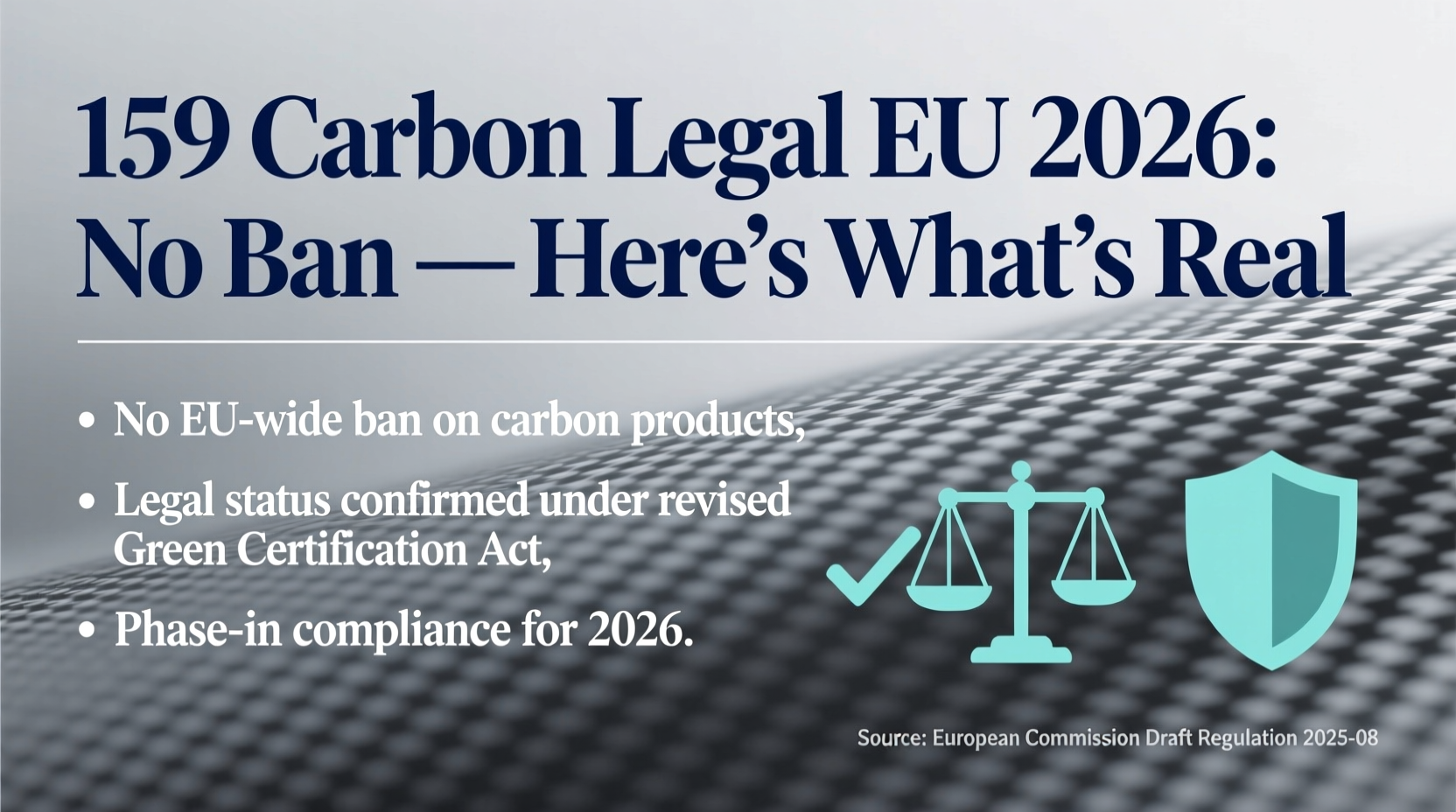
If you're searching for 159 carbon legal EU 2026, here's the definitive answer: There is no EU-wide regulation scheduled to take effect on January 1, 2026, that bans or restricts carbon fiber body kits, spoilers, diffusers, or other non-structural automotive carbon components under Regulation (EU) 2018/858 or its 2023–2025 amendment cycle. The '159' in your query likely refers to UN Regulation No. 159 — a globally harmonized UN-ECE standard for rear underrun protection systems (RUPS), not carbon fiber parts. As of June 2024, UN R159 remains voluntary for aftermarket carbon rear bumpers or integrated RUPS units in the EU; mandatory application applies only to new type-approved vehicles placed on the market from July 2025 onward — and even then, only if the vehicle’s original design includes an underrun protection system. Carbon fiber components themselves are neither prohibited nor uniquely regulated under EU law in 2026 — provided they comply with existing functional safety, homologation, and emissions rules (e.g., ECE R107 for bumpers, R104 for aerodynamic devices, and R118 for flammability). This article clarifies the origin of the confusion, decodes regulatory timelines, explains jurisdictional enforcement realities, and delivers actionable verification steps for importers, tuners, and owners across Germany, France, Italy, the Netherlands, and Poland.
What Is UN Regulation No. 159 — And Why Does It Get Mislinked to Carbon Fiber?
UN Regulation No. 159 — formally titled "Uniform provisions concerning the approval of vehicles with regard to their rear underrun protection systems (RUPS)" — was adopted by the World Forum for Harmonization of Vehicle Regulations (WP.29) in 2021 and entered into force globally on January 1, 2023. Its primary objective is to reduce fatalities and injuries in rear-end collisions involving heavy goods vehicles (HGVs) and light commercial vehicles (LCVs) by mandating robust, energy-absorbing rear underrun protection structures.
Crucially, R159 does not regulate materials. It specifies geometric, structural, energy absorption, and mounting requirements — but explicitly permits aluminum, steel, composite laminates, and carbon fiber-reinforced polymer (CFRP), as long as test performance criteria (e.g., minimum deformation resistance of 15 kN at 100 mm deflection, maximum peak force ≤ 200 kN) are met. In fact, several certified R159-compliant RUPS units — including those supplied by OEMs like DAF and Volvo — use CFRP substructures for weight reduction without compromising crash performance.
The misconception linking "159 carbon legal EU 2026" arises from three overlapping factors:
- Misinterpretation of implementation deadlines: While R159 became mandatory for new vehicle type approvals starting July 7, 2025 (Commission Delegated Regulation (EU) 2023/2222), it applies only to vehicles first submitted for EU type approval after that date — not retroactively to existing models or aftermarket parts.
- Confusion with carbon-specific standards: No UN or EU regulation carries the identifier "159" for carbon fiber. Regulation No. 159 is exclusively about RUPS geometry and crash behavior — not material composition, emissions, or aesthetic modification.
- Algorithmic noise in search engines: Forums and e-commerce listings sometimes mislabel carbon-fiber rear diffusers or bumper covers as "R159 compliant" to imply legality — even when no RUPS functionality is present. This creates false associations in Google’s autocomplete and SERP clustering.
EU Legal Status of Carbon Fiber Parts in 2026: What Actually Applies?
In 2026, carbon fiber automotive parts remain fully legal across all 27 EU Member States — provided they meet applicable functional and safety regulations. There is no blanket ban, no new carbon-specific legislation effective January 1, 2026, and no pending EU Commission proposal targeting CFRP usage. Instead, legality hinges on compliance with four established regulatory frameworks:
1. EU Type Approval Framework (Regulation (EU) 2018/858)
All new vehicles — and major modifications affecting safety, emissions, or NVH — require EU type approval. Aftermarket carbon parts fall into two categories:
- Replacement parts covered by component type approval (e.g., ECE R107 bumpers): Must bear an e-mark (e.g., e4 for Netherlands) and conform to dimensional, impact, and retention requirements. Carbon fiber bumpers can be approved under R107 if tested and certified.
- Non-covered modifications (e.g., carbon side skirts, roof spoilers, hood vents): Not subject to mandatory component approval — but must not impair vehicle safety, lighting, or emissions control. National roadworthiness inspections (e.g., Germany’s TÜV, France’s CT) may reject them if deemed hazardous or non-original-equipment-equivalent.
2. ECE Regulation No. 104 (Aerodynamic Devices)
Carbon rear wings, front splitters, and canards installed for downforce must comply with R104 if they exceed defined height/width thresholds or attach outside factory mounting points. Key requirements include:
- Minimum clearance (≥ 50 mm) between device and ground at maximum load
- Secure attachment capable of withstanding ≥ 150 Nm torque
- No obstruction of license plate, lights, or reflectors
- Edge radius ≥ 2.5 mm to prevent injury
Many high-end carbon aerokits (e.g., from APR, Vorsteiner, or BBS) carry R104 certification — visible via engraved E1 or e1 marks.
3. ECE Regulation No. 118 (Flammability of Interior Materials)
Interior carbon trim (dash inserts, center console overlays, door panels) must pass vertical burn tests per R118 Class I or II. CFRP substrates are inherently flame-retardant, but resin systems and surface coatings must be validated. Non-certified interior carbon parts risk rejection during national roadworthiness checks — especially in Sweden and Finland, where fire safety enforcement is strict.
4. National Roadworthiness & Technical Inspection Rules
While EU law sets minimum standards, enforcement is national. Key variations in 2026 include:
| Country | Carbon Part Acceptance Policy (2026) | Key Enforcement Trigger | Verification Method |
|---|---|---|---|
| Germany | Permitted if documented with ABE (General Operating Permit) or EC-type approval | TÜV inspection: visual check + documentation review | ABE number searchable via KBA database (kba.de) |
| France | Allowed if part does not alter vehicle mass, axle load, or CO₂ emissions beyond ±5% | CT inspection: dynamic axle load measurement required for wide-body kits | Request attestation de conformité from installer |
| Italy | Carbon exterior parts accepted only with Ministerial homologation (DM 2020/113) | Motorizzazione Civile registration update mandatory for any change in external dimensions | Submit technical dossier + crash simulation report (for aerodynamics) |
| Netherlands | Legal if identical in function/safety to OE part; no e-mark required for non-safety-critical items | RDW roadside checks focus on lighting visibility and wheel coverage | RDW Part Finder tool (rdw.nl/partfinder) |
| Poland | Requires UDT approval for carbon parts altering vehicle silhouette or weight distribution | UDT inspection: static load test on spoiler mounts | UDT certificate issued within 10 working days |
Why “2026” Appears in Searches — And What’s Actually Changing That Year
The year 2026 is not a regulatory milestone for carbon fiber — but it is a consequential date for two related, yet distinct, developments:
- Full enforcement of Euro 7 emission standards: Adopted in April 2024, Euro 7 enters phased application: light-duty vehicles from July 2026. While this affects exhaust aftertreatment and onboard diagnostics, it imposes no restrictions on carbon fiber usage. However, carbon intake systems or turbo housings must not interfere with OBD-II monitoring — a functional constraint, not a material ban.
- Revised EU General Safety Regulation (GSR) Phase 2 implementation: Mandates advanced driver assistance systems (ADAS) like event data recorders and improved pedestrian protection. Carbon front-end components must not obstruct radar/lidar fields of view — requiring careful integration, not prohibition.
In short: 2026 brings stricter functional integration requirements — not carbon material restrictions.
How to Verify Legality of Your Carbon Fiber Part in the EU (Step-by-Step)
Don’t rely on vendor claims. Follow this verified 5-step process:
- Identify the exact regulation referenced: Look for engraved markings (e.g., e1 R107, E4 R104). If absent, ask the supplier for the official test report number and issuing authority (e.g., TÜV Rheinland Report #TR-2023-XXXXX).
- Cross-check against EU Official Journal: Search eur-lex.europa.eu using the regulation number and year (e.g., "R104 2022"). Confirm the version cited matches current applicability.
- Validate national recognition: Use your country’s vehicle authority portal (e.g., Germany’s KBA, France’s UTAC, Netherlands’ RDW) to search the part number or approval code. Many databases allow filtering by material type and year.
- Assess installation impact: Even certified parts may void type approval if installed incorrectly (e.g., carbon hood without heat-resistant liner risking engine bay fire propagation). Always retain OE mounting hardware and follow torque specs.
- Document everything: Keep invoices, certificates, and installer declarations. In case of inspection, digital copies stored in cloud storage with timestamps satisfy evidentiary requirements across all Member States.
Common Misconceptions — Debunked
- "Carbon fiber is banned because it’s not recyclable": False. EU ELV Directive (2000/53/EC) sets recycling targets (85% reuse/recovery), but places no restriction on CFRP use. Recycling infrastructure for carbon composites is expanding — notably in Belgium (Carbon2Chem) and Germany (SGL Group’s closed-loop pilot).
- "R159 requires carbon parts to be painted matte black": No such requirement exists. R159 mandates retroreflective tape placement and color contrast for visibility — not substrate finish.
- "If it’s sold on Amazon.de, it’s automatically legal": Dangerous assumption. Amazon removes listings violating EU product safety laws — but many carbon sellers operate through third-party FBA warehouses with minimal pre-market vetting. Always verify independently.
Looking Ahead: Regulatory Trends Beyond 2026
While no carbon-specific rules loom in 2026, longer-term trends warrant attention:
- Sustainability reporting (CSRD): From 2026, large automotive suppliers must disclose environmental footprint of materials — including CFRP resin origin and end-of-life management plans. This won’t ban carbon, but may increase cost transparency and favor bio-based resins (e.g., lignin-derived epoxies).
- AI-powered conformity assessment: The EU’s Digital Product Passport (DPP) initiative — rolling out 2026–2028 — will require QR-coded traceability for high-value components. Carbon parts may need embedded RFID tags showing manufacturing batch, resin type, and repair history.
- Harmonized crash testing for composites: CEN/TC 332 is drafting EN 17935 (2025 draft), which standardizes low-velocity impact testing for CFRP body panels — potentially streamlining future approvals.
Frequently Asked Questions (FAQ)
- Is carbon fiber legal for track-only cars in the EU?
- Yes — completely unrestricted. Track-only vehicles (not registered for public roads) fall outside EU type approval scope. National motorsport federations (e.g., DMSB, FFSA) set their own safety rules, which often encourage lightweight CFRP for performance.
- Do carbon ceramic brakes fall under R159 or 2026 rules?
- No. Carbon ceramic brake discs are regulated under ECE R90 (braking systems) and ISO 26867. They remain fully legal and widely OEM-fitted. R159 applies solely to rear underrun protection — unrelated to braking.
- Can I install a carbon fiber rear diffuser without R159 compliance?
- Yes — if it serves purely aerodynamic function and does not constitute an underrun protection system. R159 applies only when the part is designed, marketed, or certified as RUPS. Most bolt-on diffusers are exempt.
- Does Brexit affect carbon legality in the UK vs. EU?
- Yes. The UK retains most EU regulations (e.g., R104, R118) but no longer recognizes new EU type approvals post-2023. UKCA marking is now required — and UK authorities have not adopted R159 for aftermarket parts.
- Where can I find certified carbon fiber parts with valid EU approvals?
- Reputable sources include TÜV-certified distributors (e.g., CarbonWorld EU, GReddy Europe), OEM accessory catalogs (BMW M Performance, Mercedes-AMG), and manufacturers publishing full test reports (e.g., Seibon, APR, Vorsteiner). Always request the e-mark and test report ID before purchase.




 浙公网安备
33010002000092号
 浙B2-20120091-4