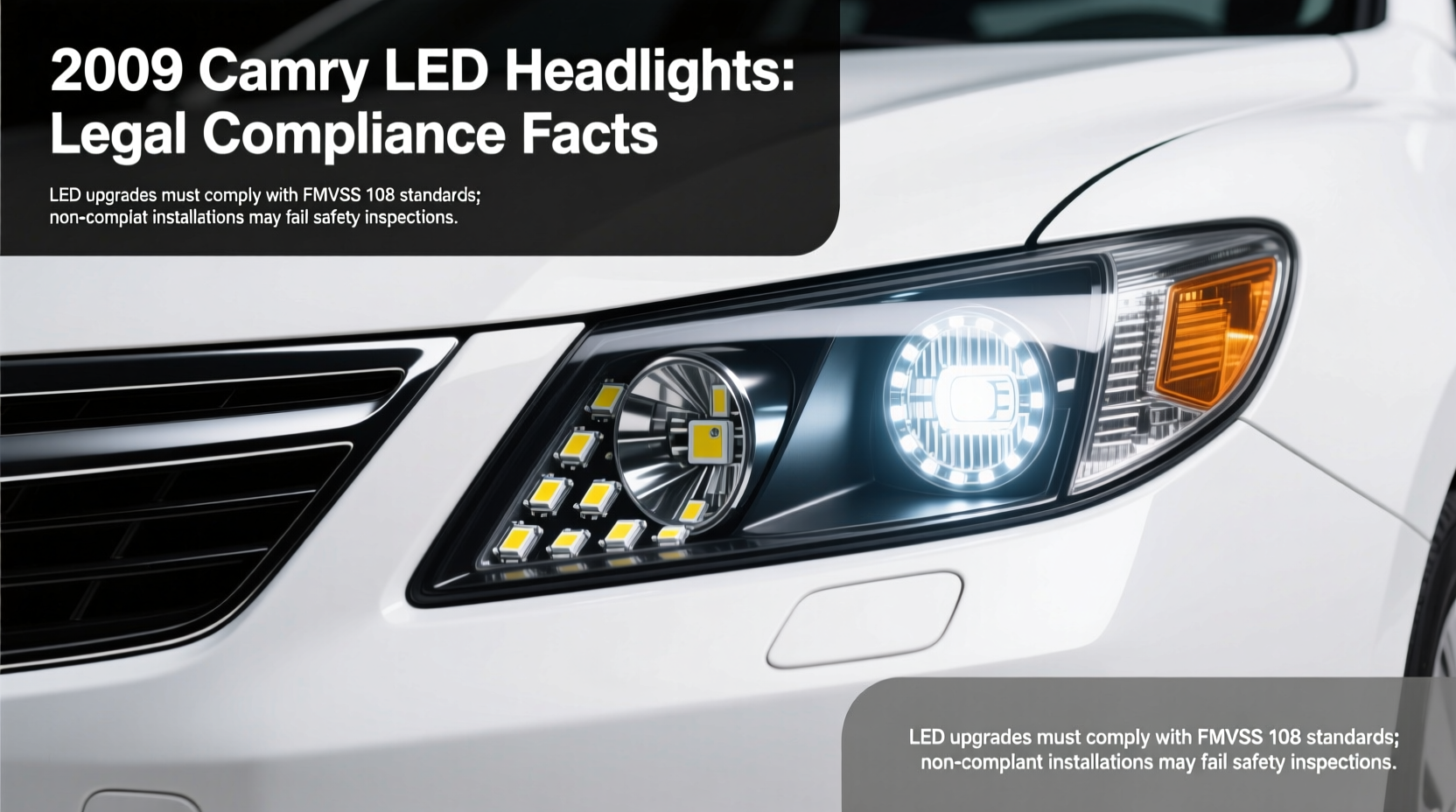
Upgrading your 2009 Toyota Camry with LED headlights is not inherently DOT-compliant or street-legal in the U.S. — unless the replacement units are certified as complete, SAE/DOT-compliant assemblies (not just LED bulbs). The key phrase 2009 Camry LED headlight assembly compliance reflects the core regulatory reality: only OEM-equivalent, fully tested, and federally certified headlamp systems meet FMVSS 108 requirements. Retrofitting aftermarket LED bulbs into halogen housings — a common but problematic practice — violates federal safety standards and may fail state inspections, void insurance coverage, and create dangerous glare for oncoming drivers. This guide details exactly what qualifies, how to verify compliance, regional enforcement nuances, and safer, legal alternatives.
Why LED Headlight Compliance Matters for Your 2009 Camry
The 2009 Toyota Camry was originally equipped with halogen headlamps — specifically, H11 low-beam and 9005 (HB3) high-beam bulbs — designed and certified under Federal Motor Vehicle Safety Standard (FMVSS) No. 108. This standard governs photometric performance, beam pattern geometry, mounting stability, durability, and labeling. When you replace factory halogen bulbs with non-OEM LED units, you fundamentally alter the optical system. Halogen reflectors and projectors are engineered for the size, shape, filament location, and thermal profile of incandescent bulbs. LEDs differ in all three: they emit light from a flat chip rather than a pinpoint filament; their thermal management requires heatsinks that shift physical positioning; and their light distribution rarely matches the precisely controlled cutoff line required to prevent blinding other drivers.
This mismatch isn’t theoretical. In 2018, the National Highway Traffic Safety Administration (NHTSA) issued Advisory Letter AL-2018-01, explicitly stating that “LED ‘bulb’ replacements for halogen headlamps do not comply with FMVSS No. 108”. NHTSA reiterated this position in its 2022 Lighting Enforcement Guidance, confirming that such retrofits lack required certification marks and cannot be legally sold or installed for on-road use. While enforcement varies by state, citations for noncompliant lighting have increased — especially in California (via CVC § 25950), Texas (TRC § 547.325), and New York (VTL § 375(22-a)).
What Constitutes Legal Compliance? Three Certification Tiers
True compliance isn’t about brightness or aesthetics — it’s about traceable, third-party verification. For a 2009 Camry LED upgrade to be legal, it must meet one of these three tiers:
- OEM Replacement Assemblies: Genuine Toyota part numbers like 81150-06050 (LH) and 81160-06050 (RH) — discontinued but occasionally available via dealer surplus or certified remanufacturers. These retain original housing, lens, projector/reflector optics, and carry the DOT/SAE stamp on the lens.
- DOT-Certified Aftermarket Assemblies: Units from brands like Depo, Spec-D, or Kensun that bear both DOT and SAE markings molded into the lens — not stickers. They must be listed in the NHTSA’s Certified Lighting Database (search by manufacturer and model number).
- FMVSS 108-Compliant Retrofit Kits: Rare for 2009 Camry, but some specialty vendors (e.g., The Retrofit Source) offer projector-based kits validated per SAE J2049 and certified by independent labs (e.g., MET Labs). These include full housing replacement, precise alignment tools, and official test reports.
Crucially, no LED bulb-only product — regardless of claims like “DOT-approved,” “street legal,” or “plug-and-play” — satisfies FMVSS 108. Such language is marketing misrepresentation. True compliance requires certification of the entire headlamp assembly, including lens, reflector/projector, bulb, and housing — tested as a single unit.
State-by-State Enforcement Realities
While FMVSS 108 is federal law, enforcement authority rests with individual states. Penalties range from warnings to fines ($25–$200) and failed vehicle inspections. Here’s how major jurisdictions treat noncompliant LED upgrades:
| State | Inspection Requirement? | Typical Enforcement Trigger | Key Statute / Regulation | Notes |
|---|---|---|---|---|
| California | Yes (biennial) | Visible glare, improper beam pattern during smog check | CVC § 25950, § 25952 | BAR inspectors use photometric testers; noncompliant LEDs almost always fail. |
| Texas | Yes (annual) | Officer observation during traffic stop | TRC § 547.325, § 547.327 | “Improper lighting” is a Class C misdemeanor; repeat offenses escalate. |
| New York | Yes (annual) | Failed safety inspection | VTL § 375(22-a) | Requires “white light only,” specific aim, and no excessive glare. |
| Florida | No statewide inspection | Traffic stop or crash investigation | FS § 316.220 | Enforcement is complaint-driven; glare complaints increasingly documented. |
| Michigan | No inspection | Police discretion during stops | MCL § 257.699 | “Unlawful equipment” citation possible if beam pattern deviates >3° vertical/horizontal. |
Note: Even in states without mandatory inspections, liability remains. If noncompliant lighting contributes to an accident, insurers may deny claims citing “failure to maintain vehicle in safe operating condition” (per ISO Auto Policy language). Courts have upheld this reasoning in multiple 2021–2023 rulings.
How to Verify Compliance Yourself — Step-by-Step
Don’t rely on vendor claims. Perform these four verifications before purchase or installation:
- Check the Lens Markings: Legally compliant assemblies must display DOT and SAE (e.g., “DOT SAE J2049”) molded into the plastic lens — not printed or stickered. Absence = noncompliance.
- Search the NHTSA Database: Go to NHTSA Certified Lighting Search. Enter the manufacturer name and exact part number. Only entries with “Certified” status and matching vehicle applicability (e.g., “2007–2011 Camry”) are valid.
- Review Lab Reports: Reputable manufacturers publish photometric test reports (per SAE J1383 or J2049) on their websites. Look for beam pattern charts showing sharp horizontal cutoff, minimal hot spots above the line, and proper left/right symmetry.
- Confirm Housing Compatibility: For 2009 Camry (XV40 chassis), verify the assembly matches the 2007–2011 facelift design — not the 2002–2006 pre-facelift. Mismatched housings cause misalignment and automatic failure.
If any step fails, discard the product. There is no workaround.
Common Misconceptions — Debunked
Misconception #1: “If it fits and lights up, it’s legal.”
Reality: Fitment ≠ compliance. Many LED bulbs physically install but scatter light uncontrollably. FMVSS 108 mandates precise photometric output — not mere illumination.
Misconception #2: “European E-marked lights are legal in the U.S.”
Reality: ECE R112 certification (common on European-market LEDs) has no legal standing under U.S. law. Only DOT/SAE certification applies.
Misconception #3: “My mechanic said it’s fine.”
Reality: Mechanics aren’t regulatory authorities. Their approval carries no legal weight during inspection or litigation.
Misconception #4: “I’ve driven for months with no ticket — so it’s okay.”
Reality: Non-enforcement ≠ legality. Risk accumulates with mileage, weather conditions (fog/rain amplifies glare), and proximity to law enforcement zones (e.g., near state borders or highway patrols).
Better Alternatives: Legal, Safe, and Effective
Rather than risking compliance, consider these proven upgrades:
- High-Performance Halogen Bulbs: Philips X-tremeUltinon gen2 (H11/9005) or Osram Night Breaker Laser deliver +150% light output while retaining full FMVSS 108 compliance. Cost: $40–$65/set.
- Headlight Restoration + Proper Aim: 80% of perceived dimness stems from yellowed lenses and misaligned beams. A professional restoration ($75–$120) plus precise aiming (using SAE J578 guidelines) restores 90%+ of original output — safely and legally.
- Certified LED Assembly Swap (if budget allows): Depo Black Housing LED Projector Assemblies (part # DEP-2009-CAMRY-LR) are NHTSA-certified for 2007–2011 Camry, feature integrated CANBUS decoders, and retail ~$380/set. Installation requires basic mechanical skill or $120–$180 labor.
All three options preserve warranty eligibility, insurance validity, and resale value — unlike noncompliant LED bulbs, which often trigger dealership service denials for related electrical issues.
Frequently Asked Questions (FAQ)
- Can I pass a state inspection with LED bulbs in my 2009 Camry?
- No — certified inspectors use photometric testers or visual beam pattern checks. Noncompliant LEDs consistently fail due to excessive upward scatter and lack of defined cutoff.
- Are there any 2009 Camry-specific LED assemblies certified by DOT?
- Yes — Depo (DEP-2009-CAMRY-LR), Kensun (KS-LED-CAMRY-0711), and Spec-D (SD-LED-CAMRY-0711) list FMVSS 108 certification for 2007–2011 Camry. Always verify current NHTSA listing before purchase.
- Will LED headlights void my Camry’s factory warranty?
- Not if installed correctly using certified assemblies. However, Toyota dealers may deny coverage for alternator, wiring harness, or BCM failures caused by uncertified LED bulbs drawing irregular current or triggering CANBUS errors.
- Do I need a relay harness or CANBUS decoder with certified LED assemblies?
- Most modern certified assemblies include built-in decoders. A separate relay harness is unnecessary and may interfere with OEM diagnostics. Check manufacturer specs — if it says “plug-and-play for 2007–2011 Camry,” no add-ons are needed.
- Is there a federal deadline banning noncompliant LED bulbs?
- No — but NHTSA’s enforcement focus has intensified since 2020. The agency now prioritizes lighting violations in its annual Recall Prioritization Plan, and several manufacturers have faced civil penalties for false “DOT-approved” labeling.




 浙公网安备
33010002000092号
 浙B2-20120091-4