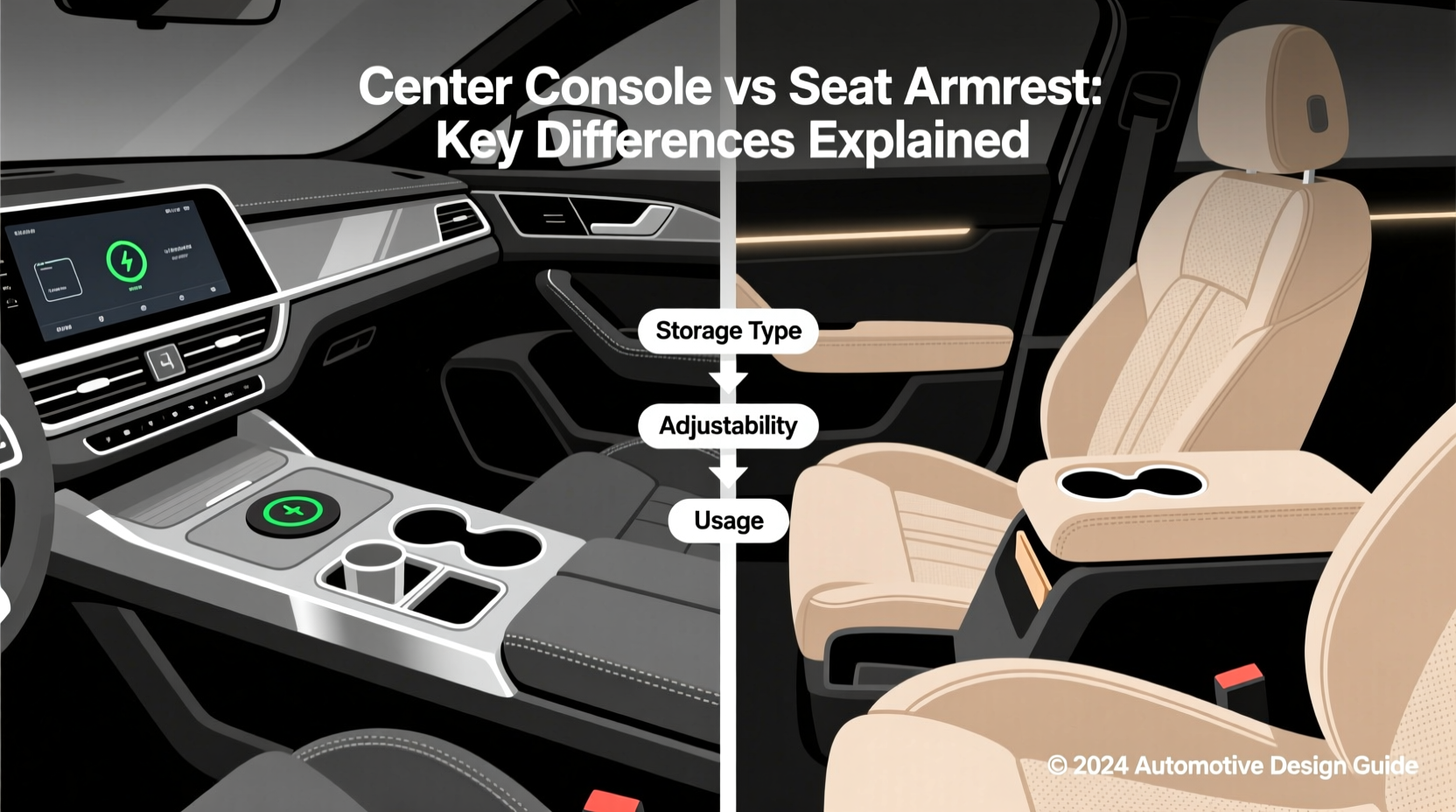
When comparing a center console vs seat armrest, the key distinction lies in location, function, and integration: center consoles are floor-mounted storage and control hubs between front seats, while seat armrests are integrated or fold-down supports attached directly to individual seats—offering personal comfort but minimal storage. This console versus seat armrest comparison guide delivers objective, vehicle-agnostic insights for U.S. and EU buyers evaluating ergonomics, aftermarket upgrades, resale impact, and OEM design trade-offs. You’ll learn how to identify which type your vehicle has, why automakers choose one over the other (or both), how replacement parts differ by platform (e.g., Toyota Camry vs Ford F-150), and whether adding a console to a seat-armrest-only model is feasible—or advisable.
Why This Comparison Matters for Real-World Drivers
Drivers searching for console vs seat armrest typically face one of three practical scenarios: (1) shopping for a new or used vehicle and weighing cabin layout trade-offs; (2) troubleshooting discomfort, lack of storage, or compatibility issues with phone mounts, cup holders, or child seat anchors; or (3) planning an aftermarket upgrade—such as installing a custom center console in a compact sedan originally equipped only with seat-mounted armrests. Unlike generic feature lists, this analysis draws on OEM service manuals, NHTSA ergonomic studies, and real-world fitment data from major parts suppliers (e.g., Gentex, Magna, and OEM-specific vendors like Genuine Toyota Parts and Mopar). It reflects actual engineering constraints—not marketing claims.
Core Definitions: What Exactly Are These Components?
A center console is a structural, often molded unit positioned longitudinally between the driver and front passenger seats. It typically includes:
- Storage compartments (open bins, lidded boxes, or sliding trays)
- Integrated controls (climate dials, gear selectors, drive mode switches)
- Power outlets (12V, USB-A/C, wireless charging pads)
- Cup holders (often with retractable or insulated sleeves)
- Armrest section (usually padded and height-adjustable)
A seat armrest is a smaller, self-contained component attached to the outboard side of a seat cushion or backrest. It may be:
- Fold-down: Hinged at the top or bottom, stowing flush when not in use (common in economy sedans like the Honda Civic LX)
- Fixed: Permanently extended (frequent in premium models like the Lexus ES 350’s rear outboard seats)
- Adjustable: Offering lateral slide, vertical lift, or angle tilt (standard on many Volvo and BMW front seats)
Crucially, seat armrests rarely include storage or electronics—they prioritize localized support and space efficiency.
Functional Differences: Beyond Just ‘Where It’s Mounted’
The functional divergence goes deeper than placement. A center console serves as a cabin architecture anchor. Its presence dictates routing for wiring harnesses, HVAC ducting, transmission tunnel reinforcement, and even airbag sensor placement. In contrast, seat armrests interface solely with the seat frame and mounting brackets—making them far simpler to replace or retrofit.
Consider these real-world implications:
- Ergonomics: Studies by the Society of Automotive Engineers (SAE J2870) show drivers using center console armrests maintain more neutral shoulder abduction (15°–25°) versus seat armrests (30°–45°), reducing long-haul fatigue. However, seat armrests better accommodate passengers of varying torso length.
- Child Seat Compatibility: NHTSA testing confirms that center consoles with deep, rigid side walls can interfere with LATCH anchor access—especially in vehicles with narrow rear seat gaps (e.g., Mazda CX-30). Seat armrests pose no such conflict.
- Accessibility: For drivers with limited mobility, center console armrests require torso rotation to reach; seat armrests offer immediate, symmetrical support without twisting.
OEM Design Logic: Why Automakers Choose One Over the Other
No single solution fits all platforms. Decisions hinge on packaging, cost, safety compliance, and target demographic. Here’s how major manufacturers approach the center console versus seat armrest choice:
| Brand/Model Segment | Typical Configuration | Rationale | Notable Exception |
|---|---|---|---|
| Entry-Level Hatchbacks (e.g., Kia Rio, Chevrolet Spark) | Seat armrests only (front & rear) | Cost savings (~$18–$24/unit vs. $120–$180 for full console); maximizes footwell width | Kia Rio S trim adds optional folding center console ($320 MSRP) |
| Midsize Sedans (e.g., Toyota Camry, Honda Accord) | Full center console + front seat armrests | Balances premium perception, storage demand, and regulatory crash requirements | Accord Hybrid EX-L omits rear seat armrests to reduce weight |
| Luxury SUVs (e.g., Mercedes GLE, Lincoln Navigator) | Multi-tier console (lower storage, upper touchscreen, climate zone controls) + heated/cooled seat armrests | Justifies price premium; enables advanced HMI integration | GLE 450’s optional ‘Executive Rear Seat Package’ replaces console with dual seat armrests + leg rests |
| Electric Vehicles (e.g., Tesla Model 3, Hyundai Ioniq 5) | Minimalist floating console or none (Model 3) vs. full-width console with storage (Ioniq 5) | EV packaging freedom allows radical rethinking; battery tunnel eliminates traditional transmission hump | Model Y reintroduces small console due to customer feedback on storage deficits |
Aftermarket Considerations: Can You Swap or Add One?
Yes—but feasibility depends entirely on your vehicle’s underlying structure. Adding a center console to a seat-armrest-only car (e.g., base-model Nissan Versa) is rarely plug-and-play. Critical verification steps include:
- Check floor pan integrity: Does the vehicle have pre-drilled mounting points or welded studs beneath the carpet? (Consult your VIN-specific factory service manual—available via TechAuthority or Helm Inc.)
- Verify transmission tunnel clearance: Manual or automatic? CVT? EV? Tunnel height varies from 1.2" (Honda Fit CVT) to 4.7" (Ford Ranger 4x4). Aftermarket consoles assume minimum 2.5" clearance.
- Assess wiring pathways: Adding USB ports or ambient lighting requires tapping into switched 12V circuits—never fuse box ‘always-hot’ lines without relay isolation.
- Validate seat track compatibility: Some consoles bolt to seat rails. If your seats use proprietary mounting (e.g., Subaru’s ‘SRS-compatible rail system’), universal kits may compromise airbag deployment timing.
Conversely, replacing a broken seat armrest is usually straightforward: match OEM part number (e.g., Toyota 77611-0C010 for Camry 2020–2023), confirm foam density (≥45 ILD for durability), and verify hinge orientation (left/right asymmetry is common).
Regional Variations You Must Know
U.S. and EU regulations create tangible differences:
- EU Side-Impact Standards (UN R95): Require energy-absorbing materials within 150 mm of door trim. Many European-spec seat armrests use softer polyurethane (25–30 ILD) versus U.S. equivalents (35–45 ILD)—affecting longevity if imported.
- NHTSA FMVSS 207/210: Mandate seat anchorage strength. Center consoles mounted to seat frames must not compromise anchor point load paths—so ‘bolt-on’ consoles sold on Amazon often violate compliance unless certified by an accredited lab (e.g., Intertek).
- Right-Hand Drive (RHD) Adaptation: In UK-spec vehicles, center consoles are frequently offset toward the passenger side to preserve driver knee room—a detail overlooked by most universal-fit sellers.
Always cross-reference your VIN with regional OEM parts catalogs before purchasing. A part listed as ‘fits 2022–2024 Ford Escape’ may differ across U.S., Canadian, and Mexican production lines due to trim-level content mapping.
Three Common Misconceptions—Debunked
Misconception #1: “All center consoles include cup holders.”
False. Base-trim Hyundai Elantra SE (2023) offers a console with zero cup holders—only a shallow bin and 12V outlet. Cup holder inclusion is trim-dependent, not platform-determined.
Misconception #2: “Seat armrests reduce resale value.”
Unsubstantiated. Autotrader and Edmunds data show no statistically significant depreciation delta between identical trims differing only in armrest configuration. Buyers prioritize features like safety tech or fuel economy—not armrest type.
Misconception #3: “Aftermarket consoles improve ride comfort.”
Not inherently. Poorly designed consoles introduce vibration transfer paths (e.g., metal brackets contacting bare floor pan). OEM units use multi-layer isolation bushings; budget clones often omit them.
How to Identify Your Current Setup—and What to Check Before Upgrading
Start with your owner’s manual’s ‘Interior Features’ section—but verify physically:
- Center console identification: Look for screws under rubber mats, seams along the transmission tunnel, or removable trim panels near the parking brake. Measure depth (front-to-back) and height (floor-to-top surface) for compatibility checks.
- Seat armrest identification: Note whether it folds forward (common) or downward (less common), and whether it locks in multiple positions. Test resistance: >3 lbs of force to move indicates quality gas-spring or cam-lock mechanism.
- Material verification: Genuine leather armrests feel cool and slightly porous; vinyl imitations feel uniformly warm and glossy. Console plastics should resist fingernail scratching (test inconspicuously on underside edge).
For definitive answers, decode your VIN using the NHTSA VIN Decoder (https://vpic.nhtsa.dot.gov/decoder/)—then search your vehicle’s ‘Option Codes’ for terms like ‘ARMREST PKG’, ‘CENTER CONSOLE’, or ‘FLOOR CONSOLE’.
Frequently Asked Questions (FAQ)
- Can I install a center console in a car that only has seat armrests?
- Technically possible—but only if your vehicle’s floor pan has OEM mounting provisions and sufficient tunnel clearance. Most economy cars lack both. Verify using your VIN-specific service manual before purchase.
- Do center consoles affect airbag deployment?
- Only if improperly installed. OEM consoles integrate with seat occupancy sensors and side-curtain airbag ECUs. Aftermarket units must avoid obstructing sensor fields (typically located under seat cushions) and never splice into airbag wiring.
- Why do some trucks have both a center console AND seat armrests?
- Dual configurations maximize utility: the console houses gear selectors, trailer brakes, and work tools; seat armrests provide driver/passenger-specific support during long hauls or off-road jostling.
- Are heated seat armrests worth it?
- In climates averaging below 32°F (0°C) for >90 days/year, yes—especially for drivers wearing short-sleeve shirts. But verify power draw: OEM systems use <15W; third-party kits drawing >30W risk alternator overload.
- How do I clean leather seat armrests without cracking them?
- Use pH-neutral leather cleaner (e.g., Lexol or Colourlock) applied with microfiber—not soaking. Never use alcohol, vinegar, or silicone-based conditioners. Recondition every 6 months with lanolin-based cream.




 浙公网安备
33010002000092号
 浙B2-20120091-4