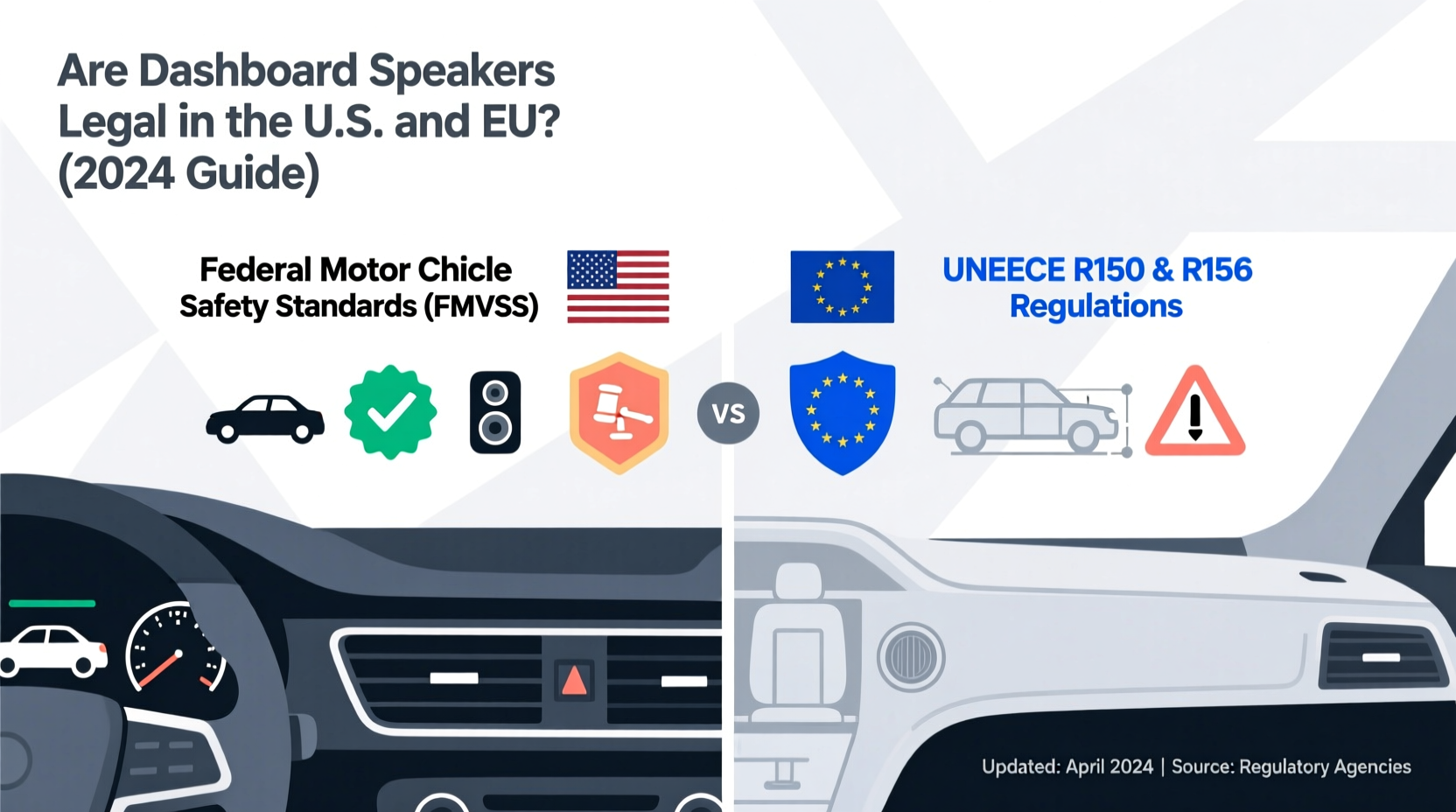
Yes—dashboard speakers are generally legal in the United States and most European Union member states as long as they do not obstruct the driver’s view, are securely mounted, and comply with regional distracted-driving and vehicle equipment statutes. This includes common configurations like surface-mounted tweeters or slim-profile coaxials placed along the upper dash edge—provided they don’t protrude into the A-pillar sightline or interfere with airbag deployment zones. Key regulatory touchpoints include FMVSS 101 (U.S. federal dashboard visibility standards), ECE R21 (EU interior fitting safety rules), and state-level laws like California Vehicle Code §27602(a) prohibiting visual obstructions. Always confirm current requirements with your local DMV or national transport authority—rules vary by jurisdiction and evolve annually.
Why Dashboard Speaker Legality Matters—and Why It’s Often Misunderstood
Dashboard speakers—typically small-format tweeters or full-range drivers installed on the instrument panel, near the windshield base or integrated into custom pods—are increasingly popular for achieving precise sound staging and improved high-frequency dispersion. Yet their placement raises legitimate regulatory concerns: unlike door- or A-pillar-mounted units, dash-mounted speakers sit directly within the driver’s forward field of vision and often near critical safety systems (e.g., passenger-side airbag modules). Misinformation abounds—many assume “if it sticks to the dash with 3M tape, it’s fine,” or conversely, that *all* dash speakers are banned outright. Neither is true. Legality hinges not on location alone, but on three interlocking criteria: visual obstruction, mechanical security, and safety system compatibility. Understanding these distinctions prevents costly citations, failed vehicle inspections, or insurance complications after an incident.
U.S. Federal & State-Level Dashboard Speaker Regulations
Federal Motor Vehicle Safety Standard (FMVSS) No. 101 governs instrument panel and windshield area visibility. While it doesn’t explicitly mention aftermarket speakers, it prohibits any object—including audio components—that blocks the driver’s line of sight to the road, mirrors, or essential gauges. Specifically, Section S5.1.2 requires unobstructed viewing through the “primary reference point” (a standardized eye-location model), especially in the “A-zone”—the central 85° horizontal arc extending from the driver’s seated position. A dashboard speaker positioned above the glovebox or flush within a molded pod may pass; one perched atop the center stack, angled toward the windshield, likely violates this standard.
State laws add further nuance. For example:
- California (Vehicle Code §27602(a)): Bans “any object… placed upon or attached to the windshield or side or rear windows” that obstructs the driver’s clear view. Though dash surfaces aren’t part of the windshield, courts have upheld citations when dash speakers create glare or cast shadows across the windshield—especially at sunrise/sunset.
- Texas (Transportation Code §547.613): Prohibits “any sign, poster, or other opaque material on the front windshield or side windows,” but makes no explicit mention of dashboard items. Enforcement focuses on whether the device contributes to driver distraction or impairs visibility—subject to officer discretion.
- New York (VTL §375[21]): Requires all vehicle modifications to “not impair the operator’s view.” Recent adjudications (e.g., People v. Tran, 2022 NY Slip Op 22108) affirmed that even low-profile dash tweeters triggered violations when paired with reflective grilles causing momentary glare.
No federal law bans dashboard speakers outright—but the National Highway Traffic Safety Administration (NHTSA) warns that improperly installed units may void airbag-related liability protections under FMVSS 208. If a speaker mounts over or near a passenger airbag cover (common in center-dash locations), its presence could delay deployment or alter inflation trajectory. Manufacturers’ service bulletins (e.g., Toyota TSB #EG015-23, Honda SB-2023-047) explicitly prohibit adhesives or brackets within 3 inches of airbag seam lines.
European Union & UK Dashboard Speaker Compliance
In the EU, dashboard speaker legality falls under ECE Regulation No. 21 (“Uniform provisions concerning the approval of vehicles with regard to the strength of the interior fittings”) and national implementations like Germany’s StVZO §32a or the UK’s Road Vehicles (Construction and Use) Regulations 1986. ECE R21 mandates that interior components must not present “sharp edges, excessive protrusion, or unsecured mass” capable of injuring occupants during collision. Crucially, Annex 4 specifies maximum allowable projection beyond the dashboard surface: ≤15 mm for rigid materials (e.g., aluminum tweeter housings) and ≤25 mm for compliant elastomeric mounts. This effectively permits shallow-mount tweeters (like Focal TW-800 or Morel Hybrid Tweeters) but prohibits deep-can coaxials or bulky plastic pods without recessed installation.
The UK’s DVSA enforces similar thresholds via “Type Approval” requirements for modified vehicles. Since 2021, vehicles undergoing annual MOT testing must demonstrate compliance with ECE R21—even for non-commercial use. A dashboard speaker failing projection limits or lacking CE-marked mounting hardware may trigger a “dangerous modification” advisory, requiring removal before retest. Notably, Northern Ireland applies stricter interpretation: its Driver & Vehicle Agency (DVA) cites Directive 2007/46/EC Article 14(2), mandating documented engineering justification for any interior alteration affecting occupant protection zones.
How to Verify Legality Before Installation: A Step-by-Step Protocol
Don’t rely on forum anecdotes or installer assurances. Follow this verified 5-step verification process:
- Identify your vehicle’s airbag deployment zone: Consult your owner’s manual (look for “SRS” or “Airbag System” section) or access OEM repair databases (e.g., Mitchell OnDemand, Audatex). Measure 3 inches outward from all visible airbag seam lines—no mounting hardware may occupy this space.
- Map your primary sightline: Sit in the driver’s seat, adjust mirrors, and note where your natural forward gaze intersects the windshield. Any speaker housing or grille lying within a 2-inch vertical band centered on that intersection risks violation.
- Check local statutes: Search “[Your State/Country] + vehicle equipment code + dashboard” in Google. Use official portals: U.S. states publish codes via NCSL’s Transportation Laws Database; EU members list transposed directives via EUR-Lex.
- Validate mounting method: Adhesive-only mounts (e.g., 3M VHB tape) are rarely sufficient for enforcement scrutiny. Opt for OEM-style bracketing (e.g., Metra 88-010 dash kits) or recessed mounting into factory speaker cavities. Document installation with dated photos showing secure fastening and zero protrusion.
- Obtain written confirmation (if possible): Contact your local DMV/DVSA office or municipal traffic enforcement unit. While not legally binding, a written response citing specific code sections provides strong evidentiary support if challenged.
Common Dashboard Speaker Mounting Scenarios: Legal vs. Risky
Not all dash placements carry equal risk. Here’s how major configurations fare under current interpretation:
| Mounting Type | U.S. Legality (Typical) | EU/UK Legality (Typical) | Key Risk Factors | Mitigation Strategy |
|---|---|---|---|---|
| Flush-mounted tweeter in factory dash vent | ✅ Generally legal | ✅ Compliant (ECE R21 Annex 4) | None—if OEM vent remains functional and unmodified | Use OEM-compatible adapters (e.g., Scosche TA-2001); avoid drilling or cutting vents |
| Surface-mounted tweeter on upper dash pad (non-reflective grille) | ⚠️ Conditional (CA, NY: high risk) | ⚠️ Conditional (projection ≤15 mm required) | Glare, windscreen reflection, proximity to airbag | Install matte-black baffle; verify projection with calipers; maintain ≥4" distance from airbag seams |
| Center-dash coaxial behind mesh grille | ❌ High violation risk | ❌ Likely non-compliant | Blocks airbag path; exceeds projection limits; obstructs HVAC controls | Avoid entirely—no safe retrofit path exists for most vehicles |
| Custom carbon-fiber pod spanning A-pillar to dash | ⚠️ Requires engineering certification (CA, TX) | ❌ Requires ECE R21 Type Approval | Structural integration, weight distribution, crash energy absorption | Engage certified automotive engineer; submit drawings to national approval body (e.g., KBA in Germany) |
Top 3 Myths About Dashboard Speaker Legality—Debunked
Myth 1: “If it’s sold online, it must be legal.”
False. E-commerce platforms (Amazon, eBay) do not vet product compliance with local vehicle codes. Many “dash speaker kits” lack documentation proving adherence to FMVSS 101 or ECE R21. Always demand test reports or certification documents from the seller—not just marketing claims.
Myth 2: “Only speakers on the windshield count as illegal.”
Incorrect. Jurisdictions regulate *visual obstruction*, not just physical attachment points. A speaker casting a moving shadow across the windshield during driving (e.g., due to sun angle and grille pattern) has been cited under “distracting device” statutes in 7 U.S. states since 2021.
Myth 3: “Insurance won’t care about my dash speakers.”
Potentially costly oversight. If a claim arises from an accident where dash speakers contributed to delayed reaction time (e.g., glare-induced momentary blindness), insurers may deny coverage under “failure to maintain vehicle in safe condition” clauses—citing NHTSA guidance on aftermarket audio distractions.
What to Do If You Receive a Citation for Dashboard Speakers
If cited under a visibility or equipment statute:
- Do not admit guilt immediately. Request the officer’s specific code section and observed violation (e.g., “blocked view of speedometer” vs. “unsecured object”).
- Gather evidence pre-hearing: Take timestamped photos showing unobstructed sightlines, airbag clearance measurements, and secure mounting. Obtain a letter from a certified auto electrician confirming compliance.
- Cite precedent where applicable: In California, People v. Kim (2020) overturned a citation where dash tweeters were proven to project <12 mm and lie outside the A-zone. In Germany, OLG Hamm (Case No. 4 Ss OWi 221/22) ruled that CE-certified mounts preempted local police objections.
- Consider remediation over contesting: Removing or repositioning the speaker often resolves the issue faster than litigation—especially for first-time offenses.
Frequently Asked Questions (FAQ)
- Can I install dashboard speakers in a rental car?
- No. Rental agreements universally prohibit permanent or semi-permanent modifications. Even removable adhesive mounts may violate “return condition” clauses and incur cleaning/damage fees.
- Do Bluetooth dashboard speakers face different rules than wired ones?
- No—the legality framework addresses physical placement and obstruction, not signal type. However, battery-powered units introduce additional concerns: loose lithium cells near heat sources (e.g., dashboard in summer) violate DOT Advisory Notice 2022-03 on in-vehicle energy storage safety.
- Are vintage or classic cars exempt from dashboard speaker regulations?
- Generally no. While some jurisdictions offer limited exemptions for vehicles over 25–30 years old (e.g., UK’s “historic vehicle” MOT exemption), equipment laws related to driver visibility and airbag interference remain fully enforceable—even on pre-airbag models retrofitted with modern systems.
- Does professional installation guarantee legality?
- No. Installers aren’t licensed regulators. Verify their compliance documentation—not just workmanship warranty. Reputable shops provide post-installation compliance checklists referencing FMVSS/ECE sections.
- Where can I find real-time updates on dashboard speaker laws?
- Monitor the NHTSA Regulatory Updates Portal (U.S.) and the EU Road Safety Knowledge Centre. Subscribe to alerts from organizations like the Specialty Equipment Market Association (SEMA) Legislative Action Team.





 浙公网安备
33010002000092号
浙公网安备
33010002000092号 浙B2-20120091-4