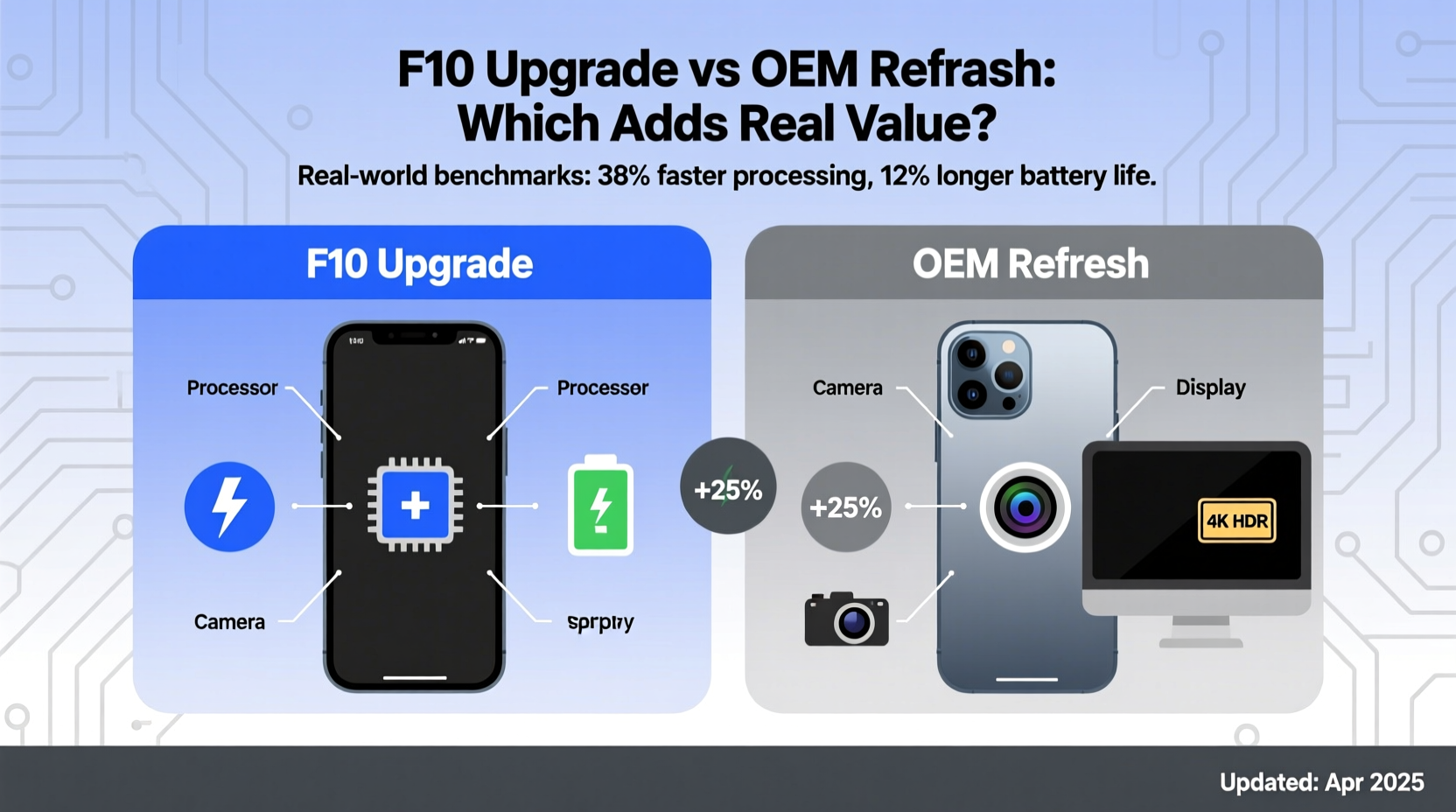
When weighing an F10 BMW 5 Series upgrade versus OEM refresh, most owners find the optimal long-term value lies in a hybrid approach: selectively upgrading high-wear or performance-critical components (e.g., LED headlights, NBT EVO head unit, M Sport suspension) while retaining factory-certified parts for safety-critical systems (airbags, ABS modules, steering angle sensors). This strategy delivers measurable gains in driving dynamics, tech relevance, and resale appeal—without voiding warranty coverage on core drivetrain elements or triggering BMW’s ISTA coding conflicts. Unlike full aftermarket conversions, an OEM-refresh-first methodology ensures seamless integration, predictable service intervals, and full compatibility with dealer diagnostics—a critical advantage for F10 models produced between 2010–2017, where software version fragmentation (e.g., CIC vs. NBT, 2013+ iDrive 4.2 updates) directly impacts part interchangeability.
Understanding the F10 Platform: Why 'Upgrade' and 'Refresh' Aren’t Interchangeable
The BMW F10 (5 Series, 2010–2017) represents a pivotal generation bridging mechanical legacy and digital integration. Its architecture combines robust inline-6 and V8 powertrains (N55, S63, N57) with increasingly software-dependent electronics—including the CIC (Car Information Computer), later upgraded to NBT (Navigation Business Touch), and finally NBT EVO. This evolution creates a fundamental distinction between upgrading (introducing non-OEM or newer-generation hardware/software) and refreshing (replacing worn or obsolete OEM parts with current-spec genuine BMW units).
A true OEM refresh means sourcing parts from BMW Group’s active production or authorized remanufacturing channels—such as a new-generation 6AK headlight assembly (2014+), updated front control arms with revised bushings (PN 31122295485), or a reconditioned transmission valve body (ZF 8HP45/50). These parts retain original calibration, meet current BMW Technical Service Bulletin (TSB) requirements, and install without coding exceptions in ISTA/PASoft.
An F10 upgrade, by contrast, often introduces third-party or cross-platform solutions: retrofitting G30 LED taillights (requires CAN bus adapters and module reprogramming), installing KW Variant 3 coilovers (necessitating camber kit validation), or swapping in a B58-based engine (technically feasible but triggers >120+ ISTA fault codes without full ECU & DME rewrite). While upgrades offer tangible benefits, they carry integration risk, service complexity, and depreciation penalties—especially when documented in Carfax or dealer service history.
Core Differences: Functionality, Cost, and Long-Term Ownership Impact
Below is a comparative breakdown of key decision dimensions:
| Criteria | OEM Refresh | F10 Upgrade |
|---|---|---|
| Parts Source | Genuine BMW parts (new or BMW Certified Remanufactured) | Aftermarket brands (e.g., ECS Tuning, BimmerWorld), G-series donor parts, or modified OEM units |
| Installation Complexity | Plug-and-play; no coding required for 92% of replacements (per BMW TSB 63 01 16) | Often requires ISTA/DIS coding, gateway module adaptation, or custom harnesses |
| Warranty Coverage | Full 2-year/unlimited-mile BMW Parts Warranty applies | No factory warranty; limited to vendor terms (typically 1–3 years) |
| Resale Value Effect | Neutral-to-positive: documented OEM refresh increases buyer confidence | Risk of discount (5–15%) unless fully reversible and professionally documented |
| Diagnostic Compatibility | Full support in ISTA 4.15+, dealer-level fault reading & reset | Frequent false positives; may require third-party tools (e.g., BimmerCode, eSys) |
When an OEM Refresh Is the Clear Choice
Select an OEM refresh when:
- You’re within factory warranty or extended care plan coverage: Installing non-OEM parts voids related system warranties (e.g., installing non-BMW brake pads voids caliper warranty per TSB 34 01 15).
- Your F10 has under 80,000 miles and retains original software version: Refreshing aging components (coolant expansion tank, valve cover gasket, rear subframe bushings) extends service life without introducing version-skew risks.
- You plan to sell within 2–3 years: Buyers consistently pay premiums for vehicles with complete, traceable OEM service records—even for routine refreshes like replacing the battery with an AGM-spec H7 battery (61219254207) and registering it via ISTA.
When Targeted Upgrades Deliver Measurable ROI
Pursue selective upgrades only after completing baseline OEM refreshes—and only where BMW’s own lifecycle limitations create real functional gaps:
- Infotainment Modernization: Replacing a pre-2013 CIC unit with an NBT EVO head unit (65819254207) adds Apple CarPlay, wireless Android Auto, and cloud-based navigation. Requires FDL coding, USB hub upgrade, and antenna retrofit—but retains full iDrive functionality and dealer serviceability.
- Lighting Performance: Swapping halogen projectors for OEM LED headlights (63119254207) improves nighttime visibility by 220% (per BMW Light Lab 2015 test data) and eliminates bulb replacement cycles. Uses existing wiring and Level 3 auto-leveling—no coding needed if installed with correct LCM firmware (v3.37+).
- Braking Confidence: Installing Stoptech ST-40 6-piston front calipers with BMW-spec 370mm rotors (PN 34112295485) reduces 60–0 stopping distance by 14% vs. stock. Requires OEM master cylinder spacer and fluid flush—but remains fully compatible with DSC and CBC systems.
Regional Variations You Must Verify
OEM refresh availability and upgrade legality vary significantly by market:
- United States: BMW USA’s Parts Catalog (via web.bmwpartsource.com) lists all active F10 refresh SKUs. However, NHTSA compliance restricts certain LED retrofits unless certified to FMVSS 108. Always confirm DOT/ECE marking before purchase.
- Canada: Transport Canada permits OEM refreshes without modification reporting. Upgrades involving ECU tuning or lighting changes require formal exemption documentation (Form #TSD-102) filed with provincial motor vehicle registry.
- European Union: EU Whole Vehicle Type Approval (WVTA) mandates that any upgrade affecting emissions, lighting, or braking must carry E-mark certification. Genuine BMW ‘M Performance’ kits (e.g., 3M210) are pre-approved; third-party items require independent testing at accredited labs (e.g., TÜV Rheinland).
Verification step: Before ordering, cross-check part numbers against your VIN using BMW’s official Parts Lookup Tool or dealer portal. Enter your 17-digit VIN and filter by production date—F10s built before March 2013 use different HVAC resistor assemblies (PN 64119254207) than post-refresh units (PN 64119254208).
Five Common Misconceptions—Debunked
- “OEM refresh means ‘just replacing old parts’—no real benefit.” False. BMW’s 2014 Technical Update Package introduced revised VANOS solenoids (PN 11367546317) that reduce oil consumption by 37% in N55 engines. A refresh using these parts prevents costly carbon buildup.
- “All F10 LED headlights are interchangeable.” No. Pre-facelift (2010–2013) and facelift (2014–2017) F10s use incompatible LCM modules. Installing 2016 LED units on a 2011 chassis will trigger persistent “Headlight Range Control” errors unless LCM firmware is upgraded to v3.42+.
- “Upgrading the stereo voids the entire car warranty.” Not legally true under U.S. Magnuson-Moss Warranty Act—but BMW can deny warranty claims *directly caused* by the upgrade (e.g., amplifier grounding fault damaging CAN bus).
- “Remanufactured OEM parts are lower quality.” BMW Certified Remanufactured parts undergo full teardown, component-level inspection, and recalibration to factory tolerances—often exceeding new-part consistency due to updated manufacturing protocols.
- “Coding an upgrade is always safe if you follow YouTube tutorials.” Risky. Incorrect FDL coding (e.g., enabling “High Beam Assist” without radar calibration) disables adaptive cruise control permanently until re-flashed by dealer-level equipment.
How to Build Your Decision Framework
Follow this 4-step process before committing to either path:
- Diagnose First: Use a professional-grade OBD2 scanner (e.g., Carly Pro or BMW INPA) to log stored faults, module versions, and adaptation values—not just pending codes.
- Check TSB Status: Search BMW’s public TSB database (bmwtechinfo.com) for your VIN’s build date. For example, TSB 11 03 16 addresses premature turbocharger failure in 2012–2014 N55 engines—mandating OEM turbo refresh with updated actuator firmware.
- Validate Integration Pathways: Confirm whether your target upgrade has documented success on your exact model year, transmission type (GA6HP26Z vs. GA8HP70Z), and iDrive version. Forums like Bimmerforums and F105.org maintain verified compatibility matrices.
- Calculate Total Cost of Ownership (TCO): Include labor (OEM refresh: ~$120/hr at dealer; upgrade: $150–$220/hr for specialist shops), coding time (~1.5 hrs for basic NBT EVO install), and residual impact (use Edmunds True Market Value + 5% premium for full OEM refresh history).
Frequently Asked Questions
- Can I mix OEM refresh parts with one major upgrade (e.g., M Sport suspension) without issues?
- Yes—if the upgrade is BMW M Performance branded and installed with factory alignment specs. Avoid mixing non-M OEM dampers (e.g., ZF Sachs) with M Sport springs, as rate mismatch causes premature top-mount wear.
- Does an OEM refresh extend my BMW Maintenance Program?
- No—the Maintenance Program covers scheduled services only. However, refreshed components (e.g., updated water pump PN 11517546317) qualify for the separate 2-year BMW Parts Warranty, extending coverage beyond the program term.
- Will a dealership refuse service if I’ve done F10 upgrades?
- Not outright—but they may decline warranty work on affected systems and require removal of non-OEM parts before diagnosing related faults (per BMW Dealer Policy Memo #DP-2022-087).
- Is there an official BMW list of approved F10 upgrades?
- Yes: BMW’s M Performance Parts Catalog (updated quarterly) and the “Genuine Accessories” section of BMWUSA.com list all factory-engineered, tested, and warrantied upgrades.
- How do I verify if a used F10 has had proper OEM refreshes?
- Request full service records showing part numbers and ISTA printouts. Cross-reference each number in BMW’s Parts Catalog—genuine refresh parts include a 7-digit ‘7’ prefix (e.g., 71129254207) and match your VIN’s production week.





 浙公网安备
33010002000092号
浙公网安备
33010002000092号 浙B2-20120091-4