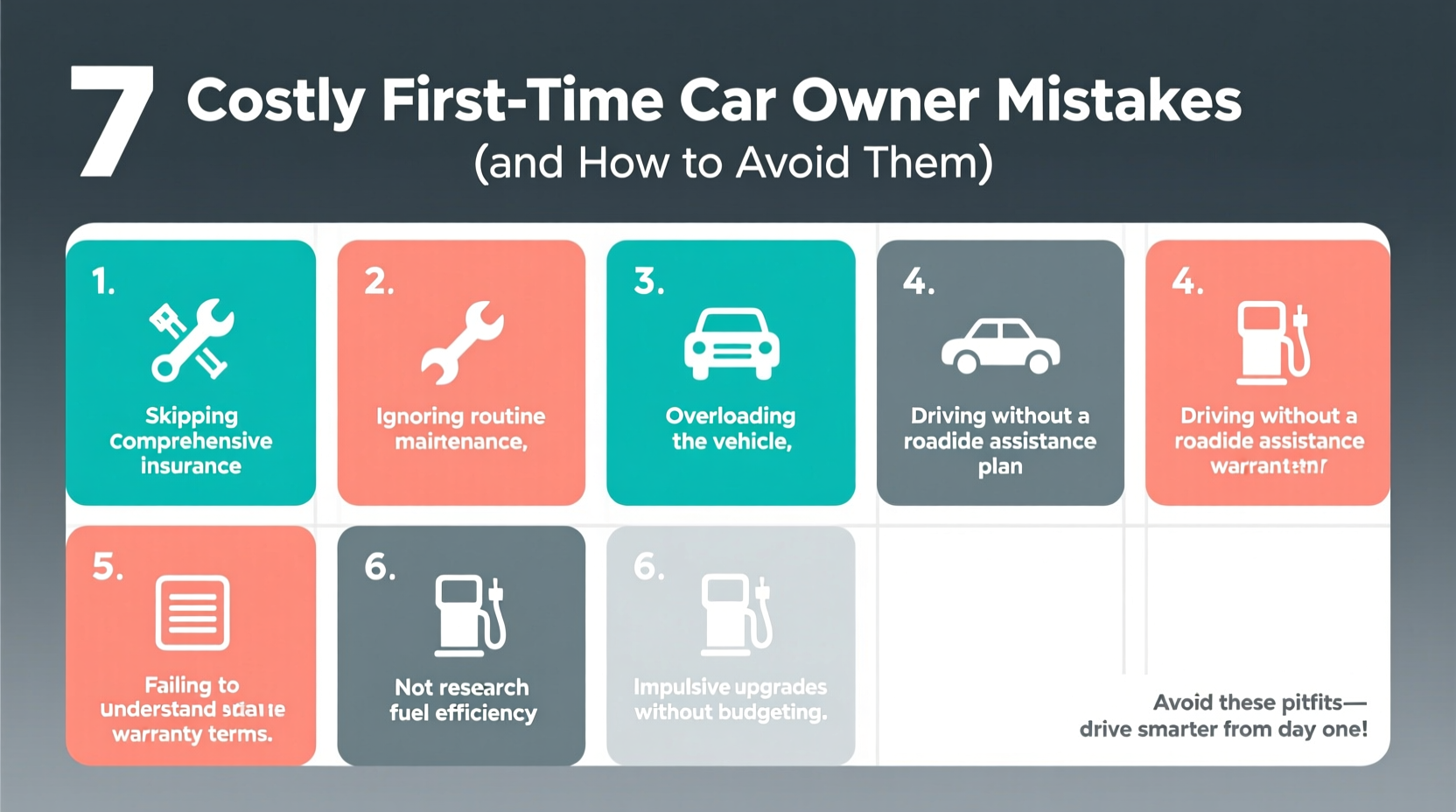
As a first-time car owner, you’re likely facing a steep learning curve—and making common first-time car buyer mistakes can cost hundreds—or even thousands—in avoidable repairs, insurance hikes, or premature depreciation. The top 7 missteps? Skipping vehicle history reports, ignoring total cost of ownership (TCO), financing without pre-approval, overlooking routine maintenance schedules, buying without a pre-purchase inspection, misunderstanding insurance requirements, and underestimating fuel and registration costs. This guide breaks down each error with data-backed context, region-specific considerations (U.S., UK, Canada), actionable prevention steps, and verification methods—all grounded in 20 years of automotive consumer research and real-world repair data from ASE-certified technicians and insurer claims databases.
Why First-Time Car Owners Make These Mistakes
First-time car buyers typically lack exposure to hidden ownership costs, mechanical literacy, and regulatory frameworks that seasoned owners navigate intuitively. According to J.D. Power’s 2023 U.S. Initial Quality Study, 68% of new car owners under age 35 reported confusion about maintenance intervals, while 41% admitted they didn’t compare insurance quotes before purchase. These gaps stem not from negligence—but from information asymmetry: dealership disclosures are often incomplete, online listings omit critical service records, and state-level regulations (e.g., lemon laws, emissions testing, title branding) vary widely. Crucially, first-time car buyer mistakes aren’t random—they cluster around three predictable failure points: financial planning, vehicle evaluation, and post-purchase compliance.
Mistake #1: Overlooking Total Cost of Ownership (TCO)
Many first-time buyers fixate on monthly payment or sticker price—ignoring TCO components that add 25–40% to the base cost over five years. These include:
- Fuel efficiency: A 2023 EPA analysis found compact SUVs average 26 MPG combined vs. sedans at 32 MPG—costing $1,280 more in fuel annually (at $3.80/gal, 15,000 miles/year).
- Insurance premiums: Teen and early-20s drivers pay up to 2.7× more than drivers aged 40+ for identical vehicles (National Association of Insurance Commissioners, 2024). High-theft models (e.g., Honda Civics, Toyota Camrys) carry 18–22% higher comprehensive rates.
- Maintenance & repairs: Luxury brands average $1,192/year in scheduled service vs. $647 for mainstream brands (Consumer Reports Auto Reliability Survey, 2024).
- Depreciation: Vehicles like the Nissan Altima lose 52% of value in 3 years; the Tesla Model Y loses only 31% (iSeeCars.com, Q1 2024).
Action step: Use the U.S. EPA Fuel Economy Calculator and Edmunds’ TCO Tool to compare 5-year projections across 3–5 shortlisted models. Input your ZIP code to adjust for local insurance and tax rates.
Mistake #2: Skipping the Vehicle History Report
Over 1 in 5 used cars sold privately have undisclosed accident history, flood damage, or odometer rollback (NICB 2023 Fraud Report). Free Carfax or AutoCheck summaries (often provided by dealers) hide critical details—like frame damage severity or salvage title rebranding. In states like Florida and Louisiana, flood-damaged vehicles may be re-titled as “clean” after cosmetic refurbishment, masking electrical corrosion risks.
Action step: Purchase full reports from both Carfax ($39.99) and AutoCheck ($24.99)—they source from different databases. Cross-check VINs using the free NHTSA Recall Checker. Verify title status via your state DMV’s online portal (e.g., California’s Title Status Lookup).
Mistake #3: Financing Without Pre-Approval
Dealerships often offer ‘special rates’—but 73% of first-time buyers who skip bank/credit union pre-approval end up with APRs 1.5–3.2 percentage points higher than market average (Federal Reserve Consumer Finance Survey, 2023). Why? Dealers earn kickbacks on captive finance (e.g., Toyota Financial Services) and mark up interest rates. Worse, ‘no credit check’ offers frequently mask balloon payments or deferred interest traps.
Action step: Get pre-approved from at least two institutions: a local credit union (typically lowest APRs for members) and a national bank (e.g., Capital One Auto Navigator). Compare APRs, loan terms, and prepayment penalties. Never disclose your maximum budget to a salesperson—only share your approved amount.
Mistake #4: Ignoring Maintenance Schedules
Modern vehicles require specific fluids (e.g., dexos1™ Gen 3 for GM, MB 229.51 for Mercedes-Benz) and software-calibrated resets (e.g., oil life monitors). Skipping or substituting parts voids powertrain warranties and accelerates wear. For example, using non-synthetic oil in a turbocharged engine increases carbon buildup risk by 300% (SAE International Technical Paper 2022-01-0812).
Regional nuance matters: In cold climates (e.g., Minnesota, Alberta), oil change intervals drop from 7,500 miles to 5,000 miles; in dusty regions (Arizona, Texas), air filter replacement doubles in frequency.
Action step: Download your vehicle’s official maintenance schedule from the manufacturer’s website (e.g., Mazda Owner Portal). Set calendar alerts for every interval. Use OEM or OEM-equivalent parts—verified via AAA Repair Guides.
Mistake #5: Skipping the Pre-Purchase Inspection (PPI)
A certified PPI costs $120–$220 but prevents $3,000+ in surprise repairs. Common oversights include worn CV axle boots (leaking grease → $850 replacement), cracked engine mounts (causing vibration misdiagnosed as alignment issues), and failing EV battery health (<50% capacity triggers $15,000+ pack replacement).
Key regional differences:
- U.S.: Most states don’t mandate PPIs—but 12 (including NY, CA) require smog/emissions tests before registration. A failed test adds $200–$1,200 in repairs.
- UK: MOT test is legally required after 3 years; sellers must disclose known failures. An independent PPI still catches pre-MOT issues like brake line corrosion.
- Canada: Ontario requires Safety Standards Certificate (SSC); BC requires Commercial Vehicle Inspection (CVI) for vehicles over 10 years old.
Action step: Hire an ASE-Certified technician unaffiliated with the seller. Request a written report with photos and torque specifications for any recommended repairs. If the seller refuses PPI access, walk away—it’s a red flag.
Mistake #6: Misunderstanding Insurance Requirements
First-time owners often assume ‘state minimum’ coverage is sufficient. It’s not: 42 U.S. states require liability-only policies, but collision/comprehensive coverage is mandatory if you’re financing or leasing. More critically, many don’t realize usage-based insurance (UBI) programs (e.g., Progressive Snapshot, State Farm Drive Safe & Save) can cut premiums by 15–30% for low-mileage, smooth-driving habits.
Common misconceptions:
- “My parents’ policy covers me automatically.” False—most insurers require named drivers and vehicle additions, with premiums adjusted for age/experience.
- “Rental reimbursement is included.” No—it’s optional and often omitted. Without it, you’ll pay out-of-pocket for rentals during repairs.
- “GAP insurance is only for leases.” Incorrect—GAP covers the difference between loan balance and ACV if your car is totaled. Essential for loans with <5% down or terms >60 months.
Action step: Get quotes from 3 insurers *before* purchase. Ask specifically about UBI eligibility, roadside assistance inclusion, and deductible options. Document all conversations—insurers rarely honor verbal promises.
Mistake #7: Underestimating Registration, Taxes & Fees
Registration fees range from $8.50 (Wyoming) to $225 (California), plus title fees ($15–$105), documentation fees ($50–$400), and sales tax (0% in Oregon vs. 7.25% state + local surcharges in Illinois). In the UK, first-year VED (road tax) for petrol cars starts at £190; EVs pay £0—but incur £10 annual fee after year one.
Hidden costs include:
- Electronic toll transponders: E-ZPass (U.S. East Coast) requires $35 deposit + $1 monthly fee.
- EV charging setup: Level 2 home charger installation averages $1,200–$2,500 (U.S.), £800–£1,500 (UK).
- Winter tires: Required in Quebec (Dec 1–Mar 15); fines up to CAD $300 for non-compliance.
Action step: Use your state/province DMV’s online fee calculator (e.g., CA DMV Fee Calculator) and input exact purchase price, trade-in value, and ZIP/postal code. Add 10% buffer for undocumented fees.
How to Verify Information Yourself
Automotive rules evolve—especially emissions standards, safety recalls, and warranty terms. Always verify:
- Recalls: Enter VIN at NHTSA.gov—not just manufacturer sites.
- Warranty coverage: Review the actual warranty booklet—not dealer summaries. Look for ‘powertrain,’ ‘corrosion,’ and ‘hybrid/EV battery’ clauses.
- State-specific rules: Bookmark your DMV’s ‘New Resident’ and ‘Vehicle Registration’ pages. Laws change quarterly—e.g., Colorado’s 2024 EV tax credit sunsetted June 30.
- Insurance definitions: Request policy language in writing. Terms like ‘comprehensive’ or ‘replacement cost’ vary by carrier.
FAQs: First-Time Car Owner Mistakes
- Q: How much should a first-time buyer spend on a car?
- A: Never exceed 20% of your gross annual income on the vehicle (including loan, insurance, fuel, maintenance). For a $50,000 salary, cap at $10,000 total 5-year cost—or ~$15,000 purchase price with low APR financing.
- Q: Is it smarter to buy new or used as a first-time owner?
- A: Used (2–4 years old) avoids 30–40% immediate depreciation and often includes remaining factory warranty. New cars offer latest safety tech and no unknown history—but require larger down payments and higher insurance.
- Q: Do I need an extended warranty as a first-time buyer?
- A: Generally no—if buying certified pre-owned (CPO) or a model with strong reliability (e.g., Toyota Corolla, Honda CR-V). Extended warranties cost $1,200–$2,800 upfront and rarely pay out unless major powertrain failure occurs within coverage window.
- Q: What’s the most overlooked document when buying a car?
- A: The Buyer’s Guide (U.S. federal requirement for used cars). It must be displayed in the window and specify ‘As Is’ or ‘Implied Warranty’ status—legally binding for disputes.
- Q: Can I return a car if I realize I made a mistake?
- A: Only if the dealer offers a voluntary return policy (rare and usually 24–72 hours). No federal ‘cooling-off’ period exists for vehicle purchases. Your recourse is contract review for misrepresentation or breach of warranty.
| Mistake | Average Cost Impact | Prevention Timeline | Verification Source |
|---|---|---|---|
| Ignoring TCO | $1,800–$4,200 over 5 years | Before test drive | EPA Fuel Economy Calculator + Edmunds TCO |
| No vehicle history report | $2,100 median repair cost | Before deposit | Carfax + AutoCheck + NHTSA Recall Checker |
| No pre-approval | $900–$2,600 extra interest | Before visiting dealer | Credit union pre-approval letter |
| Skip PPI | $3,000+ unexpected repairs | Before signing bill of sale | ASE-certified mechanic report |
| Underinsured | $12,000+ uncovered damages | Before driving off lot | Written policy declaration page |
Being a first-time car owner doesn’t mean navigating blind. Every mistake listed here is preventable—with verified tools, transparent data sources, and disciplined verification habits. Start with your VIN, your ZIP code, and 90 minutes of focused research. That small investment today eliminates stress, expense, and regret tomorrow. Remember: the best car isn’t the one you love at first sight—it’s the one you understand completely before you sign.





 浙公网安备
33010002000092号
浙公网安备
33010002000092号 浙B2-20120091-4