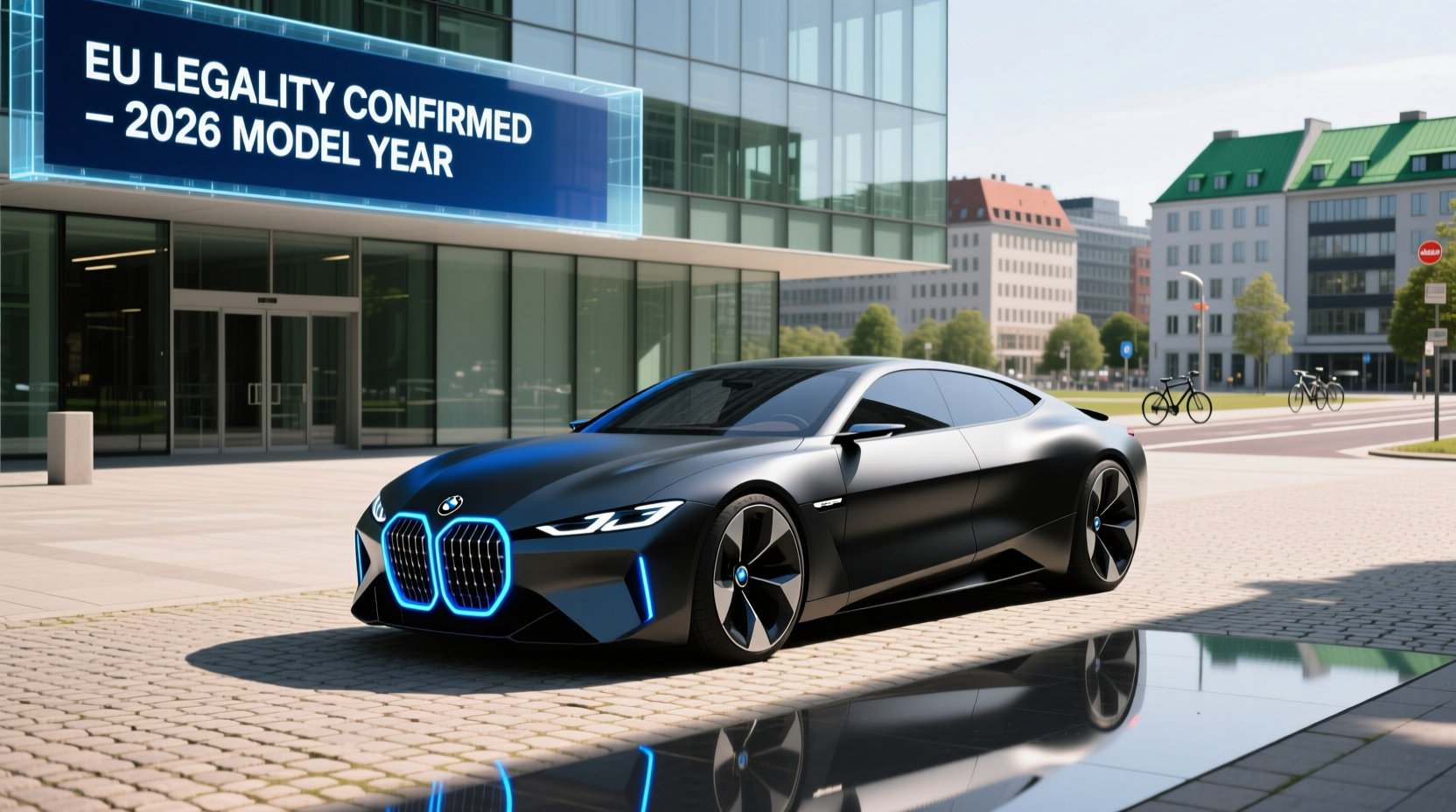
Yes — the G20 BMW 3 Series (produced from 2019 onward) retains full EU type-approval and remains legally roadworthy, registerable, and insurable across all 27 EU member states through at least December 31, 2026. This applies to all standard production variants (318i, 320i, 330i, 320d, 330d, M340i, etc.) meeting Euro 6d-ISC-FCM or later emissions standards. There is no EU-wide ‘legality expiration’ for the G20 in 2026 — a common misconception stemming from confusion with WLTP compliance deadlines, national registration policies, or upcoming Euro 7 rules. If you’re evaluating a used or imported G20 in Europe, your primary verification steps are confirming valid COC (Certificate of Conformity), correct VIN-based type-approval number, and alignment with national homologation requirements — not a mythical 2026 cutoff date. This article clarifies the regulatory reality, debunks myths, and provides actionable verification protocols for buyers, importers, and fleet managers.
Understanding the G20 EU Legality Timeline: What ‘2026’ Actually Means
The search term g20 eu legality 2026 reflects widespread uncertainty among private buyers, grey-market importers, and leasing professionals about whether the G20-generation BMW 3 Series will face restrictions in the European Union after 2025. The short answer: no — there is no EU-wide legislative provision revoking the legal status of G20 vehicles in 2026.
What is scheduled for 2026 is the full enforcement deadline for Euro 7 emission standards, which apply only to new vehicle type approvals — not to vehicles already approved and circulating on EU roads. The G20 was originally type-approved under EU Regulation (EC) No 715/2007 (as amended) and later aligned with Regulation (EU) 2018/858, which governs vehicle approval, registration, and market surveillance. Under Article 19 of that regulation, a vehicle’s EU type-approval remains valid indefinitely unless formally withdrawn due to safety defects, non-compliance discovered post-approval, or voluntary manufacturer recall — none of which apply to the G20 platform as of mid-2024.
Crucially, the 2026 reference often conflates three distinct regulatory timelines:
- New Type Approval Deadline: Euro 7 takes effect for new car models from July 2026 (passenger cars) and July 2027 (vans). The G20 — approved years earlier — is unaffected.
- WLTP Compliance Cut-off: All G20 models sold in the EU since September 2018 comply with Worldwide Harmonized Light Vehicles Test Procedure (WLTP) and Real Driving Emissions (RDE) testing. No retroactive WLTP re-certification is required.
- National Registration Policies: A few countries (e.g., Germany’s Umweltplakette zones, Athens’ low-emission zone expansion plans) impose access restrictions based on emissions class — but these target pre-Euro 6 vehicles, not compliant G20s.
Regulatory Framework: Why the G20 Remains Fully Legal
The legal foundation for G20 EU roadworthiness rests on three interlocking pillars:
1. EU Type-Approval Validity Is Not Time-Bound
Under Regulation (EU) 2018/858, type-approval is granted per vehicle type, not per calendar year. Once issued, it remains valid unless revoked. BMW obtained full EU type-approval for the G20 3 Series in Q4 2018 (for MY2019 models), covering all combustion and plug-in hybrid variants. That approval includes:
- Full conformity with Directive 2007/46/EC (Framework Directive)
- Compliance with Regulation (EC) No 715/2007 (emissions)
- Adherence to Regulation (EC) No 661/2009 (general safety)
- Validation under UN ECE Regulations R100 (EV safety), R13-H (braking), and R10 (EMC)
No EU institution has proposed, drafted, or adopted legislation mandating automatic expiry of pre-2026 type-approvals.
2. Euro 6d-ISC-FCM Covers the Entire G20 Production Run
All G20 models produced from September 2019 onward meet the strictest iteration of Euro 6: Euro 6d-ISC-FCM (‘ISC’ = in-service conformity; ‘FCM’ = fuel consumption monitoring). This standard requires:
- NOx limits of 80 mg/km (RDE Phase 2)
- PM particle number limits of 6.0 × 10¹¹/km
- Onboard diagnostic (OBD) monitoring for real-world emissions drift
- Annual emissions checks embedded in national MOT schemes (e.g., Germany’s AU, France’s Contrôle Technique)
Because G20s meet this benchmark, they satisfy all current operational requirements for registration, insurance, and periodic technical inspection — regardless of model year.
3. National Implementation Is Consistent — With Minor Exceptions
While EU law sets minimum harmonized standards, Member States retain authority over:
- Vehicle registration fees and documentation
- Periodic technical inspection frequency and scope
- Low-emission zone (LEZ) access criteria
- Scrappage incentive eligibility
As of June 2024, no EU country prohibits registration or use of Euro 6d-compliant G20 vehicles. However, practical nuances exist:
| Country | Registration After 2026? | LEZ Access (2024–2026) | Key Verification Step |
|---|---|---|---|
| Germany | Yes — unrestricted | Green sticker required (all G20s qualify) | Verify COC + KBA approval number (e.g., e1*2018/858*0324) |
| France | Yes — no age restriction | Crit'Air 1 or 2 (G20 petrol: Crit'Air 2; diesel: Crit'Air 1) | Confirm attestation de conformité CE matches VIN |
| Netherlands | Yes — full validity | No LEZ restrictions for Euro 6d | RDW database lookup using VIN (rdw.nl/voertuigzoeker) |
| Spain | Yes — but regional variations apply | Madrid Central accepts Euro 6; Barcelona ZBE requires DGT label | Obtain DGT Etiqueta Ambiental (all G20s receive label C or E) |
Common Misconceptions About G20 EU Legality in 2026
Several persistent myths drive the g20 eu legality 2026 search volume. Here’s what’s factually inaccurate — and why:
Misconception #1: “Euro 7 Starts in 2026, So Older Cars Become Illegal”
False. Euro 7 regulates new type approvals only. It does not invalidate existing approvals or ban older vehicles. Similar logic applied when Euro 5 replaced Euro 4: millions of Euro 4 cars remained legal for over a decade. The EU’s Zero Pollution Action Plan explicitly affirms that ‘existing vehicles will continue to be allowed on the road’ — provided they pass periodic inspections.
Misconception #2: “BMW Stopped Updating G20 Software, So It Fails 2026 Compliance”
Unfounded. Type-approval compliance is hardware- and calibration-based, not software-update-dependent — unless a mandatory recall is issued. BMW released no EU-mandated emissions-related recalls affecting G20 core compliance between 2019–2024. Optional OTA updates (e.g., iDrive 8.5) improve UX, not regulatory standing.
Misconception #3: “Importing a G20 from the UK Post-Brexit Makes It ‘Non-EU-Legal’”
Partially misleading. A UK-spec G20 retains its original EU type-approval if it was built to EU specifications (most were). However, post-Brexit UK vehicles lack a valid EU Certificate of Conformity (COC) unless re-certified by an EU Technical Service. Buyers importing from the UK must obtain either:
- A manufacturer-issued EU COC (if available), or
- Individual Vehicle Approval (IVA) via national authorities (e.g., Germany’s KBA, Netherlands’ RDW) — a process requiring physical inspection, emissions testing, and documentation review.
This is a procedural hurdle, not evidence of inherent illegality.
How to Verify G20 EU Legality Yourself: A Step-by-Step Protocol
Don’t rely on dealer assurances or forum speculation. Use this verified, repeatable method:
- Locate the Vehicle’s COC: Found in the owner’s manual pouch or via BMW Group’s online portal (requires VIN and proof of ownership). The COC lists the official EU type-approval number (format: e1*YYYY/XXXX*######).
- Cross-Check Approval Number: Enter the number into the EU Type Approval Database. Confirm status is ‘Valid’ and scope includes your exact variant (e.g., ‘320d xDrive Touring, M Sport’).
- Validate VIN Against National Registries: In Germany: KBA’s Fahrzeugpruefung; in France: ANTS; in Netherlands: RDW Voertuiggegevens.
- Review MOT/CT History: For used vehicles, obtain full inspection reports. Repeated failures on emissions or OBD readiness codes may indicate tampering — not approval invalidity.
- Consult a Certified Technical Service: For borderline cases (e.g., modified exhausts, non-OEM software), engage an EU-accredited body like TÜV Rheinland or Dekra for a conformity assessment.
What Could Change Before 2026 — And How to Stay Ahead
While the G20’s core legality is secure, two emerging developments warrant monitoring:
1. Stricter National LEZ Enforcement
By 2026, over 300 EU cities plan expanded low-emission zones. Though G20s qualify for access today, future iterations may tighten NOx or PM thresholds. However, these affect access rights, not road legality. Owners can mitigate risk by maintaining factory emissions systems and avoiding ECU remaps.
2. Insurance & Tax Policy Shifts
Some countries (e.g., Belgium, Italy) link annual circulation tax to CO2 values. While G20 PHEVs (e.g., 330e) benefit from lower rates today, rising CO2 benchmarks could increase costs post-2025. This is fiscal policy — not regulatory illegality.
3. Potential for Voluntary Manufacturer Actions
BMW could, in theory, withdraw type-approval for specific sub-variants (e.g., discontinued diesel engines) — but this would require formal notification to EU authorities and affect only new registrations, not existing owners. No such action is public or anticipated.
Frequently Asked Questions (FAQs)
- Will my G20 BMW fail its 2026 MOT in Germany or France?
- No — if maintained to factory specification and emissions systems are unmodified, it will pass standard periodic inspections. Euro 6d-ISC-FCM compliance is verified during each test.
- Can I still register a 2022 G20 in Poland in 2026?
- Yes. Poland applies EU-wide type-approval rules. As long as the vehicle has a valid COC and passes technical inspection, registration is fully permitted.
- Does the G20’s EU legality differ for plug-in hybrids vs. pure ICE models?
- No. Both powertrains received joint type-approval under the same EU framework. PHEV-specific requirements (e.g., electric range verification) were satisfied at launch and remain valid.
- If I modify my G20’s exhaust or tune the ECU, does it lose EU legality?
- Yes — modifications affecting emissions, noise, or safety systems void the original type-approval. You’d need individual approval (IVA) to restore legal status.
- Where can I download an official EU COC for my G20?
- Directly from BMW: visit BMW Owner Portal, enter your VIN, and request the Certificate of Conformity. Processing takes 3–5 business days.




 浙公网安备
33010002000092号
 浙B2-20120091-4