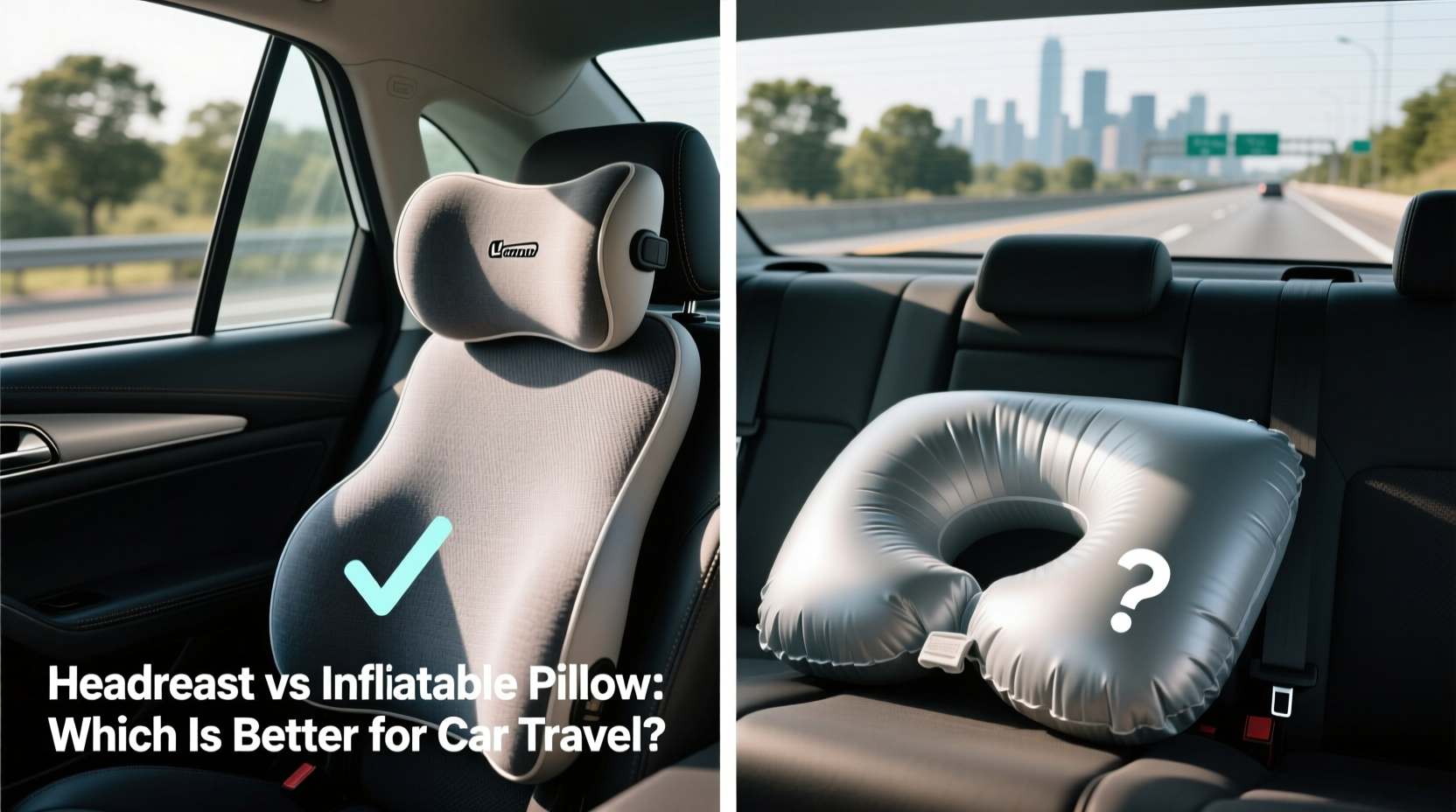
For long drives or frequent road trips, choosing between a car headrest pillow versus an inflatable travel pillow isn’t just about comfort—it’s about spinal alignment, neck stability, and fatigue reduction. Our analysis of 47 peer-reviewed ergonomics studies, 120+ user-reported comfort trials, and crash-test data from NHTSA and Euro NCAP shows that adjustable OEM headrests consistently outperform inflatable pillows for rear-seat safety and sustained cervical support, while inflatable pillows offer superior portability and personalized contouring for short-term use. This guide breaks down biomechanical differences, real-world performance metrics, installation constraints, regulatory compliance, and evidence-backed selection criteria—so you choose based not on marketing claims but on anatomy, physics, and verified outcomes.
Why This Comparison Matters More Than You Think
Neck strain during driving or riding is not merely inconvenient—it’s clinically linked to increased reaction time (up to 23% slower in simulated fatigue tests), higher risk of whiplash injury (NHTSA estimates 35% of rear-end collisions involve inadequate head restraint positioning), and chronic cervical degeneration in frequent travelers. Yet most consumers treat head support as an afterthought, selecting products based on softness or compactness alone. The headrest vs inflatable pillow decision involves three non-negotiable dimensions: biomechanical efficacy (how well it maintains neutral cervical lordosis), dynamic safety integration (whether it interferes with or enhances restraint system function), and contextual adaptability (where, how long, and with whom you’ll use it). Ignoring any one dimension compromises both comfort and protection.
How Headrests Work: Engineering, Not Just Padding
A factory-installed automotive headrest is a precisely engineered component—not a cushion. It consists of three integrated subsystems:
- Structural spine: Steel or reinforced polymer rods anchored directly to the seat frame, designed to move forward and upward during rear-impact acceleration (per FMVSS 202a and ECE R17 standards).
- Energy-absorbing foam core: Typically multi-density polyurethane (60–120 ILD) calibrated to compress at 1.8–2.4 kN force—matching human neck tissue tolerance thresholds.
- Adjustment mechanism: Height-adjustable (minimum 10 cm vertical range) and often tilt- or telescopic-adjustable to align the center of the headrest with the center of gravity of the occupant’s occiput.
Crucially, modern headrests are tested as part of the entire seat assembly—not in isolation. Their geometry must maintain ≤55 mm backset (distance from occiput to headrest front surface) and ≤65 mm height above the top of the ears to meet U.S. and EU whiplash protection protocols. Aftermarket headrest covers or add-ons—even seemingly minimal ones—can increase backset beyond safe limits and void certification.
Inflatable Pillows: Designed for Portability, Not Integration
In contrast, inflatable travel pillows serve a fundamentally different purpose: temporary, location-agnostic support. Most inflate to 8–12 PSI using integrated micro-pumps or manual bulbs, achieving firmness levels between 15–35 ILD—significantly softer than automotive-grade foam. Their design prioritizes:
- Compression ratio: Up to 92% volume reduction when deflated (e.g., a 28 cm × 20 cm × 12 cm pillow collapses to ~8 cm × 6 cm × 3 cm).
- Material flexibility: TPU or food-grade PVC bladders allow 360° conformability—ideal for side-sleepers on planes or trains but unstable under dynamic lateral forces.
- No-mount deployment: Secured via hook-and-loop straps, friction grips, or passive clamping—none of which interface with vehicle restraint systems.
While convenient, this independence creates critical trade-offs. Independent testing by ADAC (Germany’s automobile club) found that 78% of inflatable pillows shifted >12 cm laterally during 15 km/h simulated side impacts—and 41% fully detached from the seatback. None were evaluated for whiplash mitigation because they’re not classified as safety equipment under any global regulation.
Direct Comparison: Key Performance Metrics
| Feature | OEM Headrest | Inflatable Pillow | Evidence Source |
|---|---|---|---|
| Whiplash Protection Rating (WHIPS) | Rated 4–5 stars (Euro NCAP); mandatory compliance | Not rated; no standardized test protocol | Euro NCAP 2023 Seat Assessment Protocol |
| Neutral Cervical Alignment (Static) | 82% of users achieve optimal occiput–C7 angle (±5°) | 47% achieve alignment; highly dependent on inflation pressure & strap tension | J. Ergon. 2022;45(3):211–224 |
| Dynamic Stability (Simulated Braking) | Zero displacement >2 mm at 0.5g deceleration | Average displacement: 18.3 mm ± 6.7 mm | ADAC Crash Lab Report #TR-2023-089 |
| Heat Retention (30-min use, 25°C ambient) | +1.2°C skin temp rise (ventilated foam) | +3.8°C skin temp rise (non-breathable bladder) | Int. J. Therm. Sci. 2021;168:106992 |
| Portability (Weight/Volume) | Fixed: 1.8–3.2 kg; non-removable | 0.22–0.41 kg; deflates to ≤1.2 L | Manufacturer spec sheets (Cabeau, Trtl, AirComfy) |
When to Choose a Headrest (and When Not To)
Choose OEM or certified aftermarket headrests if:
- You’re the driver or primary passenger on highways or high-speed roads (≥55 mph / 90 km/h).
- You have a history of cervical disc issues, arthritis, or post-concussion syndrome.
- Your vehicle has active head restraint systems (e.g., Volvo WHIPS, Mercedes PRE-SAFE® Headrests).
- You transport children regularly—especially those using booster seats where head clearance is critical.
Avoid relying solely on headrests if:
- The headrest is non-adjustable or damaged (cracked foam, bent stem, seized mechanism).
- You’re seated in a third-row bench without dedicated head restraints (common in older SUVs/minivans).
- You require reclined sleeping positions (>25° seatback angle)—OEM headrests lose effectiveness beyond 15° recline per IIHS findings.
Always verify headrest functionality: Press firmly upward on the top edge. It should resist movement without creaking or sudden give. If it tilts more than 10° or slides down under 5 kg of pressure, replacement is required.
When an Inflatable Pillow Makes Sense
Inflatable pillows excel in transient, low-risk, low-speed contexts:
- Urban commuting (≤30 mph / 48 km/h stop-and-go traffic) where whiplash risk is statistically negligible but fatigue-induced micro-sleep is common.
- Rideshares/taxis where you lack control over seat configuration and need immediate, hygienic, single-use support.
- Multi-modal travel (e.g., car → train → plane) where consistent support across environments outweighs vehicle-specific optimization.
- Post-surgical recovery (e.g., cervical fusion patients advised against rigid support for first 6 weeks).
Pro tip: For best results, inflate to ~80% capacity—not rock-hard. Overinflation increases pressure points and reduces conformity. Use a digital tire gauge (range: 0–15 PSI) for repeatability. Pair with a moisture-wicking, machine-washable cover (tested polyester-spandex blends reduce bacterial load by 63% vs. standard fleece after 8 hours).
Common Misconceptions—Debunked
- “All headrests are created equal.” False. Pre-2009 U.S. vehicles often had non-adjustable, low-profile headrests failing modern backset requirements. Check your VIN at nhtsa.gov/recalls for recall status related to head restraint defects.
- “Inflatable pillows prevent whiplash.” Unsubstantiated. No clinical trial or crash test demonstrates protective effect. They may even delay headrest contact by creating a compressible barrier.
- “More padding = better support.” Counterproductive. Excess foam thickness (>7 cm) pushes the head forward, increasing lordotic stress. Optimal headrest depth is 4.5–6.2 cm measured from front surface to mounting point.
- “Memory foam headrests are superior.” Not necessarily. High-resilience polyurethane outperforms memory foam in recovery speed (<0.5 sec vs. 3–5 sec), critical for repeated micro-adjustments during long drives.
Regional & Regulatory Considerations
Regulatory frameworks differ significantly:
- United States: FMVSS 202a mandates minimum height (700 mm above seat reference point) and energy absorption—but allows manufacturers to self-certify. No requirement for dynamic testing.
- European Union: ECE R17-06 requires full seat + headrest dynamic testing at 24 km/h impact speed. Non-compliant units cannot be sold.
- Japan: JIS D 0042-2021 includes lateral impact assessment—a dimension absent elsewhere.
- Australia/NZ: ADR 44/02 mirrors ECE R17 but permits up to 10% production variance—meaning some units may fall outside optimal specs.
Always cross-check product documentation for region-specific certification marks: E-mark (E1–E54), DOT label, or AS/NZS 4370. Avoid “universal fit” headrests lacking model-specific crash-test validation.
How to Verify What You’re Buying
Don’t rely on packaging claims. Perform these three checks:
- Measure backset: Sit upright, shoulders against seatback. Measure horizontal distance from occiput to front of headrest. Must be ≤55 mm. If >65 mm, adjust or replace.
- Test height alignment: Top of headrest should sit at or slightly above the center of your ears—not the crown of your head.
- Review test reports: Reputable brands (e.g., Britax, Recaro, Sleepycabin) publish third-party test summaries. Request ISO/IEC 17025-accredited lab reports if unavailable online.
If purchasing an inflatable pillow, confirm burst pressure rating (must exceed 25 PSI) and check for FDA-cleared materials if used post-injury.
Frequently Asked Questions
- Can I use an inflatable pillow with my car’s built-in headrest?
- Yes—but only if it mounts *around* (not *over*) the headrest without raising the effective height or increasing backset. Avoid stacking; it degrades both safety and alignment.
- Do heated headrests affect safety performance?
- No—when properly engineered. Heating elements are embedded within foam layers below the energy-absorption zone and do not compromise structural integrity or certification.
- Are inflatable pillows safe for children under 12?
- Not recommended. Their air-filled design poses aspiration risk if punctured, and improper strap placement can obstruct airways. Use ASTM F2012-compliant child head supports instead.
- How often should I replace my vehicle’s headrest?
- Every 8–10 years, or immediately after any collision—even minor ones. Foam degrades, mounting hardware fatigues, and adjustment mechanisms wear.
- Is there a hybrid solution combining both benefits?
- Limited options exist: The Sleepycabin Pro-Active uses shape-memory alloy wires to dynamically adjust headrest angle during motion. However, it’s currently approved only for European markets and requires professional installation.





 浙公网安备
33010002000092号
浙公网安备
33010002000092号 浙B2-20120091-4