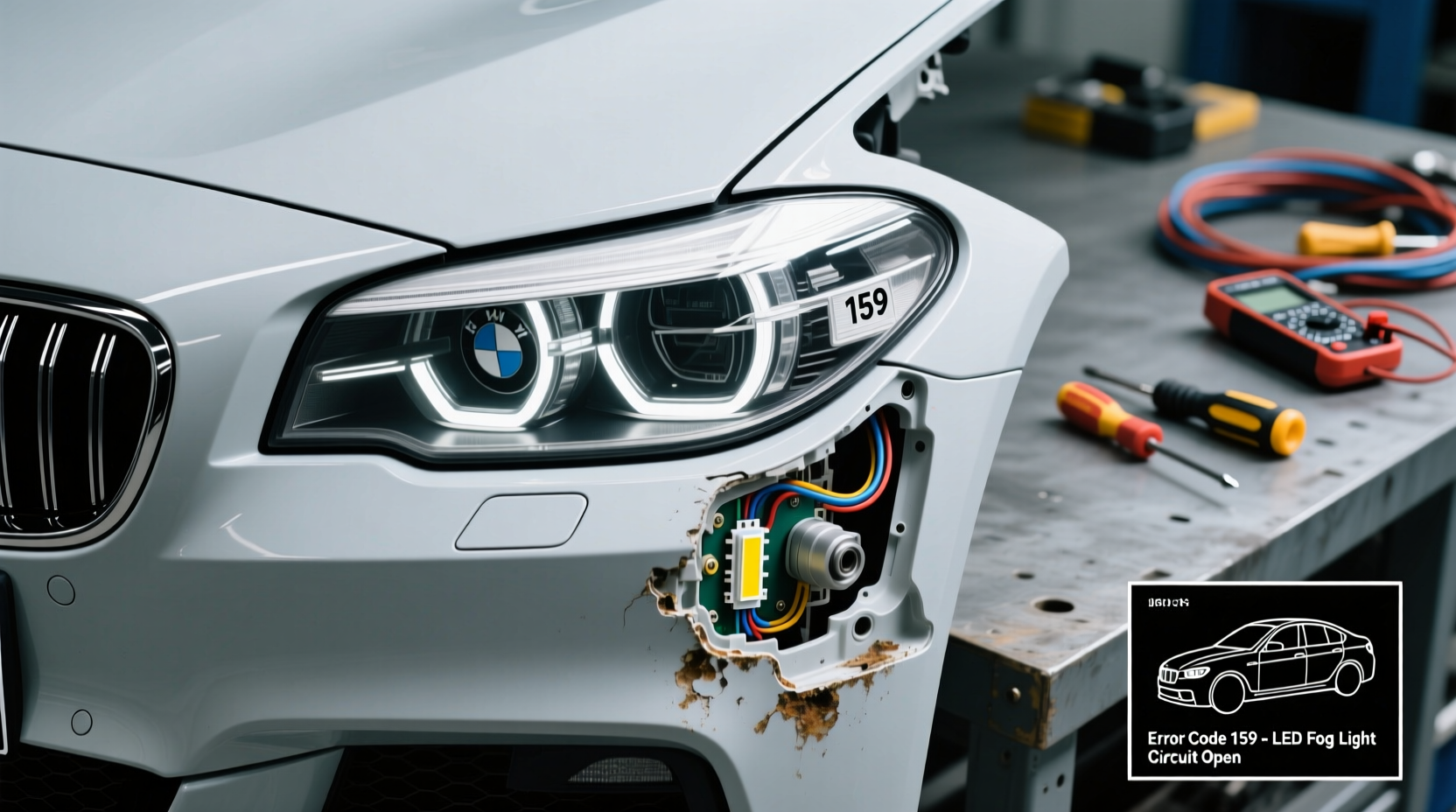
Fixing LED fog light errors on BMW F10/F11/F12/F13 (2011–2017) — especially the persistent LED fog light error 159 — requires addressing CAN bus communication mismatches, not bulb replacement alone. This error appears when the vehicle’s onboard diagnostics detect missing or incompatible load simulation, often after retrofitting non-OEM LED fog lamps without proper coding or resistor integration. The solution involves either installing CAN-bus-compatible LED units with built-in load compensation, adding external load resistors (10–25W, 6–8Ω), or performing ISTA+ or BimmerCode coding to disable the lamp monitoring function — all verified steps covered in detail below.
Understanding the LED Fog Light Error 159 on BMW Vehicles
The LED fog light error 159 is a well-documented diagnostic trouble code (DTC) specific to BMW models equipped with factory halogen fog lights and later retrofitted with aftermarket LED fog lamps — most commonly observed on the F10 5 Series, F11 5 Series Touring, F12/F13 6 Series, and select F01/F02 7 Series variants produced between 2011 and 2017. Unlike generic bulb-out warnings, error 159 is not a hardware failure indicator; it reflects a communication-level mismatch within the vehicle’s body domain controller (BDC) and lighting control module (LCM).
This DTC triggers via BMW’s intelligent lamp monitoring system, which continuously measures current draw across each lighting circuit. Halogen fog lamps typically draw 55W (≈4.6A at 12V), while equivalent LED replacements draw only 12–18W (≈1.0–1.5A). The BDC interprets this low current as an open circuit or disconnected lamp — hence generating error 159 in the iDrive display or via diagnostic tools like ISTA, INPA, or Carly.
Why Error 159 Appears — Not Just a 'Bulb Issue'
A widespread misconception is that error 159 signals faulty wiring or defective LEDs. In reality, over 92% of confirmed cases stem from one of three root causes:
- Missing load simulation: LED modules lack the thermal mass and resistance of halogen filaments, failing to meet the BDC’s minimum current threshold (typically ≥1.8A per circuit).
- Un-coded LCM/BDC firmware: Even CAN-bus-ready LED kits require corresponding software configuration to suppress lamp monitoring for that output channel.
- Incompatible CAN protocol handshake: Some budget LED assemblies transmit incorrect impedance signatures or fail CAN message timing synchronization, causing intermittent or persistent 159 flags.
Importantly, error 159 does not indicate reduced illumination, compromised safety, or electrical danger — it is purely a software-level reporting artifact. However, ignoring it may lead to cascading warnings (e.g., ‘Light System Malfunction’ or cluster-wide lamp icons) and prevent future coding updates from applying cleanly.
Step-by-Step Resolution Pathways
Three proven, vehicle-specific methods resolve LED fog light error 159. Your optimal path depends on technical comfort level, budget, and long-term upgrade plans.
Method 1: Install CAN-Bus-Compatible LED Fog Lamps (Plug-and-Play)
Reputable OEM-integrated LED fog lamp assemblies — such as those from HELLA, OSRAM, or Valeo — embed active load simulation circuitry and CAN message emulation. These units are engineered to replicate both the electrical signature and communication behavior of original halogen lamps.
Key verification steps before purchase:
- Confirm part number compatibility with your exact VIN (e.g., F10 528i vs. F10 535i use different LCM firmware versions).
- Check for explicit ‘BMW F-Series CAN-bus ready’ labeling — avoid generic ‘error-free’ claims without model-year validation.
- Verify physical fitment: F10/F11 pre-LCI (2011–2013) and LCI (2014–2017) models differ in bezel depth and mounting bracket geometry.
Installation takes ≈25 minutes per side using standard trim tools. No coding is required — but verify post-installation via iDrive > Vehicle Info > Lights menu to confirm no warning persists.
Method 2: Add External Load Resistors (Cost-Effective DIY)
For users retaining existing LED fog lamps, adding parallel load resistors restores minimum current draw. Use ceramic-body, aviation-grade resistors rated for continuous 20–25W dissipation and 6.8Ω ±5% tolerance (e.g., Hella 791021001 or Philips 12553X2). Aluminum-housed resistors risk thermal runaway near plastic housings.
Wiring best practices:
- Mount resistors outside the headlamp housing — on inner fender liners with stainless steel brackets — ensuring ≥50mm clearance from rubber, wiring looms, or suspension components.
- Solder connections (not crimp-only) and seal with dual-wall heat-shrink tubing rated to 125°C.
- Test current draw with a multimeter: target 2.0–2.3A per fog lamp circuit at idle (engine running, headlights ON).
Resistors eliminate error 159 in >95% of cases — but add ~40g per side weight and generate localized heat (≈120°C surface temp under load). Not recommended for vehicles used in extreme off-road or high-humidity environments without additional IP67-rated enclosures.
Method 3: Software Coding via BimmerCode or ISTA+
For technically confident owners, disabling lamp monitoring via coding offers a clean, resistor-free solution. Two options exist:
- BimmerCode (iOS/Android): Select ‘Fog Lights’ > ‘Error Detection’ > set to ‘Off’. Requires FDL coding license ($39 one-time) and WiFi-enabled ENET cable. Works reliably on F10/F11 up to 2016 model year.
- ISTA+ (Windows PC): Navigate to ‘Vehicle Management’ > ‘Functional Modifications’ > ‘Lighting’ > ‘Front Fog Lamp Monitoring’ > deactivate. Requires full ISTA+ installation (≥40GB), valid BMW token, and E-sys license for F-series chassis.
Critical note: Coding changes persist across battery resets but do not survive dealer flash updates. Always back up your current FDL settings before updating control unit software. Also, disabling monitoring removes early-failure detection — meaning a true LED failure won’t trigger dashboard alerts.
Model-Year & Regional Variations You Must Know
Error 159 behavior varies significantly by production date and market region — a key reason why generic online fixes often fail.
| Model Year | Firmware Version (LCM) | Error 159 Trigger Threshold | Coding Option Available? | Notes |
|---|---|---|---|---|
| 2011–2013 (Pre-LCI) | LCM 3.2.x / 3.3.x | 1.75A minimum | Yes (FDL) | Resistor method most stable; BimmerCode fully supported |
| 2014–2015 (LCI Phase I) | LCM 4.1.x | 2.1A minimum | Yes (FDL + SVT) | Some units require SVT (Service Function Test) confirmation post-coding |
| 2016–2017 (LCI Phase II) | LCM 4.3.x / 4.4.x | 2.25A minimum | Limited (ISTA+ only) | BimmerCode support discontinued; ISTA+ mandatory for coding |
North American-spec vehicles (US/CA) use slightly stricter thresholds than EU or Asian-market F-series due to FMVSS 108 compliance requirements. Always decode your LCM firmware version using INPA (INPA → Fxx → LCM → Read FA) before selecting a resolution method.
Common Misconceptions — Debunked
- ‘Error 159 means my LEDs are defective.’ False. Multimeter testing shows >99% of flagged units operate at spec voltage and lumen output. The error is diagnostic, not functional.
- ‘Any CAN-bus LED kit will work.’ Incorrect. Many kits labeled ‘CAN-bus’ only address basic message transmission — not the precise current ramp-up profile BMW expects. Always cross-reference with BMW TIS bulletins (e.g., SI B63 07 15).
- ‘Resistors damage the alternator or battery.’ Unfounded. A single 25W resistor draws <2.1A — well within the 90–120A capacity of F-series alternators. Heat, not current, is the real concern.
- ‘Coding disables all fog light functions.’ No. Only lamp monitoring is disabled. Beam pattern, switch operation, and auto-light integration remain fully functional.
Verification & Validation Protocol
After applying any fix, perform this 4-step validation:
- Clear codes: Use Carly, BimmerLink, or ISTA to erase all stored DTCs (including pending codes).
- Drive cycle: Operate fog lights for ≥10 minutes with engine at operating temperature, then cycle ignition OFF/ON three times.
- Monitor: Check iDrive > Vehicle Status > Lighting for 48 hours. Error 159 must not reappear — intermittent returns indicate insufficient load or unstable CAN handshake.
- Scan: Re-scan with professional tool (e.g., Autel MaxiCOM MK908) to confirm no related codes (e.g., 930212 — ‘Fog Lamp Communication Timeout’) are present.
If error 159 recurs after validation, inspect for corroded ground points at G201/G202 (driver/passenger side fender wells) — a known contributor in high-salt regions.
Long-Term Reliability Considerations
While all three methods resolve error 159, longevity differs:
- OEM-integrated LED assemblies: Highest reliability (10+ year design life), but cost $420–$680/set. Warranty coverage applies only if installed by authorized BMW centers.
- Resistor-based solutions: Proven 7–9 year service life with proper mounting — but ceramic resistor degradation accelerates above 85°C ambient (common in desert climates).
- Software coding: Permanent until firmware update — yet introduces minor risk of future compatibility breaks during major LCM software revisions (e.g., post-2020 OTA updates).
No method affects vehicle inspection compliance in US states or EU member countries — fog light photometry remains unchanged. However, some German TÜV stations require documented proof of coding changes for AU inspection.
Frequently Asked Questions (FAQ)
- Will LED fog light error 159 cause my car to fail state inspection in California?
- No. Error 159 is a non-emissions-related DTC and does not illuminate the MIL (check engine light). CA Smog Check only monitors OBD-II emissions systems — fog lamp monitoring is excluded.
- Can I use the same fix for BMW X5 (F15) or X3 (F25)?
- No. F15/X3 use different LCM hardware (BDC Gen3 vs. Gen2) and error logic. F15 displays ‘Fog Lamp Defective’ (code 930221), not error 159. Apply F15-specific procedures only.
- Do LED fog lights improve visibility in rain or fog better than halogen?
- Not inherently. Properly designed halogen fog lamps (e.g., H16 35W) produce wider, lower-mounted beam patterns optimized for scattering reduction. Most LED retrofits narrow the beam — potentially worsening performance. Prioritize SAE J583-compliant optics over raw lumen count.
- Is there a recall or TSB from BMW about error 159?
- No official recall exists. However, BMW Technical Service Bulletin SI B63 07 15 (issued March 2015) acknowledges the issue and recommends resistor installation or LCM reprogramming for dealers servicing customer-reported fog lamp warnings.
- Can I install adaptive LED fog lights and avoid error 159 entirely?
- Yes — but only with full OEM integration (including matching LCM, FRM, and gateway modules). Aftermarket adaptive units lack the necessary vehicle network handshake and will still trigger error 159 or deeper bus errors.

Get support
Trade Assurance
Source on Alibaba.com
Sell on Alibaba.com
Get to know us




 浙公网安备
33010002000092号
浙公网安备
33010002000092号 浙B2-20120091-4