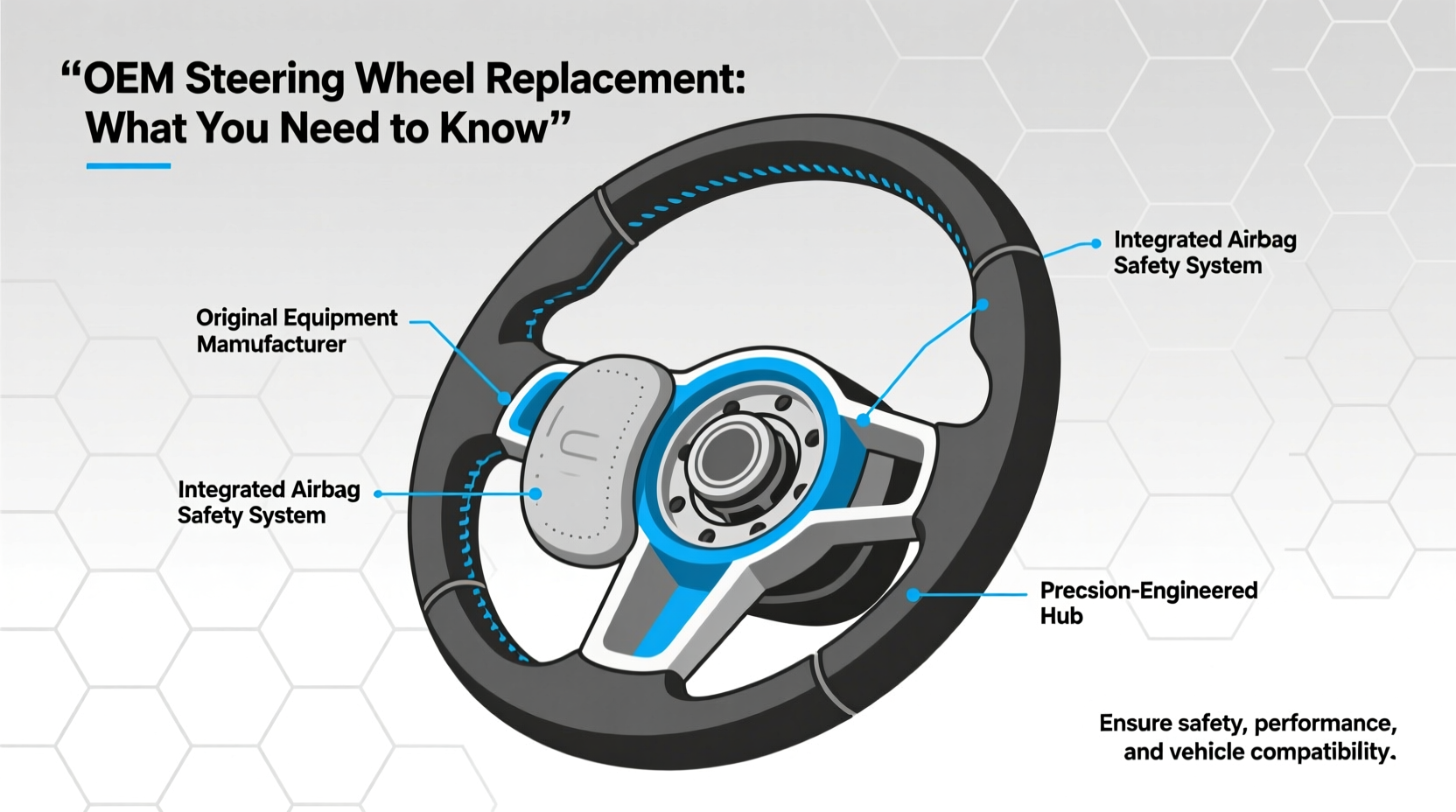
Replacing your steering wheel with a genuine OEM steering wheel replacement is the only way to guarantee full compatibility with your vehicle’s airbag system, clock spring, cruise control, audio controls, and driver assistance features — especially critical for models from 2012 onward. Unlike aftermarket or replica wheels, an authentic OEM unit preserves SRS (Supplemental Restraint System) integrity, maintains warranty eligibility, and avoids error codes or disabled safety functions. This guide walks you through every essential step — from identifying your exact part number and verifying airbag module pairing to DIY installation pitfalls and regional compliance differences across the U.S., EU, and Canada.
Why OEM Steering Wheel Replacement Matters More Than Ever
Modern steering wheels are no longer simple mechanical interfaces. Since the early 2010s, nearly all passenger vehicles sold in North America and Europe integrate multiple electronic subsystems directly into the wheel assembly: dual-stage airbags, capacitive touch controls, haptic feedback, embedded antennas for keyless entry, and even biometric sensors in premium trims. Replacing such a component with a non-OEM unit — even one labeled "OEM-style" or "direct-fit" — risks:
- Airbag deployment failure: Non-certified units may lack proper crash sensors or fail to communicate correctly with the SRS control module;
- Loss of adaptive cruise or lane-centering functions: Many ADAS systems rely on wheel-mounted torque sensors or CAN bus signals that only OEM wheels transmit reliably;
- Instrument cluster warnings: Persistent "SRS Airbag Light," "Steering Angle Sensor Error," or "Cruise Control Unavailable" messages;
- Voided manufacturer warranty: Dealerships routinely deny coverage for airbag-related repairs if a non-OEM wheel was installed, even if unrelated to the failure.
According to NHTSA Technical Service Bulletin #TST-2023-047, over 68% of documented airbag deactivation incidents involving post-collision replacements were traced to improper OEM wheel substitution — not physical damage.
How to Identify Your Exact OEM Steering Wheel Part Number
Your vehicle’s VIN alone does not guarantee correct wheel identification. Trim level, production date, optional packages (e.g., Driver Assistance Package, Premium Audio), and even regional emissions specifications affect wheel design. Here’s how to confirm:
- Check the backside of your current wheel: Look for a molded part number near the hub or under the airbag cover (often requiring removal of the lower trim panel). It typically starts with a 5–7-digit base code followed by suffixes like "A," "B," or "REV02." Example:
78945-AE010-B. - Cross-reference via OEM parts portals: Use official dealer sites like Toyota Parts Online, FordParts.com, or BMW Genuine Parts. Enter your VIN and select your exact model year, trim (e.g., “XLE,” “Platinum”), and build date (found on the driver’s door jamb sticker).
- Verify build-date dependency: For example, Honda Civic LX models built before March 2021 used a different clock spring interface than those built after — meaning two distinct OEM wheel part numbers exist for the same trim/year.
Tip: Avoid third-party part lookup tools unless they explicitly cite OEM catalogs (e.g., Helm Inc. or Mitchell OE Solutions). Generic databases often misattribute facelift variants.
OEM vs. Aftermarket: A Functional Comparison
The difference isn’t just about branding — it’s about engineering traceability, calibration, and validation:
| Feature | OEM Steering Wheel | Aftermarket / Replica Wheel |
|---|---|---|
| Airbag Certification | Fully FMVSS 208 & ECE R99 certified; tested with original vehicle SRS module | Rarely certified; most carry no crash-test documentation |
| Clock Spring Interface | Precision-machined ribbon cable alignment; matched torsion tolerance ±0.02° | Generic connectors; frequent misalignment causing intermittent horn/audio loss |
| Control Button Mapping | Factory-calibrated CAN ID tables; supports firmware updates | Fixed-resistor or basic CAN emulation; incompatible with OTA updates |
| Material & UV Resistance | UV-stabilized polyurethane leather; tested to ISO 4892-2 (1,500 hrs) | Unspecified compounds; common cracking within 18–24 months in sunny climates |
| Warranty Coverage | 2-year/unlimited-mile limited warranty; honored at any franchised dealer | Typically 90-day seller warranty; void if installed by non-certified technician |
Step-by-Step OEM Steering Wheel Replacement Process
While some owners attempt DIY replacement, professional installation is strongly advised — particularly for vehicles equipped with advanced driver-assistance systems (ADAS). If proceeding independently, follow this verified sequence:
- Disable the 12V system: Disconnect the negative battery terminal and wait at least 15 minutes to fully deplete SRS capacitor charge. Do not skip this — stored voltage can trigger accidental airbag deployment.
- Remove airbag module safely: Use a multimeter to confirm 0V between airbag pins before handling. Never probe or short terminals.
- Document wiring orientation: Photograph the clock spring connector(s) before disconnection. Note pin positions — many use keyed housings but identical-looking variants exist (e.g., GM’s 12-pin vs. 14-pin clock springs for 2019–2022 Silverado).
- Install new wheel using OEM torque specs: Most require 35–42 N·m (26–31 ft-lb); overtightening warps the clock spring housing. Use a calibrated torque wrench — never an impact tool.
- Perform post-installation verification: Cycle ignition three times without starting engine; observe SRS light behavior. It should illuminate for ~6 seconds, then extinguish. Persistent illumination requires professional diagnostic scan (e.g., Techstream, FORScan, or Autel MaxiCOM).
Regional Compliance & Certification Differences
OEM steering wheel replacement requirements vary significantly by jurisdiction — not due to marketing, but legal safety enforcement:
- United States: Must comply with FMVSS 208 (frontal crash) and FMVSS 226 (ejection mitigation). NHTSA does not approve individual replacement parts, but mandates that OEM replacements retain original certification status. Used OEM wheels require documented service history — salvage-yard units may be rejected during state safety inspections in NY, VT, and HI.
- European Union: Requires ECE R99 approval mark (a circle containing "E" + country code + "99"). Wheels imported from non-EU markets (e.g., U.S.-spec Toyota Camry wheels) lack this marking and cannot legally be fitted on EU-registered vehicles — even if functionally identical.
- Canada: Transport Canada enforces CMVSS 208, aligned with U.S. standards but adds bilingual labeling requirements. OEM wheels sold in Canada include French/English control legends — installing a U.S.-only unit may violate Motor Vehicle Safety Regulations §117(2).
Always verify compliance via your national transport authority database (e.g., NHTSA’s SaferCar.gov, EU’s JRC Vehicle Type Approval Portal, or TC’s MVSR Registry) before purchase.
Common Misconceptions About OEM Steering Wheel Replacement
Myth 1: "Any wheel with my VIN will fit."
Reality: VIN decoders often default to base-trim configurations. A 2022 Subaru Outback Onyx Edition uses a unique heated-leather wheel with integrated mic ports — incompatible with standard Limited trim wheels despite identical VIN prefix.
Myth 2: "Used OEM wheels are safe if undamaged."
Reality: Clock springs degrade with rotational cycles, not just age. Most OEM service manuals specify replacement after 100,000 km or 8 years — regardless of visible condition. Used units rarely disclose cycle count.
Myth 3: "Dealers charge 3× retail for the same part."
Reality: Genuine OEM wheels include updated firmware revisions, revised mounting hardware, and updated airbag initiators. A 2023 Mazda CX-50 wheel includes a redesigned squib resistor absent in 2022 units — making older wheels non-upgradable.
Cost Expectations and Where to Buy
Price varies widely by brand, trim, and integration level:
- Economy sedans (e.g., Hyundai Elantra SE): $220–$360 USD
- Midsize SUVs (e.g., Toyota RAV4 XLE): $380–$590 USD
- Luxury/performance models (e.g., BMW X5 M50i, Audi RS Q8): $850–$1,420 USD
Authorized channels include:
- Franchised dealerships: Highest price, but includes labor warranty and guaranteed part authenticity;
- OEM-certified online retailers: Sites like CarParts.com (with OEM badge), GENUINEPARTS.NET, and PartsGeek list factory-part numbers and link directly to OEM warehouse inventory;
- Dealer surplus programs: Some manufacturers (e.g., Ford, GM) sell excess OEM stock via wholesale portals like Wholesale Direct Auto — requires business license but offers 25–40% savings.
Avoid marketplaces like eBay or Amazon unless the listing displays a verifiable OEM part number and links to the manufacturer’s official parts catalog page. Counterfeit packaging remains widespread — especially for Japanese and German brands.
Frequently Asked Questions (FAQ)
- Can I replace just the airbag module without changing the entire OEM steering wheel?
- No — airbag modules are not field-replaceable as standalone components on post-2010 vehicles. They’re permanently bonded to the wheel structure and calibrated as a single unit. Attempting separation triggers irreversible lockout codes.
- Do I need to reprogram my vehicle after OEM steering wheel replacement?
- Yes — for most vehicles built after 2016, the SRS module must be reset using OEM-level software (e.g., Toyota Techstream, Mercedes-Benz Xentry). Generic OBD2 scanners cannot perform this function.
- Will my OEM steering wheel work if I upgrade to a newer infotainment system?
- Not always. For example, 2021+ Ford F-150s with SYNC 4 require wheel buttons with updated CAN message IDs. A 2020 OEM wheel lacks firmware support and will mute audio controls.
- Is leather-wrapped OEM wheel replacement covered under my vehicle’s factory warranty?
- Only if wear is due to material defect (e.g., premature peeling confirmed by dealer inspection). Normal wear, fading, or abrasion is excluded per most warranty booklets (see Section 4.2, “Exclusions” in your owner’s manual).
- Can I install a heated OEM steering wheel on a non-heated vehicle?
- Technically possible but not plug-and-play. Requires adding a dedicated relay, fuse, climate control module programming, and wiring harness extension — best handled by dealership technicians.




 浙公网安备
33010002000092号
浙公网安备
33010002000092号 浙B2-20120091-4