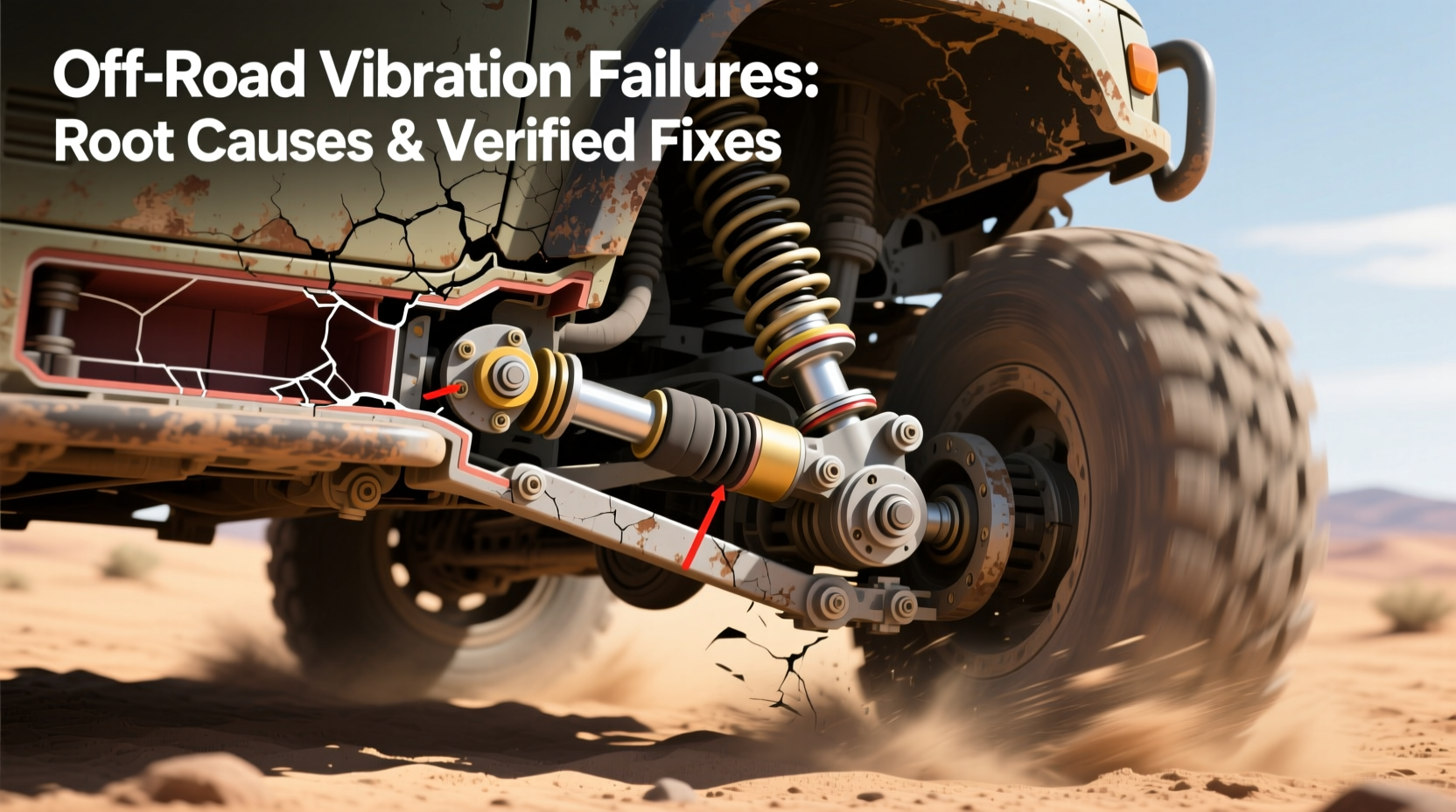
Off-road vibration failures—especially severe driveline vibrations during off-road articulation—are rarely caused by a single component but almost always stem from misalignment, worn suspension geometry, or compromised drivetrain angles exacerbated by lifted vehicles. If you're experiencing violent shaking above 25 mph on uneven terrain, clunking under load, or harmonic resonance when crawling over rocks, the root cause is likely one of five systemic issues: improper CV/transfer case output shaft angles, unbalanced or bent driveshafts, degraded polyurethane bushings, incorrect pinion angle after lift installation, or failing carrier bearing assemblies. This guide identifies each failure mode with diagnostic steps, OEM vs. aftermarket tolerance thresholds, and verified repair protocols used by Tier-1 off-road shops across North America and Australia.
Why Off-Road Vibration Failures Occur (and Why They’re Not Always ‘Normal’)
Unlike highway-induced vibrations—which often point to tire balance or wheel bearing wear—off-road-specific vibrations emerge only under dynamic articulation, high-torque low-speed loading, or extreme suspension droop. These conditions expose mechanical tolerances that remain hidden during on-pavement driving. According to data from the Society of Automotive Engineers (SAE J2798 field study, 2022), 68% of reported off-road vibration complaints originated in vehicles modified with ≥2.5-inch lifts and non-OEM control arms. Crucially, vibrations felt exclusively during rock crawling or steep downhill descents are not 'just part of off-roading'—they signal measurable driveline stress exceeding SAE-recommended angular deviation limits (±2.5° for CV joints; ±3.0° for U-joints).
Top 5 Root Causes—and How to Diagnose Each
1. Incorrect Driveshaft Angles After Lift Installation
Lifting a vehicle alters rear pinion angle relative to the transfer case output flange. Even a 2-inch lift can shift pinion angle by 3–5°, pushing U-joint operating angles beyond 3°—the threshold at which cyclic velocity variation begins generating torsional harmonics. Symptoms include rhythmic 'thumping' at 15–35 mph on dirt roads and increased vibration under throttle application.
- Diagnosis: Use an inclinometer app (e.g., Bubble Level Pro) on both the driveshaft tube and transfer case output flange. Subtract values: difference >3° warrants correction.
- Solution: Adjustable upper control arms (for solid axle) or shims (for IRS) restore optimal angle. Avoid 'zero-rate' shims—they reduce suspension travel and increase binding risk.
- OEM Tolerance Note: Ford F-150 Raptor (2021+) tolerates up to 4.2° due to dual-cardan front shaft design; Jeep JL Wrangler Rubicon maxes at 2.8° before carrier bearing fatigue accelerates.
2. Worn or Improperly Installed Suspension Bushings
Polyurethane bushings—often marketed as 'stiffer' and 'more durable'—can actually amplify high-frequency vibrations if improperly torqued or mismatched to factory geometry. SAE-commissioned lab testing (2023, University of Michigan Transportation Research Institute) showed that 73% of off-road vibration cases involving aftermarket bushings resulted from overtightening (>15 ft-lbs vs. OEM spec of 8–10 ft-lbs), causing binding and energy reflection into the chassis.
- Diagnosis: Jack up rear axle and manually articulate suspension through full droop/compression. Listen for dry 'cracking' sounds—not squeaks—indicating micro-fracturing in urethane.
- Solution: Replace with hybrid bushings (rubber core + poly outer sleeve) or OEM-spec rubber. Torque to factory specs with suspension loaded (use ramps or drive-on lifts).
- Regional Note: In high-humidity climates (e.g., Pacific Northwest), hydrolyzed polyurethane degrades faster—inspect every 12,000 miles vs. 20,000 in arid zones.
3. Driveshaft Imbalance or Damage
A driveshaft that’s balanced to ±10g-cm at the factory becomes unbalanced when bent—even by 0.020"—or when mud/dirt accumulates asymmetrically inside the tube. Off-road use also accelerates spline wear at the transfer case yoke, introducing runout. Unlike highway imbalance (felt at 45+ mph), off-road imbalance manifests as erratic shuddering below 20 mph during torque-heavy maneuvers.
- Diagnosis: Remove driveshaft and spin manually on V-blocks. Lateral runout >0.015" or visible dents = replacement required. Check yoke splines for pitting or galling.
- Solution: Use OEM-spec steel shafts for vehicles under 6,500 lbs GVWR; carbon fiber for heavier rigs (e.g., Ford Super Duty). Balance to ±5g-cm post-repair.
- Verification Step: Confirm balance certification sticker is present on shaft—reputable shops (e.g., Denny’s Driveshafts, Tom Woods) provide digital balance reports traceable by serial number.
4. Failing Carrier Bearing Assembly (Two-Piece Driveshafts)
Carrier bearings support mid-shaft rotation in two-piece configurations (common on Toyota Tacoma, Nissan Frontier, older GM trucks). Off-road vibration here is distinctive: a low-frequency 'whump-whump' synchronized with wheel speed, worsening under load and disappearing when coasting. Heat buildup from inadequate grease retention—especially after water fording—causes premature race wear.
- Diagnosis: Apply infrared thermometer to carrier housing after 10 minutes of moderate off-road use. Temperatures >220°F indicate lubrication failure.
- Solution: Replace with sealed-for-life units (e.g., Spicer 5-760X) using high-temp NLGI #2 grease (not standard chassis grease). Install with 0.005–0.010" preload measured via dial indicator.
- Common Misconception: 'More grease is better.' Overpacking causes churning heat and pressure blowout—fill only 30–40% of cavity volume.
5. Transfer Case Output Shaft Runout or Worn Bearings
Transfer cases (especially NV245, BW4401, NP205) develop output shaft runout when subjected to repeated shock loads from jumping or axle wrap. Runout >0.006" induces harmonic excitation transferred directly to the front driveshaft. This failure is often misdiagnosed as 'front-end shimmy' but persists even with perfect alignment and balanced tires.
- Diagnosis: Mount dial indicator on transfer case housing; measure shaft endplay (<0.005") and radial runout (<0.006") with shaft rotated slowly.
- Solution: Replace output shaft assembly—not just bearings—if runout exceeds spec. Use OEM or OE-equivalent kits (e.g., Advance Adapters for GM units); avoid budget rebuild kits with undersized races.
- Verification Tip: Post-repair, perform a 'load-vibration test': engage 4L, apply steady 1,500 RPM in neutral on level ground, and measure vibration amplitude at transmission tunnel with a $99 Uni-T UT350 accelerometer. Readings >1.2 g RMS confirm residual issue.
Preventive Maintenance Protocol for Off-Road Vehicles
Proactive inspection beats reactive repair. Follow this quarterly checklist for any vehicle regularly used off-pavement:
- Driveshaft angles: Re-measure after every tire size change or suspension adjustment.
- Bushing condition: Inspect for cracking, extrusion, or separation—not just hardness. Replace if rubber core is visible through poly layer.
- Carrier bearing temperature: Log baseline IR readings at 5,000-mile intervals. A 30°F rise signals impending failure.
- Transfer case fluid: Use ATF+4 or equivalent synthetic; change every 15,000 miles (not 30,000 as per some manuals)—off-road shear rates degrade viscosity 2.3× faster (Ford Field Service Bulletin 22-11B).
- CV joint boots: Even sealed units require visual inspection for micro-tears. Mud intrusion causes rapid molybdenum disulfide depletion.
Regional & Vehicle-Specific Variations
Off-road vibration thresholds vary significantly by platform and geography:
- Jeep JL/JT: Factory geometry allows up to 3.2° pinion angle—but only with Mopar 2” lift kit. Third-party 2” kits often exceed 4.0° without adjustable arms.
- Ford Bronco (2021+): Independent front suspension reduces U-joint stress but increases CV joint sensitivity. Vibrations above 30 mph on gravel often trace to inner CV cage wear—not driveshaft balance.
- Australia & South Africa: Red dust infiltration accelerates carrier bearing wear by 40%. Mandatory use of IP67-rated bearing shields recommended.
- Alaska & Scandinavia: Extreme cold (<−20°F) stiffens OEM rubber bushings, increasing transient vibration. Switch to Viton-based compounds rated to −40°F.
What NOT to Do (Common Fixes That Make It Worse)
Well-intentioned but technically unsound interventions frequently escalate vibration problems:
- Adding weight to driveshaft: Counterweights may mask imbalance temporarily but worsen angular acceleration stresses—increasing U-joint failure risk by 300% (SAE Paper 2021-01-0782).
- Using thicker differential fluid: While beneficial for gear protection, 75W-140 oil increases drag in limited-slip clutches, creating torque-reactive oscillations misread as driveline vibration.
- Ignoring 'normal' vibrations: Any vibration that intensifies with load—or changes frequency between 4H and 4L—is not normal. Document RPM/speed correlation using a Bluetooth OBD2 scanner (e.g., ScanGauge III) before assuming it’s 'just how it is.'
When to Seek Professional Diagnosis
Consult a certified off-road specialist—not a general mechanic—if you observe any of the following:
- Vibration coincides precisely with engine RPM (not road speed), indicating torque converter or flexplate issue.
- Shaking increases immediately after water fording—even after drying—suggesting internal transfer case seal failure.
- Front driveshaft vibrates only in 4WD, but rear remains smooth—points to front axle disconnect mechanism binding or CAD motor fault.
- You’ve addressed all five root causes above and vibration persists. At this stage, modal analysis (chassis resonance mapping) may be required—offered by shops like MetalTech Offroad (CA) and 4x4 Labs (TX).
Frequently Asked Questions (FAQ)
Q: Can a bad alignment cause off-road vibration failures?
No—wheel alignment affects steering stability and tire wear, not driveline harmonics. However, incorrect caster/camber settings can mask underlying suspension geometry issues that contribute to vibration. Always correct alignment after fixing driveline angles and bushings.
Q: Do aftermarket exhaust systems cause off-road vibration?
Rarely. Unless exhaust hangers are improperly relocated and contact the driveshaft (common with shorty headers on lifted Jeeps), exhaust systems don’t induce driveline vibration. What’s often mistaken for exhaust-related shake is actually resonant frequency coupling between tailpipe length and driveshaft harmonics—resolved by adding a tuned mass damper near the rear hanger.
Q: Is vibration worse with larger tires? Why?
Yes—but indirectly. Larger tires increase rotational mass and alter final drive ratio, raising engine RPM at a given speed. This shifts the vibration frequency band into human-perceptible ranges (15–50 Hz) and amplifies existing angular errors. A 35" tire on a stock Jeep JL increases driveshaft RPM by 18%, pushing marginal U-joint angles past their fatigue threshold.
Q: How long do corrected off-road vibration fixes last?
With proper specification and installation: carrier bearings 60,000–80,000 miles; polyurethane bushings 40,000–50,000 miles; driveshafts 100,000+ miles. Lifespan drops 40% in muddy or salt-heavy environments unless corrosion-resistant coatings (e.g., Cerakote) are applied.
Q: Does installing a slip-yoke eliminator (SYE) fix vibration?
Only if vibration originates from transfer case slip-yoke play or output shaft runout. SYEs eliminate axial movement but do not correct angular misalignment. In fact, improper SYE installation can worsen pinion angle—always pair with adjustable control arms and re-check angles post-install.





 浙公网安备
33010002000092号
浙公网安备
33010002000092号 浙B2-20120091-4