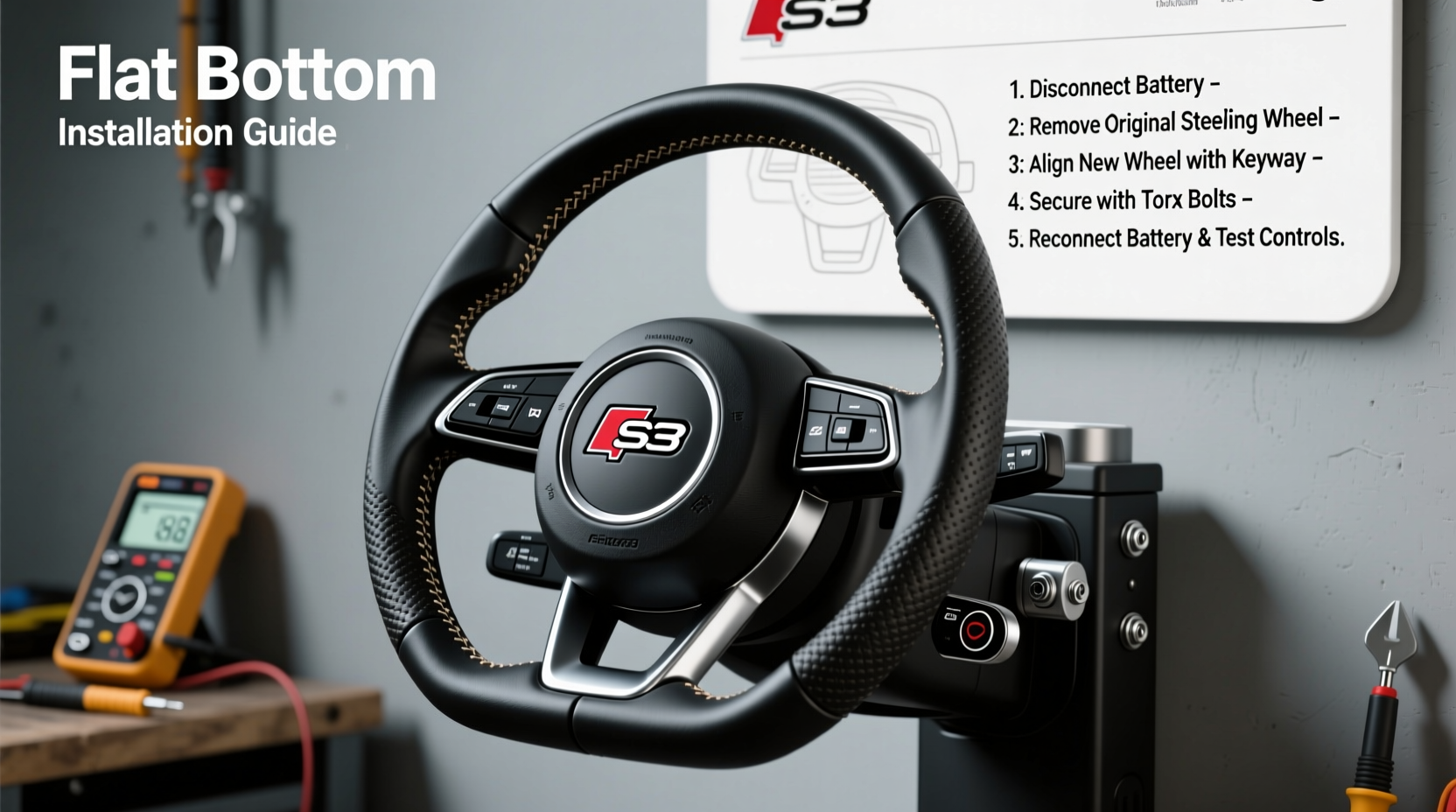
Installing a flat-bottom steering wheel on your 2013–2016 Audi S3 (8V) is a popular and highly effective upgrade—but it’s not plug-and-play. You’ll need the correct airbag module (8V0 419 171 C or later), a compatible flat-bottom wheel (e.g., Audi Sport OEM 8V0 419 091 D/E/F or aftermarket options like MOMO, Nardi, or Sparco with proper hub adapters), and a functional clock spring. S3 8V flat bottom steering wheel installation requires coding via VCDS or OBDeleven to deactivate airbag fault codes and enable multifunction button mapping. Skip any of these—and you’ll face persistent airbag warnings, non-functional controls, or unsafe deployment risk.
Why This Installation Is More Complex Than It Appears
The Audi S3 (8V) platform—built on the MQB architecture—integrates the steering wheel deeply into its safety and infotainment systems. Unlike older models or non-Audi vehicles, the S3’s flat-bottom wheel isn’t just aesthetic: it’s engineered with specific torque sensors, CAN bus signaling, and airbag deployment logic tied directly to the vehicle’s ECU. That means even if a wheel physically fits, it won’t function correctly without matching hardware and software configuration.
This complexity explains why DIY installers often report error codes like 01320 – Steering Angle Sensor (G85) implausible signal, 01279 – Airbag Control Module (J234) internal fault, or 01290 – Driver Airbag (N95) open circuit. These aren’t random glitches—they’re diagnostic responses to mismatched components or missing coding steps.
What Exactly Is the 'S3 8V Flat Bottom'?
The term S3 8V flat bottom refers specifically to the OEM flat-bottom steering wheel designed for the 2013–2016 Audi S3 (model code 8V, chassis type 8V1). It debuted with the S3’s facelift in mid-2014 and was available as standard on S-line and S-tronic-equipped models—or as a $650–$950 factory option on base trims. The wheel features:
- Three-spoke design with stitched leather and aluminum trim
- Integrated multifunction buttons for cruise control, phone, media, and voice command
- Reinforced lower spoke geometry for improved knee clearance and sportier ergonomics
- Factory-matched airbag module with dual-stage deployment logic
Crucially, the S3 8V flat-bottom wheel is not interchangeable with the A3 8V (8V1/8VA) or TT 8S (8S) wheels—even though they share visual similarities. Differences include airbag connector pinouts, clock spring compatibility, and button resistance values. Installing an A3 flat-bottom wheel on an S3 will trigger permanent airbag faults unless modified—a practice strongly discouraged by Audi Technical Service Bulletins (TSB 2015-047-02).
Required Components: The Non-Negotiable Kit
A successful S3 8V flat bottom steering wheel installation depends on four interdependent parts. Omitting or substituting any one risks system failure or safety compromise.
1. OEM Steering Wheel (Part Numbers Matter)
Valid part numbers for genuine Audi S3 8V flat-bottom wheels include:
- 8V0 419 091 D — Black leather, silver trim, no paddle shifters (pre-2015)
- 8V0 419 091 E — Black leather, brushed aluminum trim, no paddles (2015–2016)
- 8V0 419 091 F — Black leather, carbon fiber trim, with paddle shifters (S-tronic only)
Note: Wheels ending in G, H, or J are for A3 8V or Q2—not S3. Using them voids airbag certification and may fail MOT/annual inspection in the UK or TÜV in Germany.
2. Matching Airbag Module
The airbag must match both the wheel and your S3’s production date. For S3s built before March 2014, use 8V0 419 171 B. From March 2014 onward, 8V0 419 171 C or later (D, E) is mandatory. Later modules support enhanced crash detection algorithms and integrate with Audi’s pre-sense basic system. Swapping airbags without verifying build date leads to ‘Airbag Light ON’ and failed diagnostics.
3. Clock Spring (Spiral Cable)
The clock spring (part # 8V0 959 653 C or 8V0 959 653 D) must be rated for flat-bottom wheel use. Standard clock springs lack the rotational tolerance needed for the S3’s full 180°+ steering lock range when combined with the lowered spoke profile. Failure here causes intermittent horn, airbag, or multifunction loss—often misdiagnosed as a faulty wheel.
4. Coding & Software Tools
You’ll need either:
- VCDS (Ross-Tech HEX-V2 or HEX-FM) with at least Basic Level license, OR
- OBDeleven Pro (Gen 2) with Full Access subscription
Coding steps include:
- Adapting the airbag control module to recognize the new wheel ID
- Enabling ‘Steering Wheel with Paddle Shifters’ (if applicable)
- Mapping multifunction buttons to correct CAN messages (e.g., Button 1 = Volume Up, not Phone Answer)
- Resetting G85 steering angle sensor calibration
Without this step, buttons remain unresponsive—even if wiring is perfect.
Step-by-Step Installation Guide (Verified for 2014–2016 S3)
Note: Disconnect battery negative terminal for 15+ minutes before starting. Wait until airbag warning light stays off after reconnection before proceeding.
Phase 1: Disassembly (25–35 minutes)
- Remove two T30 Torx screws behind the lower airbag cover (use plastic pry tool to avoid cracking)
- Unplug airbag connector (yellow, located top-center of module)—do NOT use metal tools near terminals
- Detach horn wire (black/white stripe) and multifunction ribbon cable (flat gray)
- Loosen steering column tilt mechanism to gain clearance
- Remove center nut (24mm, 45 Nm spec)—do NOT use impact gun; torque wrench required
Phase 2: Wheel & Clock Spring Swap (40–55 minutes)
- Align clock spring neutral position using alignment marks (small arrows on housing and rotor)
- Install new wheel—ensure spline engagement is full and centered before tightening
- Torque center nut to 45 Nm + 90° turn (Audi specification; overtightening warps hub)
- Reconnect all cables in reverse order—verify no pinching or strain on ribbon cable
Phase 3: Coding & Verification (15–20 minutes)
- Connect VCDS/OBDeleven → Select [03 - ABS] → [Coding – Long Coding Helper]
- Under “Steering Wheel Configuration”, select “Flat Bottom” and confirm paddle shifter presence
- Navigate to [15 - Airbags] → [Security Access 20103] → [Adaptation → Steering Wheel Variant]
- Enter value 000002 for flat-bottom (non-paddle) or 000003 for paddle-equipped
- Perform G85 calibration: Drive straight at >20 km/h for 15 seconds, then stop and cycle ignition
Common Pitfalls & How to Avoid Them
| Pitfall | Root Cause | Prevention / Fix |
|---|---|---|
| Airbag light stays on after install | Incorrect airbag module version or missing security access coding | Verify part number against VIN using ETKA; perform [15 - Airbags] → Security Access → Adaptation |
| Horn works intermittently | Worn clock spring contacts or misaligned neutral position | Replace clock spring; double-check alignment marks before final assembly |
| Volume buttons do nothing | Button mapping not coded or incorrect long-code byte | Use VCDS Long Code Helper; verify Byte 12 Bit 0–3 settings match wheel variant |
| Steering angle sensor fault (01320) | G85 not recalibrated post-install or damaged sensor ring | Complete full G85 calibration drive cycle; inspect sensor ring for scratches or debris |
Aftermarket Alternatives: What Works (and What Doesn’t)
While OEM remains safest, several aftermarket options meet S3 8V requirements—if vetted carefully:
- MOMO Heritage Evo S3 Kit: Includes hub adapter (MOMO 301200), airbag-compatible wiring loom, and flat-bottom wheel. Requires VCDS coding but supports full button mapping.
- Sparco SPX-R Flat Bottom: Only compatible with S3s equipped with factory paddle shifters. Needs custom clock spring (Sparco 302011) and firmware update from Sparco Tech Support.
- Nardi Deep Corniche: Pure aesthetics—no airbag integration. Requires full airbag deletion (illegal in EU/UK/CA; voids insurance).
Red flags: Any wheel advertised as “plug-and-play for all Audi MQB” or “no coding needed” should be avoided. There is no universal flat-bottom solution for the S3 8V.
Regional Considerations & Legal Compliance
Regulatory compliance varies significantly:
- United States: FMVSS 208 mandates certified airbag functionality. Installing non-OEM airbag modules may violate federal law and invalidate insurance claims.
- United Kingdom: MOT testers check for airbag warning lights. Persistent illumination = automatic failure.
- Germany: TÜV inspectors verify airbag module part numbers against vehicle documentation. Mismatched parts result in rejection.
- Canada: Transport Canada requires OEM-equivalent crash performance. Aftermarket airbags require third-party certification (rarely available).
Always cross-check local regulations using official sources: NHTSA.gov (US), GOV.UK/mot (UK), kba.de (Germany), tc.gc.ca (Canada).
Frequently Asked Questions (FAQ)
- Can I install an S3 8V flat bottom wheel on a 2017+ S3 (8Y)?
- No. The 8Y uses a completely different electrical architecture (Modular Infotainment Platform), incompatible airbag connectors, and revised clock spring design. Attempting retrofit risks permanent module damage.
- Do I need to replace the entire clock spring—or just the airbag module?
- You must replace both if upgrading from a round wheel. The stock 8V clock spring lacks the angular range and contact durability needed for flat-bottom operation. Reusing it causes premature failure within 6–12 months.
- Is there a way to retain heated steering wheel function?
- Yes—but only with OEM 8V0 419 091 F (carbon/paddle version) and full coding via VCDS. Aftermarket wheels lack heating elements and cannot interface with the S3’s climate control bus.
- How much does professional installation cost in the US or UK?
- US shops charge $320–$580 (labor + parts markup); UK specialists quote £290–£470. Independent Audi specialists typically offer better coding accuracy than general garages.
- Will this void my factory warranty?
- Only if damage is directly attributable to the modification (e.g., airbag failure due to incorrect module). Powertrain and drivetrain coverage remains intact per Magnuson-Moss Warranty Act (US) and Consumer Rights Act 2015 (UK).





 浙公网安备
33010002000092号
浙公网安备
33010002000092号 浙B2-20120091-4