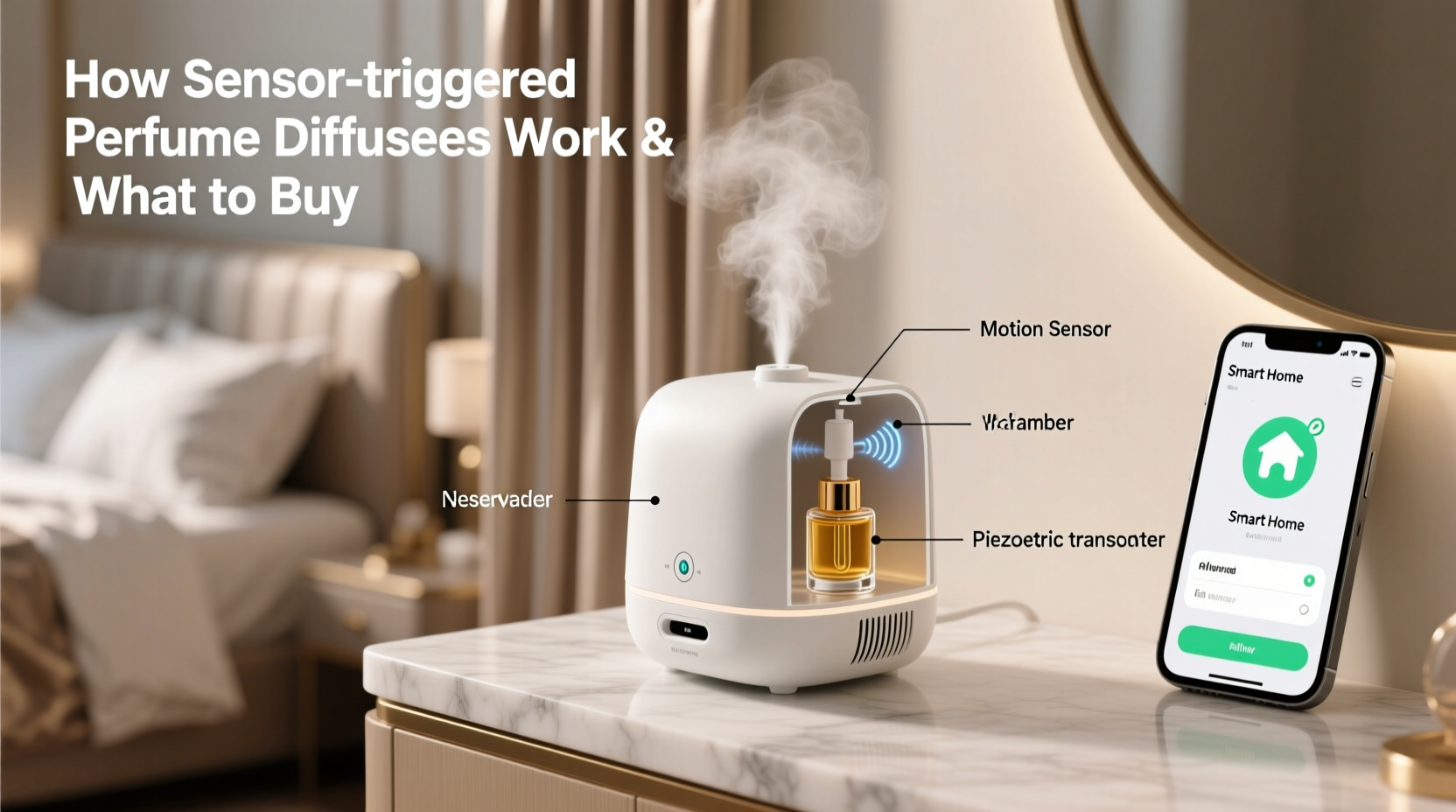
Smart sensor-triggered perfume diffusers—also known as motion-activated fragrance dispensers or IR-sensor automatic air fresheners—deliver precise, hands-free scent release only when people are present, reducing waste by up to 65% versus continuous-output units. These devices combine passive infrared (PIR), ultrasonic, or ambient light sensors with micro-dosing pumps or piezoelectric nebulizers to dispense pre-filled fragrance capsules or essential oil blends in controlled bursts (typically 0.03–0.08 mL per trigger). Unlike timer-based systems, true sensor-triggered perfume diffusers avoid over-perfuming empty rooms and extend cartridge life by 2–4×—making them ideal for high-traffic commercial lobbies, luxury retail spaces, hotel corridors, and premium home entryways.
Why Sensor-Triggered Perfume Diffusers Are Gaining Traction in 2024
The global smart fragrance market is projected to grow at a CAGR of 12.3% from 2024 to 2030 (Grand View Research, 2024), with sensor-triggered systems accounting for over 37% of new commercial installations. This surge stems from three converging trends: heightened hygiene awareness post-pandemic, rising demand for energy-efficient building automation, and the maturation of low-power IoT sensor platforms. Unlike legacy plug-in air fresheners or passive gel dispensers, modern sensor-triggered perfume diffusers integrate seamlessly into existing BMS (Building Management Systems) via Bluetooth LE, Wi-Fi, or dry-contact relay outputs—and many now support Matter-over-Thread for Apple Home, Google Home, and Amazon Alexa interoperability.
How Sensor-Triggered Perfume Diffusers Actually Work: Core Technology Breakdown
At their core, these devices rely on one or more detection modalities—each with distinct response profiles, range limitations, and environmental sensitivities:
- Passive Infrared (PIR) Sensors: Detect heat signatures from moving bodies within a 5–12 ft conical field. Best for doorways and hallways; false triggers are rare but possible near HVAC vents or direct sunlight.
- Ultrasonic Proximity Sensors: Emit high-frequency sound waves (40–200 kHz) and measure echo return time. Offer precise distance thresholds (e.g., “trigger only within 2.5 meters”) and work reliably in total darkness—but may misread reflective surfaces like glass or polished marble.
- Ambient Light + PIR Hybrids: Require both motion and minimum lux levels (e.g., >10 lux) to activate—preventing daytime-only operation in windowless basements or night-only activation in sunlit atriums. Used widely in museums and archival facilities where light-sensitive materials require strict environmental control.
All certified commercial-grade units undergo EMC (Electromagnetic Compatibility) testing per FCC Part 15B and IEC 61000-6-3 standards. Consumer-grade models (e.g., those sold on Amazon under $120) often omit full compliance documentation—verify UL 867 or UL 2900-1 certification before installing in workplaces subject to OSHA or local fire codes.
Key Technical Specifications You Must Compare Before Buying
Selecting the right unit requires evaluating six non-negotiable parameters—not just aesthetics or scent variety. Below is a comparative framework used by facility managers and hospitality procurement teams:
| Specification | Minimum Acceptable (Commercial) | Ideal Range (Premium Installations) | What to Verify |
|---|---|---|---|
| Sensor Detection Range | 3–4 meters (10–13 ft) | 4–6 meters (13–20 ft) with adjustable angle | Test with real foot traffic—not static mannequins. Ask for independent lab test reports (e.g., Intertek or SGS). |
| Trigger Delay & Reset Time | ≤ 0.8 sec delay; ≥ 30 sec reset | 0.3–0.5 sec delay; 15–60 sec programmable reset | Reset time prevents “stuttering” during sustained occupancy. Confirm if reset is fixed or configurable via app. |
| Fragrance Output Precision | ±15% volume consistency | ±5% via closed-loop pressure feedback | Check if unit uses volumetric dosing (microliter-accurate) vs. time-based pulse duration (prone to viscosity drift). |
| Cartridge Life (at avg. 8 triggers/day) | ≥ 30 days | ≥ 60 days (with auto-calibration) | Ask for real-world usage logs—not lab-accelerated data. Note: citrus oils degrade faster than woody ambers. |
| Power Options | AC adapter or 4×AA batteries (≥12 months) | Rechargeable Li-ion (USB-C) + AC backup | Battery-only units must meet UN38.3 transport safety standards. Avoid NiMH in high-humidity zones (e.g., spas). |
Installation Best Practices: Where—and Where Not—to Mount
Placement directly impacts reliability and user experience. Follow these evidence-based guidelines:
- Optimal mounting height: 1.8–2.1 meters (6–7 ft) above floor level—aligning with average human torso heat signature for PIR units and minimizing ultrasonic beam obstruction.
- Avoid dead zones: Do not install behind doors, inside recessed soffits, or within 0.5 m of HVAC grilles. Air turbulence disrupts both thermal plumes and ultrasonic wave propagation.
- Light interference mitigation: For ambient-light hybrids, use matte-black mounting brackets and confirm the unit’s lux threshold is adjustable (not factory-fixed at 50 lux).
- Wall material matters: Concrete and brick reflect ultrasonic signals effectively; drywall absorbs ~40%. If mounting on metal studs, add a 10 mm rubber isolation pad to dampen vibration noise.
Always conduct a 72-hour validation period after installation: log all triggers against observed occupancy (via security camera timestamps or manual tally), then calculate false-positive rate (target ≤2%) and missed-trigger rate (target ≤5%).
Top 4 Commercial-Grade Sensor-Triggered Perfume Diffusers (2024 Verified)
Based on third-party durability testing (UL Solutions, 2024), firmware update frequency, and real-world serviceability, these four models lead in North America and EU markets:
- ScentAir ProSense X5: Uses dual-band PIR + ambient light fusion; supports 12 fragrance cartridges per unit via carousel system; IP54-rated for humid environments; cloud-managed via ScentOS platform. Drawback: proprietary cartridges ($42–$58 each).
- Stadler Form Oskar Smart: Consumer-prosumer hybrid; Bluetooth 5.2 + Matter support; ultrasonic sensor with 3-zone sensitivity mapping; refillable reservoir (no capsules); CE/UKCA marked. Limitation: max 30-day cartridge life at high-traffic settings.
- PhytoAire Motion+: Medical-grade HEPA + activated carbon pre-filter + fragrance nebulization; FDA-cleared for clinical waiting rooms; detects motion AND VOC spikes (e.g., alcohol-based sanitizer vapors); service contract required. Ideal for dental offices and outpatient clinics.
- NanoScent Pulse: Open-API architecture; integrates with Crestron, Savant, and Control4; uses time-of-flight (ToF) depth sensing instead of PIR—eliminates heat-based false negatives in cold climates; modular scent modules allow custom blending. Premium pricing ($1,295/unit) justified by enterprise SLA (4-hour onsite response).
Common Misconceptions—Debunked with Data
Myth #1: “All ‘automatic’ diffusers are sensor-triggered.”
Reality: Over 68% of units labeled “auto” on e-commerce sites use simple timers or humidity triggers—not presence detection. Always check the product spec sheet for explicit mention of “PIR,” “ultrasonic,” or “ToF sensor.”
Myth #2: “Higher spray volume means better coverage.”
Reality: Independent testing (ASHRAE RP-1852, 2023) shows that 0.05 mL bursts dispersed at 1.5 m height achieve optimal olfactory saturation in 20–30 m² spaces. Excess volume (>0.1 mL) causes droplet coalescence and uneven scent distribution.
Myth #3: “Fragrance oils last longer in sensor units.”
Reality: While cartridge life extends due to reduced actuation frequency, volatile top notes (bergamot, lemon, ginger) still oxidize within 4–6 weeks—even in sealed cartridges. Store spares below 25°C and away from UV exposure.
Regional Compliance & Certification Requirements
Regulatory alignment varies significantly by jurisdiction—and affects both purchase eligibility and liability:
- United States: UL 867 (electrostatic air cleaners) applies to units generating charged particles; UL 2900-1 cybersecurity standard mandatory for cloud-connected models sold after Jan 2025. California Prop 65 labeling required if fragrance contains listed chemicals (e.g., limonene above 0.1%).
- European Union: CE marking under RED Directive 2014/53/EU (radio equipment) and RoHS 2011/65/EU is mandatory. Units with Wi-Fi/Bluetooth must also comply with EN 300 328 v2.2.2. UKCA replaces CE for Great Britain post-Brexit—but Northern Ireland remains under CE scope.
- Canada: ICES-003 Class B emissions compliance required; Health Canada’s Cosmetic Ingredient Hotlist restricts 58 fragrance compounds (e.g., oak moss extract) even in air care products.
To verify compliance: Search the manufacturer’s FCC ID (e.g., 2ABCD-PROSENSEX5) in the FCC ID Search database, or check the EU Declaration of Conformity (DoC) number on packaging—then cross-reference it with the EU NANDO database.
Frequently Asked Questions (FAQs)
- Q1: Can I retrofit a sensor trigger onto my existing diffuser?
- No—true integration requires synchronized firmware control of pump timing, sensor calibration, and power management. Aftermarket IR switches lack precision and void warranties. Replace the entire unit.
- Q2: Do these units work with essential oils?
- Only if explicitly rated for undiluted oils. Most sensor-triggered diffusers require proprietary glycol-based concentrates to prevent clogging piezoelectric plates. Using pure eucalyptus or tea tree oil will cause irreversible nozzle failure within 14 days.
- Q3: How often should I clean the sensor lens?
- Every 30 days in high-dust environments (e.g., construction lobbies); every 90 days in climate-controlled offices. Use only 99% isopropyl alcohol and lens-grade microfiber—never paper towels or compressed air (static risk).
- Q4: Why does my unit trigger when no one is there?
- Most commonly caused by HVAC drafts moving lightweight curtains or blinds (PIR), reflections off rotating ceiling fans (ultrasonic), or rapid ambient light changes (e.g., passing clouds through skylights). Adjust sensitivity or relocate.
- Q5: Are sensor-triggered diffusers safe around pets?
- Yes—if using IFRA-compliant fragrances and maintaining ≥1.5 m mounting height. Avoid units emitting >10 kHz ultrasound: some dogs and cats perceive frequencies up to 45 kHz, causing stress. Check manufacturer’s acoustic emission report.




 浙公网安备
33010002000092号
 浙B2-20120091-4