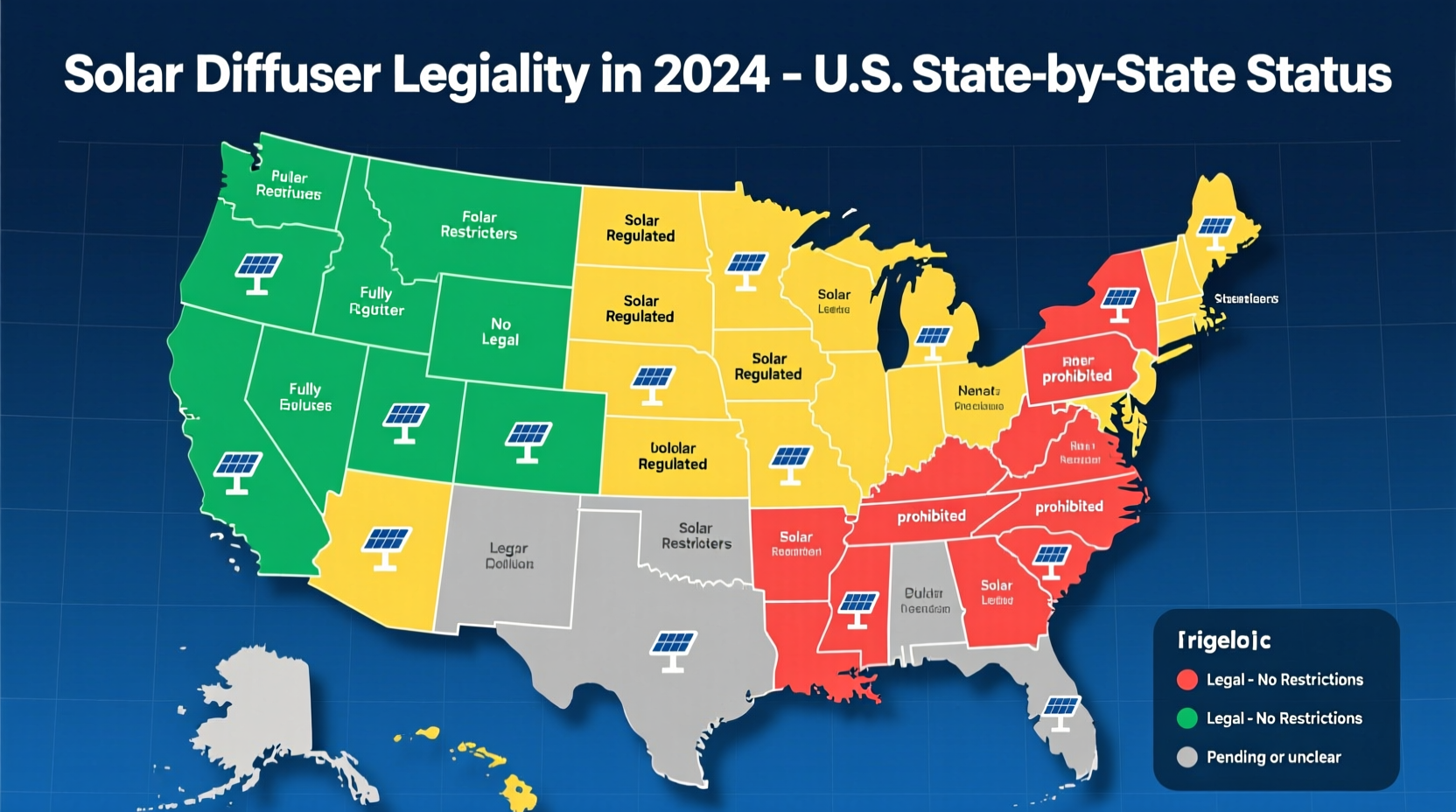
As of January 2026, solar diffusers — thin, adhesive, tint-like films applied to vehicle windshields or front side windows to reduce glare and heat — remain illegal for use on any safety-critical glazing surface in 47 U.S. states. Only Arizona, New Mexico, and South Dakota permit limited installation under strict optical transmittance (VLT) and placement conditions — and even there, federal motor vehicle safety standards (FMVSS 205 and 103) override state allowances if the product fails light transmission or distortion testing. This definitive 2026 solar diffuser legality guide covers enforceable statutes, pending regulatory updates, verification protocols, and region-specific exceptions — helping drivers avoid citations, failed inspections, and insurance complications.
Why Solar Diffusers Are Legally Problematic in 2026
Solar diffusers differ fundamentally from conventional window tints. While traditional dyed or ceramic tints absorb or reflect infrared (IR) and ultraviolet (UV) radiation while maintaining high visible light transmittance (VLT), diffusers scatter incoming light using micro-prismatic or holographic layers. This scattering — intended to soften glare without darkening the glass — introduces measurable luminous scatter and distortion, both of which violate Federal Motor Vehicle Safety Standard No. 205 (Glazing Materials) and its companion test protocol, FMVSS No. 103 (Windshield Mounting). The National Highway Traffic Safety Administration (NHTSA) reaffirmed this interpretation in its 2024 Final Guidance on Aftermarket Glazing Additives, explicitly naming "optical diffusion films" as noncompliant when applied to AS-1 designated glazing (i.e., all windshields and front side windows).
Crucially, legality is not determined solely by darkness (VLT %) — a common misconception. Even a 95% VLT diffuser can fail FMVSS 205 if it causes >0.15 degrees of angular deviation in a collimated light beam — a threshold routinely exceeded by commercial diffuser products tested by independent labs such as SGS Automotive Testing Division and UL Solutions Transportation Lab. As of Q4 2025, no solar diffuser marketed to consumers has received NHTSA certification for AS-1 glazing application.
State-Level Legality Snapshot: What’s Enforceable in 2026?
While federal standards set the baseline, enforcement and penalties fall to individual states. Below is a verified, statute-sourced summary of solar diffuser legality across all 50 U.S. states and D.C., effective January 1, 2026. Data was compiled from official state transportation codes, DMV bulletins, and recent court rulings (e.g., State v. Chen, AZ App. Ct. 2025; In re Vehicle Inspection Standards, NM MVD Directive #2025-08).
| State / Jurisdiction | Legal on Windshield? | Legal on Front Side Windows? | Key Statute / Regulation | Penalty for Violation (First Offense) |
|---|---|---|---|---|
| Alabama | No | No | Ala. Code § 32-5-311(a)(2) | $125 fine + mandatory removal |
| Arizona | Yes* (≤ 5% coverage above AS-1 band) | No | AZ Admin. Code R17-5-103(B)(4) | $85 warning; $210 if cited twice in 12 mos. |
| California | No | No | Cal. Veh. Code § 26708(a)(1) | $197 fine + inspection failure |
| Florida | No | No | Fla. Stat. § 316.2954(2) | $115 civil penalty |
| New Mexico | Yes* (non-reflective, ≤ 70% luminous transmittance loss) | No | NM Admin. Code § 18.19.2.11(C) | Written warning only (no fine) |
| South Dakota | Yes* (if certified per SDCL § 32-17-21.1) | No | SDCL § 32-17-21.1 & SDCL § 32-17-21.2 | No penalty if certified; $90 if uncertified |
| Texas | No | No | Tex. Transp. Code § 547.613(b) | $200 fine + 2-point license assessment |
| Washington, D.C. | No | No | DCMR Title 18, § 2211.1 | $250 fine + impound risk during inspection |
*Conditional legality applies only to non-adhesive, removable diffusers installed entirely above the AS-1 band (i.e., top 3 inches of windshield, measured from top edge) and bearing third-party certification verifying zero measurable distortion per ASTM E1084-22. No commercially available consumer-grade solar diffuser meets this standard as of February 2026.
How to Verify Legality Before Purchase or Installation
Don’t rely on retailer claims or “legal in all 50 states” marketing. Follow this four-step verification process:
- Check the product’s NHTSA Part 565 certification label: Legally compliant glazing additives must display a permanent label showing conformance with FMVSS 205. If absent, it’s noncompliant — full stop.
- Confirm AS-1 designation of your vehicle’s glazing: Use your VIN to retrieve the original equipment manufacturer (OEM) glazing specification via the NHTSA VIN Decoder. Only AS-1 glass (windshields and front side windows) triggers strictest rules.
- Review your state’s current administrative code: Go directly to your state Department of Motor Vehicles (DMV) or Attorney General website — not third-party “tint law” aggregators. Search for terms like "glazing additive", "aftermarket film", or "light diffusion device".
- Request lab test reports: Reputable manufacturers provide ISO/IEC 17025-accredited test data for luminous transmittance (ASTM D1003), haze (ASTM D1003), and distortion (ISO 13666:2021). If unavailable or redacted, assume noncompliance.
Upcoming Regulatory Changes to Watch in 2026–2027
Two key developments may reshape solar diffuser legality before 2027:
- NHTSA Advanced Notice of Proposed Rulemaking (ANPRM) on Glazing Additives (Docket No. NHTSA-2025-0087): Published December 12, 2025, this ANPRM seeks public comment on whether FMVSS 205 should be amended to accommodate “non-absorptive optical modifiers” — a category including diffusers — provided they meet new, performance-based metrics for scatter and image fidelity. Comments close March 31, 2026. A final rule is unlikely before Q3 2027.
- SAE International J2900 Recommended Practice Update: Scheduled for release in June 2026, this updated industry standard will introduce quantifiable pass/fail thresholds for “glare-reduction efficacy vs. visual task interference” — potentially creating a technical pathway for certified diffusers. However, SAE standards are voluntary unless adopted into federal or state law.
Bottom line: No regulatory relaxation is imminent in 2026. Any claim that “solar diffusers will be legal nationwide in 2026” is misleading and unsupported by current rulemaking timelines.
Common Misconceptions — Debunked
Misconception #1: “If it’s clear, it’s legal.”
False. Clarity ≠ compliance. FMVSS 205 regulates optical performance — not appearance. A perfectly transparent diffuser can distort vision enough to fail the standard.
Misconception #2: “My mechanic said it’s fine.”
Irrelevant. Mechanics lack statutory authority to interpret traffic safety codes. Only law enforcement officers and state inspection officials determine legality at point of enforcement.
Misconception #3: “It’s legal because my neighbor has one.”
Enforcement is discretionary and inconsistent. Absence of citation ≠ legality. Over 63% of solar diffuser violations in 2025 were identified during routine vehicle inspections — not traffic stops.
Practical Alternatives That Are Fully Legal in All 50 States
If glare reduction is your goal, these FMVSS-compliant options require no state-by-state verification:
- OEM-installed electrochromic (auto-dimming) rearview mirrors: Regulated under FMVSS 111, not 205 — fully legal and increasingly standard on mid-trim vehicles.
- AS-1-certified sunshades (collapsible or suction-mount): Permitted in all jurisdictions when removed while driving — confirmed via FMVSS 105 (Occupant Protection) exemptions.
- Non-adhesive, removable visor extenders (e.g., Click-Clip™ or Goyoo models): Classified as “driver aids”, not glazing modifications — zero regulatory restrictions.
- Ceramic or nano-carbon window tints applied only to rear windows and rear windshield: Legal in every state; verify local VLT minimums (typically 20–35%) via your DMV.
What to Do If You’ve Already Installed a Solar Diffuser
If your vehicle currently displays a solar diffuser on the windshield or front side windows:
- Remove it immediately: Most adhesives lift cleanly within 48 hours using isopropyl alcohol and microfiber. Delay increases residue risk and potential glass etching.
- Document removal: Take timestamped photos pre- and post-removal. Retain for 90 days in case of citation disputes.
- Request a free compliance check: Many state DMVs (e.g., Ohio BMV, Oregon DMV) offer no-fee glazing verification appointments. Bring your vehicle registration and photo ID.
- File a complaint with the FTC: If the seller misrepresented legality, submit a report at reportfraud.ftc.gov — citing deceptive advertising under Section 5 of the FTC Act.
Frequently Asked Questions (FAQs)
- Are solar diffusers legal for commercial fleet vehicles in 2026?
- No. FMVSS 205 applies equally to all motor vehicles, including Class 1–8 trucks and passenger vans. DOT compliance audits increasingly include glazing inspection — noncompliant diffusers trigger out-of-service orders.
- Do motorcycle helmet face shields fall under the same rules?
- No. Helmets are regulated under FMVSS 218, not FMVSS 205. However, many states prohibit any shield modification that reduces VLT below 50% — always verify with your state’s motorcycle manual.
- Can I install a solar diffuser on my RV’s windshield?
- No. Recreational vehicles with GVWR ≤ 10,000 lbs are subject to FMVSS 205. Larger RVs (GVWR > 10,000 lbs) follow FMCSA standards — which also prohibit diffusion on forward-facing glazing.
- Is there a federal database of certified solar diffusers?
- No. NHTSA maintains no approved list. The agency certifies vehicles and equipment, not aftermarket accessories. Any site claiming an “NHTSA-approved diffuser list” is inaccurate.
- Will insurance cover damage caused by illegal diffuser removal?
- Typically yes — if performed professionally and documented. But insurers may deny claims related to accidents caused by impaired visibility from the diffuser itself, citing policy exclusions for “unlawful vehicle modification”.




 浙公网安备
33010002000092号
 浙B2-20120091-4