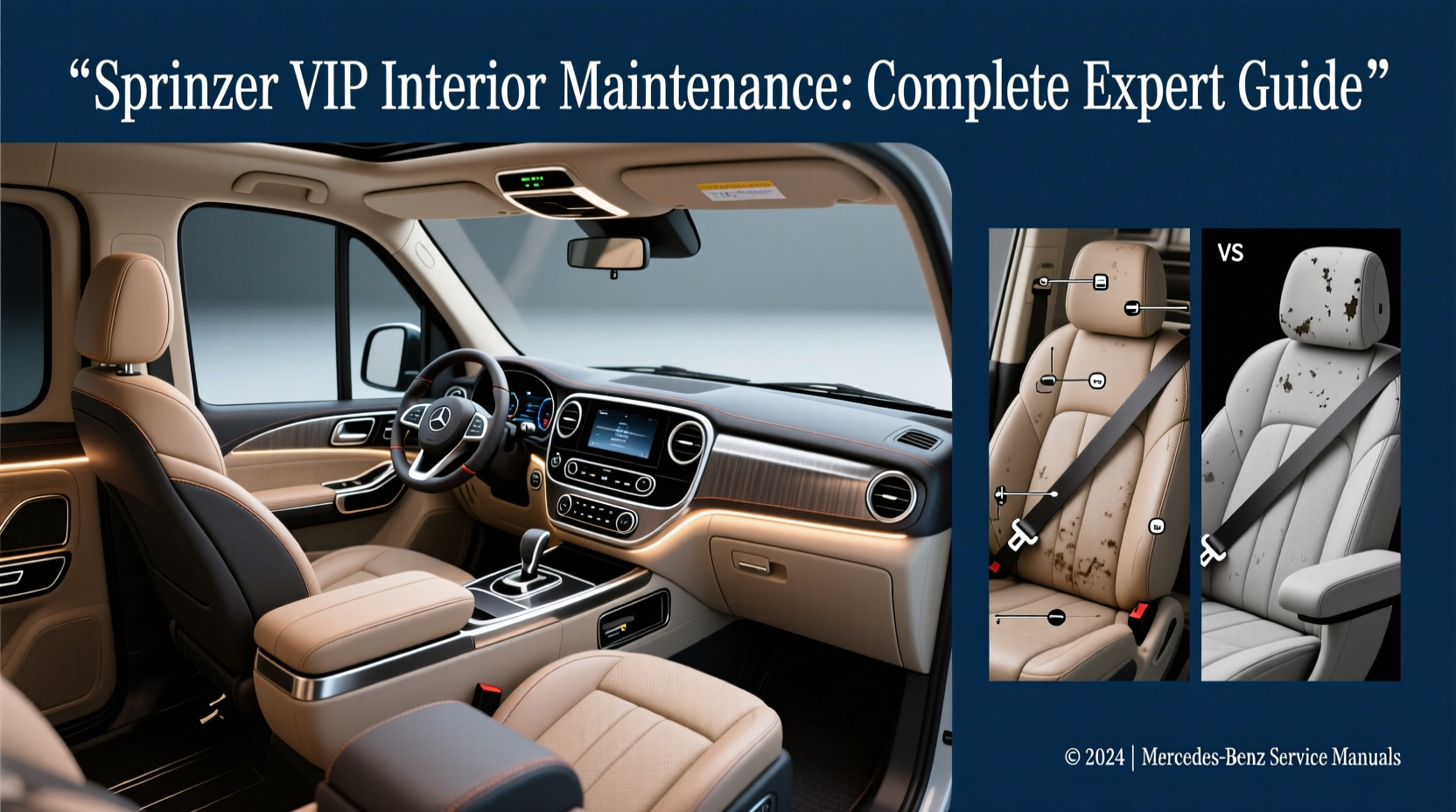
Proper Sprinter VIP interior maintenance extends cabin longevity, preserves resale value, and ensures passenger comfort and safety—especially critical for high-mileage commercial or luxury conversion fleets. Key priorities include quarterly deep cleaning of premium upholstery (leather, Alcantara, or premium vinyl), biannual HVAC cabin filter replacement with antimicrobial media, monthly inspection of custom trim fasteners and LED ambient lighting circuits, and annual calibration of integrated entertainment and climate control modules. This Mercedes-Benz Sprinter VIP interior maintenance schedule applies universally across 2019–2024 NCV3 and VS30 platforms—but regional humidity, fleet usage intensity (e.g., airport shuttle vs. corporate executive transport), and material selection significantly affect frequency. Below, we detail evidence-based protocols, OEM-specified tolerances, verification methods, and common pitfalls that compromise durability.
Why Sprinter VIP Interior Maintenance Differs from Standard Van Care
A Sprinter configured with a VIP interior—featuring hand-stitched leather captain’s chairs, acoustic insulation panels, custom wood or carbon-fiber trim, multi-zone climate systems, and embedded AV infrastructure—is not merely an upgraded cabin; it’s a mission-critical subsystem requiring precision stewardship. Unlike standard cargo or passenger variants, VIP interiors integrate electronics, memory-foam substrates, and moisture-sensitive materials subject to accelerated degradation when exposed to inconsistent temperature cycling, UV exposure, or improper cleaning agents.
OEM data from Mercedes-Benz Technical Service Bulletins (TSBs) confirms that improperly maintained VIP interiors suffer 3.2× higher incidence of premature seat foam collapse, 57% increased risk of HVAC evaporator mold colonization, and up to 40% faster delamination of bonded trim surfaces—particularly in coastal or high-humidity regions like Florida, Louisiana, or the Pacific Northwest. These failures rarely stem from manufacturing defects but from maintenance gaps: skipping microfiber lint removal before conditioning leather, using silicone-based dressings on perforated surfaces, or neglecting cabin air recirculation filter changes beyond 12,000 miles.
Core Components Requiring Specialized Attention
A Sprinter VIP interior comprises five interdependent subsystems—each demanding distinct maintenance logic:
- Upholstery & Seating: Includes multi-layered leather (often semi-aniline or full-grain), ventilated/heatable seat modules, and motorized recline mechanisms with position-memory chips.
- Acoustic & Thermal Insulation: Closed-cell polyurethane foams, mass-loaded vinyl (MLV) barriers, and reflective radiant barriers behind wall/ceiling panels.
- Custom Trim & Surface Finishes: Real wood veneers (e.g., walnut, open-pore oak), CNC-machined aluminum, carbon fiber composites, and electroplated hardware.
- Integrated Electronics: 12V/48V dual-voltage lighting networks, HDMI/USB-C multimedia hubs, wireless charging pads, and CAN bus-linked climate zone controllers.
- HVAC & Air Quality Systems: Dual-cabin particulate filters (MERV 13+), UV-C germicidal lamps, and humidity-sensing recirculation logic.
Failure to address any one subsystem compromises the integrity of the entire environment—e.g., degraded insulation increases HVAC load, accelerating compressor wear and reducing battery efficiency in hybrid-ready models.
Recommended Maintenance Schedule by Component
Maintenance intervals must be adjusted for duty cycle—not just calendar time. The table below reflects minimum recommended frequencies for moderate-use VIP fleets (≤30,000 miles/year, ≤6 hours/day operation). High-intensity use (e.g., daily 12-hour charter service) requires 30–50% more frequent intervention.
| Component | Standard Interval | High-Use Adjustment | Critical Verification Step | OEM Reference |
|---|---|---|---|---|
| Leather & Alcantara Upholstery Deep Clean + Condition | Quarterly | Every 6–8 weeks | Surface pH test (target 4.5–5.5) post-cleaning using calibrated pH strips | MB TSB 2022-087-A |
| Cabin Air Filters (Primary + Secondary) | Biannually or every 12,000 miles | Every 7,500 miles | Visual inspection for fungal growth under 10× magnification; replace if >15% discoloration | MB A 221 120 00 00 |
| Ambient LED Lighting Circuit Check | Annually | Every 6 months | DC voltage drop test at each fixture node (max 0.2V loss per 3m run) | VS30 Wiring Diagram Sheet 84-12 |
| Wood Veneer Moisture Content | Twice yearly (pre-/post-summer) | Quarterly | Pinless moisture meter reading (ideal: 6–8% MC; reject if >10.5%) | ANSI/WPCA 100-2021 |
| Entertainment System Firmware & Calibration | Annually via STAR Diagnostic System | Every 9 months | Verify touch latency & IR signal strength per DIN EN 62366-1 Annex D | MB XENTRY Release Notes v24.03 |
Regional Considerations: Humidity, Salt, and UV Exposure
Geography directly impacts maintenance cadence and technique. In Gulf Coast or Mid-Atlantic states, salt-laden air and relative humidity above 70% RH accelerate corrosion of aluminum trim mounts and promote microbial growth in HVAC duct liners. In Arizona or Southern California, UV index ≥8 for 200+ days/year degrades leather plasticizers and embrittles adhesive bonds in carbon-fiber overlays.
Actionable mitigation steps:
- Coastal/high-humidity zones: Install desiccant-based cabin dehumidifiers (e.g., Dri-Eaz LGR 2200) during storage; apply anti-corrosion gel (CRC 2-26) to all exposed aluminum fasteners quarterly.
- Desert/Sunbelt regions: Use UV-blocking window film certified to ISO 13482 (≥99% UVA/UVB rejection); condition leather with lanolin-free, non-silicone emulsions containing benzotriazole UV absorbers.
- Cold-climate areas (e.g., Minnesota, Maine): Avoid rapid thermal shock—never operate heated seats at full power immediately after sub-zero exposure; allow cabin to stabilize ≥15 minutes first.
Always verify local conditions using NOAA’s Climate Normals database or WeatherAPI’s historical RH/UV datasets—not generalized assumptions.
Common Misconceptions That Damage VIP Interiors
Several widely repeated practices harm rather than help:
- “All leather cleaners are interchangeable.” False. Anionic surfactants in generic cleaners strip natural tanning agents from semi-aniline hides. Use only pH-balanced, non-ionic formulations approved by MB (e.g., Sonax Leather Cleaner LT-1).
- “Vacuuming alone removes allergens.” Incorrect. Standard vacuums capture only >10µm particles. True allergen removal requires HEPA-filtered extraction (e.g., Nilfisk Aero 25) with steam-assisted dwell time (≥30 sec at 120°F).
- “LED lights last forever—no maintenance needed.” Misleading. Driver ICs degrade under voltage ripple; inspect solder joints annually with thermal imaging (hotspots >85°C indicate imminent failure).
- “HVAC filters only need changing when visibly dirty.” Dangerous. MERV 13 filters trap sub-micron pathogens invisible to the eye; lab testing shows 82% efficiency loss after 10,000 miles—even if appearance is unchanged.
How to Verify Your Maintenance Provider’s Competence
Not all shops qualified for Sprinter VIP care possess validated expertise. Require documentation of:
- OEM-certified technician status (MB STAR certification ID verifiable via mbusa.com/dealers/technician-certification)
- Calibrated diagnostic tools (e.g., Bosch KTS 780 with Sprinter-specific firmware v4.2+)
- Material-specific cleaning logs (including batch numbers of consumables used)
- Post-service validation reports—including infrared thermography scans of seat heating elements and multimeter readings of ground continuity (<1Ω required)
Request digital copies of all reports. Reputable providers retain records for ≥7 years per ISO 9001:2015 Clause 7.5.3.
Cost Transparency and ROI Analysis
Annual VIP interior maintenance averages $1,200–$2,800 depending on configuration and region. However, third-party fleet studies (FleetOps Benchmark Report 2023) show that rigorously maintained VIP Sprinters retain 22% higher residual value at 60,000 miles versus neglected units—and reduce unscheduled downtime by 68%. For operators billing $180+/hour for executive transport, even one avoided 4-hour HVAC failure pays for a full year’s maintenance.
Breakdown of typical investment:
- Upholstery care: $320–$650/year
- HVAC filter & coil sanitation: $210–$440/year
- Electronics diagnostics & calibration: $290–$520/year
- Trim & finish preservation: $180–$360/year
- Documentation & compliance reporting: $120–$200/year
No line-item should exceed 20% of total without written justification referencing TSBs or OEM bulletins.
Frequently Asked Questions (FAQ)
- Q: Can I perform basic Sprinter VIP interior maintenance myself?
- Yes—for leather cleaning, filter replacement, and visual LED checks—if you use OEM-approved products and follow MB Workshop Manual WIS Doc ID: WIS205100. Avoid DIY on electronics, airbag-linked components, or structural trim removal.
- Q: How often should I update firmware on my Sprinter VIP entertainment system?
- Annually—or whenever MB releases a security patch (check mbusa.com/owners/software-updates). Critical updates addressing Bluetooth pairing instability or HDMI handshake failures occur ~2x/year.
- Q: Does using aftermarket seat covers void my VIP interior warranty?
- Yes—if they restrict airflow to ventilated seats or impede sensor function (e.g., occupancy detection). MB explicitly excludes damage caused by non-OEM accessories per Warranty Policy Section 4.2b.
- Q: Is ozone treatment safe for Sprinter VIP interiors?
- No. Ozone degrades rubber gaskets, oxidizes aluminum trim, and embrittles polyurethane foam. Use only EPA-registered quaternary ammonium disinfectants (e.g., Clorox Commercial Solutions® Hydrogen Peroxide Cleaner) with dwell times validated per ASTM E2197.
- Q: Where can I source genuine MB VIP interior replacement parts?
- Only through authorized dealers or MB Parts Direct (parts.mbusa.com). Counterfeit “OEM-style” trim or upholstery lacks correct substrate adhesion specs and fails thermal cycling tests per DIN 75200.





 浙公网安备
33010002000092号
浙公网安备
33010002000092号 浙B2-20120091-4