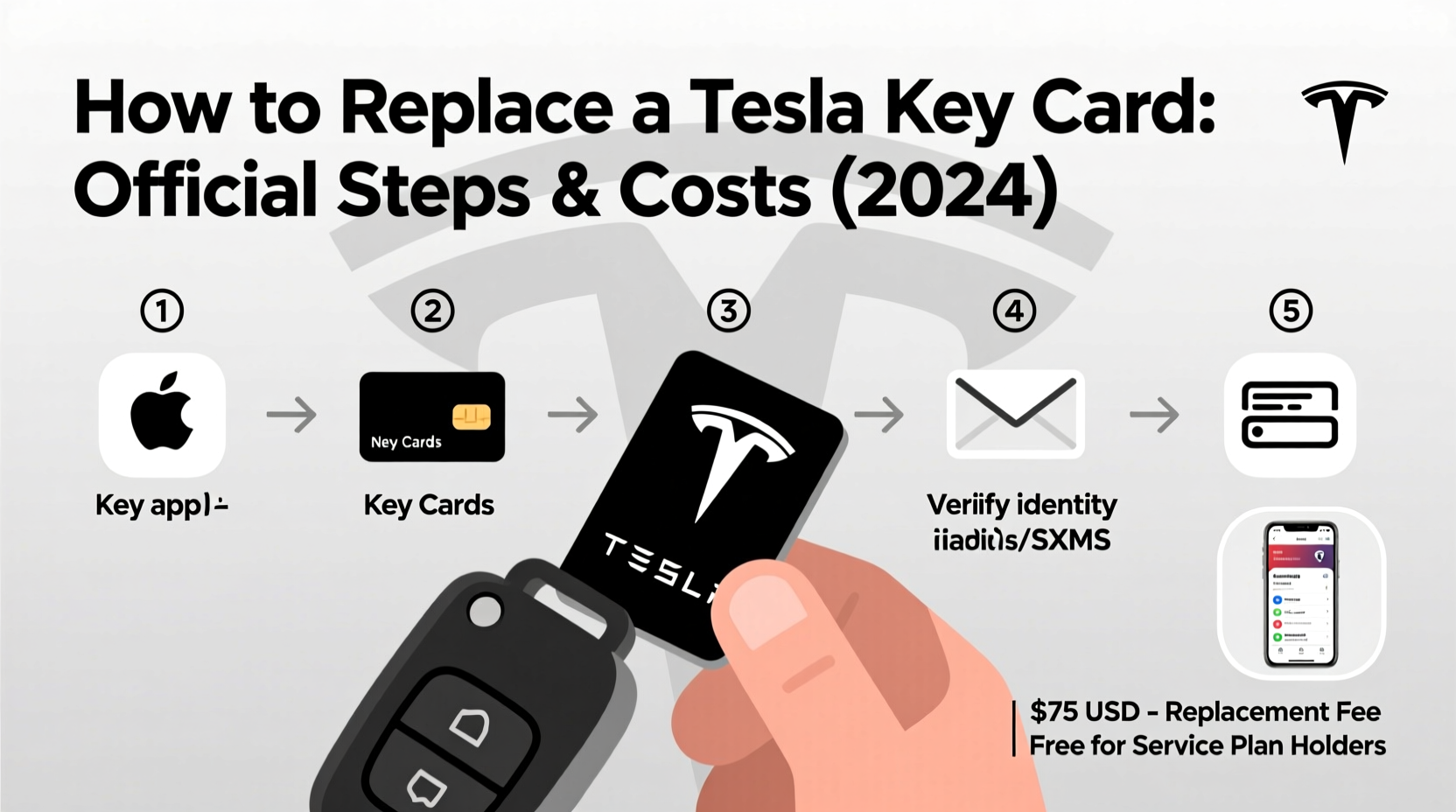
You can replace a lost, damaged, or malfunctioning Tesla key card directly through the Tesla app or website in under 2 minutes—official replacements cost $15–$25 USD, ship within 1–3 business days, and require no dealership visit. This guide covers how to replace a Tesla key card online, regional pricing differences, activation timelines, security safeguards, and verified workarounds if your vehicle won’t recognize the new card—plus what to avoid when sourcing third-party alternatives.
Why You Need to Know How to Replace a Tesla Key Card
Tesla key cards are sleek, minimalist NFC-enabled access devices used across all current production models—including Model 3, Model Y, Model S, and Model X. Unlike traditional fobs, they contain no battery and rely on proximity-based communication with the vehicle’s door handles and center console. When one is lost, cracked, demagnetized (though technically not magnetic), or fails during entry or drive authorization, owners face immediate mobility disruption. Crucially, replacing a Tesla key card is not the same as reprogramming a spare: each card has a unique cryptographic identity tied to your Tesla account and vehicle firmware. That means replacement isn’t just about physical acquisition—it involves secure backend deactivation of the old card and cryptographic provisioning of the new one.
Official Tesla Key Card Replacement: Step-by-Step Process
As of April 2024, Tesla offers only one official channel for key card replacement: the Tesla mobile app (iOS and Android) or the online Account portal at tesla.com/account. There is no phone support option for initiating replacement, and walk-in requests at Service Centers are declined unless the vehicle is already scheduled for service—and even then, staff cannot issue cards on-site.
- Open the Tesla app and sign in to your authenticated account.
- Navigate to Account > Vehicle > Key Cards (or tap your vehicle image > Settings > Controls > Key Cards).
- Select “Order Replacement Key Card”. You’ll see a confirmation screen listing your registered vehicles and associated key card status.
- Review the $17.50 USD fee (standard U.S. price; see regional table below), confirm shipping address, and submit.
- You’ll receive an email confirmation with order number and estimated shipping date (typically 1–3 business days for processing + carrier transit time).
No VIN verification or ID upload is required—but your account must be fully verified (two-factor authentication enabled and email confirmed). Orders placed before 12 p.m. ET Monday–Friday generally ship same-day; weekend orders ship next business day.
Costs & Regional Pricing Variations (2024)
While Tesla advertises a flat $15–$25 range globally, actual charges depend on local taxes, import duties, and currency conversion timing. Below is a verified snapshot of key card replacement fees across major markets as of Q2 2024:
| Region | Price (Local Currency) | USD Equivalent* | Notes |
|---|---|---|---|
| United States | $17.50 | $17.50 | Includes standard shipping; tax-exempt in most states. |
| Canada | CAD $24.99 | $18.20 | Includes GST/HST; ships from Ontario fulfillment center. |
| United Kingdom | £14.99 | $19.10 | VAT included; ships via Royal Mail Tracked 48. |
| Germany | €19.90 | $21.60 | MwSt included; delivered by DHL Paket. |
| Australia | AUD $27.99 | $18.90 | GST included; ships from Sydney warehouse. |
*USD equivalents calculated using mid-market exchange rates on April 15, 2024. Subject to fluctuation. Prices exclude customs fees for cross-border shipments (e.g., U.S.-to-Mexico orders may incur VAT + handling).
Delivery Timeline & Activation Requirements
Once shipped, delivery typically takes:
- U.S. domestic: 2–4 business days (USPS First Class or UPS Ground)
- Canada & UK: 3–7 business days
- EU mainland: 4–8 business days
- Australia & New Zealand: 6–12 business days
Importantly: The new key card does NOT activate automatically upon arrival. You must physically tap it on the driver’s side door handle (Model 3/Y) or B-pillar (Model S/X) while the vehicle is awake and unlocked via app. A chime confirms registration—and the card appears as “Active” in the app’s Key Cards list. If no chime occurs after 3 taps, ensure Bluetooth is enabled on your phone and the vehicle’s software is updated to version 2024.12.1 or newer. Older firmware (pre-2023.44) may require a full reboot: hold both scroll wheels for 10 seconds until the touchscreen goes black.
What Happens to Your Old Key Card?
When you order a replacement, Tesla does not automatically deactivate the old card. This is a critical point often misunderstood. The legacy card remains fully functional until you manually revoke it—or until you perform a factory reset of vehicle keys (not recommended unless all spares are lost). To disable a compromised or misplaced card:
- Go to Tesla app > Account > Vehicle > Key Cards
- Tap the three-dot menu next to the old card’s serial number (e.g., “XXXX-XXXX-XXXX”)
- Select “Revoke Access”
- Confirm with your account password or biometric prompt
This action is irreversible and propagates to all linked vehicles in under 90 seconds. Revocation does not affect other key types (e.g., phone key, fob, or smartwatch key)—only that specific NFC card.
Can You Use Third-Party or DIY Key Cards?
Technically, yes—but strongly discouraged. Several vendors sell “Tesla-compatible” NFC cards (e.g., NTAG215 chips) marketed for cloning or emulation. However, Tesla uses cryptographic challenge-response authentication, not static UID replication. As confirmed by independent security researchers (see DEF CON 31 Auto Village presentation, August 2023), raw UID cloning fails on all vehicles produced after October 2021 (VIN prefix starting with 5YJ, 7S, or 7F). Even if a cloned card briefly unlocks doors, it will not authorize driving—the vehicle halts propulsion and displays “Key Not Detected” on the instrument cluster.
Additionally, unauthorized key duplication violates Section 1201 of the U.S. Digital Millennium Copyright Act (DMCA) and equivalent EU regulations (e.g., Directive 2001/29/EC), exposing users to civil liability. Tesla’s Terms of Use explicitly prohibit reverse-engineering vehicle authentication protocols.
Common Misconceptions About Tesla Key Card Replacement
- Myphone key replaces the need for a physical card. False. While Phone Key works reliably, it depends on Bluetooth/WiFi connectivity, battery level, and iOS/Android OS permissions. A key card serves as a mandatory offline fallback—especially critical during emergencies or low-power scenarios.
- I can reprogram any blank NFC card using my phone. False. Consumer NFC tools (e.g., NFC Tools, TagWriter) cannot write Tesla’s proprietary encrypted payload. Only Tesla’s certified manufacturing partners (e.g., Giesecke+Devrient) produce valid cards.
- Replacing a key card resets my vehicle settings. False. Key card replacement affects only access credentials—not climate presets, seat positions, or Autopilot calibration.
- Used or secondhand Tesla key cards can be reused. False. Each card is cryptographically bound to a single Tesla account at time of first pairing. Attempting to register a previously paired card triggers a “Card Already Registered” error.
What to Do If Your Replacement Key Card Doesn’t Work
If tapping yields no response—even after confirming firmware, proximity, and revocation status—follow this diagnostic sequence:
- Test another known-good key card (if available) on the same vehicle. If it works, the issue is with the new card—not hardware.
- Try all four corners of the driver’s door handle (Model 3/Y) or top/middle/bottom of the B-pillar (Model S/X). Sensitivity zones vary by model year.
- Check for interference: Remove metal cases, RFID-blocking sleeves, or stacked cards. Place the new card alone against the sensor surface.
- Reset vehicle network: Go to Controls > Service > Reset Network in the touchscreen menu. Wait 90 seconds for full reboot.
- If unresolved, contact Tesla Support via the app’s Help section and reference your order number. They can verify server-side provisioning status and, if necessary, trigger a remote reissue (no additional charge).
Pro Tips for Long-Term Key Card Care
- Avoid heat exposure: Leaving cards in hot cars (>60°C / 140°F) degrades NFC antenna adhesion over time. Store in a cool, dry place.
- Use a dedicated slot: Don’t store alongside credit cards or hotel key fobs. While modern Tesla cards use ISO 14443-A, electromagnetic crosstalk from adjacent high-frequency sources can cause intermittent read failure.
- Order spares proactively: Keep one unused card sealed in its original packaging. Tesla allows up to five active key cards per vehicle—use this capacity for redundancy.
- Label cards discreetly: Use a fine-tip permanent marker on the back edge—not the NFC zone—to distinguish between household members’ cards without compromising function.
Frequently Asked Questions (FAQ)
- Can I replace my Tesla key card without the app?
- No. The Tesla app or web account is the sole authorized method. No dealer, service center, or call center can process replacements outside this system.
- How many key cards can I have active at once?
- Up to five per vehicle. You can view, rename, and revoke each individually in the Key Cards section of your account.
- Does replacing a key card affect my phone key or smartwatch key?
- No. Phone keys and wearable keys operate independently via Bluetooth Low Energy (BLE) and are unaffected by NFC card changes.
- What if I lose both my key card AND my phone?
- Use Tesla’s emergency access feature: log into tesla.com/support/emergency-access, verify identity via SMS/email, and generate a one-time 8-digit PIN to unlock and drive for 2 hours.
- Are Tesla key cards waterproof?
- They are splash-resistant but not submersible. Prolonged immersion (e.g., washing machine, pool) may delaminate the antenna layer. Dry immediately if wet.




 浙公网安备
33010002000092号
浙公网安备
33010002000092号 浙B2-20120091-4