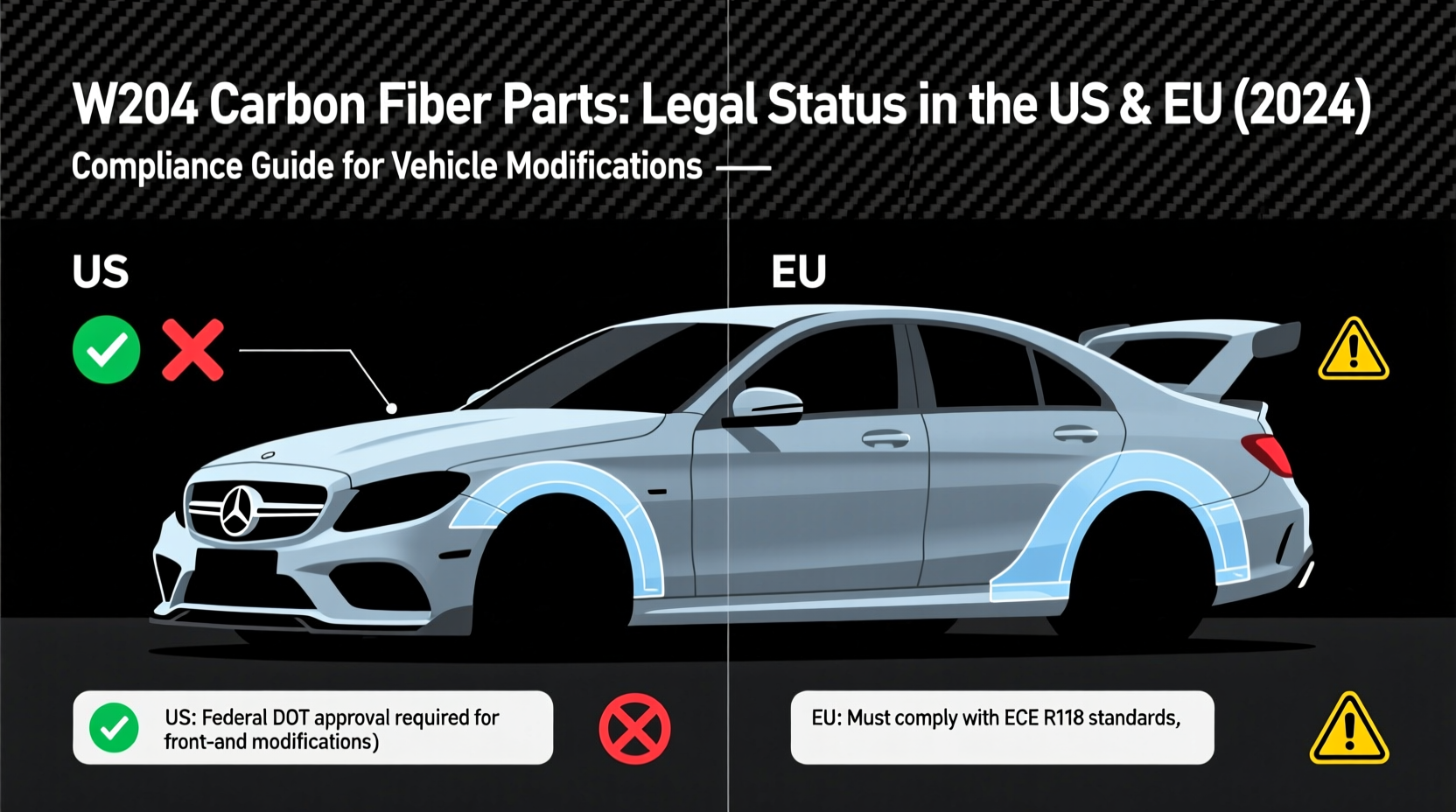
W204 carbon fiber legality in the United States and European Union is not blanket-approved: exterior carbon fiber body kits (e.g., front lips, side skirts, rear diffusers) are generally legal only if certified to FMVSS 108 (lighting), FMVSS 212/219 (impact resistance), or ECE R107 (aerodynamic devices) and R118 (flammability). As of 2024, unmodified OEM-style carbon trim (e.g., interior bezels, shift paddles) remains widely permissible—but aftermarket carbon aerodynamic components on the Mercedes-Benz C-Class W204 require documented homologation or national type-approval. This guide details exact regulatory pathways, regional enforcement realities, verification methods, and common missteps that trigger inspection failures or registration denials.
Why W204 Carbon Legality Matters — And Why It’s So Confusing
The Mercedes-Benz W204 C-Class (2007–2014) remains a popular platform for cosmetic and performance upgrades. Among the most sought-after modifications are carbon fiber parts — from subtle interior accents to aggressive widebody kits. Yet unlike simpler accessories like alloy wheels or LED bulbs, carbon fiber components straddle multiple regulatory domains: structural integrity, aerodynamics, fire safety, lighting compliance, and vehicle identification. A part may pass flammability testing but fail frontal impact absorption requirements — or meet EU ECE R118 but lack DOT FMVSS 212 certification needed for U.S. street use. Crucially, legality is assigned per part, not per vehicle model. There is no ‘W204 carbon legality certificate’ — only component-specific approvals.
U.S. Regulatory Framework: DOT, FMVSS, and State-Level Enforcement
In the United States, federal motor vehicle safety standards (FMVSS) administered by the National Highway Traffic Safety Administration (NHTSA) govern all equipment installed on vehicles used on public roads. For carbon fiber parts on the W204, three standards dominate:
- FMVSS 108: Governs lighting devices. Any carbon fiber spoiler or bumper with integrated LEDs, DRLs, or reflectors must be certified as compliant — including photometric output, mounting angle, and ingress protection (IP67 minimum).
- FMVSS 212 / 219: Addresses low-speed front and rear impact protection. Aftermarket front lips, splitters, and rear diffusers that extend beyond OEM dimensions may violate crush zone geometry or energy absorption thresholds — especially if mounted rigidly without deformation zones.
- FMVSS 301: Fuel system integrity. Carbon fiber underbody panels or belly pans must not compromise fuel line routing or tank shielding during barrier impact tests.
Importantly, NHTSA does not pre-approve aftermarket parts. Instead, manufacturers self-certify compliance — meaning legality hinges on whether the supplier maintains test documentation and affixes a valid DOT-compliant label (e.g., “DOT FMVSS 212 Compliant” + manufacturer ID). Many carbon vendors sell ‘for off-road use only’ parts with no labeling — rendering them illegal for public road use in all 50 states.
State-level enforcement varies significantly. California’s Bureau of Automotive Repair (BAR) conducts stringent smog and visual inspections; carbon front bumpers lacking CARB Executive Order (EO) numbers are routinely rejected during biennial Smog Check renewals. Texas DPS inspectors increasingly flag non-OEM aerodynamic components during registration verification. In contrast, Montana and South Dakota perform minimal visual checks — but that doesn’t confer legality; it merely reflects lower enforcement capacity.
European Union Regulations: ECE Type Approval & National Transposition
Within the EU, carbon fiber legality follows UN-ECE regulations, implemented nationally via directives like Directive 2007/46/EC (Framework Directive) and Regulation (EU) No 168/2013 (for L-category vehicles, though W204 falls under M1). Key applicable ECE regulations include:
- ECE R107: Applies to ‘devices affecting vehicle aerodynamics’ — i.e., spoilers, splitters, canards, and diffusers. Requires wind tunnel testing (lift/downforce ratios), structural anchoring validation (≥ 1.5× static load), and durability cycling (10,000+ km simulated vibration).
- ECE R118: Mandates flame propagation limits (≤ 100 mm/min horizontal burn rate) for interior and exterior trim within 13 mm of occupant compartments or engine bays. Most dry-carbon fiber fails R118 unless resin-modified or coated with intumescent lacquer.
- ECE R10: Covers electromagnetic compatibility — critical for carbon fiber housings containing radar modules (e.g., ACC sensors relocated into custom front lips).
Crucially, ECE approval is granted per component type, not per vehicle fitment. A kit approved for the W204 C250 may not be valid for the C63 AMG due to differing crash structure load paths. Approved parts carry an ‘E-mark’ (e.g., E1 00R107-000123), where ‘E1’ = Germany, ‘00’ = regulation version, ‘R107’ = standard, and numeric suffix = unique approval number. You can verify authenticity via the UNECE WP.29 database.
Key Differences Between Interior, Exterior, and Structural Carbon Components
Legality risk scales dramatically based on location and function:
| Component Type | U.S. Risk Level | EU Risk Level | Key Compliance Hurdles |
|---|---|---|---|
| Interior carbon trim (dash bezels, console covers) | Low | Low–Medium | R118 flammability (EU); no FMVSS conflict (US) unless obstructing airbag deployment zones |
| Carbon shift paddles / steering wheel accents | Low | Low | Must retain OEM airbag functionality; no added mass altering deployment timing |
| Carbon rear spoiler (OEM-height, bolt-on) | Medium | Medium–High | FMVSS 108 reflectivity (US); R107 anchoring & lift testing (EU); often requires engineering sign-off |
| Carbon front lip / splitter (aggressive, extended) | High | High | FMVSS 212/219 impact absorption (US); R107 downforce/load path validation (EU); frequently triggers rejection at DMV/ITV |
| Carbon hood (with functional vents) | Very High | Very High | FMVSS 201/202 head impact zones (US); R118 + R107 + R121 (hood latch security) (EU); almost always requires full vehicle re-certification |
| Component Type | U.S. Risk Level | EU Risk Level | Key Compliance Hurdles |
|---|---|---|---|
| Interior carbon trim (dash bezels, console covers) | Low | Low–Medium | R118 flammability (EU); no FMVSS conflict (US) unless obstructing airbag deployment zones |
| Carbon shift paddles / steering wheel accents | Low | Low | Must retain OEM airbag functionality; no added mass altering deployment timing |
| Carbon rear spoiler (OEM-height, bolt-on) | Medium | Medium–High | FMVSS 108 reflectivity (US); R107 anchoring & lift testing (EU); often requires engineering sign-off |
| Carbon front lip / splitter (aggressive, extended) | High | High | FMVSS 212/219 impact absorption (US); R107 downforce/load path validation (EU); frequently triggers rejection at DMV/ITV |
| Carbon hood (with functional vents) | Very High | Very High | FMVSS 201/202 head impact zones (US); R118 + R107 + R121 (hood latch security) (EU); almost always requires full vehicle re-certification |
How to Verify Legality: 5 Actionable Steps
- Identify the part’s manufacturer and model number — Not just ‘W204 carbon spoiler’, but the exact SKU (e.g., ‘ACS-W204-SPL-2023-UL’). Generic listings rarely hold certifications.
- Request official compliance documentation: Ask for FMVSS test reports (signed by accredited lab like MGA Research or Intertek) or ECE type-approval certificates (with E-mark visible on part and paperwork).
- Cross-check E-mark validity using the UNECE WP.29 portal. Enter the full mark — e.g., ‘E4 107 03 001234’ — to confirm active status and scope.
- Contact your state DMV or national vehicle authority (e.g., UK DVLA, German KBA, California BAR) with the part’s documentation. Some agencies offer pre-submission review (e.g., CA BAR’s ‘Aftermarket Parts Inquiry’ form).
- Retain all records digitally and physically: Certification PDFs, invoices showing part/model number, installer affidavits. During roadside inspection or registration, digital copies on phone are accepted in most jurisdictions — but printed backups prevent connectivity issues.
Common Misconceptions About W204 Carbon Legality
Misconception #1: “If it fits, it’s legal.”
Fitment ≠ compliance. A carbon splitter that bolts directly to OEM mounting points may still fail FMVSS 219 because its stiffness alters crash pulse distribution — even with identical geometry.
Misconception #2: “Carbon fiber is automatically lightweight and therefore safer.”
Unidirectional dry carbon lacks controlled failure modes. In low-speed impacts, brittle carbon can shatter unpredictably — violating FMVSS 212’s ‘progressive energy absorption’ requirement, which favors engineered thermoplastic composites.
Misconception #3: “EU-approved parts work in the U.S. (and vice versa).”
ECE R107 does not substitute for FMVSS 212. Similarly, a DOT-labeled spoiler lacks ECE R118 flammability data — making it unacceptable for EU registration, even if physically identical.
Misconception #4: “My tuner said it’s fine.”
Tuners are not regulatory authorities. Their installation expertise doesn’t equate to legal standing. In Germany, unauthorized modifications void insurance coverage; in California, unapproved parts trigger automatic Smog Check failure — regardless of installer reputation.
Regional Variations You Must Consider
Legality isn’t binary — it’s jurisdictionally layered:
- California: Enforces CARB’s Advanced Clean Cars II rules. Carbon body kits must carry an Executive Order (EO) number if they affect emissions-related airflow (e.g., undertrays near catalytic converters). No EO = no registration renewal.
- Germany: Requires §19 StVZO technical inspection for any modification. Carbon parts need either ABG (General Operating Permit) or individual ABE (Individual Operating Permit) — obtainable only with TÜV-certified engineering analysis.
- United Kingdom: Post-Brexit, retains ECE standards but enforces via MOT. Carbon spoilers failing ‘secure attachment’ or ‘no sharp edges’ clauses (MOT Manual §6.1.3) result in immediate failure — no advisory.
- Canada: Transport Canada accepts ECE R107/R118 but requires bilingual labeling (English/French) and CSA Group verification for flammability. Many EU-sourced kits lack French text — causing CBSA seizure at border.
What’s Changed Since 2020? 2024 Updates
Two major shifts impact W204 owners in 2024:
- NHTSA’s 2023 Final Rule on Aftermarket Lighting (88 FR 62292) now requires all LED-integrated carbon components sold after January 1, 2024, to undergo photometric recalibration every 24 months — verified via lab report upload to NHTSA’s new Aftermarket Lighting Portal.
- EU Commission Delegated Regulation (EU) 2023/1954, effective July 2024, mandates cyber-resilience assessments for carbon parts housing ADAS sensors (e.g., radar-integrated front lips). Non-compliant units cannot receive new E-mark approvals.
While these don’t retroactively invalidate older parts, they raise the bar for future purchases — and signal stricter scrutiny of legacy platforms like the W204 during periodic inspections.
Frequently Asked Questions (FAQ)
- Can I install carbon fiber parts on my W204 for track-only use?
- Yes — but you must declare ‘off-highway use only’ to your insurer and remove or cover all non-compliant parts before entering public roads. Track venues like Laguna Seca require SFI 4.1 certification for carbon bodywork, separate from road legality.
- Are OEM carbon options (e.g., AMG Carbon Package) automatically legal?
- Yes — factory-installed carbon components underwent full vehicle-level certification. However, dealer-installed ‘genuine’ accessories (e.g., post-purchase carbon mirrors) may lack individual approval — verify part number against MB’s 2024 Parts Compliance Matrix.
- Do carbon fiber wraps count as illegal modifications?
- No — vinyl or polyurethane-based carbon-look wraps are legally neutral in all major jurisdictions, provided they don’t obscure lighting, registration plates, or reflective elements. Real carbon fiber overlays do require certification.
- What happens if I’m cited for illegal carbon parts?
- Penalties range from fix-it tickets (CA Vehicle Code §24003) to impound (DE StVO §22b) or mandatory removal before re-registration (UK VOSA Notice). Repeat violations may trigger vehicle classification review — especially for modified W204 AMGs.
- Where can I find certified W204 carbon suppliers?
- Reputable sources include Brabus (E-marked body kits), Carlsson (TÜV-certified spoilers), and STM Tuning (DOT-tested lighting-integrated lips). Avoid marketplaces like eBay or AliExpress unless seller provides verifiable, current certification documents — not expired PDFs or stock images.





 浙公网安备
33010002000092号
浙公网安备
33010002000092号 浙B2-20120091-4